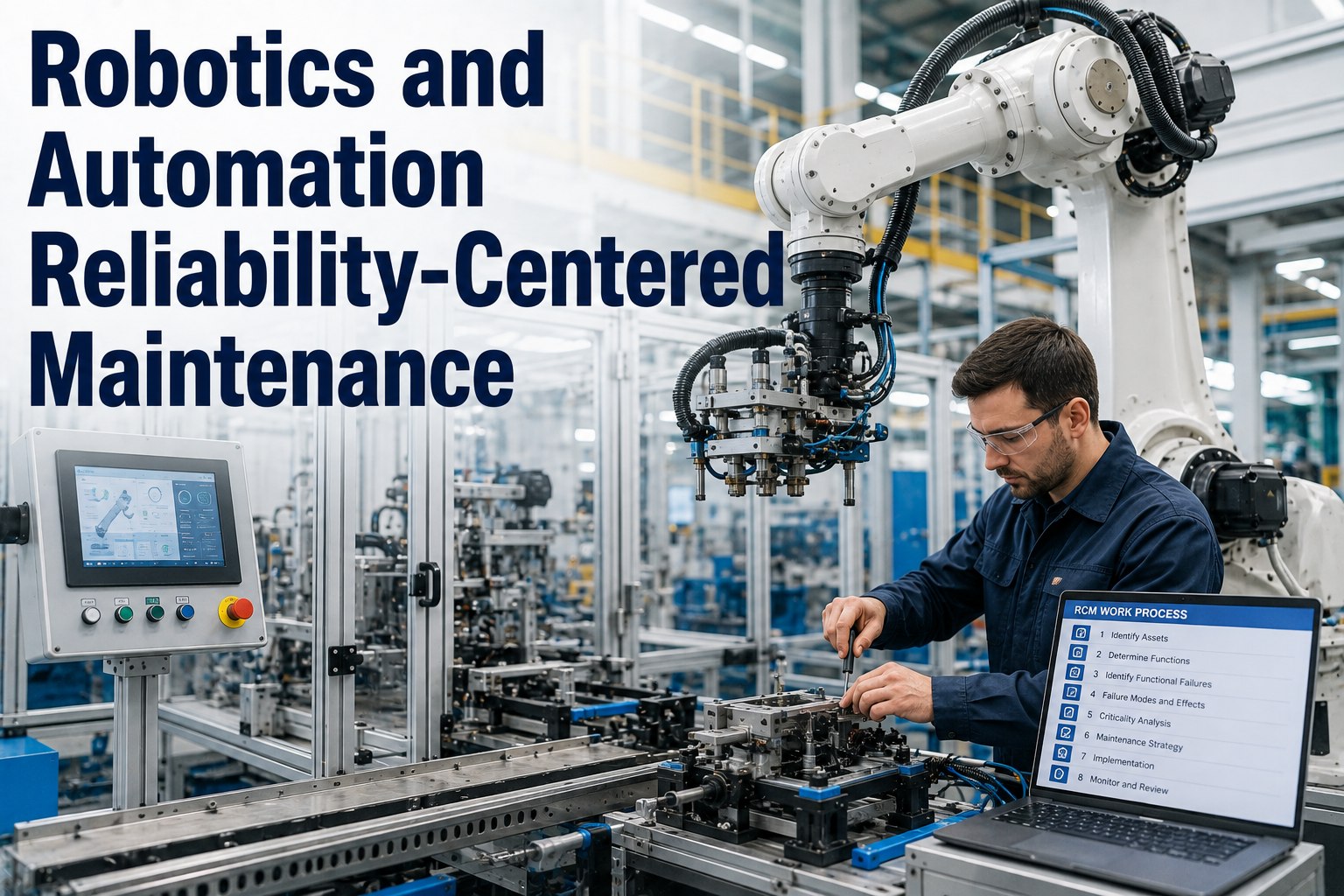
Reliability-Centered Maintenance for robotics and automation in manufacturing is the discipline of matching each robot, PLC, and automated cell to the maintenance strategy that actually prevents its dominant failure modes — not just running generic PMs. Plants that apply RCM to their robotics fleets cut unplanned downtime by 30–50% and extend asset life by 20–40%, because they stop over-maintaining low-risk components and start catching the failures that actually stop production. This guide walks through the failure modes, monitoring techniques, and RCM decision logic that work specifically for manufacturing robotics and automation — and shows how to operationalize them without drowning in spreadsheets. If you're ready to move from reactive firefighting to controlled reliability, Start Free Trial and see how OxMaint puts RCM into daily practice across every robot, technician, and shift.
What if your robots told you they were failing — three weeks before they stopped?
That's not predictive-maintenance hype. It's what happens when you apply RCM logic to robotics: you identify the 20% of failure modes that cause 80% of your downtime, monitor for those specific signals, and intervene at the optimal moment. Most manufacturing plants run their automation on generic calendar-based PMs — and miss the bearing wear, cable fatigue, and servo drift that actually kill production.
The 6 robotics failure modes that cause 85% of manufacturing downtime
RCM starts with failure-mode analysis — and robotics fail differently than traditional rotating equipment. Here are the dominant failure modes in manufacturing automation, ranked by frequency and production impact.
Cable & Dress-Pack Fatigue
34% of robot downtime
Continuous flexing causes conductor breakage and insulation wear, especially on axes 1–3. Leads to intermittent faults, encoder errors, and sudden stops. Detectable via cycle-count tracking and visual inspection every 2,000 hours.
Harmonic Drive & Gearbox Wear
22% of robot downtime
Backlash increases gradually, causing path inaccuracy and vibration. Often misdiagnosed as a programming issue. Vibration analysis and torque-monitoring catch this 3–6 weeks before failure.
Servo Motor & Encoder Drift
14% of robot downtime
Bearing wear and encoder contamination cause position errors and overheating. Thermal imaging and current-signature analysis flag degradation early. Common in high-duty-cycle pick-and-place applications.
End-Effector & Tooling Wear
9% of robot downtime
Grippers, vacuum cups, and weld tips degrade with cycles. Causes quality defects before full failure. Cycle-count PMs and vision-system checks are the control strategy.
Controller & I/O Failures
4% of robot downtime
Capacitor aging, fan failures, and corroded connectors cause intermittent faults. Thermal imaging during quarterly inspections catches 80% of these before they stop production.
Safety System Degradation
2% of robot downtime
Light curtains, e-stops, and interlocks fail silently. Not a downtime driver, but a compliance and injury risk. Monthly functional tests are mandatory under ISO 10218 and RIA R15.06.
The RCM insight: cable fatigue and gearbox wear alone account for over half of robot downtime — yet most PM schedules treat all components equally. That's the gap RCM closes.
Best condition-monitoring techniques for manufacturing robotics & automation
RCM doesn't mean "monitor everything." It means matching each failure mode to the monitoring technique that detects it earliest at the lowest cost. Here's what works for robotics.
| Failure Mode | Best Monitoring Technique | Detection Lead Time | Cost per Robot |
|---|---|---|---|
| Cable & dress-pack fatigue | Cycle-count tracking + visual inspection | 2–4 weeks | $0 (labor only) |
| Harmonic drive wear | Vibration analysis (monthly) | 3–6 weeks | $80–120/yr |
| Servo motor degradation | Current-signature analysis + thermal imaging | 4–8 weeks | $150–200/yr |
| End-effector wear | Cycle-count PM + vision-system checks | 1–2 weeks | $0–50/yr |
| Controller & I/O faults | Quarterly thermal imaging + functional tests | 2–6 weeks | $40–60/yr |
| Safety system degradation | Monthly functional tests (ISO 10218) | Immediate | $0 (labor only) |
Total monitoring cost: roughly $300–400 per robot per year. Compare that to a single unplanned robot failure, which costs $8,000–$25,000 in lost production, emergency labor, and expedited parts. The ROI is 20:1 or better.
How to build an RCM maintenance strategy for robotics in 5 steps
RCM isn't a software you buy — it's a decision framework. Here's the process that works for manufacturing robotics, whether you're running 6-axis arms, SCARA robots, or automated guided vehicles.
Identify functions & performance standards
What does each robot do, and what does "working" mean? A welding robot's function isn't "move the torch" — it's "maintain 0.5mm path accuracy at 40 cycles/min." Define the standard, or you can't define failure.
Define functional failures
A functional failure is any state where the robot can't meet its performance standard. That includes full breakdowns, but also quality drift, reduced speed, and safety-system faults. List every way the robot can fail to do its job.
Identify failure modes & root causes
For each functional failure, ask: what physical failure mode causes it? Cable fatigue causes encoder faults. Gearbox wear causes path inaccuracy. Use OEM manuals, technician experience, and failure history to build the list.
Assess failure consequences
Not all failures are equal. Safety-system faults have regulatory consequences. Cable fatigue on a bottleneck robot stops the line. End-effector wear causes scrap. Rank each failure mode by safety, production, quality, and cost impact.
Select the optimal maintenance task
For each failure mode, choose: condition-based monitoring (if detectable), time-based PM (if age-related), or run-to-failure (if low-consequence). This is where RCM beats generic PM — you stop over-maintaining low-risk parts and start catching the failures that matter.
A 24-robot plant cut downtime 47% in 9 months — here's how
A Tier-1 automotive supplier running 24 welding and material-handling robots was losing 180 hours per month to unplanned automation downtime. Their PM schedule was calendar-based: grease every 6 months, inspect cables annually, replace dress packs every 3 years. It wasn't working.
Unplanned downtime. 60% from cable fatigue and gearbox wear. Maintenance cost: $310K/yr. OEE: 71%.
Unplanned downtime. Cable failures caught 2–3 weeks early via cycle-count tracking. Gearbox wear flagged by vibration analysis. Maintenance cost: $265K/yr. OEE: 84%.
The plant saved $45K in maintenance cost and recovered 85 hours of production per month — worth roughly $340K/yr in throughput. Total RCM implementation cost: $18K in training and monitoring tools. Payback: 3.2 months.
Turn RCM strategy into daily practice with OxMaint
RCM fails when it lives in a binder. OxMaint is the AI-powered CMMS + EAM platform that puts RCM logic into every work order, PM schedule, and technician workflow — so your robotics reliability strategy actually happens.
Failure-Mode-Based PM Automation
Build PM schedules around failure modes, not just calendars. Trigger cable inspections by cycle count, vibration checks by runtime hours, and safety tests by regulation. OxMaint automates the scheduling so nothing slips.
Cut unplanned downtime 30–50%
Condition-Monitoring Integration
Connect vibration sensors, thermal cameras, and cycle counters to OxMaint. When a robot crosses a threshold — backlash, temperature, cycle count — OxMaint auto-generates a work order and assigns it to the right technician.
Catch failures 2–4 weeks early
Mobile Work Orders & Checklists
Technicians get RCM-based inspection checklists on their phones — torque specs, wear limits, photo capture, and pass/fail logic. No paper, no guesswork, no missed steps. Everything syncs back to the asset record.
Eliminate 100% of paper work orders
Reliability Analytics & Reporting
Track MTBF, failure-mode frequency, PM compliance, and downtime cost by robot, line, or plant. OxMaint's dashboards show which failure modes are actually driving your downtime — so you can refine your RCM strategy with data, not hunches.
Prove ROI to leadership in 1 click
See OxMaint on your robots — book a 30-minute demo
We'll show you how to build failure-mode-based PMs, automate condition-monitoring workflows, and cut unplanned downtime 30–50% — using your actual asset list.
Robotics RCM: your questions answered
What is Reliability-Centered Maintenance for robotics?
RCM for robotics is a structured process that identifies each robot's functions, failure modes, and consequences — then matches each failure mode to the optimal maintenance task (condition monitoring, time-based PM, or run-to-failure). It replaces generic calendar-based PMs with a strategy based on how robots actually fail.
How much does unplanned robot downtime cost in manufacturing?
A single unplanned robot failure costs $8,000–$25,000 in lost production, emergency labor, and expedited parts — and that's for a non-bottleneck robot. If the robot is on a constraint line, costs can hit $50K+ per incident. Plants running RCM cut unplanned downtime 30–50%, which typically saves $100K–$500K per year depending on fleet size.
What's the best way to monitor robot cable and dress-pack wear?
Track cycle counts and inspect cables every 2,000 hours or 500K cycles, whichever comes first. Look for conductor discoloration, insulation cracks, and connector corrosion. OxMaint automates cycle-count tracking and auto-generates inspection work orders when thresholds are hit — Start Free Trial to see it in action.
Do I need vibration analysis for every robot?
No. RCM says: monitor based on failure consequence and detectability. Vibration analysis makes sense for high-duty-cycle robots with harmonic-drive wear risk (welding, material handling). For low-cycle pick-and-place robots, cycle-count PMs and visual inspections are usually enough. Match the monitoring cost to the failure consequence.
How long does it take to implement RCM for a robotics fleet?
A focused RCM analysis for 20–30 robots takes 6–12 weeks: 2 weeks for function/failure-mode workshops, 2–4 weeks for task selection and PM schedule design, and 2–6 weeks for CMMS setup and technician training. Most plants see measurable downtime reduction within 3–6 months. Book a Demo and we'll map out your timeline.
Stop firefighting. Start preventing.
OxMaint puts RCM into daily practice across every robot, technician, and shift — so you catch failures before they stop production.
Free 14-day trial · No credit card · Set up in under 1 hour


-optimizing-your-maintenance-strategy.png)
