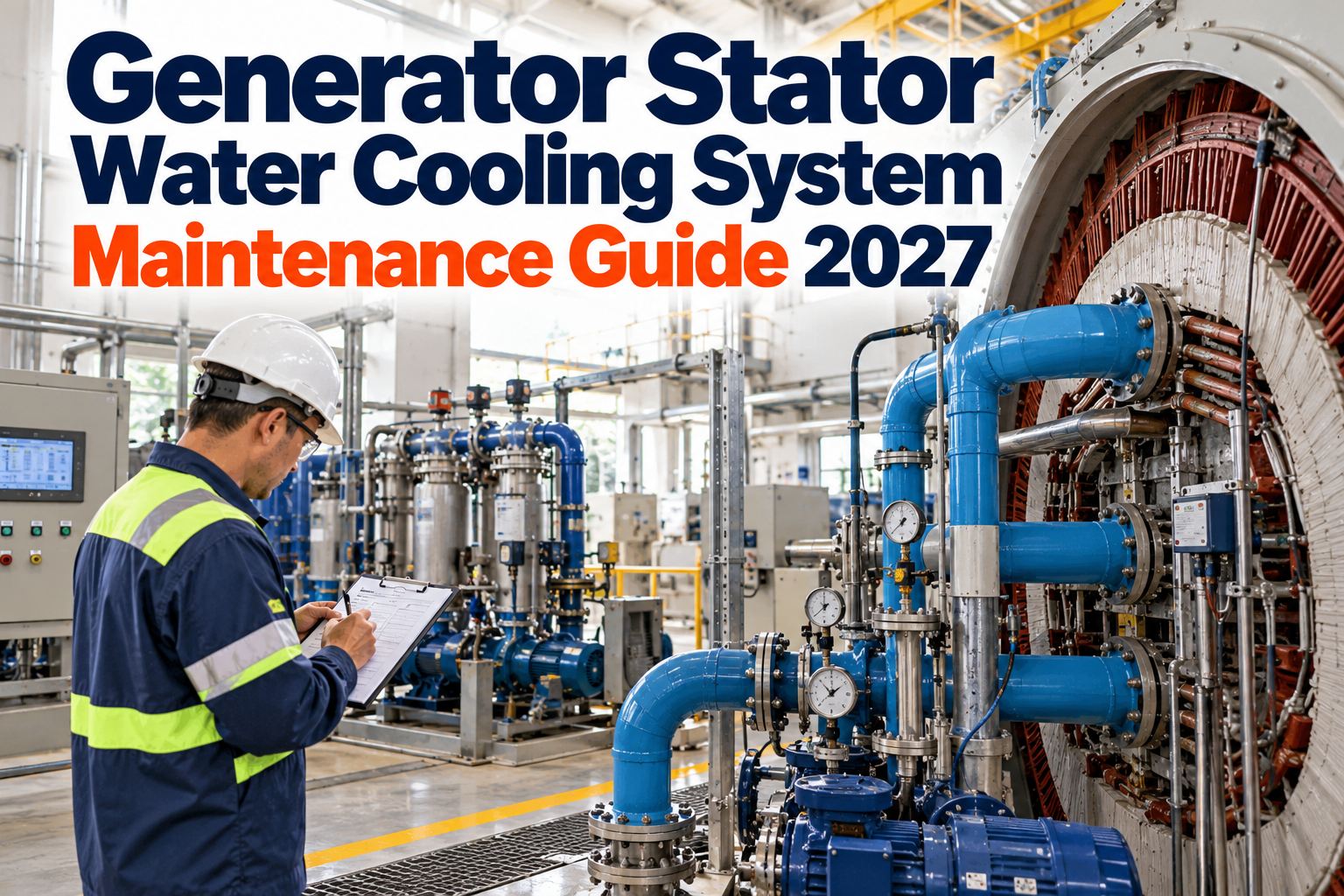
The stator winding of a large generator carries serious current, and the heat has to go somewhere. In water-cooled units, deionized water flows through hollow copper strands inside the winding to carry it away. When that flow is restricted, by copper oxide deposits, a loaded strainer, a failing pump or a chemistry upset, winding temperatures rise, load may have to be cut, and in the worst case the unit trips. The warning signs are usually there first: a slowly rising pressure differential, a drifting conductivity reading, a tank level that won't hold. OxMaint AI maintenance management software schedules the rounds, flags what's drifting and turns it into a work order, so cooling problems are handled while there is still time to plan.
Generator Stator Water Cooling System Maintenance Guide 2027
Most stator cooling failures start as small, trendable changes that nobody connected: a differential pressure creeping up, a filter loading faster than last quarter, conductivity moving off baseline. This guide shows what to watch, what each change can mean and how to maintain the system. OxMaint AI connects the round reading to a flagged issue, an assigned work order and a PM schedule that learns from the history.
How Loss of Cooling Escalates
Cooling rarely disappears all at once. It steps down. Catching it on the top step is a maintenance job; catching it on the bottom step is an outage. Book a demo to see early-warning checks scheduled.
Four Ways the Cooling System Fails
Each failure mode leaves different clues, so the checks you run should match them. Start free and log each check against the asset.
Read the Trend: What a Change Can Mean
Set alarm limits from your OEM and chemistry guidance. The value is in the direction of the change. Book a demo to trend readings by asset.
| Reading | If it moves | What to check |
|---|---|---|
| Winding differential pressure | Rises over time | Strand or filter plugging; inspect strainers, review chemistry |
| Filter / strainer differential | Loads faster than usual | Copper release; check resin, oxygen regime, upstream corrosion |
| Conductivity | Climbs off baseline | Exhausted deionizer resin, contamination, make-up water quality |
| Dissolved oxygen / pH | Leaves the chosen regime | Air ingress, seals, dosing or venting practice |
| Tank level | Falls with no maintenance activity | Possible leak; isolate source and review hydrogen-in-water |
| Outlet temperatures | Rise or spread apart | Restricted flow, cooler performance, individual strand blockage |
The Trend Is Only Useful If It Reaches a Work Order.
Readings logged on a clipboard don't change a filter or a resin bed. OxMaint AI schedules the rounds, records each reading against the generator and its subsystems, raises an issue when something drifts and tracks the fix, so the history guides the next outage.
A Maintenance Rhythm That Matches the Risk
Short, frequent checks catch drift; deeper work waits for the outage. Align intervals with your OEM manual. Start free and load these as recurring PMs.
- Flow, pressure and differential
- Tank level and conductivity
- Outlet temperatures
- Standby pump on auto
- Alarms and leak indicators
- Strainer and filter inspection
- Chemistry sampling and trends
- Pump vibration and seal check
- Cooler temperature approach
- Hydrogen-in-water review
- Resin bed change or analysis
- Strainer and filter overhaul
- Cooler cleaning and test
- Pump and valve overhaul
- Pressure and leak tests
Deionizer and Filter Care: What to Remember
How OxMaint AI Supports Stator Cooling Reliability
Frequently Asked Questions
Protect the Winding. Plan the Fix.
Stator cooling problems give notice, if someone is watching the trend. OxMaint AI schedules the checks, tracks the repairs and keeps the record, so a small drift never becomes a trip.