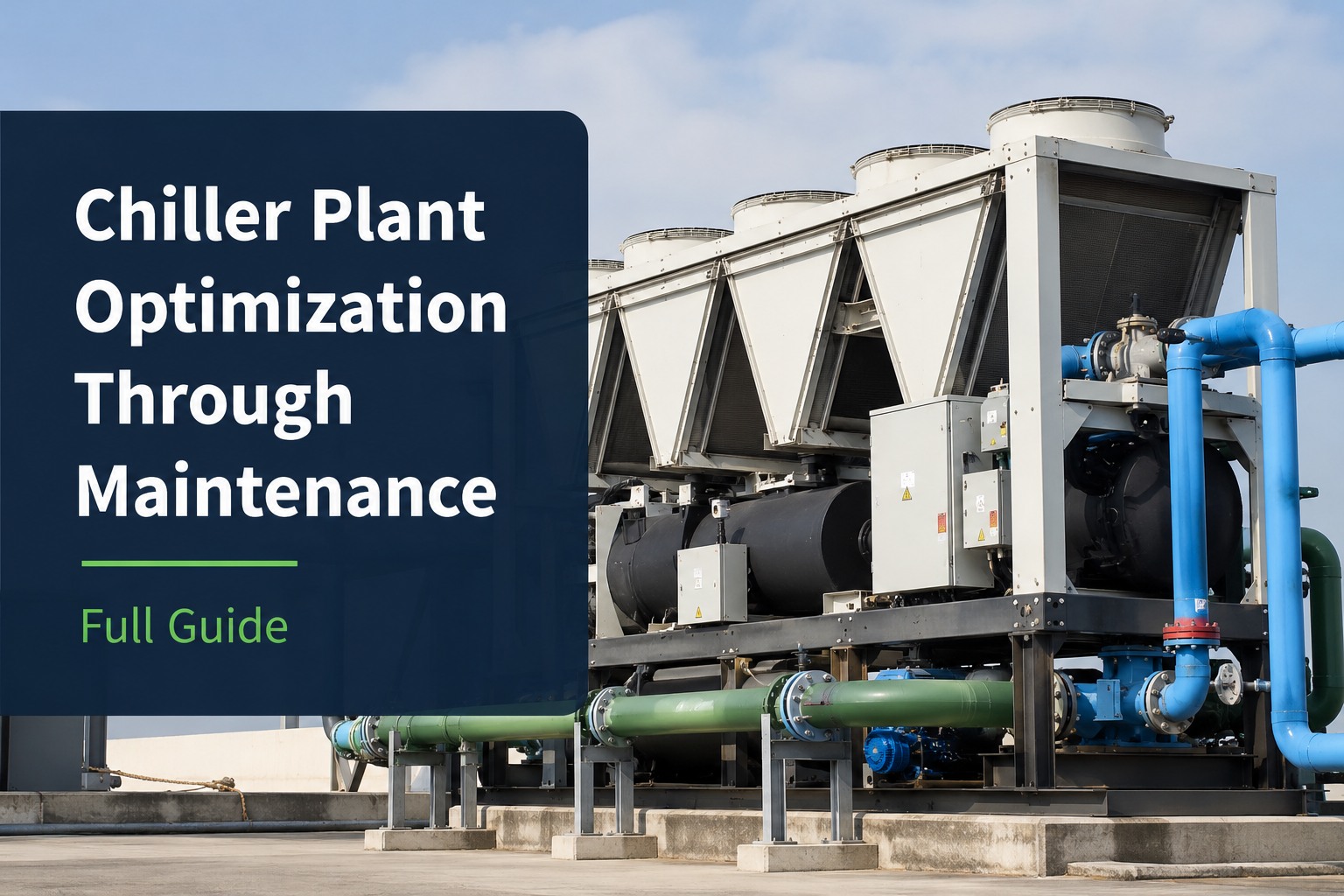
Commercial chiller plant optimization is the process of fine-tuning sequencing, preventive maintenance cadence, water treatment, and real-time condition monitoring to drive down HVAC energy consumption while extending equipment life. In most commercial buildings, the chiller plant accounts for 30–50% of total electrical energy use, meaning even a 5–10% efficiency gain translates into six-figure annual savings for large facilities. By combining controls logic with a strict CMMS-driven maintenance framework, facility teams can eliminate reactive breakdowns, prevent tube fouling, and keep chillers operating at peak kW/ton performance. You can Start Free Trial to immediately map your chiller assets, preventive maintenance schedules, and condition monitoring data into one centralized platform.
Stop wasting 30% of your chiller plant's energy on poor sequencing and fouled tubes
Most commercial chiller plants lose thousands of dollars annually to reactive maintenance, unoptimized staging, and missed water treatment cycles. OxMaint transforms your chiller plant management with predictive analytics and automated PM scheduling that keeps kW/ton low and reliability high.
How chiller plant sequencing lowers energy use and eliminates short-cycling
Optimizing chiller plant sequencing is the fastest lever for HVAC efficiency, often yielding a 10–15% reduction in plant energy consumption within the first month of deployment.
The goal of chiller plant optimization is to minimize this ratio under all load conditions. Sequencing chillers based on actual efficiency curves—rather than simply "lead/lag by runtime"—prevents low-load short-cycling and keeps machines in their efficient operating zones.
Without a CMMS enforcing tube cleaning cadence and water treatment, fouling quietly erodes chiller energy efficiency. A 1,000-ton chiller operating at 0.6 kW/ton can quickly degrade to 0.72 kW/ton, adding tens of thousands of dollars in wasted electricity annually.
A properly tuned sequencing controller stages chillers, pumps, and cooling towers together to maintain the optimal differential pressure and entering condenser water temperature. However, software logic alone is not enough. If maintenance teams are unaware of a drifting VFD or a clogged condenser tube, the controls will compensate by pushing chillers harder, spiraling energy costs. OxMaint integrates maintenance triggers with controls data, automatically generating work orders when condition monitoring detects performance degradation, ensuring your sequencing logic always operates on clean, efficient machinery.
The essential chiller plant maintenance checklist for peak efficiency
A CMMS-driven chiller plant maintenance program ensures no critical task slips through the cracks. Below is the core PM checklist required to sustain chiller energy savings and equipment health.
- Log chiller kW, kW/ton, and tonnage at peak load
- Inspect for refrigerant leaks and oil levels
- Verify entering/leaving chilled water temperatures
- Check cooling tower sump water levels and chemistry
- Clean condenser tubes (brush or chemical)
- Calibrate chilled water and condenser sensors
- Perform compressor oil analysis for predictive insights
- Verify VFD operation and pump sequencing logic
- Eddy-current test condenser and evaporator tubes
- Re-tube or plug failing sections before peak season
- Overhaul cooling tower fill and drift eliminators
- Recommission chiller plant sequencing parameters
Chiller condition monitoring and maintenance ROI breakdown
Consider a 1,500-ton commercial chiller plant running 3,500 hours per year at $0.12/kWh. Without optimized maintenance and monitoring, the plant typically operates at a degraded 0.75 kW/ton.
At 0.75 kW/ton, unoptimized plant draws 1,125 kW, costing roughly $472,500 annually in electricity.
By enforcing PM and sequencing optimization to achieve 0.60 kW/ton, the plant draws 900 kW, saving $95,000 per year.
Predictive maintenance catches bearing wear and tube fouling early, preventing catastrophic compressor failures and scrap costs.
In this scenario, deploying a CMMS to manage chiller condition monitoring, automate tube cleaning schedules, and enforce water treatment generates $119,000 in total annual savings. The payback period for migrating from spreadsheets to a structured maintenance software platform is typically less than 3 months for large commercial buildings.
Stop losing money to degraded chiller efficiency
See how OxMaint automates your chiller PM, tracks condition monitoring data, and sequences maintenance tasks to keep your plant running at peak kW/ton.
How OxMaint helps optimize commercial chiller plants
OxMaint is an AI-powered CMMS and EAM platform built to bridge the gap between maintenance execution and energy performance. Here is how our platform directly targets chiller plant inefficiencies.
Predictive Condition Monitoring
Connect BMS data, vibration sensors, and oil analysis results. OxMaint's AI predicts compressor failures and tube fouling before they spike energy use, cutting unplanned downtime by 30–50%.
Automated PM Scheduling
Digitize your chiller tube cleaning, water treatment, and cooling tower inspections. Eliminate paper work orders and ensure no PM task is missed, extending equipment life by up to 25%.
Asset & Inventory Tracking
Track chiller run-hours, refrigerant logs, and critical spare parts inventory in real-time. Ensure tubes, gaskets, and compressor oil are always in stock when seasonal overhauls come due.
Maintenance Analytics & Audits
Visualize kW/ton trends against maintenance interventions. Generate instant compliance reports for ISO 55000 and internal audits to prove your chiller optimization strategy is working.
Commercial chiller optimization: vs. standard reactive maintenance
Shifting from a reactive model to an optimized, CMMS-driven program changes the fundamental economics of commercial building operations.
| Operational Metric | Reactive / Spreadsheet Model | OxMaint Optimized Model |
|---|---|---|
| Chiller Efficiency (kW/ton) | 0.70 – 0.85 (Degraded) | 0.55 – 0.60 (Peak Performance) |
| Unplanned Downtime | 10–15 days per year | < 2 days per year |
| Tube Cleaning Cadence | When performance drops | Scheduled via run-hours & fouling factor |
| Water Treatment Tracking | Paper logs, inconsistent | Automated work orders & chemical tracking |
| Compliance Audit Prep | Weeks of manual data gathering | Instant reporting via CMMS dashboard |
Commercial chiller plant optimization FAQs
What is chiller plant optimization?
Chiller plant optimization is the continuous process of improving cooling plant efficiency through controls sequencing, preventive maintenance, and real-time condition monitoring. By integrating these strategies into a CMMS like OxMaint, facility teams can minimize kW/ton, reduce energy waste, and prevent unplanned equipment failures. You can Start Free Trial to see how automated PM scheduling improves your plant's efficiency.
How much energy can chiller plant sequencing save?
Proper chiller plant sequencing typically saves 10–15% on overall chiller energy consumption, and up to 30% when combined with optimized pump and cooling tower staging. The exact savings depend on the current state of controls logic and how strictly the maintenance team enforces PM schedules to keep heat exchangers clean.
Why is chiller water treatment critical for efficiency?
Chiller water treatment prevents scale, corrosion, and biological fouling in condenser tubes. Just 1 millimeter of scale buildup increases chiller energy use by 10–12% because it insulates the heat exchanger and forces the compressor to work harder. A CMMS automates water testing and chemical dosing schedules to prevent this efficiency loss.
How does condition monitoring improve chiller maintenance?
Chiller condition monitoring uses sensors to track vibration, refrigerant pressures, and oil quality, alerting maintenance teams to microscopic changes before a failure occurs. This shifts maintenance from reactive to predictive, reducing emergency repair costs by up to 50% and extending the operational life of the compressor and tubes.
How does OxMaint software support chilled water optimization?
OxMaint supports chilled water optimization by centralizing asset tracking, automating PM work orders, and integrating sensor data for predictive analytics. Facility managers use OxMaint to schedule tube cleanings based on actual fouling factors rather than guesswork. Book a Demo to learn how to configure these workflows for your plant.
Maximize your chiller plant efficiency today
Join the facility teams using OxMaint to cut energy costs, eliminate reactive breakdowns, and extend the life of their commercial HVAC assets.
Free 14-day trial · No credit card