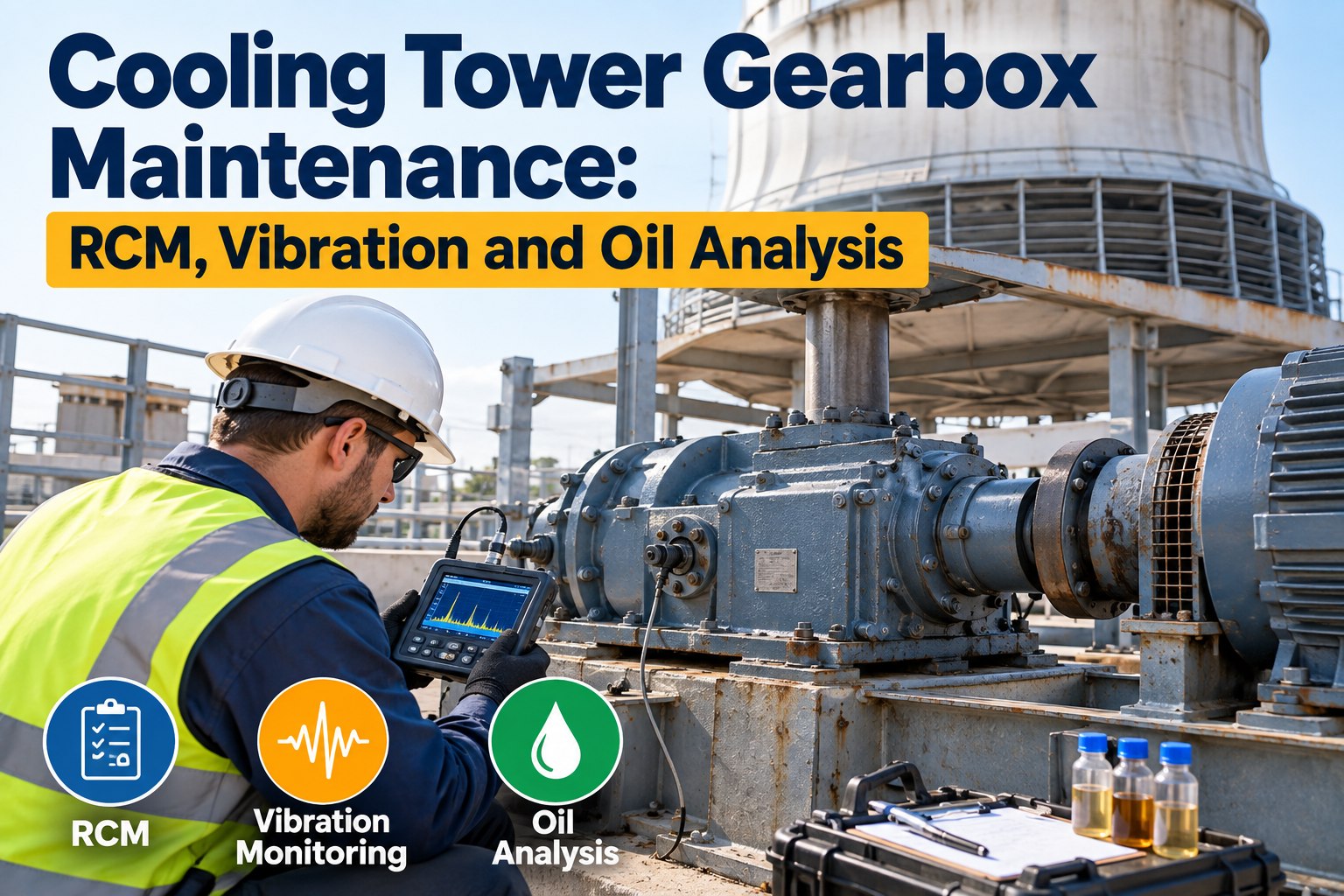
Power Plant Cooling Tower & Condenser Maintenance: Performance Optimization Guide
Condenser back-pressure is the single most impactful performance variable in a thermal power plant — a 1 inHg increase in turbine exhaust pressure at a 500 MW unit costs approximately $800,000 in annual output loss. Nearly every condenser vacuum problem traces back to a cooling tower or condenser maintenance gap: fouled tubes reducing heat transfer, biological growth reducing flow, drift eliminator failure increasing plume losses, or fan drive deterioration cutting airflow by 15–20% before anyone notices. OxMaint connects every cooling system condition indicator to a maintenance work order — so tube cleanliness trends become planned cleaning campaigns, chemistry excursions become corrective actions, and every condenser performance decline is intercepted before it becomes a dispatch penalty.
Condenser vacuum loss doesn't appear suddenly. It's predicted by the data your plant already collects — tube cleanliness assessments, water chemistry trends, CT fan performance, and vacuum excursion logs. The question is whether that data is driving maintenance decisions or sitting in a report nobody acts on.
Cooling tower fill · fan drive PM · condenser tube cleaning · vacuum trending · water treatment · drift eliminators · basin inspection — all connected to maintenance work orders through OxMaint.
annual output loss per 1 inHg condenser back-pressure increase at a 500 MW unit
15–20%
CT fan airflow reduction from degraded fan blades before operators detect performance loss
72%
of condenser tube fouling events detected at planned cleaning inspections — not during emergency vacuum excursions
2.8×
cost multiplier for reactive condenser re-tube vs planned replacement during a scheduled outage — EPRI benchmarks
68%
of cooling tower performance losses involve a measurable degradation mechanism — fill fouling, drift eliminator damage, fan blade pitch drift, or water chemistry imbalance — that leaves visible evidence weeks to months before vacuum loss becomes operationally significant. Plants with structured condenser cleanliness trending and CMMS-integrated cooling system PM consistently intercept these losses before they become dispatch penalties.
CT fill condition. Fan drive PM. Tube cleanliness trending. Vacuum excursion records. Water treatment logs.
All connected to the maintenance work orders that protect condenser vacuum and protect plant output — active from your first cooling system configuration in OxMaint.
Six Cooling System Maintenance Domains OxMaint Manages
Cooling system maintenance spans six technical domains — each with its own failure modes, performance impacts, and documentation requirements. OxMaint manages all six from a single platform, connecting condition data to maintenance decisions across every domain. Sign in to OxMaint to configure your cooling system maintenance programme.
CTF
Cooling Tower Fill & Structure
OEM specification · CTI STD-135
Fill condition assessed per cell — fouling depth, biological growth, and structural collapse mapped to replacement scope. Fill replacement planned 12–18 months in advance based on condition trending rather than reactive discovery during an outage.
Fill fouling assessment per cell with photo comparison
CT performance test records · Fill replacement history
FAN
CT Fan Drive & Mechanical
OEM PM schedule · vibration limits
Individual PM per fan cell — blade pitch setting, gear drive oil, drive shaft coupling, motor bearing vibration. Fan efficiency degradation of 15–20% from blade pitch drift reduces airflow and increases condenser back-pressure without triggering any alarm.
Blade pitch angle per blade — quarterly verification
Gear drive oil sampling and viscosity check
Motor bearing vibration trend per fan cell
Fan PM compliance history · Vibration trend records
TUB
Condenser Tube Cleaning & Inspection
HEI standards · EPRI guidelines
Online brush-type cleaner system performance tracked continuously — insert recovery rate and pressure differential across tube bundle monitored. Annual offline cleaning and tube plugging scope generated from eddy current survey data per bundle section.
Online cleaner recovery rate and pressure differential
Eddy current survey results — tube wall loss per tube
Plugging count history and remaining tube capacity
Eddy current survey reports · Tube plugging records
VAC
Vacuum System & Air Ejectors
Turbine OEM · HEI vacuum curves
Condenser back-pressure trended against OEM design curves corrected for inlet circulating water temperature. Air in-leakage test scheduled annually — vacuum excursion events logged with root cause and correction time. Performance loss quantified in MW equivalent.
Back-pressure vs design curve — corrected for CW temp
Air in-leakage test results and acceptance limits
Vacuum excursion event log with MW loss calculation
Vacuum performance trend records · Air ejector test history
WTR
Circulating Water Treatment
EPRI CW chemistry guidelines
Full EPRI circulating water parameter set tracked — cycles of concentration, pH, inhibitor residual, biocide dose, Legionella risk assessment schedule. Chemistry exceedances generate corrective work orders automatically. Treatment cost trended per MW·h.
CoC, pH, inhibitor residual, biocide dose per sample
Legionella risk assessment and monitoring schedule
Makeup water quality and blowdown rate records
CW chemistry compliance log · Legionella risk records
DFT
Drift Eliminators & Distribution
CTI BPG-250 · Legionella code
Drift eliminator condition inspected per cell at each outage — damage, displacement, and bypass pathways mapped. Water distribution system nozzle condition and spray pattern verified. Plume abatement performance documented for regulatory compliance.
Drift eliminator condition per cell — damage mapping
Distribution nozzle spray pattern and plugging
Plume abatement compliance documentation
Drift eliminator inspection reports · Plume compliance records
Cooling System Performance Loss Causes: Where Maintenance Delivers Highest Return
Five degradation mechanisms account for over 90% of all condenser vacuum losses and cooling tower performance deficits. Fill fouling and tube deposits together cause 55% of all condenser performance events — and both are detectable through condition monitoring and water chemistry tracking before vacuum loss becomes operationally significant. OxMaint quantifies performance loss per mechanism within 14 days of data entry.
COOLING SYSTEM PERFORMANCE LOSS DISTRIBUTION · % OF CONDENSER VACUUM EVENTS · EPRI ANALYSIS
Loss Mechanism
Share of Performance Events
Freq.
Severity
OxMaint Detection
CT Fill Fouling & Biological Growth
32%
48% P1
Fill condition assessment per cell + water chemistry trending
Fan blade pitch measurement + drive vibration trending
Air In-Leakage (Vacuum Loss)
14%
51% P1
Annual air in-leakage test + back-pressure vs design curve
Drift Eliminator / Distribution Failure
12%
28% P1
Outage inspection per cell + distribution nozzle survey
Plants spending $120K/yr on planned cooling system maintenance avoid an average of $1.1M in back-pressure performance losses. OxMaint connects condition data directly to the PM scope that prevents vacuum excursions.
Performance Anomaly Severity — How OxMaint Routes Each Cooling System Issue
A condenser unit with back-pressure 0.8 inHg above design needs a scheduled tube cleaning campaign. A fan cell with vibration exceeding trip threshold needs an emergency shutdown. A chemistry exceedance needs same-day corrective dosing. Book a demo to see OxMaint's cooling system severity routing.
P1
Immediate Threat — Same Day Investigation
Confirmed fault posing imminent risk to unit availability or safety. Emergency work order auto-generated with management escalation within 2 hours of detection.
Examples
CT fan vibration at trip threshold · Condenser vacuum >1.5 inHg above design · Gross chemistry exceedance · Tube bundle leak confirmed · Air ejector failure
Response<2 hrs
WO PriorityP1 Emergency
EscalationPlant Manager
P2
Condition Trending — Plan Before Next Outage
Degradation trend requiring planned intervention — no immediate operational impact but deferral creates a forced outage risk costing 2.8× more to resolve reactively.
Early-stage deterioration identified below immediate threshold. Scheduled at next PM window — captures value before escalation to P2 and associated daily performance cost.
Examples
Minor fill surface fouling · Chemistry at 85% of limit · Fan vibration slightly elevated · Drift eliminator minor damage · Basin sediment accumulation
ResponseNext PM window
WO PriorityP3 Routine
EscalationWeekly review
Cooling System Maintenance Requirements — OxMaint Coverage Matrix
Seven compliance and performance obligations span cooling system maintenance — each with a distinct technical source and evidence standard. OxMaint manages all seven from a single platform. Sign in to OxMaint to configure cooling system compliance tracking.
Maintenance Activity
System / Component
Interval Basis
Documentation Required
OxMaint Status
CT Fill Condition Assessment
All CT cells — fill media
Annual + condition-based
Fouling depth per cell, photo comparison, replacement scope
Technology: How Each Integration Enhances Cooling System Maintenance
Condition-based cooling system maintenance requires continuous data from multiple sources. OxMaint integrates with the full plant technology stack — creating a closed loop from condition signal to work order to performance record. Connect all monitoring layers through OxMaint.
AI Analytics Engine
6×
Faster vacuum loss root cause identification
AI analyses back-pressure trends, water chemistry trajectories, and fan performance parameters — ranking degradation pathways by impact to guide maintenance resource allocation.
IoT Online Instruments
60 sec
Chemistry exceedance to corrective work order
Online chemistry analysers and fan vibration monitors feed OxMaint continuously — threshold exceedances generate corrective work orders within minutes, not after the next manual sampling round.
Digital Twin
1–2%
Efficiency loss detected weeks before derating
Digital twin models condenser heat transfer performance — detecting efficiency loss from tube fouling or CT fill degradation before it escalates to dispatch-significant back-pressure impact.
PLC / DCS Integration
Auto
Fan trip alarm to work order at point of detection
DCS process variable data feeds OxMaint — CT fan fault codes, condenser back-pressure alarms, and CW pump anomalies all generate maintenance work orders automatically at the point of DCS alarm.
SAP / ERP Integration
Planned
Fill and tube material procurement before outage
CT fill replacement scope from OxMaint generates SAP purchase orders automatically — fill media, tube plugs, and spare fan blades ordered before the outage window opens, not reactively after discovery.
Predictive PM Engine
2.8×
Better ROI vs reactive-only maintenance
Condenser back-pressure trajectory, rising inhibitor dose requirements, and fan efficiency decline all trigger PM work orders at the optimum intervention point — not on a fixed calendar.
Complete cooling system performance packages generated in under 15 minutes.
CT fill condition history, fan drive PM records, condenser tube survey data, vacuum performance trend charts, and CW chemistry compliance logs — all from one platform, in the format engineers and insurance reviewers require.
"We had two consecutive summers where condenser back-pressure cost us over $2M in output losses. Post-season review found the same root cause each time — CT fill in cells 3 and 7 had been progressively fouling for 18 months and nobody had quantified the performance impact. We loaded three years of back-pressure data and water chemistry logs into OxMaint. Within three weeks we had the fill replacement scope prioritised and the fan blade pitch correction scheduled. The following summer we ran 0.3 inHg below design for the first time in five years."
Operations Manager · 660 MW combined cycle power plant
Frequently Asked Questions
Q1How does OxMaint use condenser back-pressure data to identify maintenance priorities?
OxMaint trends back-pressure against OEM design curves corrected for circulating water inlet temperature — isolating true performance loss from ambient temperature effects. When back-pressure deviation exceeds the configured threshold, OxMaint generates a root cause investigation work order and calculates MW loss in real economic terms. Sign in to configure vacuum trending.
Q2What water chemistry parameters does OxMaint track for circulating water compliance?
OxMaint tracks cycles of concentration, pH, inhibitor residual, biocide dose, suspended solids, and Legionella monitoring results against EPRI circulating water guidelines. Chemistry exceedances generate corrective work orders automatically. Legionella risk assessment schedule and monitoring results are maintained as a separate compliance record per tower cell.
Q3How does OxMaint manage CT fan drive PM across a large cooling tower fleet?
Each fan cell is configured as an individual asset with its own quarterly PM schedule — blade pitch verification, gear drive oil sampling, motor bearing vibration, and coupling inspection. Cells with vibration trending above baseline are flagged before trip threshold. Fan PM history is correlated with back-pressure performance data to quantify the airflow value per cell.
Q4How does OxMaint handle eddy current survey data for condenser tube management?
Eddy current survey results are stored per tube per bundle section — wall loss percentage, defect type, and plugging recommendation linked to the tube asset record. OxMaint tracks cumulative plugging count per bundle and generates an alert when plugging approaches the design limit, quantifying the remaining heat transfer capacity and scheduling the next survey.
Q5Can OxMaint generate performance documentation packages for outage planning?
Yes — OxMaint generates complete cooling system performance packages for any date range per unit, including CT fill condition history, fan PM records, condenser tube survey data, vacuum performance trend charts, and CW chemistry compliance logs — formatted for engineering review in under 15 minutes. Book a demo to see package generation for a multi-unit plant.
The fill fouling data was there. The back-pressure trend was visible. The fan pitch drift was measurable. OxMaint connects those indicators to the work orders that prevent the next vacuum excursion — before the condenser performance loss makes the decision for you.
CT fill trending · fan drive PM · condenser tube management · vacuum performance tracking · CW chemistry compliance · outage scope planning · active from first cooling system configuration.