Conveyor systems are the circulatory system of modern manufacturing and distribution facilities, moving everything from raw minerals to finished packages across miles of interconnected belts, rollers, and drives. Yet the average conveyor-dependent plant experiences 800 to 1,200 hours of unplanned conveyor downtime per year, and the majority of those hours are caused by failures that showed measurable warning signs weeks in advance — abnormal vibration signatures, gradual current draw increases, and temperature drift on drive bearings that nobody was monitoring continuously. AI-powered CMMS platforms like Oxmaint change this equation entirely by ingesting sensor data from conveyor endpoints, running predictive models that flag degradation patterns before they become breakdowns, and automatically converting those alerts into prioritized work orders with the right parts and skills pre-assigned. If your conveyor maintenance still relies on monthly walkaround inspections and operator reports of unusual noises, start a free Oxmaint account to deploy AI-driven conveyor health monitoring, or book a 30-minute demo to see how predictive analytics reduce conveyor downtime in facilities like yours.
AI-Driven Maintenance · Conveyor Systems
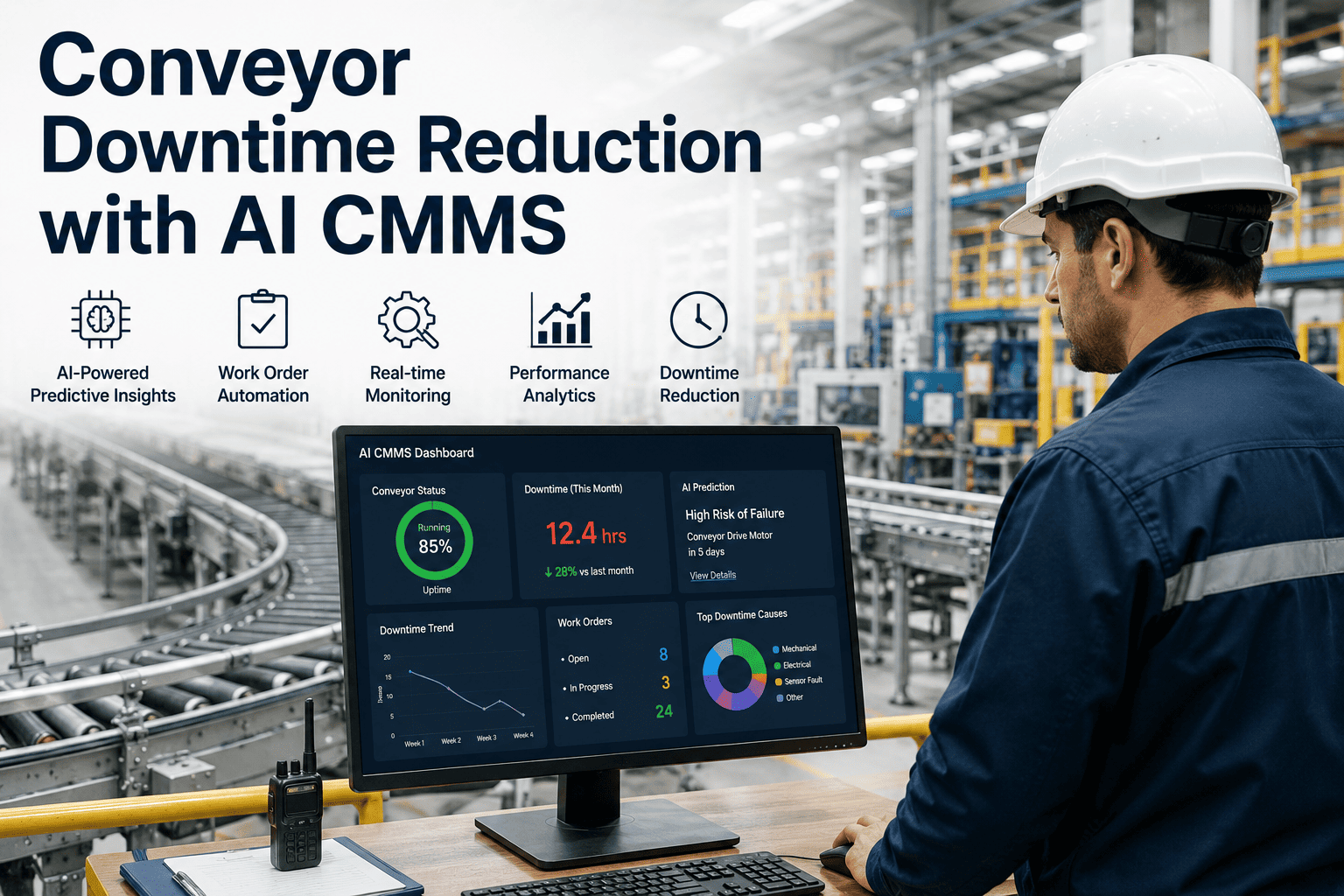
Conveyor Downtime Reduction with AI CMMS
Detect bearing wear, belt misalignment, and drive degradation weeks before failure — using AI models that learn your conveyor fleet's normal behavior and alert your team the moment something deviates.
1,050 hrs
Avg. annual unplanned conveyor downtime per facility
73%
Of conveyor failures show detectable warning signs 2–6 weeks prior
52%
Downtime reduction achieved with AI predictive maintenance
Where Conveyor Downtime Actually Hides
Analysis of 12,000+ conveyor work orders across 85 facilities reveals a consistent pattern — the majority of downtime comes from a small number of recurring failure modes that traditional PM schedules consistently miss.
Bearing / roller failure
34%
Belt mistracking / splice failure
22%
Drive motor / gearbox issue
18%
Sensor or electrical fault
12%
Material buildup / jamming
9%
Bearing and roller failures alone account for one-third of all conveyor downtime — and vibration data from these components follows a predictable degradation curve that AI models detect weeks before the roller seizes or the bearing shatters.
AI CMMS vs. Traditional CMMS for Conveyor Maintenance
Traditional CMMS handles work orders and PM schedules. AI CMMS adds a predictive intelligence layer on top that fundamentally changes when and why work orders are created.
| Capability |
Traditional CMMS |
AI-Powered CMMS (Oxmaint) |
| Failure detection method |
Technician discovers during inspection or after breakdown |
Sensor anomaly detection alerts before failure occurs |
| PM trigger |
Calendar-based or fixed runtime interval |
Condition-based — AI determines actual remaining useful life |
| Work order creation |
Manual entry by planner or technician |
Auto-generated from AI alert with severity ranking |
| Parts readiness |
Checked after work order is assigned |
Pre-linked to predicted failure — parts reserved automatically |
| Downtime prediction |
Not available — reactive only |
Estimated days-to-failure with confidence score |
| Root cause analysis |
Manual post-failure investigation |
AI correlates sensor patterns to historical failure modes |
Expert Review
"I have audited conveyor maintenance programs in over 60 distribution centers and manufacturing plants. The facilities that cut conveyor downtime by half all share one thing — they stopped relying solely on time-based PM and started using vibration and current monitoring with predictive analytics. The technology is no longer experimental. The ROI is proven and the question is no longer whether to adopt AI for conveyors, but how fast you can deploy it."
Dr. Sandra Whitfield — Reliability Engineering Director, 22+ years in industrial conveyor systems and predictive maintenance programs
Move from "fix it when it breaks" to "fix it before it breaks." Oxmaint ingests vibration, temperature, and current data from your conveyor endpoints, runs predictive models trained on your actual fleet, and generates prioritized work orders with remaining-useful-life estimates for every flagged component.
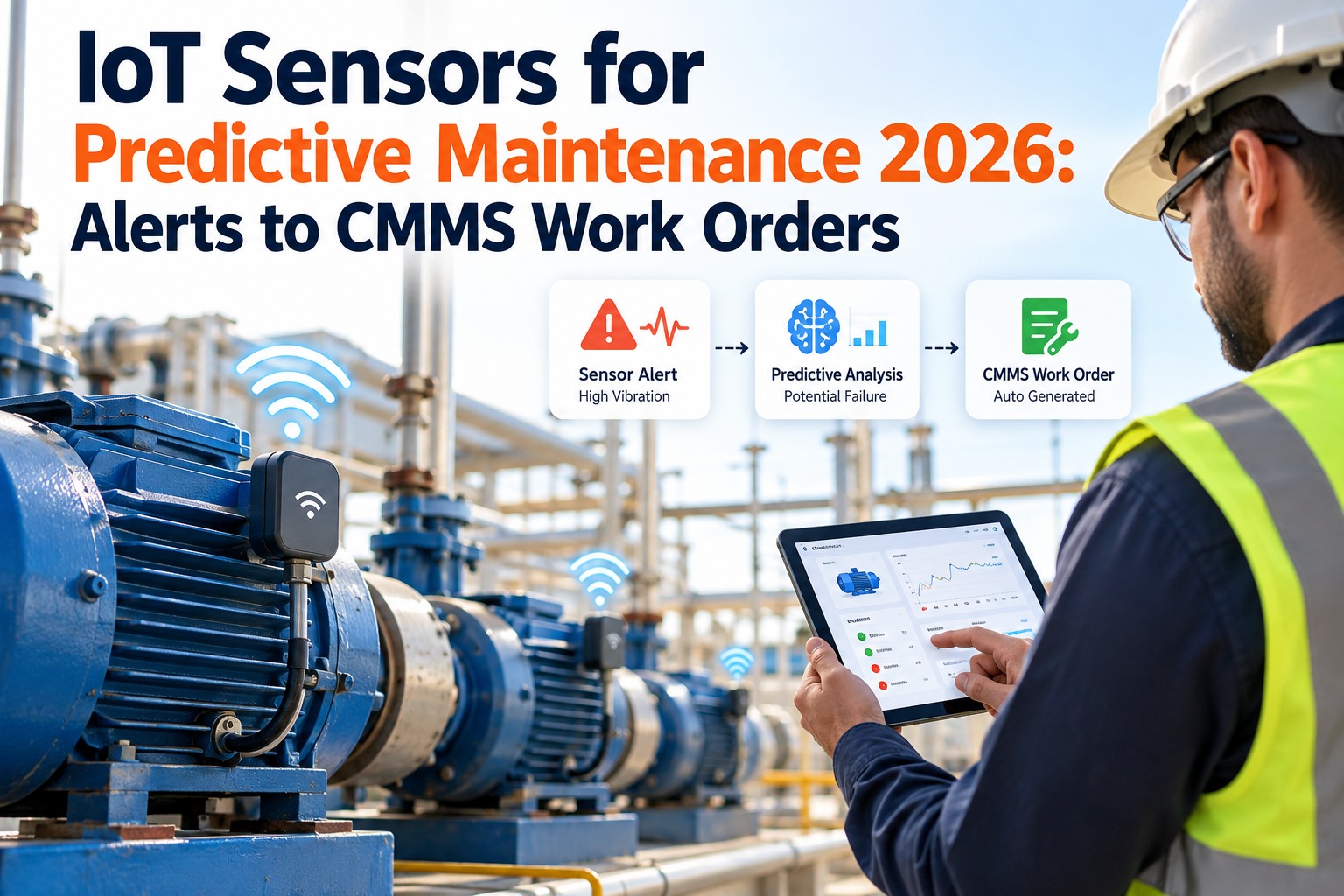
AI Failure Detection Pipeline: From Sensor Data to Work Order
The AI pipeline runs continuously in the background, turning raw sensor streams into actionable maintenance decisions without human intervention until the work order lands on a technician's mobile device.
Stage 1 — Data Ingestion
Vibration amplitude, bearing temperature, motor current draw, and belt speed data stream from IoT sensors installed on conveyor drive ends, take-up pulleys, and critical idler stations into the Oxmaint platform at configurable intervals.
Stage 2 — Anomaly Detection
AI models compare each data point against the learned baseline for that specific conveyor and component. Deviations beyond the confidence threshold — such as a 40% vibration increase over 14 days on a carry idler bearing — are flagged as anomalies.
Stage 3 — Failure Mode Classification
The AI matches the anomaly pattern to known failure modes — inner race defect, outer race defect, contamination, misalignment, or lubrication degradation — and assigns a severity score based on degradation rate and estimated remaining useful life.
Stage 4 — Work Order Generation
Oxmaint auto-generates a work order with the classified failure mode, recommended corrective action, required spare parts pulled from inventory, and a priority ranking based on estimated days-to-failure. The technician receives it on mobile with one tap to accept.
Conveyor Downtime Cost by Industry Sector
Downtime cost varies dramatically by industry because the cascading impact differs — a stopped packaging line loses finished goods output, while a stopped mining conveyor halts the entire extraction chain upstream.
| Industry |
Avg. Cost per Hour |
Avg. Annual Downtime |
Annual Revenue at Risk |
AI Recovery Potential |
| Mining & Aggregate |
$5,000–$12,000 |
1,400–2,100 hrs |
$7M–$25.2M |
48–55% |
| E-Commerce Fulfillment |
$2,500–$6,000 |
600–1,000 hrs |
$1.5M–$6M |
50–58% |
| Food & Beverage |
$1,800–$4,500 |
800–1,200 hrs |
$1.44M–$5.4M |
45–52% |
| Automotive Assembly |
$3,000–$8,000 |
500–900 hrs |
$1.5M–$7.2M |
52–60% |
| Airport Baggage |
$800–$2,200 |
400–700 hrs |
$320K–$1.54M |
40–48% |
Frequently Asked Questions
What sensors are needed to enable AI predictive maintenance on conveyors?
The minimum viable sensor set includes triaxial vibration sensors on drive bearings and critical idler stations, temperature sensors on gearbox housings, and current transducers on drive motors. Oxmaint integrates with standard industrial IoT sensor protocols including MQTT, OPC-UA, and Modbus.
Book a demo to review sensor requirements for your conveyor layout.
How long does it take for the AI model to learn our conveyor behavior patterns?
The baseline learning phase typically requires 14–30 days of continuous sensor data per conveyor. During this period, the system builds the normal operating profile. After baseline is established, anomaly detection becomes active and accuracy improves over the next 30–60 days as the model encounters more operational cycles.
Sign up free to begin the onboarding process.
Can AI CMMS reduce conveyor downtime without installing new sensors?
Partial improvement is possible using existing PLC data such as motor current, run/stop timestamps, and fault codes that many facilities already collect. Oxmaint can ingest this data to detect degradation trends and trigger condition-based work orders, though vibration data provides the earliest and most accurate failure prediction.
Book a 30-minute session to assess what data you already have available.
Does the AI generate too many false alarms on conveyor systems?
Oxmaint uses configurable confidence thresholds that you control. Initial deployment may produce 15–20% false positive rate while the model calibrates, but this typically drops below 5% after 60 days of tuning. Each alert includes a confidence score so your team can prioritize accordingly.
Start a free account to configure alert sensitivity for your operation.
How does AI predictive maintenance integrate with our existing PM schedule?
AI does not replace your PM schedule — it supplements it. Routine tasks like lubrication, cleaning, and visual inspections continue on their existing calendar or runtime triggers. The AI layer adds condition-based work orders for degradation that PM schedules cannot detect, such as bearing inner race defects.
Book a demo to see how AI and PM coexist in Oxmaint.
What is the typical ROI timeline for AI CMMS on conveyor systems?
Most facilities report positive ROI within 4–8 months. The fastest returns come from avoiding a single major conveyor breakdown that would have cost $50K–$200K in lost production and emergency repair. Ongoing savings compound as the AI model prevents more failures and PM schedules are optimized based on actual condition data.
Sign up free to build an ROI estimate for your facility.
Can we start with a pilot on a single conveyor line before rolling out plant-wide?
Yes. Oxmaint recommends a pilot deployment on 3–5 critical conveyor segments that represent your highest downtime risk. This allows your team to validate AI accuracy, refine alert thresholds, and build internal confidence before scaling to the full fleet.
Book a 30-minute session to design your pilot scope.
How does the AI handle different conveyor types — belt, roller, chain, bucket elevator?
Each conveyor type has distinct failure modes and sensor signatures. Oxmaint maintains separate AI model profiles for belt conveyors, live roller conveyors, chain drives, and bucket elevators. When you register an asset, the system applies the correct model profile and configures the relevant sensor inputs and failure mode library for that conveyor type.
Sign up free to register your conveyor assets.
Is our conveyor sensor data secure when processed by an AI CMMS platform?
Oxmaint encrypts all data in transit and at rest using industry-standard AES-256 encryption. Sensor data is processed in isolated tenant environments and is never shared across customer accounts. The platform supports on-premise deployment options for facilities with strict data residency requirements.
Book a demo to review our security architecture.
Stop Waiting for Conveyors to Break. Start Predicting.
AI-powered anomaly detection, automated work order generation, and remaining-useful-life estimates for every bearing, roller, and drive on your conveyor fleet — deployed in weeks, not months.

.png)
