Every open work order on the manufacturing floor represents one of three states: a production line at risk, a technician's next hour, or both. When those work orders live in radio traffic, whiteboards, and spreadsheets, the plant's mean time to repair (MTTR) has stretched from 49 minutes in 2019 to 81 minutes today — driven by skill gaps, supply chain friction, and the structural gap between failure detection and repair completion. At the industry benchmark of $532,000 per hour of unplanned downtime, that 32-minute stretch is $283 per minute in unrecovered production capacity per failure event. Deloitte's 2024 MRO Survey found that plants running standardised work order processes achieve 28% lower MTTR and 35% fewer repeat failures. A properly-configured work order management system does not just automate paperwork — it collapses the four phases of MTTR (Detect · Diagnose · Repair · Verify) into a single visible, measurable, improvable pipeline. Oxmaint's Work Order Management platform orchestrates the full lifecycle from initial request through parts kitting, technician assignment, execution, downtime attribution, and closure — with the reporting infrastructure to prove every recovered minute of production time.
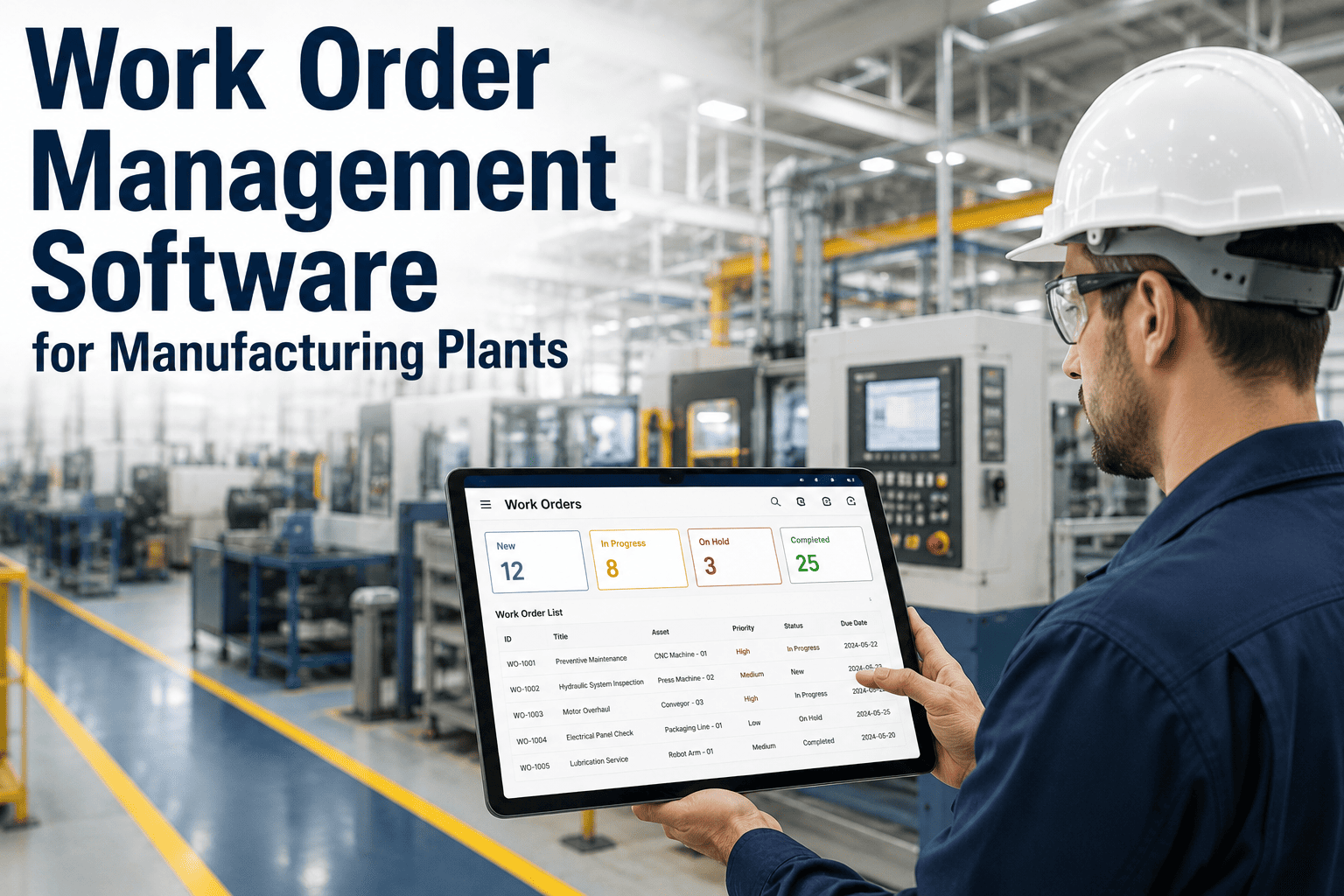
Work Order Management Software for Manufacturing Plants
From request to closure — priorities, technician assignment, parts, downtime tracking, and reporting in one unified pipeline. Purpose-built for plants where every minute of unplanned downtime carries a five-digit production cost.
The Six-Stage Work Order Lifecycle
Every work order — corrective or preventive, mobile or stationary asset — moves through the same six-stage lifecycle. The stages that are most often invisible in radio-dispatched plants are the ones where the biggest MTTR gains hide. Work order priority and SLA management for manufacturing makes each stage visible, timestamped, and improvable.
Six Feature Pillars — What Modern Work Order Management Actually Does
A work order module is not one feature. It is six operational systems that must interlock — each one delivering direct measurable value on the plant floor. The pillars below map to the specific capabilities OxMaint delivers under the Work Order Management umbrella.
Priority & SLA Engine
4-tier priority system (P1–P4) with configurable response and completion SLAs per priority × asset criticality. SLA breach warnings surface before the deadline, not after. Escalation to supervisor at 75% of SLA, to manager at 90%.
Technician Assignment
Skill-matched dispatch based on certifications, availability, location, and current workload. Optional auto-assign for P1 sensor triggers; manual dispatch for planned work. Cross-shift handover captured in the work order record.
Parts Integration
Live parts catalogue lookup at WO creation. Parts reserved when the WO is scheduled, issued at pickup, and consumed at closure. Backorder flags trigger alternate-supplier logic. Reorder points auto-adjust based on WO velocity.
Downtime Tracking
Every WO captures start time, end time, and reason code — feeding MTTR, MTBF, and OEE Availability automatically. Downtime attribution splits planned vs unplanned, mechanical vs electrical vs operator error, driving root-cause visibility.
Mobile Execution
Full WO capture from the technician's phone — status updates, photos, part scans, time entries, sign-offs. Works fully offline; syncs on reconnection. QR/barcode scanning on any asset opens the WO in under 2 seconds.
Reporting & Analytics
Pre-built dashboards for MTBF, MTTR, PM compliance, wrench time, cost per WO, cost per asset — plus custom reporting via drag-drop. Audience-specific views: technician queue, supervisor throughput, plant manager OEE, executive cost.
The Priority × SLA Matrix — Response and Completion Standards
The priority matrix below is the industry-standard 4-tier framework applied by most manufacturing operations. Every OxMaint work order carries a priority tag, and the SLA clock starts the moment the WO enters the queue. Technician workload balancing in CMMS is what enables consistent SLA achievement across the priority spectrum.
Inside the Product — The Work Order Screen
The single screen the maintenance supervisor lives in during a production shift. Filterable, sortable, colour-coded — with SLA countdown, priority tag, and assignee visible on every row. Below is a stylised representation of the OxMaint work order list view during a live shift.
Every Work Order Should Be a Countdown, Not a Question Mark.
OxMaint gives your maintenance supervisor a real-time view of every open WO, every SLA countdown, every assigned technician, and every reserved part — in one screen your team already knows how to read.
The Four Phases of MTTR — Where Traditional CMMS Goes Blind
Mean time to repair is not a single number — it is the sum of four sequential phases. Most legacy CMMS platforms capture only Phase 3 (the wrench-time portion) because that is where the work order clock officially starts. The other three phases live on radio, in text messages, and in operator memory. MTBF and MTTR reporting for plant maintenance requires capture across all four phases — because the phases that traditional CMMS ignore are typically where the largest MTTR gains hide.
Downtime Attribution — Where Availability Actually Goes
Every OxMaint work order that carries a downtime start/end pair contributes to the plant's availability calculation. The waterfall below is what the availability breakdown looks like on a typical manufacturing shift — with each loss category attributed to a specific WO type or reason code. Downtime tracking analytics for manufacturing makes each of these categories independently trendable, so improvement effort targets the right loss.
The Economics — What Manufacturing Plants Actually Recover
Manufacturing WO management delivers value in three places: recovered production time, reduced maintenance labour waste, and lower emergency-repair cost. The scenario below models a mid-size plant on realistic industry benchmarks — reactive baseline vs planned-first with structured WO management.
The Work Order KPIs Every Manufacturing Plant Should Track
Six KPIs — reviewed weekly by the maintenance manager and monthly by the plant director — that consistently separate mature manufacturing WO operations from firefighting ones. Each surfaces a distinct system health dimension.
MTTR (Mean Time to Repair)
Average corrective repair time from WO open to WO close. Below 2 hours is world-class; 2–4 hr is good; 4–8 hr is average; above 8 hr requires structural review.
PM Compliance Rate
Percentage of scheduled preventive work orders completed within their target window. Above 90% signals a healthy planned-first culture; below 70% forecasts rising unplanned events.
Wrench Time %
Percentage of technician shift spent on actual repair work vs travel, waiting, searching, or admin. Industry starts around 22%; mature deployments reach 48–55%.
Schedule Compliance
Percentage of scheduled work orders completed within their planned window. Above 85% indicates strong planning and coordination between maintenance and production.
Emergency Work %
Percentage of maintenance hours consumed by emergency (P1/P2) work orders. Above 40% signals a reactive culture; below 15% signals a mature preventive discipline.
MTBF (Mean Time Between Failures)
Average operating time between unplanned failures. Trending direction matters more than absolute value; rising MTBF confirms preventive work is finding the right assets at the right interval.
Expert Review — A Plant Maintenance Manager's Perspective
We had thirty-five maintenance technicians and no idea how productive they were. When we implemented OxMaint and started tracking wrench time, the first measurement came in at twenty-two percent — meaning seventy-eight percent of a technician's day was going to non-repair activities. Walking to the parts room. Waiting for the supervisor to confirm a diagnosis. Searching for the correct schematic. Filling out paper forms that nobody would ever read. The real insight was that we did not need more technicians. We needed to remove the obstacles preventing the ones we had from doing their jobs. Twelve months in, wrench time hit forty-eight percent. That is the equivalent of adding twelve technicians without hiring anyone. Our PM compliance moved from sixty-eight percent to ninety-four percent. MTBF increased forty percent. Emergency work as a share of total maintenance hours dropped from forty-five percent to fifteen percent. But the number that convinced the board was maintenance cost per unit of output — down thirty-one percent. That is a metric every executive understands, and it does not appear in your CMMS by accident. It appears because the work order module is capturing enough structured data to feed it, every shift, every day, without asking the technicians to do meaningfully more paperwork. In manufacturing, the difference between a WO module that just documents work and one that actively improves the plant is not a feature list. It is whether the four phases of MTTR are all being measured. Once they are, the improvements become obvious. Before they are, everything is guesswork.
Frequently Asked Questions
How does OxMaint handle work orders when a technician is offline in a shielded area of the plant?
Manufacturing plants routinely have signal-dead zones — heavy machinery cages, deep basement utility rooms, EMI-shielded process areas. The OxMaint mobile app operates fully offline: WO details, checklists, part information, and photo capture all work with zero connectivity. When the technician re-enters signal range, everything syncs in seconds — start times, end times, photos, notes, part consumption, and sign-offs. The audit trail preserves the actual timestamps from the field, not the sync timestamps. This is critical for MTTR accuracy — the timer runs on the WO clock, not the network. Start free to test the offline behaviour on your floor.
Can work orders be triggered automatically by PLC or SCADA fault codes, not just manual reports?
Yes. OxMaint integrates with the major PLC and SCADA platforms via OPC-UA, MQTT, and standard REST webhooks. A fault code on a Rockwell, Siemens, Mitsubishi, or B&R controller can auto-trigger a work order in the OxMaint queue, priority-scored based on the fault severity and the asset's criticality classification. The WO carries the fault code, timestamp, and equipment state at trigger — giving the responding technician diagnostic context before they leave the shop. For plants with existing SCADA alarm floods, the OxMaint side applies deduplication and severity throttling so the queue does not flood. Preventive maintenance scheduling for manufacturing combines these sensor triggers with time-based PM logic.
How does the priority and SLA engine handle a P1 that arrives when all techs are already busy on other P1s?
When a new P1 enters the queue with no available skill-matched tech, OxMaint's dispatcher escalates to the shift supervisor with three actions surfaced: (1) reassign a lower-priority WO's current tech to the new P1 with automatic capture of the interruption reason, (2) call in on-call standby techs with pre-configured callout logic, or (3) hold the P1 in an escalation queue with the supervisor accepting explicit responsibility for the delay. Each path produces a complete audit trail — critical for post-incident review and for defending SLA breaches when downstream Six Sigma or quality investigations occur. Book a demo to walk through the escalation workflow.
How does the parts integration work when a work order needs a part that shows in stock but is not physically on the shelf?
Shelf-vs-system parts variance is a real problem in most stockrooms — cycle-count accuracy averages 82% in manufacturing operations without disciplined parts issue tracking. OxMaint reduces this through three mechanisms: (1) parts are reserved at WO scheduling and locked from other WOs, (2) the technician confirms physical availability at issue with a scan, and (3) any mismatch immediately raises a cycle-count exception with the specific bin location for supervisor review. Over a rollout period, the variance typically closes to under 3%. In parallel, OxMaint's reorder-point logic tightens automatically based on WO consumption velocity, reducing "system-in-stock, shelf-empty" events at the root. Sign in to see the parts reservation workflow.
How quickly does a manufacturing plant typically go live with OxMaint Work Order Management?
A typical mid-size manufacturing plant reaches first live work orders in 3–5 business days after asset registry import. The phased rollout: Days 1–3, asset hierarchy loaded, priority rules configured, technician roster and skill matrix built. Days 4–5, mobile app deployed to a pilot line, first WOs run in parallel with existing paper flow. Weeks 2–4, expanded rollout across production lines, integrations activated (parts, PLC/SCADA sensors, ERP if applicable). Month 2, KPI dashboards populated with enough data to drive weekly reviews. Full mature-state operation with confident MTTR/MTBF/OEE reporting typically emerges 3–6 months in. Book a demo to map the deployment phases for your plant.
The Next Production Line to Stop Is the One That Should Have Had a Work Order Yesterday.
OxMaint's Work Order Management platform turns every fault, PM, and improvement request into a tracked, prioritized, skill-matched, parts-reserved, SLA-monitored, downtime-attributed record — captured on the floor, closed on the floor, reported to the boardroom.