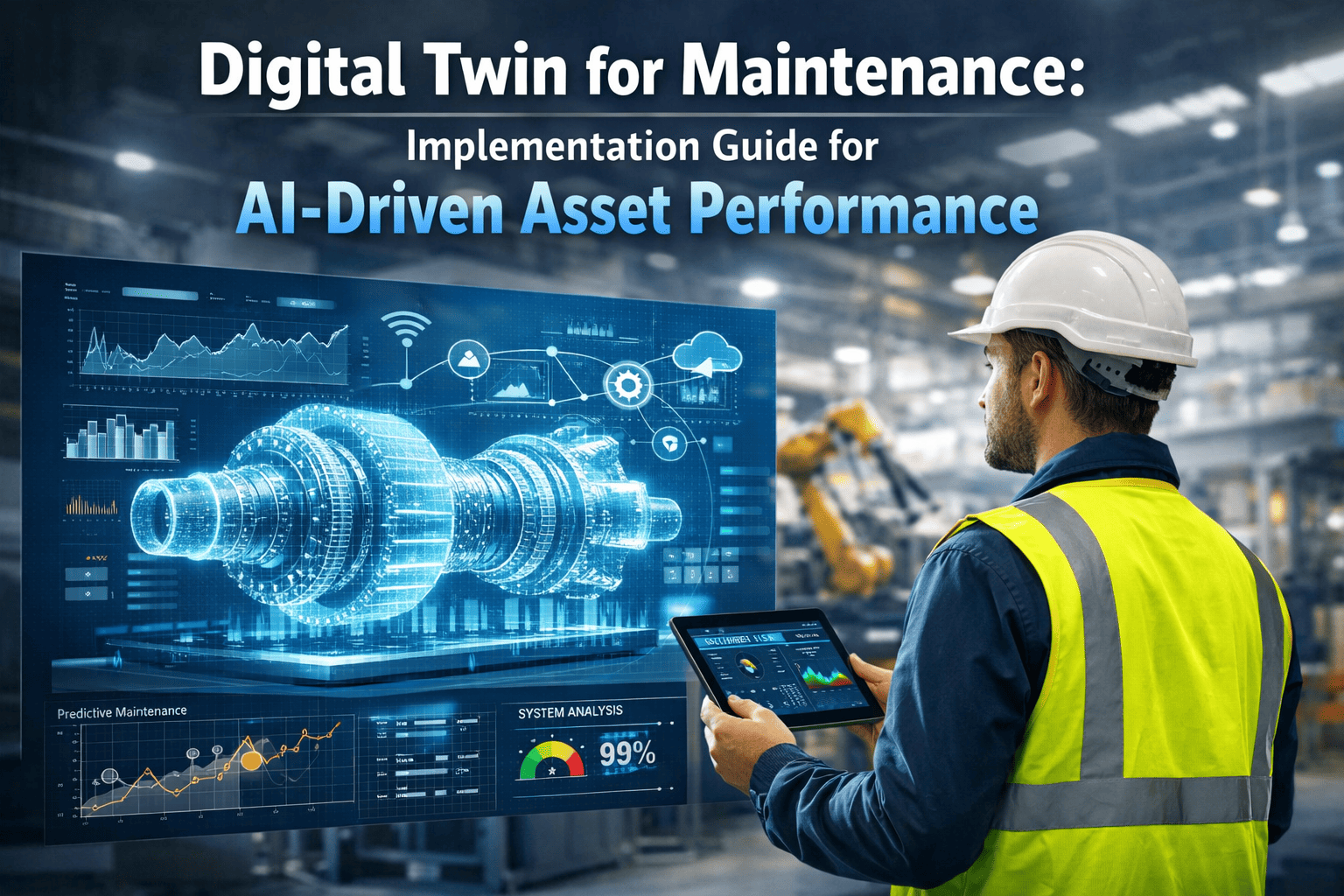
Traditional maintenance monitoring captures only 15-25% of the parameters that actually determine whether a piece of equipment is about to fail. The remaining 75-85% — the interaction effects between vibration patterns, thermal stress, load cycling, and material fatigue — stays invisible until something breaks. Digital twins close this gap by creating virtual replicas of physical assets that process every available data stream simultaneously, achieving 88-97% predictive accuracy across different asset categories. The digital twin market is projected to grow from $24.5 billion in 2025 to $259.3 billion by 2032, and facilities using digital twin-based predictive maintenance report 50-70% reductions in unplanned downtime while cutting total maintenance costs by 35-50%. This is not incremental improvement over condition monitoring — it is a fundamentally different approach to understanding why equipment fails and when it will happen next. Oxmaint's CMMS platform provides the operational data foundation that digital twins require — work order history, failure codes, asset hierarchy, and sensor integration — making it the ideal launch pad for digital twin deployment.
This guide explains how digital twins work for maintenance, what makes them different from traditional monitoring, which assets to prioritize, and the practical implementation path from first sensor to fully autonomous failure prediction.
How Digital Twins Work for Maintenance
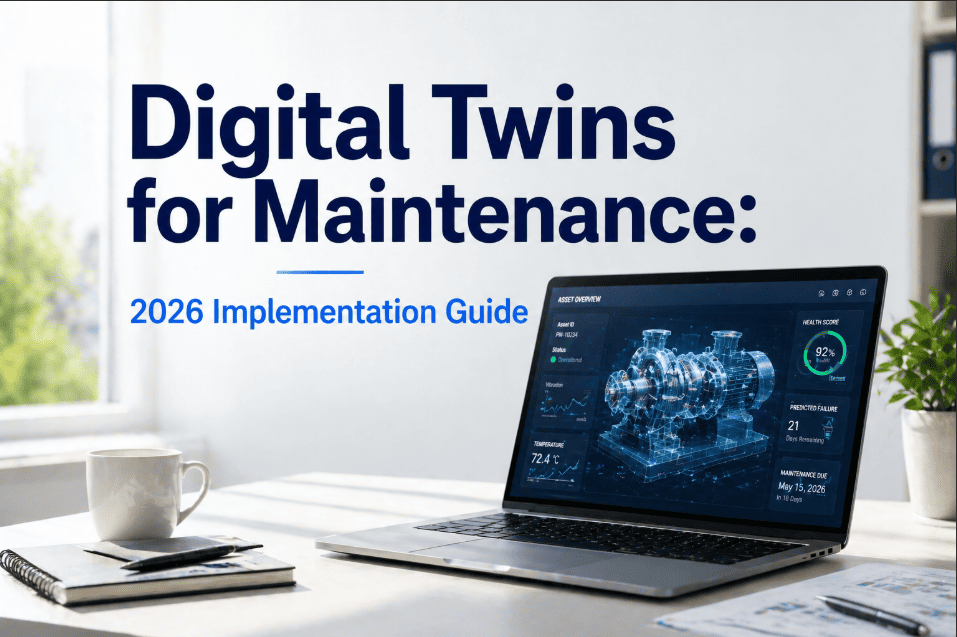
A digital twin is not a dashboard, not a 3D model, and not a monitoring system. It is a virtual replica of a physical asset that ingests real-time sensor data, applies physics-based and machine learning models, and simulates the asset's current condition and future behavior with enough accuracy to predict failures weeks or months before they occur. The twin continuously learns from the physical asset's actual performance, recalibrating its models as the asset ages, operating conditions change, and maintenance interventions alter the degradation trajectory.
Digital Twin Architecture for Maintenance
What Digital Twins Can Predict That Traditional Monitoring Cannot
The power of digital twins lies in their ability to model failure modes that no single sensor can detect. Cascading failures, interaction effects between components, and degradation patterns that only become visible when multiple data streams are analyzed together — these are the failure modes that cause the most expensive and dangerous breakdowns. Oxmaint captures the operational data that feeds digital twin models: complete work order histories, failure code libraries, and asset performance baselines.
Multi-Component Failure Chain
A cooling fan circuit fails, causing a temperature rise in a motor bearing, which increases vibration in the coupled gearbox, which accelerates wear on downstream equipment. No single sensor catches the chain reaction — only the digital twin modeling the complete system interaction predicts the cascade before it reaches the critical asset.
Remaining Useful Life Estimation
A pump shows normal vibration levels today, but the digital twin's physics model calculates that the current operating pattern — slightly off-spec pressure combined with marginally elevated temperature — will consume the bearing's remaining fatigue life 40% faster than the standard wear curve predicts. The twin updates the RUL estimate in real time.
Maintenance Decision Optimization
Production needs to run at 110% capacity for the next 3 weeks to meet a customer deadline. The digital twin simulates the accelerated wear on every critical component at elevated load and predicts which assets will survive the run and which need preventive intervention before the high-demand period begins.
External Factor Impact Analysis
Seasonal humidity changes affect electrical insulation resistance. Ambient temperature shifts alter cooling efficiency. Raw material hardness variation impacts crusher wear rates. The digital twin correlates environmental and operational variables with asset degradation — predicting failures that only occur under specific combinations of conditions.
Accuracy and Performance Benchmarks
Digital twin predictive maintenance is not theoretical — it is delivering measurable results across manufacturing, energy, aerospace, and heavy industry. The benchmarks below represent documented performance from operational digital twin deployments, not laboratory testing or vendor projections.
Predictive Accuracy
Across different asset categories after 6-12 months of model training
Unplanned Downtime Reduction
Compared to conventional condition monitoring approaches
Total Maintenance Cost Cut
Through elimination of unnecessary PM and prevention of catastrophic failures
Maintenance Efficiency Gain
Technicians spend more time on planned work, less on reactive scrambling
Catastrophic Failure Prevention
Virtual modeling prevents the majority of high-consequence equipment failures
ROI Timeline
$200K-600K initial investment generating $1.2-3.5M annual savings
Build the Data Foundation Your Digital Twin Needs
Every digital twin starts with clean, structured operational data. Oxmaint delivers the CMMS backbone — work order history, failure codes, asset hierarchy, and sensor integration — that makes digital twin deployment possible in months, not years.
Which Assets to Prioritize for Digital Twin Deployment
Digital twin implementation does not start by instrumenting every asset in the plant. It starts with 2-5 high-value assets where failure costs are highest, operating conditions are complex, and sufficient sensor data is either already available or cost-effective to deploy. The selection matrix below helps identify the optimal starting assets for maximum ROI.
Implementation Path: From CMMS to Digital Twin
A digital twin cannot function without clean, structured maintenance data as its training foundation. The implementation path begins with CMMS maturity — ensuring that work orders, failure codes, and asset history are digitized and consistent — before layering sensor data, physics models, and predictive algorithms. Sign up for Oxmaint to establish the data foundation that makes digital twin deployment practical.
Data Foundation: CMMS Deployment
Deploy digital work orders, build asset registry with complete hierarchy, standardize failure codes across all technicians. Begin capturing the structured maintenance history that digital twins will use as training data. Without this step, every subsequent phase produces unreliable results.
Sensor Deployment: Instrumentation Layer
Install 10-50 sensors per priority asset: vibration, temperature, pressure, flow, electrical current, and acoustics. Configure data transmission protocols (OPC UA, MQTT) to stream continuous readings into the CMMS and future twin platform. Validate data quality and fill gaps before building models on unreliable inputs.
Model Building: Physics + Machine Learning
Build hybrid models combining physics-based simulation (finite element, thermodynamic, fatigue life) with machine learning trained on the sensor and CMMS data collected in Phases 1-2. Digital twins require 6-12 months of data collection to train virtual models effectively — predictive capabilities improve significantly once systems learn asset-specific behavior patterns.
Operational Integration: Automated Decision Loop
Connect digital twin predictions to CMMS work order generation. When the twin detects an emerging failure, it automatically creates a maintenance work order with predicted failure date, recommended intervention, and required spare parts. Close the loop from prediction to action without manual interpretation.
Scale and Optimize: Facility-Wide Deployment
Expand digital twin coverage to all critical and production-significant assets. Implement what-if scenario simulation for production planning. Deploy cross-asset interaction modeling to predict cascade failures across connected systems. Establish continuous model improvement as the twin learns from every maintenance event.
Common Barriers and How to Overcome Them
Digital twin adoption is accelerating — but 65% of maintenance teams still have not deployed AI-powered maintenance solutions. The barriers are real but solvable. Understanding them upfront prevents the pilot-to-graveyard path that stalls most industrial technology initiatives. Book a demo to see how Oxmaint removes the data foundation barrier that blocks most digital twin projects.
Start Building Your Digital Twin Foundation Today
The #1 barrier to digital twin deployment is missing CMMS data. Oxmaint gives you the work order history, failure coding, asset hierarchy, and sensor integration your future digital twin needs — while delivering immediate ROI through preventive maintenance automation.
Frequently Asked Questions
What is a digital twin in maintenance and how does it differ from condition monitoring?
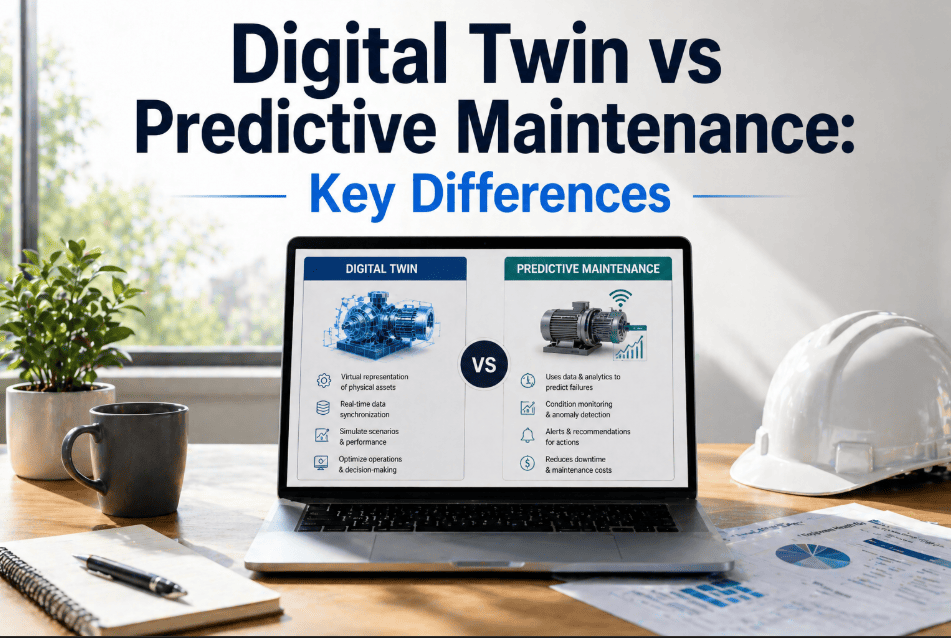
A digital twin is a virtual replica of a physical asset that processes real-time sensor data through physics-based and machine learning models to simulate the asset's current condition and predict its future behavior. Condition monitoring triggers alerts when individual sensor readings cross predefined thresholds — a single-variable reaction. A digital twin processes all sensor inputs simultaneously, models the interaction effects between components, and predicts not just that something will fail, but when, why, and what the optimal intervention timing and method should be. The accuracy difference is significant: traditional monitoring captures 15-25% of failure parameters while digital twins achieve 88-97% predictive accuracy.
How much does a digital twin implementation cost?
Initial digital twin investments typically range from $200,000-$600,000 depending on the number of assets, sensor requirements, and model complexity. This covers sensor instrumentation, data infrastructure, model development, and integration with existing CMMS and production systems. Most manufacturers achieve positive ROI within 18-36 months, with prevented failures and optimized maintenance generating $1.2-3.5 million in annual savings. Starting with 2-5 high-value assets keeps initial investment manageable while proving the business case for broader deployment.
How long does it take for a digital twin to become accurate?
Digital twins require 6-12 months of continuous data collection to train virtual models effectively for a specific asset. During this initial period, the twin operates in learning mode — building baseline behavior models and identifying normal operating patterns. Predictive capabilities improve significantly after the training period as the system learns asset-specific behavior patterns and environmental influences. Pre-built models for common asset types (rotating machinery, pumps, motors) can accelerate the training period by starting with industry-standard failure physics rather than learning everything from scratch.
Do we need a CMMS before implementing a digital twin?
Yes — a CMMS is the essential data foundation for any digital twin deployment. Digital twins need structured maintenance history (work orders, failure codes, repair actions) to train their predictive models accurately. Without CMMS data, the twin has no historical context about how the asset has been maintained, what failure modes have occurred, and how the asset responded to different interventions. Plants that attempt digital twin deployment without a mature CMMS consistently report poor prediction accuracy because the models are training on incomplete or inconsistent data.
Which assets should be prioritized for digital twin deployment?
Prioritize assets that combine high failure cost ($100K+/day impact), complex multi-variable failure modes, available or easily deployable sensor infrastructure, and at least 12 months of CMMS work order history. Rotating machinery (compressors, turbines, large motors), process equipment (kilns, reactors, heat exchangers), and control systems with cascading failure potential deliver the fastest ROI. Start with 2-5 assets to prove value before expanding. Avoid starting with assets that have simple single-point failure modes — these are better served by standard condition monitoring without the full digital twin investment.
How many sensors does a digital twin require per asset?
Effective digital twins typically require 10-50 sensor inputs per asset depending on complexity. Common sensor types include vibration accelerometers, temperature probes (surface and ambient), pressure transducers, flow meters, electrical current transformers, acoustic emission sensors, and performance parameter monitors. The sensor count depends on the asset's complexity and the number of interacting failure modes. A simple pump might need 10-15 sensors; a complex turbine or kiln system might need 40-50. The key is covering all significant failure pathways, not instrumenting every possible measurement point.
Can digital twins work alongside existing maintenance strategies?
Absolutely — and they should during the initial deployment period. Run the digital twin in advisory mode alongside existing PM schedules and condition monitoring for 3-6 months. Track the twin's predictions against actual outcomes to build confidence in its accuracy. Gradually shift decision authority to the twin as its track record proves reliable. This parallel-run approach builds organizational trust, identifies model blind spots, and prevents the risk of relying on unproven predictions for critical maintenance decisions. Most facilities transition to twin-led scheduling for individual assets as each twin proves its accuracy for that specific equipment.