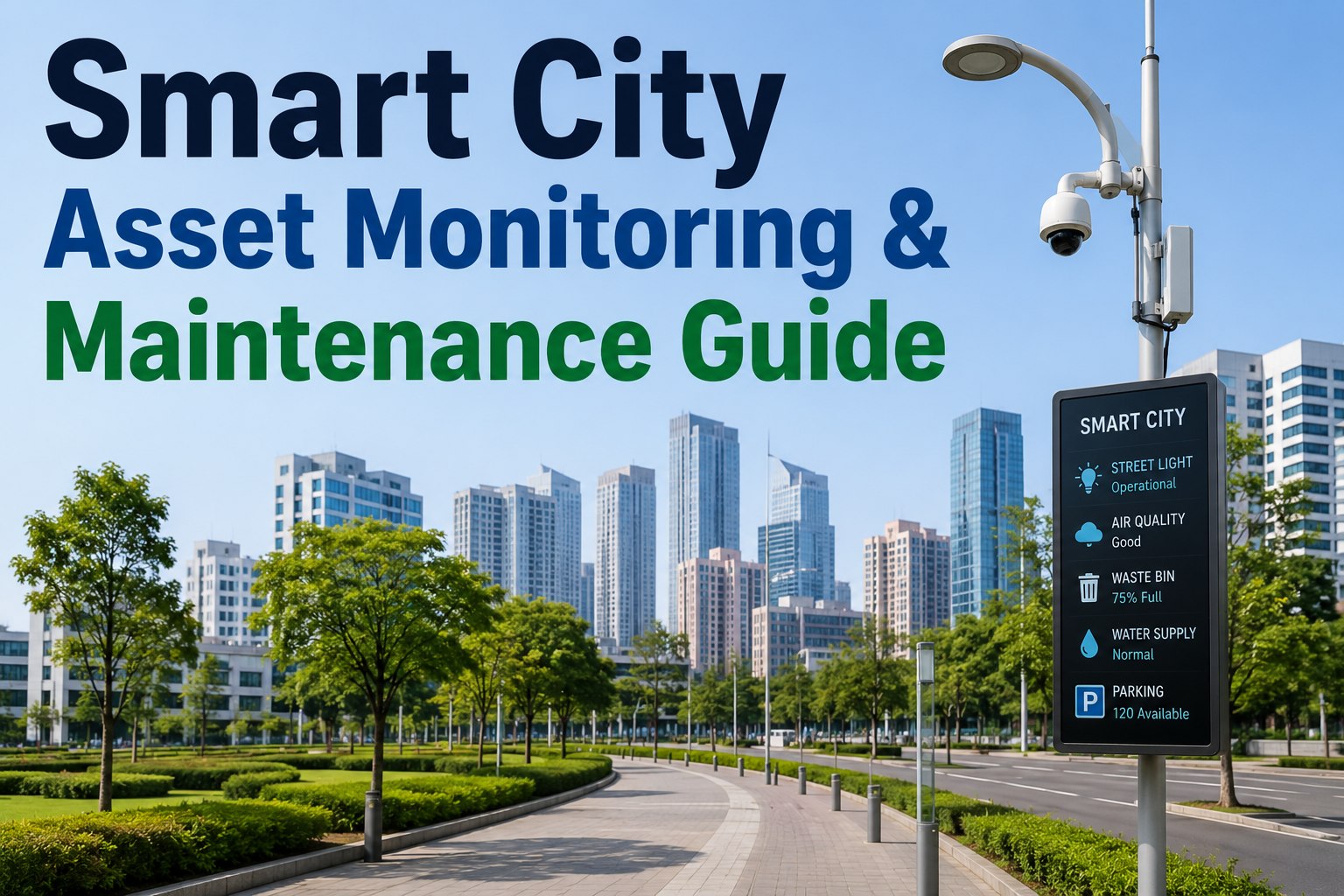
Smart city asset monitoring and maintenance is the discipline that determines whether a municipality's investment in connected infrastructure delivers lasting operational value or becomes a collection of disconnected pilot projects. As cities deploy IoT sensors, connected streetlights, and smart utilities, maintenance and reliability teams face an explosion of condition data that legacy systems were never built to operationalize. OxMaint provides the AI-powered CMMS foundation that turns smart city monitoring data into automated work orders, cross-department workflows, and measurable uptime for connected public assets. You can Start Free Trial to experience the platform or book a personalized demo to see it mapped to your city's infrastructure.
SMART CITY OPERATIONS
Is your smart city investment generating data — or delivering outcomes?
Over 70% of municipalities have deployed IoT sensors on public assets, yet fewer than 30% have integrated that data into a maintenance workflow that automatically triggers work orders. OxMaint closes the gap between smart city monitoring and actionable maintenance.
THE INTEGRATION CHALLENGE
Why smart city infrastructure creates new maintenance demands
A mid-sized city managing 12,000 connected streetlights, 800 traffic sensors, and 200 smart water valves generates over 2 million status data points per day. Without a CMMS engineered for IoT integration, that data volume overwhelms spreadsheet-based maintenance teams and silently degrades the very infrastructure it was meant to protect.
WORKED EXAMPLE
A municipality with 8,500 connected assets across lighting, traffic, and water systems was spending $310,000 annually on reactive dispatch and overtime. Sensor alerts arrived via three vendor portals with no unified workflow. After implementing OxMaint with condition-based work order triggers, the city reduced mean time to repair by 41% and cut emergency dispatch costs by $128,000 in year one — paying back the software investment in under four months.
SMART CITY MAINTENANCE FRAMEWORK
The four streams of connected city asset management
Municipal operations teams that succeed at intelligent city maintenance organize work into four parallel streams. Each stream requires a different data trigger, workflow, and SLA — all managed inside a single CMMS to avoid siloed pilot projects.
Sensor-driven fault detection
Connected streetlights, traffic controllers, and water sensors stream vibration, voltage, and flow data. OxMaint ingests threshold breaches and automatically generates triaged work orders with asset context, location, and priority — no manual alert review required.
Scheduled servicing for connected public assets
Smart city infrastructure still requires periodic inspection, calibration, and component replacement. OxMaint manages PM schedules based on meter readings, calendar intervals, or manufacturer specifications — ensuring compliance with municipal SLA and ISO 55000 asset management standards.
AI-driven failure prediction
OxMaint's predictive engine analyzes historical failure patterns and real-time sensor trends to forecast asset degradation weeks before breakdown. Cities using predictive maintenance on critical infrastructure report 30–50% reductions in unplanned downtime and 20–25% lower spare-parts inventory costs.
Unified dispatch and resolution
A streetlight fault may require lighting, electrical, and traffic teams. OxMaint routes multi-craft work orders with dependency tracking, digital checklists, and photo verification — eliminating the handoff gaps that delay resolution by 2–5 days in email-based systems.
SMART CITY MONITORING CHECKLIST
Essential checklist for smart city asset monitoring programs
Use this checklist to evaluate whether your municipal operations team has the CMMS foundation to turn connected city assets into reliable public services. Each item maps to a capability within OxMaint.
Data Integration Readiness
- IoT sensor data ingested via API into a single CMMS dashboard
- Asset registry maps every connected device to GPS coordinates and metadata
- Threshold rules configured for automatic alert-to-work-order conversion
- Vendor portal data consolidated — no more three-tab triage
Workflow & Dispatch
- Condition-based triggers auto-generate prioritized work orders
- Mobile app delivers job details, checklists, and photo capture to field crews
- Cross-department routing with dependency tracking for multi-craft jobs
- SLA timers and escalation rules enforced automatically
Compliance & Audit
- Complete maintenance history per asset — audit-ready in seconds
- ISO 55000-aligned asset lifecycle tracking and depreciation records
- Digital evidence (photos, signatures, readings) attached to every work order
- Automated reporting for municipal council and grant compliance
Inventory & Spare Parts
- Parts inventory tracked across multiple depots and warehouses
- Auto-reorder points prevent stockouts on critical components
- Parts consumption linked to work orders for true cost-per-asset visibility
- Predictive usage forecasting reduces excess inventory by 20–25%
HOW OXMAINT HELPS
How OxMaint operationalizes smart city data for maintenance teams
OxMaint is built for the reality of modern municipal operations — where IoT data volume, cross-department coordination, and public accountability demand more than spreadsheets and email chains. These are the four capabilities that deliver measurable ROI within the first 90 days.
IoT-to-Work-Order Automation
Connect streetlight controllers, traffic sensors, water meters, and environmental monitors via API. OxMaint converts threshold breaches into prioritized, asset-context-rich work orders — automatically, 24/7.
Outcome: Eliminate 18+ hours/week of manual alert triage
Predictive Maintenance Engine
Machine learning models analyze sensor trends and historical failure data to predict asset degradation before breakdown. Transition from reactive dispatch to condition-based intervention.
Outcome: Cut unplanned downtime 30–50% on critical infrastructure
Unified Asset Registry
Every connected public asset — from 12,000 streetlights to 200 water valves — lives in a single GPS-mapped registry with full lifecycle history, warranty tracking, and depreciation data aligned to ISO 55000.
Outcome: Full audit readiness in under 60 seconds
Mobile Field Operations
Field crews receive work orders on mobile devices with digital checklists, parts availability, photo verification, and offline capability. Cross-department routing eliminates handoff delays.
Outcome: Reduce mean time to repair by 35–45%
"We went from three vendor dashboards and a wall of spreadsheets to one system where a streetlight fault triggers a work order, routes to the right crew, and closes with a photo — all before our old process would have flagged the email. OxMaint paid for itself in four months on dispatch savings alone."
— Municipal Operations Director, 8,500-asset smart city program
ROI & COST ANALYSIS
What does smart city maintenance software cost — and what does it save?
The cost of NOT operationalizing smart city data is measured in emergency dispatch rates, SLA penalties, and premature asset replacement. Here is a straightforward payback model for a municipality managing 5,000–15,000 connected assets.
ANNUAL SAVINGS FORMULA
Annual Savings = (Emergency Dispatches Avoided × $380) + (Downtime Hours Reduced × $1,200) + (Inventory Carrying Cost Reduction) + (SLA Penalty Avoidance)
| Cost & Savings Category | Before OxMaint (Annual) | With OxMaint (Annual) | Year-One Savings |
|---|---|---|---|
| Emergency dispatch & overtime | $310,000 | $182,000 | $128,000 |
| Unplanned downtime (SLA penalties + public impact) | $145,000 | $72,000 | $73,000 |
| Excess spare-parts inventory carrying cost | $68,000 | $51,000 | $17,000 |
| Manual reporting & audit preparation labor | $42,000 | $11,000 | $31,000 |
| Total Annual Cost | $565,000 | $316,000 | $249,000 |
For a typical mid-sized municipality, OxMaint delivers $249,000 in year-one savings against an annual software cost of $18,000–$36,000 — a payback period of under two months. The largest single driver is the reduction in emergency dispatch, which drops 40–55% when condition-based work orders replace reactive callouts.
See OxMaint on your connected assets — book a 30-minute demo
We will map your streetlight, sensor, and utility data to live work-order triggers and show you the exact dashboard your field crews will use.
FREQUENTLY ASKED QUESTIONS
Smart city asset monitoring and maintenance FAQ
What is smart city asset monitoring and maintenance?
Smart city asset monitoring and maintenance is the practice of using IoT sensor data from connected public infrastructure — streetlights, traffic systems, water utilities, and environmental sensors — to trigger, prioritize, and dispatch maintenance work orders automatically. It requires a CMMS like OxMaint that integrates with IoT platforms and converts real-time condition data into actionable maintenance workflows rather than passive dashboards.
How does IoT integration work with a CMMS for smart city operations?
IoT devices stream status, voltage, vibration, and flow data via APIs to a CMMS. OxMaint applies threshold rules — for example, a streetlight controller reporting voltage drops below 200V — and automatically generates a prioritized work order with asset ID, GPS location, fault history, and required parts. This eliminates manual alert review and ensures condition-based maintenance triggers fire 24/7. You can see this in action when you Book a Demo.
How much does smart city maintenance software cost?
For a municipality managing 5,000–15,000 connected assets, OxMaint typically costs $18,000–$36,000 per year depending on user count and IoT integration volume. Year-one savings from reduced emergency dispatch, downtime, and excess inventory commonly reach $200,000–$250,000, delivering payback in under two months. You can explore the platform with a Start Free Trial — no credit card required.
Can OxMaint handle cross-department maintenance workflows for city assets?
Yes. OxMaint supports multi-craft work order routing with dependency tracking, so a single streetlight fault can trigger sequential tasks for electrical, traffic, and lighting crews. Each department sees its assigned tasks, required checklists, and completion dependencies — eliminating the 2–5 day handoff delays common in email-based municipal maintenance coordination.
How long does it take to switch from spreadsheets to OxMaint for smart city maintenance?
Most municipalities are live on OxMaint within 2–4 weeks. The implementation includes asset registry import, IoT API configuration, PM schedule setup, and mobile app onboarding for field crews. Our team handles data migration from spreadsheets and legacy systems, and the intuitive interface means dispatchers and technicians are productive within the first week of go-live.
Turn your smart city data into reliable public infrastructure
Join the municipal operations teams using OxMaint to cut downtime 30–50%, eliminate paper work orders, and prove compliance in seconds — not weeks.
Free 14-day trial · No credit card