How Digital Twin + IoT + Robotics Creates Autonomous Maintenance: Guide 2026
In late 2025, a Tier-1 automotive parts manufacturer watched $1.7 million vanish in a single week. A critical CNC spindle bearing failed catastrophically on Line 4, shredding three downstream components and halting production for 96 hours. The IoT vibration sensor had actually flagged anomalous frequencies 18 days earlier—but the alert sat in one system, the digital twin model lived in another, and the robotic inspection drone's thermal scan from the previous week was archived in a third. No single platform connected the dots. Across heavy industry, this scenario repeats daily: organizations own all three pillars of autonomous maintenance—digital twins, IoT sensors, and inspection robots—but operate them as disconnected silos. The missing orchestration layer is the CMMS. Schedule a demo to see how Oxmaint unifies these technologies into a self-driving maintenance engine.
Autonomous Maintenance 2026
Digital Twin + IoT + Robotics: The Autonomous Maintenance Stack
How the convergence of simulation, sensing, and physical automation—orchestrated by CMMS—creates maintenance systems that predict, decide, and act without human intervention.
achievable today with integrated Digital Twin + IoT + Robotics
91%Fault prediction accuracy
78%Reduction in unplanned downtime
8-12xAverage program ROI
3 PillarsDigital Twin + IoT + Robotics
1 CMMSOrchestrating all three in real time
ZeroHuman intervention for routine tasks
24/7Continuous predict-decide-act loop
Why Disconnected Technologies Fail
Most organizations have invested in at least one pillar—sensors, digital models, or robotic inspections—yet 72% report they cannot connect these systems into a unified workflow. The IoT sensor detects a vibration anomaly; the digital twin could simulate remaining useful life; the inspection robot could verify the condition on-site. But without a CMMS orchestrating the handoffs, each technology operates in its own silo, generating alerts that go unconnected and insights that expire before anyone acts on them. Start Free Trial.
The Six Failure Modes of Siloed Technology
01
Alert Fatigue
62%
of IoT sensor alerts are ignored because operators lack context from the digital twin to judge severity and urgency.
02
Simulation Waste
$180K
Average annual spend on digital twin models that never trigger maintenance actions because they aren't connected to a CMMS.
03
Robot Underutilization
35%
of inspection robot capacity sits idle because dispatching is manual—no system tells the robot where and when to inspect.
04
Delayed Response
14 Days
Average lag between IoT anomaly detection and maintenance action when systems are not orchestrated by a CMMS.
05
Data Silos
4 Sys
Average number of disconnected platforms holding maintenance-relevant data that technicians must manually cross-reference.
06
Missed Convergence
Zero
Number of autonomous maintenance decisions possible when digital twin, IoT, and robot data don't feed the same workflow engine.
The Autonomous Maintenance Loop
True autonomous maintenance is not about any single technology—it's about the closed-loop interaction between all three, orchestrated by a CMMS that serves as the central nervous system. The digital twin simulates "what will happen," IoT sensors report "what is happening," and robots execute "what needs to happen"—all without waiting for a human to connect the dots.
The Predict → Decide → Act Closed Loop
CMMS-orchestrated autonomous maintenance workflow
1
IoT Sensing — Detect Anomaly
VibrationThermalCurrent
IoT sensors continuously stream condition data to the CMMS. When readings cross anomaly thresholds, the system flags the asset and forwards data to the digital twin for simulation.
2
Digital Twin — Simulate & Predict
Physics ModelRUL Calculation
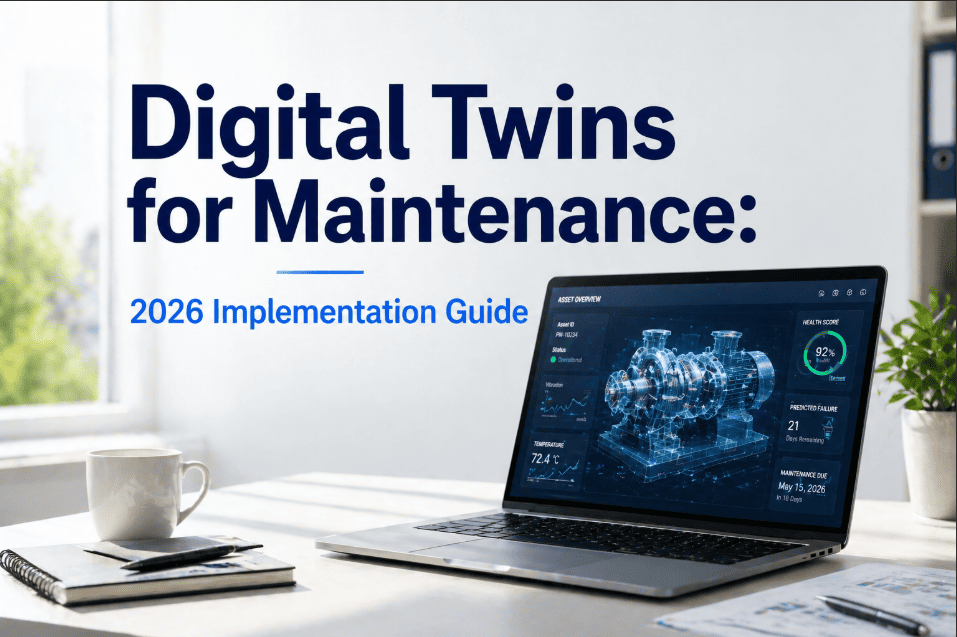
The digital twin ingests real-time sensor data and simulates failure progression. It calculates Remaining Useful Life (RUL), identifies the likely failure mode, and recommends the optimal intervention window.
3
CMMS Decision Engine — Plan Action
Risk ScoringScheduling
The CMMS evaluates the twin's prediction against production schedules, spare parts inventory, and crew availability. It auto-generates a work order timed to the optimal maintenance window—or dispatches a robot for verification first.
4
Robotic Execution — Verify & Repair
Drone InspectRobot Repair
An inspection drone or robot is dispatched to physically verify the condition. If confirmed, the robot performs accessible maintenance tasks (lubrication, tightening, cleaning) or confirms scope for the human crew.
5
Twin Update — Learn & Optimize
Model UpdateAI Learning
Post-intervention, the digital twin recalibrates its model with actual outcome data. Each cycle makes the prediction more accurate and the decision engine smarter—creating a continuously improving autonomous loop.
See the Autonomous Loop in Action
Watch how Oxmaint orchestrates digital twins, IoT sensors, and robotic systems into a single self-driving maintenance engine that predicts, decides, and acts.
Each technology pillar contributes a unique capability to autonomous maintenance. The digital twin provides foresight, IoT provides real-time awareness, and robotics provides physical agency. Alone, each is powerful. Connected through a CMMS, they become transformational—enabling maintenance decisions and actions that happen faster and more accurately than any human-driven process.
The Autonomous Maintenance Technology Stack
Oxmaint CMMS
Orchestration Layer
Decision engine, work order automation, scheduling, inventory, crew dispatch, ROI tracking
The CMMS serves as the central nervous system—receiving predictions from the twin, real-time data from IoT, and dispatching robots to verify and act.
Autonomous Maturity: Measuring the Journey
Moving from reactive maintenance to fully autonomous operations is a progressive journey. Each level builds on the previous one, adding new technology integrations and decision-making capabilities. Understanding where your organization sits—and what's required to reach the next level—is essential for roadmap planning and investment justification.
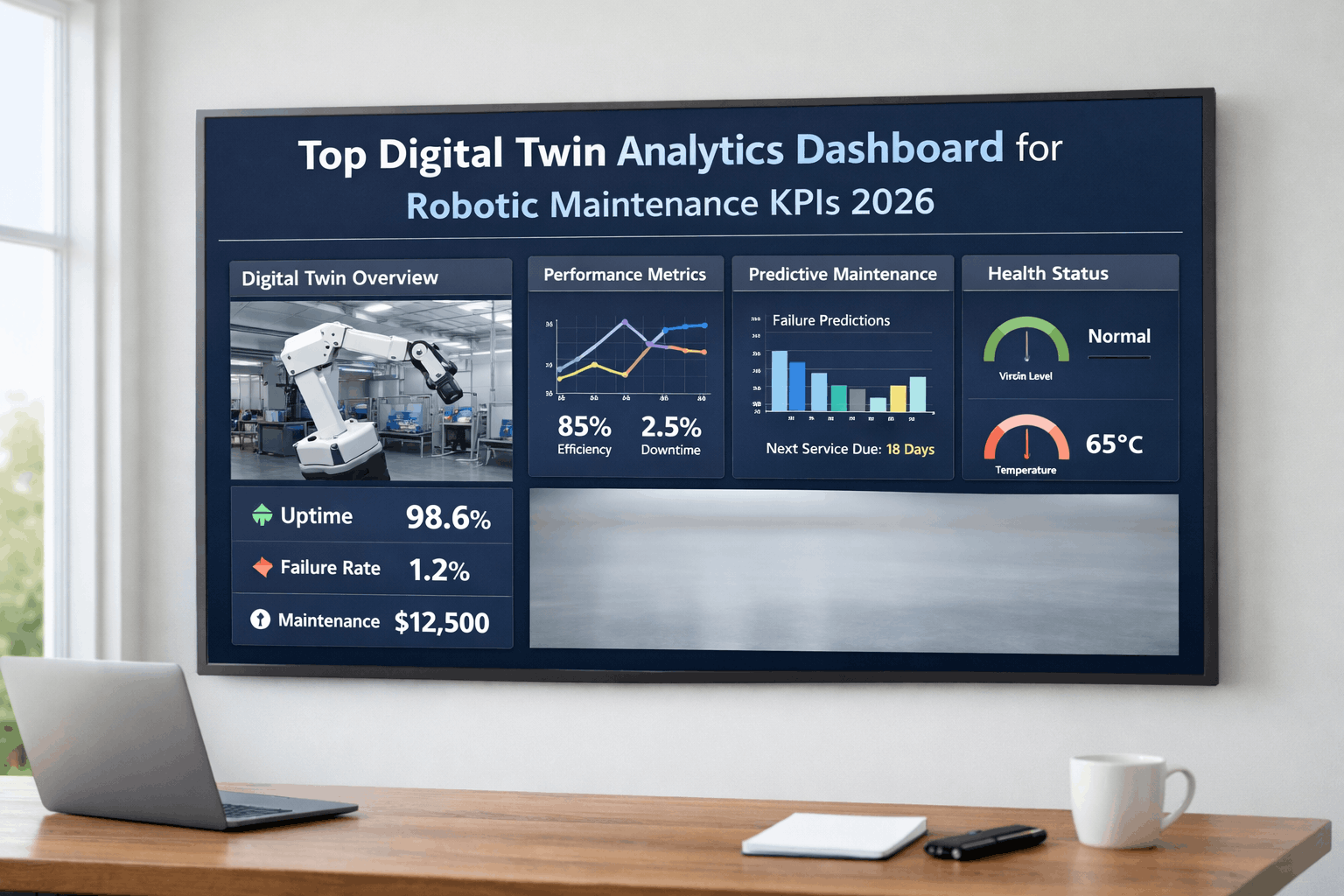
Autonomous Maintenance Maturity KPIs
Measuring convergence readiness across all three pillars
Prediction Accuracy
91%
Target: >90%
Digital twin RUL predictions validated against actual failures
Auto-Decision Rate
70%
Target: >80%
Work orders auto-generated without human approval needed
Robot Dispatch Ratio
55%
Target: >60%
Inspections performed by robots vs. humans
Loop Closure Time
<4hr
Target: <2 Hours
Time from anomaly detection to maintenance action initiated
Before & After: The Convergence Effect
The difference between operating three technologies separately versus operating them as an integrated autonomous system is dramatic. Organizations that achieve convergence don't just improve incrementally—they fundamentally transform the speed, accuracy, and economics of their maintenance operations.
Siloed Technologies vs. CMMS-Orchestrated Convergence
Anomaly-to-Action Time
14 Days
→
< 4 Hours
Prediction Accuracy
55-65%
→
88-93%
Human Decisions Required
100%
→
30%
Robot Utilization
35%
→
85%
Unplanned Downtime
High
→
78% Less
Twin Model Accuracy
Static
→
Self-Improving
Annual ROI
2-3x
→
8-12x
Unify Your Maintenance Stack
Join forward-thinking plants using Oxmaint to orchestrate digital twins, IoT sensors, and robotic systems into a single autonomous maintenance engine.
Each combination of technologies unlocks specific autonomous capabilities. This matrix maps which integrations are required for each level of autonomous maintenance, helping teams prioritize their convergence roadmap.
Autonomous Capability Integration Map
Autonomous Capability
Technologies Required
CMMS Role
Autonomy Level
Anomaly Detection
IoT Sensors → CMMS
Alert filtering, threshold management
Level 1 — Assisted
Failure Prediction
IoT + Digital Twin → CMMS
RUL-based work order scheduling
Level 2 — Predictive
Automated Inspection
IoT + Robotics → CMMS
Robot dispatch, finding integration
Level 3 — Semi-Autonomous
Predict-Verify-Act
Digital Twin + IoT + Robotics → CMMS
Full closed-loop orchestration
Level 4 — Autonomous
Self-Optimizing
All + Machine Learning → CMMS
Continuous model recalibration
Level 5 — Cognitive
Autonomous Repair
Robotics + Twin + CMMS
Repair scope generation, verification
Level 4 — Autonomous
Inventory Auto-Replenish
Twin (RUL) + CMMS + ERP
Predictive parts ordering
Level 3 — Semi-Autonomous
Fleet Self-Scheduling
All Three + Production Schedule
Dynamic maintenance calendar
Level 5 — Cognitive
Expert Perspective: The Convergence Imperative
"
We had $2 million in IoT sensors, a sophisticated digital twin for our turbine fleet, and four inspection drones. For two years, they operated as three separate science projects. The sensors fired thousands of alerts that nobody could prioritize. The twin was beautiful but disconnected from our work orders. The drones flew when someone remembered to schedule them. The day we connected everything through a single CMMS orchestration layer, the system came alive. Within six months, 70% of our maintenance decisions were being made autonomously—the twin predicted, the sensor confirmed, the CMMS scheduled, and the drone verified. Our unplanned downtime dropped 72%. The technology was always there; we just needed the connective tissue.
— VP of Reliability Engineering, Power Generation Company
72%
Downtime reduction
70%
Autonomous decisions
6 Mo
Time to value
$3.8M
Annual savings
The convergence of digital twins, IoT, and robotics isn't a future vision—it's happening now in forward-thinking organizations. The differentiator between successful and stalled programs is the orchestration layer. Without it, you own three expensive tools. With it, you own an autonomous maintenance system. Schedule a demo to build your convergence roadmap.
Build Your Autonomous Maintenance Engine
Oxmaint connects your digital twins, IoT sensors, and robotic systems into one orchestrated platform. Predict failures, automate decisions, and deploy robots—all from a single CMMS.
What exactly is "autonomous maintenance" and how does it differ from predictive maintenance?
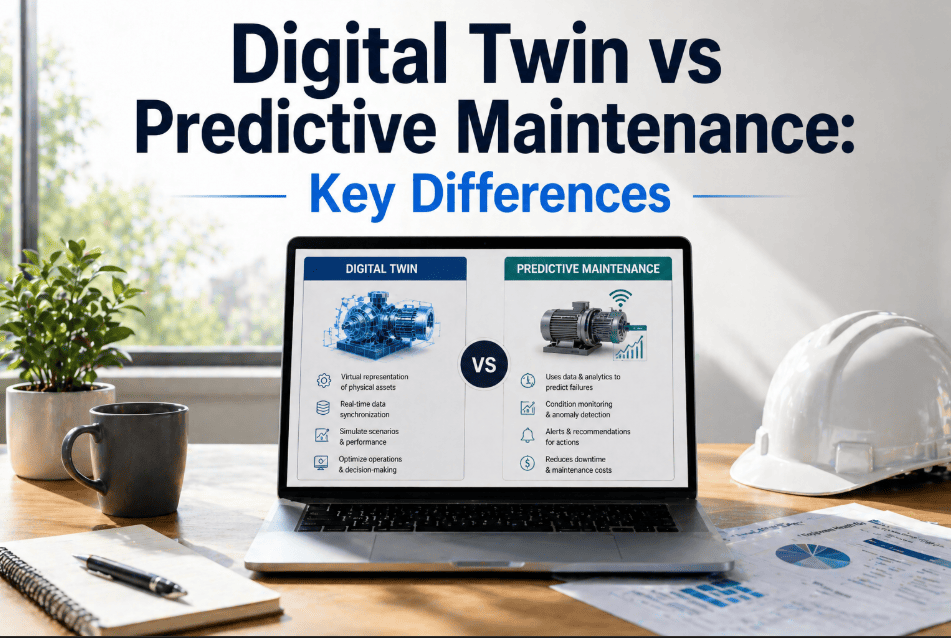
Predictive maintenance tells you when something will fail. Autonomous maintenance goes three steps further: it predicts the failure (digital twin), confirms the condition (IoT + robot verification), generates the work order, schedules it against production, checks parts availability, dispatches the right resource—and in some cases, the robot performs the repair—all without a human making a decision. The human role shifts from "deciding what to do" to "approving what the system has already planned" and handling complex repairs that exceed robotic capability.
Do we need all three technologies to get started, or can we phase them in?
Absolutely phase them in. Most organizations start with IoT sensors feeding a CMMS (Level 1-2). The second phase connects a digital twin for RUL predictions (Level 2-3). The third phase adds robotic inspection and execution (Level 3-4). Each phase delivers standalone ROI while building toward full convergence. The critical requirement at every phase is the CMMS as the orchestration backbone—without it, each technology remains a silo regardless of how many you deploy.
How does the digital twin know when its predictions are wrong?
This is where the closed loop is critical. Every time the CMMS generates a work order from a twin prediction—and that work order is completed—the actual finding (confirmed failure mode, actual wear measurement, actual remaining life) is fed back into the twin's model. If the twin predicted 30 days of remaining life but the actual was 45, the model recalibrates. Over hundreds of cycles, this feedback loop drives prediction accuracy from a typical starting point of 60-70% toward 90%+ within 12-18 months.
What types of robots are used in autonomous maintenance today?
Four primary categories: (1) Inspection drones—aerial UAVs for visual and thermal scanning of elevated or hazardous assets. (2) Crawling/climbing robots—magnetic or vacuum-adhesion units that traverse pipes, tanks, and structures for contact-based testing. (3) Autonomous mobile robots (AMRs)—ground-based units for facility 3D scanning and environmental monitoring. (4) Manipulator robots—robotic arms that perform physical maintenance tasks like lubrication, bolt tightening, valve operation, and simple component swaps. The CMMS dispatches the right robot type based on the work order requirements.
What ROI can we expect from full convergence versus siloed technologies?
Industry data shows siloed IoT or digital twin programs typically deliver 2-3x ROI. When the same technologies are connected through a CMMS orchestration layer, ROI jumps to 8-12x. The multiplier comes from three sources: (1) faster anomaly-to-action response eliminates the "detection-to-decision" gap that causes most residual failures, (2) robot verification eliminates false positive work orders that waste labor, and (3) the closed feedback loop continuously improves prediction accuracy, compounding savings every quarter. Most organizations see payback within 9-14 months of achieving Level 3+ convergence.