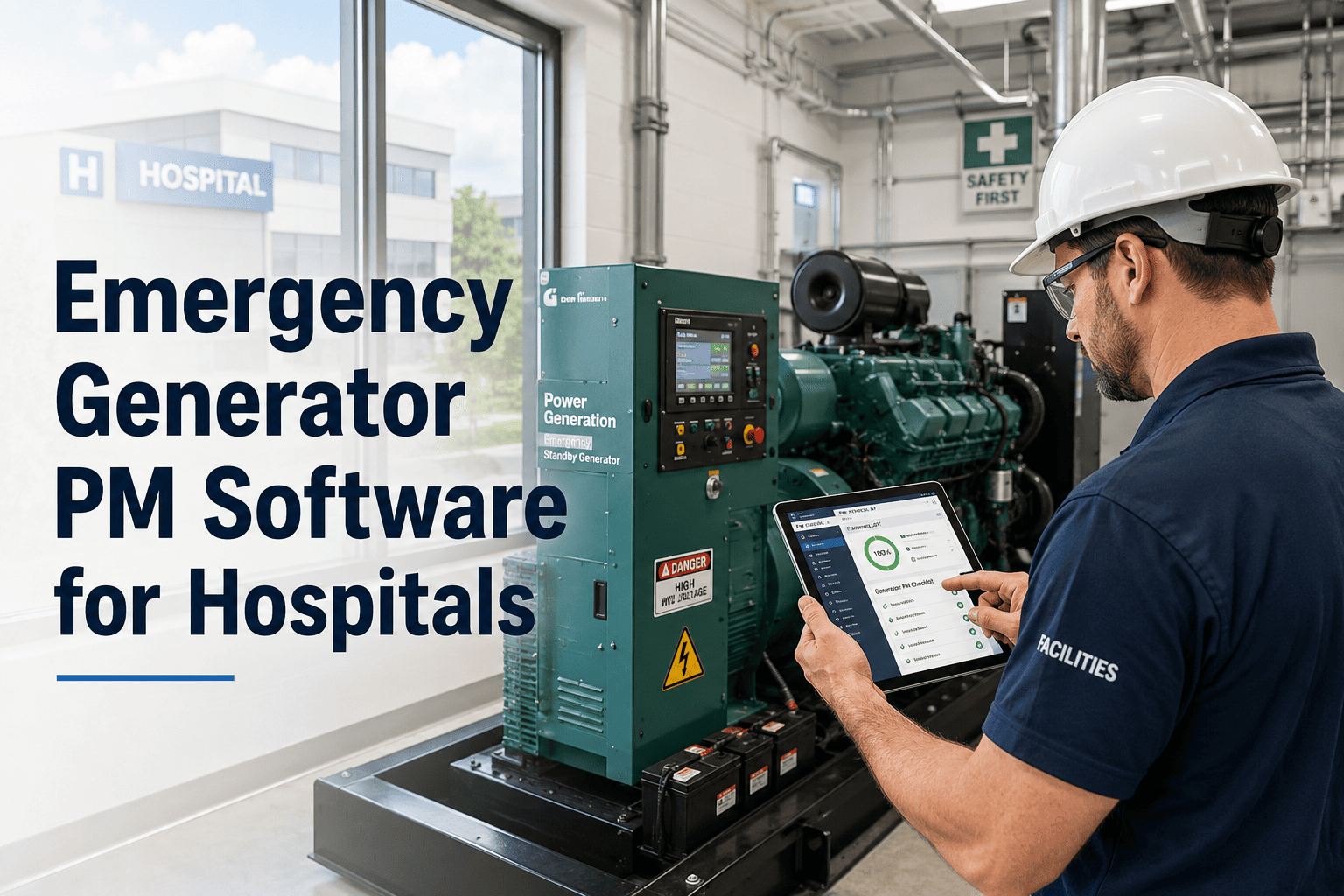
When the grid fails at a hospital, the automatic transfer switch has ten seconds to move ICU ventilators, surgical suites, and neonatal incubators onto generator power — there is no second attempt. Yet the most common cause of emergency power failure is rarely the generator itself; it is a missed monthly load test, a starting battery left past its service life, or a paper logbook that cannot prove the last inspection happened. Joint Commission and CMS surveyors know this, which is why EC.02.05.07 documentation is one of the first things reviewed during any unannounced survey. Facilities still tracking generator PMs on spreadsheets or wall calendars are the ones most likely to discover a gap only after a real outage. See how OxMaint structures emergency generator PM software for hospitals so every weekly check, monthly exercise, and annual load bank test happens on schedule, every time.
Ten Seconds Decide Whether Your Generator Saves a Life or Becomes an Incident Report
NFPA 110 gives Level 1 hospital power systems a 10-second window to transfer life safety loads. Emergency Generator PM Software for Hospitals turns that requirement into a tracked, auto-scheduled, audit-ready maintenance programme — instead of a binder nobody can find during a survey.
The Outage Doesn't Wait for Your Paperwork to Catch Up
Power failure inside a hospital is not a facilities inconvenience — it is a clinical event the moment it touches a ventilator, an OR table, or a neonatal unit. Reported cases of intraoperative power loss point to the same root causes again and again: a generator that failed to start, a delayed transfer, or a backup system nobody had verified recently. None of those failures begin as electrical problems. They begin as a missed maintenance interval that nobody flagged in time.
Generators tested only at low load build up unburned fuel deposits on pistons and injectors. The unit starts and runs fine every month — then can't deliver full rated output the one time a real outage demands it.
A starting battery can test marginally fine at room temperature in March and fail to crank the engine during a winter outage. Service life tracking by date, not guesswork, is what catches this before it becomes a failed start.
Contact oxidation inside an ATS doesn't trip an alarm. It just adds milliseconds to transfer time until one day the switch doesn't transfer at all within the 10-second mandate.
A test that was performed but not properly documented is, from a Joint Commission standpoint, indistinguishable from a test that never happened. Missing records are one of the most common EC.02.05.07 survey findings.
Stop Managing Life Safety Equipment With a Wall Calendar
OxMaint's Emergency Generator PM Software for Hospitals auto-triggers every weekly, monthly, annual, and 36-month interval at the asset level — so no test is ever late and no record is ever missing when an inspector asks for it.
What Hospital Facility Teams Actually Get From OxMaint
Weekly, monthly, annual, and 36-month PM templates ready to assign to every generator, ATS, and day tank in your facility — no manual schedule-building required before you can start tracking compliance.
Technicians record voltage, transfer time, and battery readings on a phone or tablet standing next to the unit — not from memory back at a desk an hour later. Required fields stop incomplete submissions before they happen.
A transfer time over 10 seconds or a failed battery reading doesn't sit in a notebook — it generates a corrective work order immediately, linked to the exact asset and the exact inspection that flagged it.
Every reading, every technician signature, every fuel certificate lives against the asset record. When a Joint Commission or CMS surveyor asks for twelve months of generator history, it's a export, not an afternoon of searching binders.
Before and After: Generator PM Without and With OxMaint
| Maintenance Activity | Spreadsheet or Paper Logs | OxMaint PM Software |
|---|---|---|
| Monthly load exercise tracking | Manually scheduled, easy to miss during staff turnover | Auto-triggers monthly, overdue alerts fire before due date |
| Battery service life | Tracked informally, often discovered only at failure | Installation date logged, replacement alert before 3–5 year limit |
| ATS transfer time records | Written in a logbook, hard to trend over time | Recorded per test, trended automatically against the 10-second mandate |
| Survey documentation request | Hours spent locating binders and signed forms | Compliance export generated in minutes from asset history |
| Deficiency follow-up | Verbal handoff, easy to lose track of open items | Auto-generated work order linked to the original finding |
Frequently Asked Questions
Your Next Grid Failure Will Test Whether Your PM Programme Actually Worked
Every interval your team tracks on paper is a chance for a gap nobody notices until the power goes out. OxMaint keeps every weekly check, monthly exercise, and annual test on schedule — and keeps the records ready before a surveyor ever has to ask.





.png)