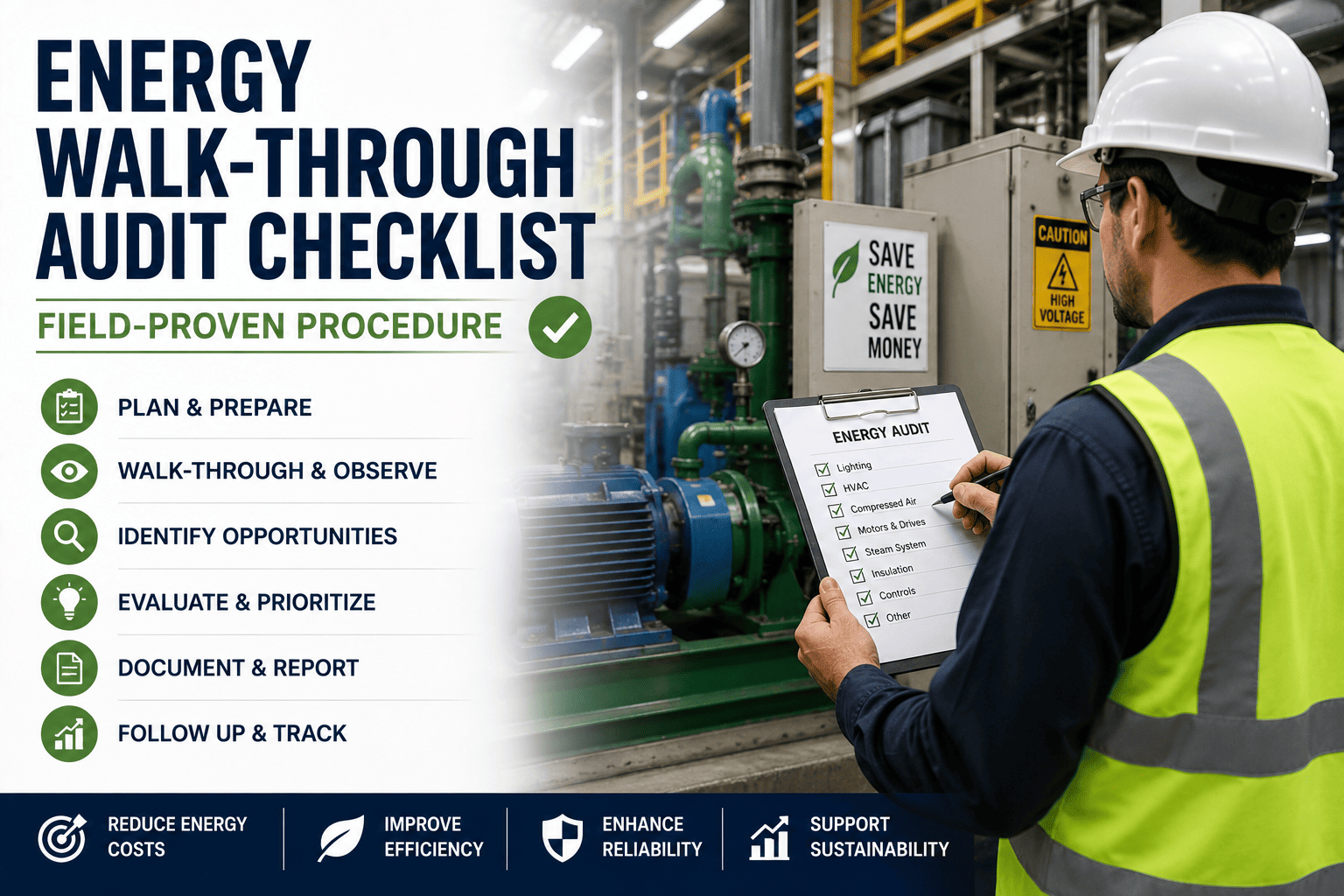
Most energy waste in a facility isn't hiding in some hard-to-reach system — it's sitting in plain sight, in a leak, a stuck damper, or a light that never gets turned off. The energy walk-through audit is how teams catch it before it turns into next quarter's utility bill. Here's the field-proven procedure that holds up when an auditor asks for the paper trail.
A Walk-Through Only Counts If It's Written Down
An auditor doesn't care how thorough the walk felt — they care whether each zone was checked, what was found, and whether flagged items were closed out. A finding that only exists in someone's memory doesn't exist at all on paper.
Five Zones Every Energy Walk-Through Must Cover
Run the same five zones in the same order every time so results are comparable audit to audit.
1
Lighting Systems
Fixtures left on in unoccupied areas, sensors not triggering, and burnt-out bulbs replaced with non-efficient stock.
2
HVAC & Air Handling
Stuck dampers, mismatched setpoints, and filters overdue for change that force units to work harder than they should.
3
Compressed Air & Steam
Audible leaks at joints and valves, logged with location so repairs can be prioritized by loss, not guesswork.
4
Motors & Drives
Motors running at full speed on variable loads, and equipment left energized outside operating hours.
5
Building Envelope
Open dock doors, damaged seals, and insulation gaps that let conditioned air escape unnoticed.
Score Every Finding On A Simple Scale
A three-tier scale keeps the walk-through fast and keeps findings comparable across teams and sites.
Pass
No action needed this cycle
Flag
Minor waste, scheduled for fix
Fail
Significant loss, urgent fix
The Corrective Action Workflow Auditors Expect
Finding Logged
Every flagged or failed item recorded on the spot with a photo and its zone.
Fix Assigned
A named owner and a deadline, tracked against the finding, not a general to-do list.
Closure Verified
A second check confirms the fix was made, not just marked complete from memory.
Oxmaint operationalizes exactly this checklist — mandatory safety checks built into high-risk work orders, digital permit workflows, inspection records linked directly to each asset, photo evidence, e-signatures, and an audit trail that satisfies regulators without a scramble before the next audit. Teams that sign up get every zone, finding, and closure in one defensible record — or book a demo to see the compliance workflow live.
Q
How often should an energy walk-through be done?
Most facilities run it monthly, with a lighter version weekly for high-waste zones like compressed air and HVAC. Consistency matters more than frequency — the same five zones, the same way, every time.
Q
What counts as a "Flag" versus a "Fail"?
A Flag is minor and scheduled waste, like a sensor slightly out of calibration. A Fail is significant ongoing loss — an audible steam leak or a motor running full-time on a variable load — that needs urgent attention.
Q
Who should be responsible for closing out findings?
A named owner per finding, not the walk-through team itself. Whoever completes the walk should hand off the fix, and a separate sign-off should confirm it was actually done.
Make Every Energy Walk-Through Count
Mandatory safety checks, digital permit workflows, photo evidence, e-signatures, and an audit trail linked to every asset and every zone. Sign up for a free trial to run your first walk-through, or book a demo to see the compliance workflow live.