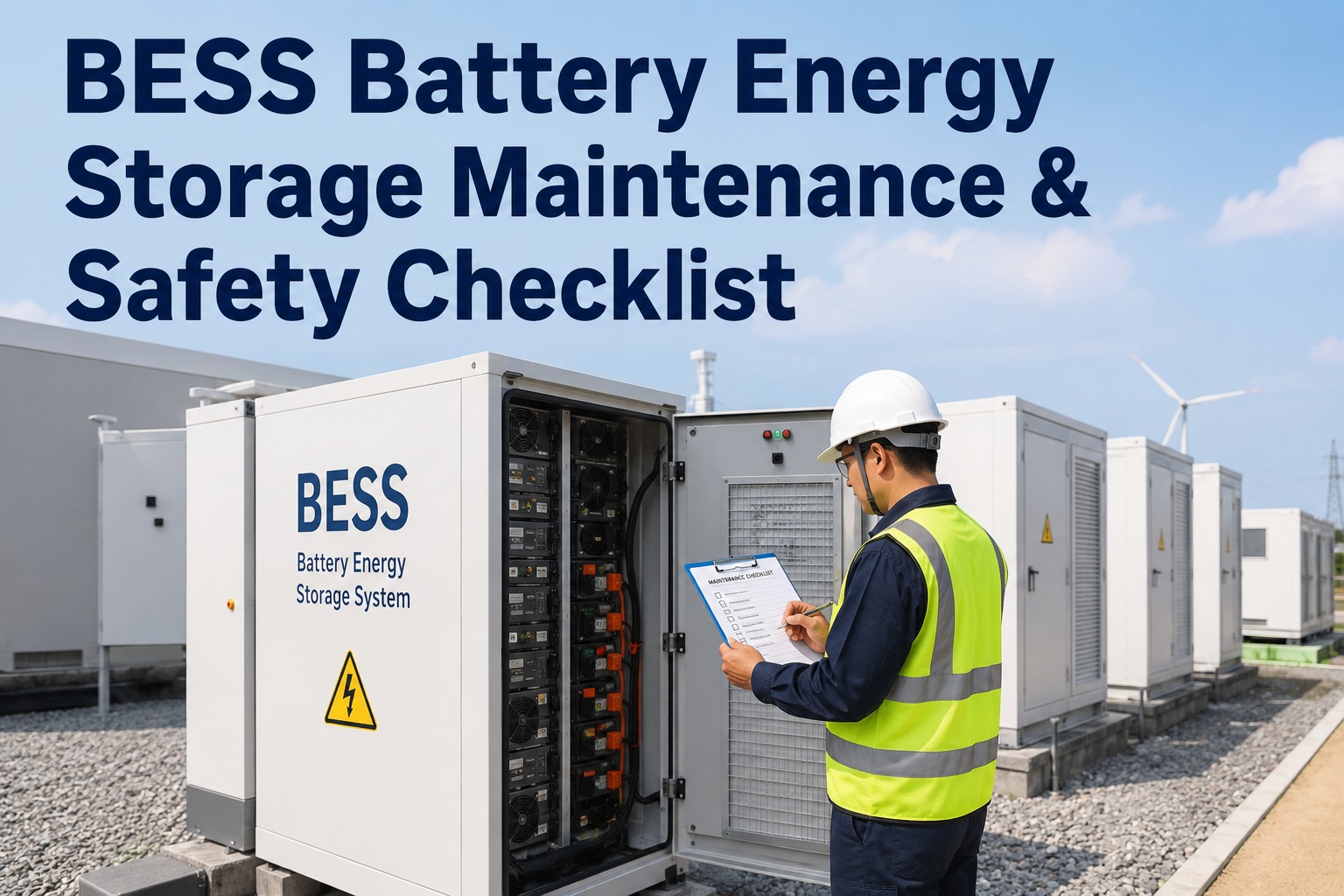
Grid-scale battery energy storage systems (BESS) are now the backbone of renewable integration, peak shaving, and grid resilience — yet a single neglected thermal sensor or untracked fire-suppression service date can cascade into a thermal runaway event costing millions. A defensible BESS maintenance program fuses electrical, thermal, and fire-safety compliance into one disciplined workflow, and OxMaint gives operators the CMMS backbone to run it. The checklist below translates the 2026 sector standards into practical, audit-ready PMs you can deploy today — Start Free Trial and assign your first BESS inspection round inside an hour.
Thermal. Electrical. Fire-safety. Three failure modes, one defensible maintenance program.
Battery energy storage maintenance is no longer "inspect and hope." Operators running grid-scale BESS in 2026 must document module-level health, thermal-management PM, and fire-safety compliance as a single, time-stamped workflow — or face uninsurable downtime and regulator scrutiny.
- Battery module inspection & SoH logging
- Thermal management PM (HVAC, coolant, sensors)
- Fire-safety compliance & suppression service
- CMMS-driven audit trail & PM scheduling
One discipline, three interlocking failure domains
A grid-scale BESS concentrates megawatt-hours of electrochemical energy in a single enclosure — so electrical, thermal, and fire-safety systems are not independent silos. A 2°C coolant drift degrades cell balance; unbalanced cells stress the BMS; a stressed BMS raises thermal-runaway probability. Industry incident data from 2019–2024 attributes roughly 70% of large-format battery fires to thermal-management or BMS gaps, not cell manufacturing defects. The checklist below treats the system as one.
Module-level inspection: catch degradation before the BMS does
The BMS reports aggregate pack health — it will not flag a single weak module until it has already pulled neighbours down with it. Tier 1 closes that gap with monthly-to-quarterly electrical and cell-level checks.
State of Health (SoH) logging
Record per-module SoH, capacity (Ah), and internal resistance (mΩ) each quarter. Flag any module whose SoH drifts more than 3% below the pack median for replacement scheduling.
Cell voltage & balance check
Verify inter-cell voltage spread stays under 50 mV for LFP and 30 mV for NMC chemistries. Document cell-balancing events; persistent imbalance signals a pending module failure.
Connection torque & thermal imaging
Re-torque busbar and DC-terminal connections to spec annually. Run a thermal scan under load; any junction 15°C above ambient is a loose-connection red flag.
Insulation resistance & grounding
Perform a 1 kV insulation resistance test on the DC array each six months. Confirm >1 MΩ to ground and verify the BESS ground bond is intact at the container's single-point ground.
BMS firmware & alarm log review
Pull the BMS alarm log monthly; verify firmware is patched to the latest OEM release. An unpatched BMS is a documented gap in every major 2023–2024 insurer audit.
DC contactor & fuse inspection
Cycle main DC contactors under no-load and inspect arc erosion annually. Pull-test fuses for tight seating; verify fuse curves still match the revised short-circuit study.
Keep the delta-T under 3°C or watch capacity collapse by year eight
Thermal runaway begins as thermal drift. A 5°C sustained intra-pack temperature gradient can accelerate LFP capacity fade by up to 15% over the warranty window — translating to a 0.7-year revenue shortfall on a 4-hour, 100 MWh system. Tier 2 keeps the gradient tight.
HVAC & liquid-cooling service
Replace or clean HVAC filters quarterly; verify coil airflow and refrigerant charge. For liquid-cooled packs, inspect coolant pH (8.0–10.5), conductivity, and inhibitor level every 90 days.
Temperature sensor calibration
Cross-check 10% of pack thermistors against a reference probe annually. A 2°C biased sensor can mask a real hot-spot — replace any sensor reading outside ±1°C of reference.
Coolant loop leak & pressure test
Pressure-test coolant loops at 1.5× operating pressure semi-annually. Inspect quick-disconnects, manifold seals, and expansion tank levels; log every joint with a photo in the CMMS.
Intra-pack gradient audit
During a 1C discharge cycle, log the max temperature spread across all modules. If the gradient exceeds 3°C, schedule a coolant-flow balancing and HVAC capacity review within 14 days.
Defensible fire-safety PM — the line between an incident and a catastrophe
Fire codes for stationary batteries tightened materially after 2022 (NFPA 855 ESS 2023 edition, IFC 1207, and local AHJ overlays). Compliance is not "install once" — it is a recurring service schedule with documented proof. Each missed date becomes a finding in the next insurer or AHJ audit.
| Fire-safety PM task | Frequency | Standard / code | Documentation required |
|---|---|---|---|
| Gas detection (CO, H₂, electrolyte off-gas) functional test | Quarterly | NFPA 855 §4.6, UL 2075 | Sensor serial, test gas, pass/fail, technician sign-off |
| Aerosol / clean-agent suppression weight & pressure check | Semi-annual | NFPA 2010, NFPA 2001 | Cylinder ID, weight vs. nameplate, agent type |
| Deflagration vent inspection | Annual + post-event | NFPA 68, container OEM spec | Vent condition photo, seal integrity, replacement date |
| Container water-mist / sprinkler valve trip test | Annual | NFPA 15 / NFPA 13 | Flow test report, valve tag number, inspector |
| Emergency shutdown / E-stop functional drill | Semi-annual | NFPA 855 §4.7, site EOP | Drill log, response time, corrective actions |
| Hazardous-materials / electrolyte spill kit audit | Quarterly | IFC 1207, EPA SPCC if applicable | Inventory list, expiry dates, restock log |
| AHJ annual BESS site walk & compliance binder | Annual | NFPA 855 §4.1, IFC 1207 | Complete PM history, test reports, OEM certs |
A 100 MWh operator: from paper binder to defensible CMMS in 90 days
Untracked service dates, 11 uninsurable gaps
A four-site, 100 MWh operator ran BESS PM on shared spreadsheets and a paper binder. During a 2025 insurer audit they could not produce 11 of 38 required gas-detection test records and three suppression-cylinder weight checks were 4 months overdue. Result: a 90-day non-renewal notice and $180K in emergency third-party retest fees.
Auto-scheduled PMs, audit-ready in one click
After deploying OxMaint, every Tier 1–3 task was scheduled against the asset registry with photo capture, technician sign-off, and a code-reference field. On the next audit the compliance binder exported in 12 minutes. Premium renewal held flat and the operator recovered 0.6-year capacity warranty value from improved SoH trending.
What OxMaint locks down that spreadsheets cannot
A spreadsheet records what happened. A purpose-built CMMS forces what must happen next — and proves it did. Below are the four capabilities BESS operators most frequently cite as the difference between a pass and a finding.
Asset registry down to the module serial
Each rack, module, and sensor is a unique asset with OEM specs, install date, warranty end, and full PM history — so an auditor can trace any single thermistor back to its last calibration in seconds, not hours.
Code-linked PM templates
Every PM task carries a code reference (NFPA 855 §, IFC 1207, OEM bulletin). When a code updates, you update the template once and every affected asset inherits the new frequency and checklist instantly.
Photo & sign-off capture in the field
Technicians complete checklists on mobile with mandatory photo evidence for torque, thermal scans, and vent inspections. No photo, no close — the audit trail is built at the source, not reconstructed later.
Overdue & risk-escalation automation
Overdue fire-safety PMs auto-escalate to the site manager at 7 days and to the operations director at 14. The system cannot "forget" — which is exactly what insurers and AHJs want to see in your procedures.
Turn a 90-day non-renewal risk into a 12-minute compliance export.
Schedule your BESS asset registry, code-linked PMs, and fire-safety compliance tracking in OxMaint — and walk into your next audit with a defensible, time-stamped trail.
BESS maintenance & safety — the five questions operators ask most
How often should I inspect a grid-scale BESS?
A defensible cadence runs monthly BMS alarm-log reviews, quarterly Tier 1 electrical and gas-detection checks, semi-annual coolant and suppression service, and an annual full AHJ-aligned site walk. High-cycling systems (1+ cycle/day) should compress Tier 1 to monthly. OxMaint auto-schedules each frequency against the asset registry so nothing slips — you can Start Free Trial and import your full PM calendar in one session.
What temperature gradient is acceptable inside a battery pack?
Industry best practice keeps the intra-pack temperature spread under 3°C during a 1C discharge. Gradients above 5°C accelerate capacity fade meaningfully and are a leading early indicator of coolant-flow imbalance or HVAC degradation. Any reading above 3°C should trigger a balancing review within 14 days.
Which fire codes govern stationary BESS in 2026?
The primary frameworks are NFPA 855 (Standard for Stationary Energy Storage Systems, 2023 edition), IFC 1207, and local AHJ overlays. UL 9540 / 9540A apply at the unit level. Compliance is recurring, not one-time — gas detection, suppression, deflagration vents, and E-stop drills all require documented service on fixed cycles.
Can OxMaint track compliance for multiple BESS sites?
Yes. OxMaint supports a multi-site asset registry with per-location PM calendars, role-based access, and a single compliance export. Site managers see their site; operations directors see all sites with overdue and risk-escalation flags. Book a walkthrough at calendly.com/oxmaintapp/30min to see a multi-site BESS configuration.
What happens if a fire-safety PM is overdue during an audit?
An overdue fire-safety PM is treated as a finding by virtually every insurer and AHJ. Consequences range from a corrective-action letter (30–90 days to cure) to non-renewal of coverage or a shutdown order. OxMaint's escalation engine flags overdue fire-safety tasks at 7 and 14 days precisely to prevent this scenario.
One checklist. Three failure domains. Zero uninsurable gaps.
Build your BESS asset registry, schedule Tier 1–3 PMs, and walk into your next audit with a defensible trail. OxMaint makes it happen inside a single afternoon.
Free 14-day trial · No credit card