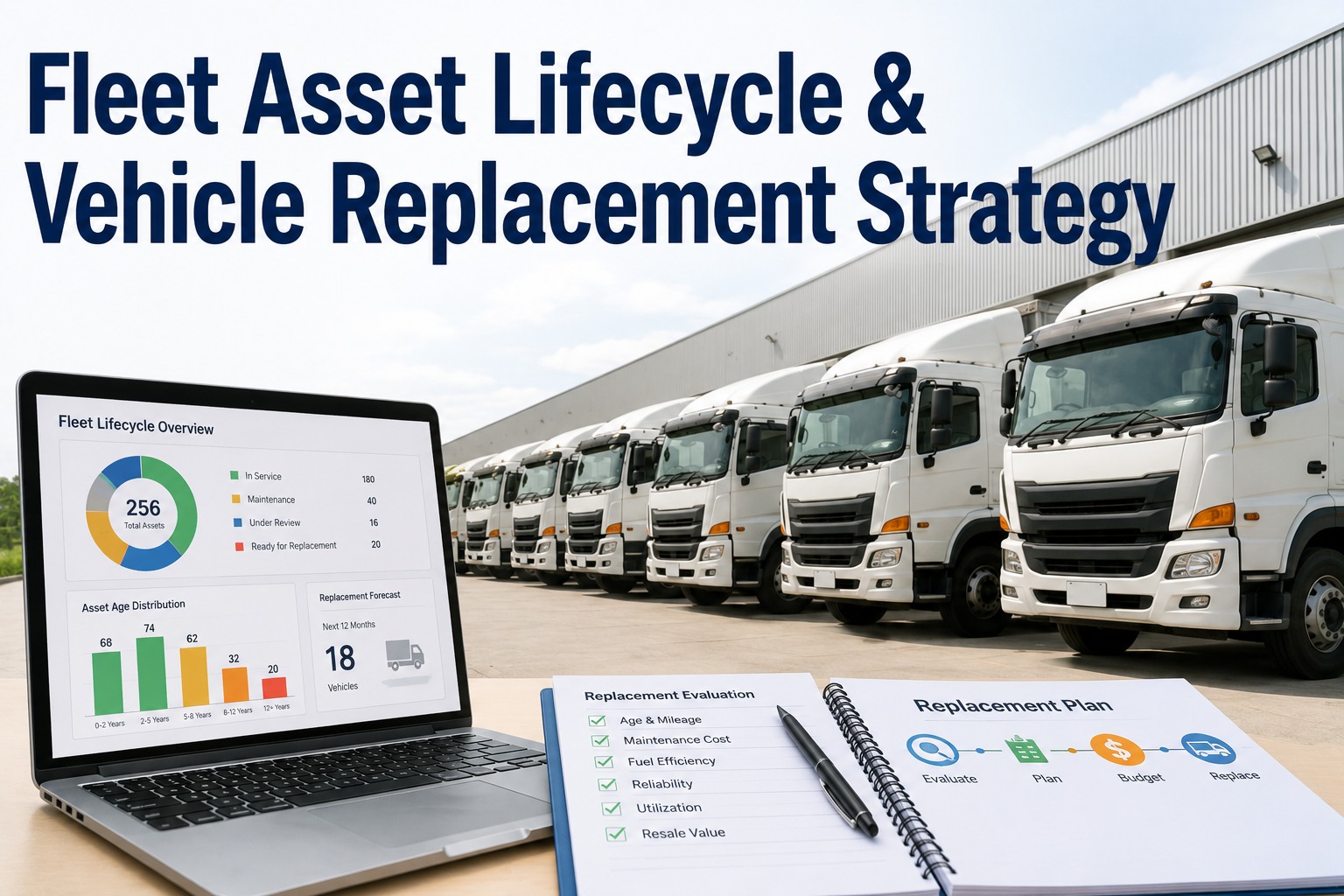
Fleet asset lifecycle management is the disciplined practice of tracking each vehicle from acquisition through disposal, and a data-driven vehicle replacement strategy tells you exactly when repairing an aging asset stops making economic sense. Most fleets that rely on age-based replacement intervals or gut-feel decisions either retire vehicles too early — burning capital that could have served another route — or hold them too long, letting rising downtime and parts costs erode margins. By applying a fleet lifecycle cost model that aggregates total cost of ownership (TCO), downtime events, and condition data, maintenance leaders can pinpoint the optimal replacement point for every asset class. OxMaint brings that lifecycle economics engine into a single AI-powered CMMS, turning scattered work-order history into defensible replacement decisions — you can Start Free Trial today or book a walkthrough to see it on your own fleet data.
Replace every fleet vehicle at its economically optimal lifecycle moment — not a mile too soon, not a repair too late.
Replace gut-feel with a lifecycle-cost model that flags each asset's optimal replacement trigger, defends your capital request with TCO data, and keeps your fleet availability above 95%.
Why fleet vehicle replacement timing drains — or protects — your capital budget
Fleet managers lose an average of $4,200 per vehicle annually by holding assets past their optimal replacement cycle — a cost hidden in rising downtime, parts escalation, and lost revenue hours.
Rising repair cost per mile
Once a vehicle passes its economic inflection point — typically 60–70% of useful life — repair spend climbs 18–30% annually. A single transmission replacement at $4,800 can exceed the asset's residual book value.
Downtime revenue loss
A vehicle in the shop generates zero revenue. A truck averaging $1,200/day in revenue that sits 12 extra days per year past its replacement window costs the operation $14,400 — often more than a new unit's annual depreciation.
Residual value collapse
Holding a Class 6 truck from year 6 to year 8 can drop its auction value from $28,000 to $15,500 — a $12,500 capital loss — while that same period adds only $3,100 in depreciation savings. The math rarely works.
Compliance & safety risk
Aging assets accumulate DOT violations and roadside failures. CSA scores above the alert threshold trigger audits, and a single preventable OOS violation costs $1,200–$3,500 in fines plus reputational damage.
The fleet lifecycle cost model: repair vs replace, quantified
A defensible replacement decision compares cumulative TCO against projected future cost. When the marginal cost of keeping the asset one more year exceeds the average annual cost of a replacement unit, it is time to cycle it out.
MFC = next-year projected repairs + projected downtime cost + depreciation loss + residual value decline. When MFC exceeds AALC, replace the asset that cycle.
Track this metric annually for every asset. The year-over-year inflection — where TCO/mile jumps more than 15% — is your early-warning replacement signal.
A 220-vehicle delivery fleet spending $1.8M annually on maintenance
OxMaint ingested 3 years of work-order data and found 34 vehicles past their MFC trigger — collectively costing $312K/year in excess repairs and downtime.
The fleet manager exported a prioritized replacement schedule ranked by marginal cost overrun, staged across 3 quarterly capital cycles to smooth cash flow.
After cycling 22 of the 34 flagged assets, maintenance spend dropped $186K, fleet availability rose from 91% to 96.5%, and average cost per mile fell from $0.24 to $0.19.
How to build a fleet replacement planning cycle that defends itself
A replacement cycle is only credible when it is built on real TCO data, reviewed on a set cadence, and tied to capital approval workflows. Here is the 5-stage cycle OxMaint automates.
Data consolidation
Pull acquisition cost, accumulated maintenance spend, fuel data, downtime hours, and odometer into one asset record. OxMaint auto-aggregates this from work orders, fuel cards, and telematics integrations — no spreadsheet reconciliation needed.
TCO normalization
Calculate cost per mile and cost per hour for every asset, normalized by duty cycle so a heavy-haul tractor is not benchmarked against a local delivery van. Class-of-vehicle benchmarking prevents skewed comparisons.
Trigger identification
Set multi-factor replacement triggers: age threshold, mileage threshold, MFC-exceeds-AALC, downtime-day threshold, or condition-score threshold. OxMaint flags any asset that crosses two or more triggers simultaneously.
Capital request packaging
Generate a one-page replacement justification per asset: 3-year cost trend, projected next-year cost, residual value estimate, and recommended replacement spec. This is the document your CFO needs to approve the check.
Disposal & replacement execution
Schedule the disposal auction, transfer the spare-parts inventory associated with the retiring asset, and onboard the replacement unit into the PM schedule — all within the same workflow so nothing falls through the cracks.
Repair vs replace: the fleet manager's decision matrix
When a major repair estimate lands on your desk, use this matrix to decide in under 60 seconds whether to authorize the repair or initiate replacement.
| Decision Factor | Repair if… | Replace if… |
|---|---|---|
| Repair cost vs residual value | Repair estimate is under 40% of current residual value | Repair estimate exceeds 50% of residual value |
| Asset age vs replacement cycle | Asset is in first 60% of planned lifecycle | Asset is in final 25% of planned lifecycle |
| Downtime frequency trend | Fewer than 3 OOS events in last 12 months | 4+ OOS events or 15+ unscheduled shop days in last 12 months |
| TCO per mile trajectory | TCO/mile is flat or rising under 8% YoY | TCO/mile has risen 15%+ in the last year |
| Parts availability & lead time | Parts are in stock or available under 48 hours | Parts are discontinued or require 2+ week lead times |
| Compliance & safety posture | Asset passes inspection with minor corrections | Repeated CSA violations or structural integrity concerns |
OxMaint turns lifecycle data into replacement decisions you can defend
OxMaint is an AI-powered CMMS and EAM platform that automates the data collection, TCO modeling, and trigger monitoring your fleet replacement strategy depends on — so every capital decision is backed by work-order evidence, not guesswork.
AI-powered TCO & lifecycle cost engine
OxMaint automatically aggregates acquisition cost, maintenance spend, downtime, and fuel data into a live TCO-per-mile score for every asset. When marginal future cost crosses your AALC threshold, the system flags the asset for replacement review — no manual spreadsheet hunting.
Predictive failure & condition scoring
OxMaint's predictive maintenance models analyze work-order history, inspection results, and telematics feeds to assign each vehicle a real-time condition score. Degrading trends fire early warnings weeks before a breakdown — giving you time to plan replacement rather than react to a roadside failure.
Replacement trigger automation
Set multi-factor triggers — age, mileage, MFC threshold, downtime days, condition score — and OxMaint monitors every asset continuously. When an asset crosses two or more triggers, it auto-generates a capital request package with full cost-justification documentation.
Spare-parts & disposal lifecycle tracking
When a vehicle is marked for disposal, OxMaint automatically identifies associated spare-parts inventory, flags it for transfer or liquidation, and onboards the replacement unit into the correct PM schedule — closing the lifecycle loop without manual reconciliation.
See your fleet's replacement triggers on a live dashboard
Book a 30-minute demo and we will load your fleet data into OxMaint to show you exactly which vehicles are past their optimal replacement point — before they cost you another quarter.
Fleet asset lifecycle & vehicle replacement strategy: top questions
What is fleet asset lifecycle management?
Fleet asset lifecycle management is the end-to-end process of tracking a vehicle from acquisition through operation, maintenance, and disposal — using TCO data and condition metrics to determine the optimal replacement point. It replaces age-based or mileage-only rules with economics-driven decisions that minimize total cost per mile. OxMaint automates this by aggregating work-order, fuel, and downtime data into a live lifecycle score for every asset. You can see it on your own data when you Start Free Trial.
When should I replace a fleet vehicle instead of repairing it?
Replace a vehicle when its marginal future cost — projected next-year repairs plus downtime plus residual decline — exceeds the average annual lifecycle cost of a replacement unit. Practically, if a single repair estimate tops 50% of the asset's residual value, or TCO per mile has risen 15%+ year-over-year, replacement is almost always the better economic call. OxMaint's lifecycle engine flags both conditions automatically.
How is fleet lifecycle cost calculated?
Fleet lifecycle cost equals acquisition cost plus all maintenance, fuel, and downtime costs accumulated over the asset's life, minus its residual value at disposal — divided by total miles or hours operated. The resulting cost-per-mile figure is the single most defensible metric for replacement decisions. OxMaint calculates this continuously from live work-order and telematics data, so you always have a current number.
What are the best replacement triggers for a fleet?
The strongest replacement triggers are multi-factor: a combination of age, mileage, TCO-per-mile trend, downtime-day count, and condition score. An asset that crosses two or more thresholds simultaneously is a high-confidence replacement candidate. OxMaint lets you configure custom trigger sets per vehicle class and auto-generates capital requests when thresholds are breached. Book a demo to see trigger configuration on your fleet mix.
How does a CMMS improve fleet replacement planning?
A CMMS improves replacement planning by capturing every maintenance event, cost, and downtime hour in a structured asset record — creating the historical data foundation that TCO models and replacement triggers depend on. Without a CMMS, fleet managers reconcile spreadsheets and estimate costs; with OxMaint, the data is already aggregated, normalized, and scored in real time, turning replacement planning from an annual guess into a continuous, defensible process.
Stop guessing. Start replacing at the right moment.
Every quarter you hold an asset past its optimal replacement point, the cost compounds. OxMaint shows you exactly when to cycle each vehicle — backed by data your CFO will approve.
Free 14-day trial · No credit card required