A fleet preventive maintenance schedule keeps every vehicle in service longer, safer, and cheaper — but the right interval depends entirely on vehicle class. Light-duty pickups, medium-duty box trucks, Class 8 tractors, and off-road equipment face radically different duty cycles, stress loads, and regulatory expectations, so a one-size-fits-all vehicle maintenance schedule almost guarantees PM drift, missed DOT inspections, and unplanned breakdowns. This guide gives you a class-by-class fleet PM schedule template you can adopt today — with mileage and time-based intervals, compliance checkpoints, and the CMMS structure that keeps a mixed fleet disciplined. Ready to stop chasing spreadsheets? Start Free Trial and let OxMaint automate every trigger.
Fleet PM Schedule Template
One missed PM on a Class 8 tractor can cost $4,200+ in roadside repair, tow, and late-delivery penalties. What's your drift costing you?
Fleets running class-specific preventive maintenance schedules see 25–40% fewer unplanned breakdowns and 15% lower lifetime repair costs. OxMaint keeps every vehicle class on its exact interval — automatically.
Why Class Matters
Fleet preventive maintenance intervals must match the duty cycle
A light-duty van doing 18,000 urban miles per year wears completely differently than a Class 8 day-cab pulling 80,000 lb GCW on interstate routes. Treating them the same is the #1 reason fleet maintenance plans fail.
Manufacturers publish minimum PM intervals, but smart fleet managers build buffer into those numbers based on telemetry, route severity, and load factors. A truck running mountain grades in winter needs shorter brake, fluid, and drivetrain intervals than the same spec running flat Midwest highways in spring. The fleet preventive maintenance program that wins is the one that bakes in both the OEM baseline and the real-world duty cycle — then triggers work orders automatically before the next threshold is crossed.
Class-by-Class Template
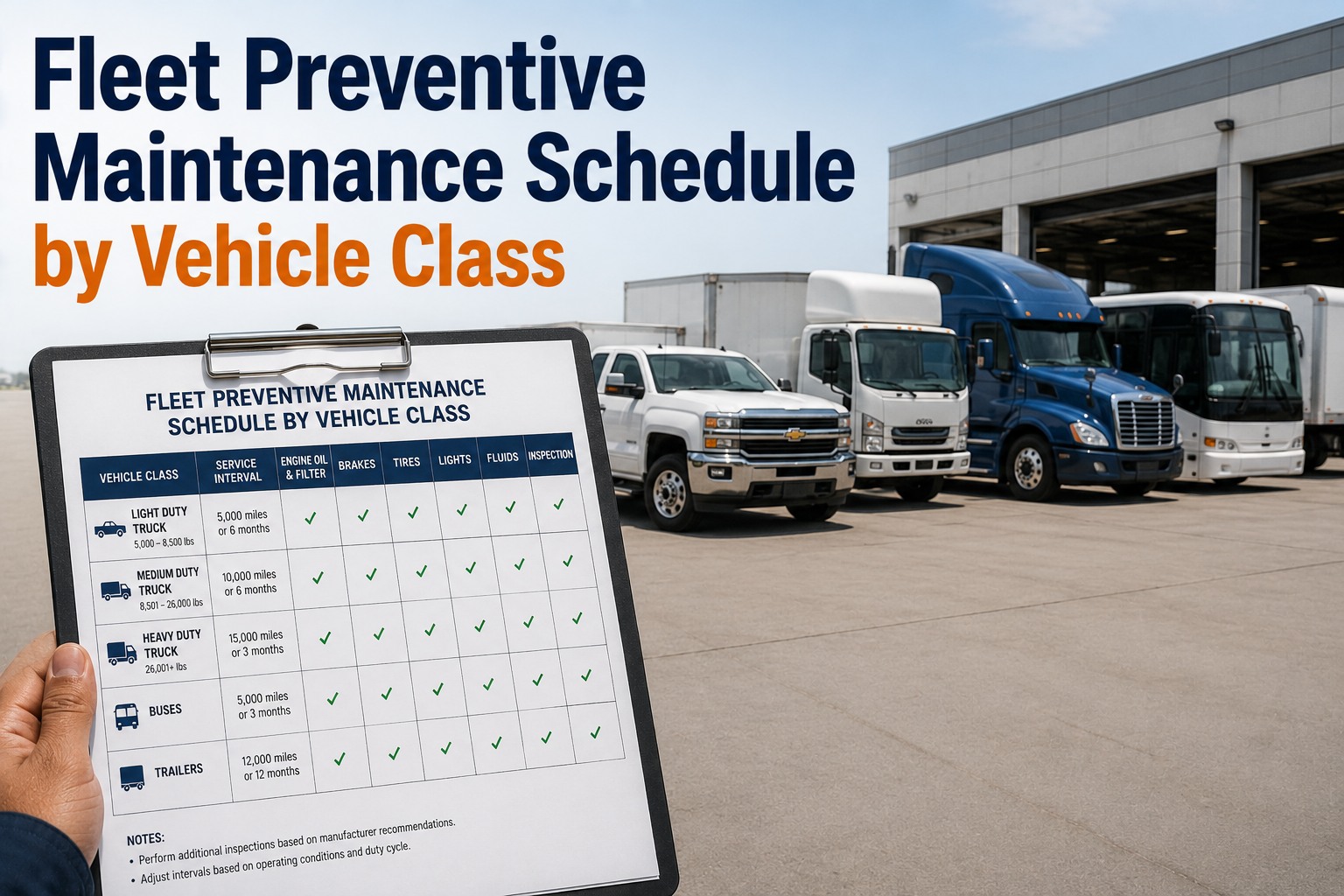
Fleet PM schedule template by vehicle class
Use these baseline intervals as your starting fleet PM template. Adjust tighter for severe-duty cycles. OxMaint lets you clone these into class-specific PM libraries and auto-trigger work orders on mileage, engine hours, or calendar days.
Light-Duty (Pickups, Vans, SUVs)
- Engine oil & filter change
- Tire rotation & pressure check
- Brake pad & rotor inspection
- All fluid levels top-off
- Wiper blades & lighting check
- Cabin & engine air filter
- Transmission fluid inspection
- Coolant system pressure test
- Suspension & steering components
- OBD-II diagnostic scan & DTC clear
Medium-Duty (Box Trucks, Delivery, Utility)
- Engine oil, filters, fuel/water separator
- Brake adjustment & slack adjuster check
- Tire tread depth & inflation (all positions)
- Chassis lubrication (all zerk fittings)
- Battery & charging system load test
- Transmission fluid & filter service
- Axle & differential fluid change
- Air system governor & dryer service
- Exhaust & DPF inspection
- Hydraulic system check (if equipped)
Heavy-Duty (Tractors, Straight Trucks)
- Full DOT pre-trip / post-trip defect review
- Engine oil, coolant, DEF level & DPF status
- Brake chamber stroke & push-rod travel
- 5th wheel & coupling component inspection
- Air compressor build-up time test
- Wheel bearings & seal inspection
- Clutch adjustment & free-play check
- Driveline & U-joint inspection
- Suspension air bags & ride-height valve
- Annual DOT inspection (Form MCS-63)
Off-Road & Heavy Equipment
- Engine oil & all filter changes
- Track / tire & undercarriage inspection
- Hydraulic fluid level & condition
- Grease all pins, bushings & pivot points
- Air filter restriction indicator check
- Hydraulic filter & full fluid change
- Final drive & planetary oil change
- Coolant & DCA test (SCA levels)
- Battery, alternator & starter inspection
- Full chassis & structural weld inspection
Worked Example
What a 120-vehicle mixed fleet saves with disciplined PM
Consider a regional logistics operator running 60 light-duty vans, 35 medium-duty box trucks, 20 Class 8 day-cabs, and 5 off-road yard switchers. Before implementing a structured fleet preventive maintenance program, they tracked PM on a shared spreadsheet.
That $37,800 in avoided roadside cost alone covers the OxMaint platform for the entire fleet several times over — before counting the recovered revenue hours, lower driver overtime, and reduced CSA score exposure. The ROI of a disciplined fleet service schedule is not theoretical; it shows up in the P&L within the first quarter.
How OxMaint Helps
How OxMaint keeps every vehicle class on schedule
OxMaint replaces spreadsheets, whiteboards, and tribal knowledge with an AI-powered CMMS built for mixed-fleet operations. Here is exactly what changes when you switch.
Mileage & time-based auto-triggers
OxMaint monitors odometer feeds, telematics integrations, engine hours, and calendar days — then generates a work order the moment a vehicle crosses its next PM threshold. No manual checks, no missed intervals, no PM drift across classes.
Class-specific PM libraries
Build a PM checklist template for each vehicle class — light, medium, heavy, off-road — and clone it across every asset in that group. Techs see the exact tasks, parts, and torque specs for the vehicle on the bay, not a generic list.
DOT compliance & audit readiness
Every PM, inspection, and repair is logged with timestamp, technician ID, parts consumed, and digital signature. Annual DOT inspections, driver DVIRs, and Form MCS-63 records are searchable in one dashboard — audit-ready in seconds, not days.
Predictive maintenance analytics
OxMaint's AI analyzes PM history, fault codes, and wear patterns to flag vehicles trending toward failure before the next scheduled service. Move from time-based PM to condition-based PM — fixing what will break, not just what the calendar says.
Quick Reference
Commercial vehicle maintenance intervals at a glance
Print this, pin it in the shop, or import it directly into OxMaint as your baseline fleet maintenance checklist. Every row is a trigger — OxMaint turns it into an automatic work order.
| Vehicle Class | A-Service Interval | B-Service Interval | Annual / DOT | Key Focus Areas |
|---|---|---|---|---|
| Class 1–2 Light-duty | 5,000 mi / 6 mo | 15,000 mi / 12 mo | 12 mo | Oil, tires, brakes, fluids, filters |
| Class 3–6 Medium-duty | 10,000 mi / 6 mo | 25,000 mi / 12 mo | 12 mo | Brake adjust, air system, DPF, chassis lube |
| Class 7–8 Heavy-duty | 15,000 mi / 30 days | 50,000 mi / 6 mo | 12 mo (MCS-63) | 5th wheel, air compressor, clutch, bearings |
| Off-Road Equipment | 250 hrs / 3 mo | 1,000 hrs / 12 mo | 12 mo | Hydraulics, undercarriage, final drive, pins |
Stop PM Drift Today
See OxMaint on your fleet — book a 30-minute demo
We'll load your vehicle classes, build your PM library, and show you exactly how automatic triggers eliminate missed services and roadside surprises.
FAQ
Fleet preventive maintenance schedule — common questions
How often should fleet preventive maintenance be performed?
PM frequency depends on vehicle class and duty cycle. Light-duty vehicles typically need A-service every 5,000 miles or 6 months; medium-duty every 10,000 miles; Class 8 trucks every 15,000 miles or 30 days; and off-road equipment every 250 engine hours. Severe-duty operations — extreme temperatures, stop-and-go, heavy loads — should tighten these by 20–30%. OxMaint lets you set class-specific triggers so the right interval fires automatically for every asset.
What is included in a fleet PM checklist?
A standard fleet maintenance checklist covers oil and filter change, fluid level inspection, tire condition and pressure, brake inspection and adjustment, lighting and electrical check, steering and suspension components, and chassis lubrication. B-services add transmission service, air system maintenance, exhaust/DPF inspection, and diagnostic scans. Heavy-duty PMs also include DOT pre-trip defect review and 5th wheel coupling inspection. You can import these directly as templates — Start Free Trial and clone a class-specific library in minutes.
What is the difference between A-service and B-service for fleet trucks?
A-service is the shorter, more frequent preventive visit — oil, filters, fluids, tires, brakes, and basic safety checks. B-service is the deeper, less frequent service that adds transmission fluid, axle and differential oil, air system components, and (for heavy-duty) annual DOT inspection requirements. Running both on a staggered cadence (e.g., A at 15K, B at 50K for Class 8) keeps major components healthy without over-servicing the vehicle.
How do I create a fleet preventive maintenance program from scratch?
Start by inventorying every vehicle by class, mileage, and duty cycle. Pull OEM-recommended intervals for each, then adjust for your operating conditions. Build A- and B-service checklists for each class, assign trigger thresholds (mileage, hours, or days), and set up a system to auto-generate work orders when those thresholds approach. Finally, track completion rate and roadside events monthly to tighten intervals where failures cluster. OxMaint automates this entire workflow — book a demo at calendly.com/oxmaintapp/30min and we'll build your first PM library live.
Can a CMMS reduce DOT violations and roadside breakdowns?
Yes — dramatically. A CMMS like OxMaint eliminates the missed-PM problem that causes roughly 80% of preventable roadside breakdowns. Automatic triggers ensure no annual DOT inspection or quarterly service slips past its due date. Digital DVIR integration, timestamped repair logs, and a compliance dashboard mean you can produce audit-ready records in seconds. Fleets typically see roadside events drop 30–50% within the first two quarters after implementation.
Get Started
Your fleet preventive maintenance schedule — automated, compliant, and audit-ready
Join the maintenance teams using OxMaint to cut unplanned breakdowns 30–50%, eliminate paper work orders, and keep every vehicle class on its exact PM interval.
Free 14-day trial · No credit card