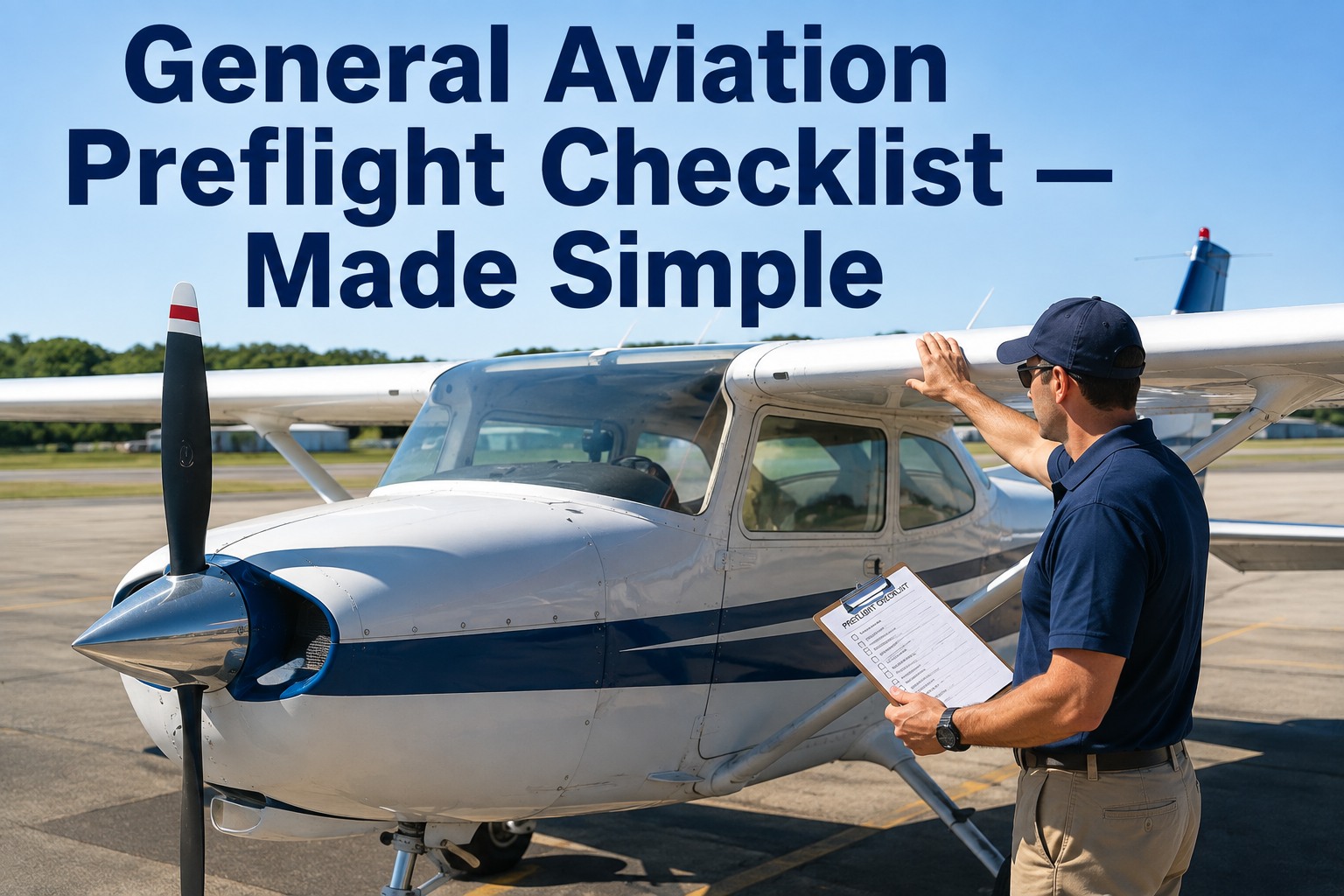
A general aviation preflight checklist is the structured, point-by-point inspection procedure that pilots, technicians and fleet operators run before every flight to verify that each asset is airworthy, compliant and safe to dispatch. Whether you manage a single FBO or a multi-site charter fleet, doing this checklist from memory or a photocopied paper form is how missed steps become missed failures — and missed failures become unplanned downtime, FAA write-ups or worse. This guide lays out a complete general aviation preflight checklist SOP you can standardise across your team today, then shows how OxMaint turns that checklist into an automated, photo-verified, audit-ready preventive maintenance program. You can Start Free Trial to deploy it on your fleet immediately, or book a demo and we'll map it to your POH in 30 minutes.
GENERAL AVIATION PREFLIGHT CHECKLIST
One missed step is one aircraft grounded — standardise every preflight before it costs you.
Replace clipboard forms and tribal memory with a FAA POH-compliant preflight checklist that your whole team executes the same way — every aircraft, every taxi-out, every time — with mandatory photo proof, e-signatures and a full digital audit trail.
PREFLIGHT INSPECTION BREAKDOWN
Complete General Aviation Preflight Checklist — Every Point Your Team Should Touch
A defensible preflight SOP covers six zones, 40+ checkpoints and clear pass/defect thresholds. Below is the standardised general aviation preflight checklist example your technicians and pilots can execute on every aircraft visit.
Cabin & Cockpit
- Required documents on board: ARROW (Airworthiness, Registration, Radio Station, Operating Handbook, Weight & Balance)
- Control column full travel — free movement, no binding or excessive play
- Pitot heat operational; static port clear and unobstructed
- Magnetos OFF; master switch ON; fuel quantity gauges cross-checked against dipstick
- Avionics boot-up: GPS acquisition, transponder reply, ADS-B Out signal confirm
- ELT armed and within battery expiration date
Empennage & Fuselage
- Skin panels — no wrinkles, oil canning, loose or missing rivets
- Static port and angle-of-attack sensor — visibly clear, no insect nests or debris
- Antennas secure and upright; base seals intact
- Horizontal and vertical stabilisers — no play at hinges, no corrosion at attach points
- Trim tab continuity verified from cockpit to surface
- Baggage door latched; contents secured within CG envelope
Powerplant & Propeller
- Oil level within POH minimum (typically 6 qt minimum for most Lycoming/Continental IO-360/IO-540)
- Cowling and fasteners — all secure, no cracks around baffles
- Alternator belt tension — 1/4 inch deflection at midpoint, no fraying
- Exhaust stacks and muffler — no soot trails, no loose clamps, no visible cracks
- Propeller — no nicks deeper than 0.015 in, no oil seepage at hub
- Induction air filter — clean, no blockage, alternate air door seats properly
Landing Gear & Tires
- Tire pressure within POH range (typically 38–55 PSI depending on aircraft class)
- Tire tread — minimum 2/32 in visible across full width; no chord exposure
- Brake pads — minimum 3/16 in friction material; no hydraulic seepage at caliper
- Oleo strut — 2–3 inches visible chrome, no hydraulic film on barrel
- Wheel fairings secure; no foreign object debris in wheel well
- Tie-down rings intact; chocks stowed and secured
Fuel System
- Sump all drains (wing, fuselage, gascolator) — first cup checked for water or particulates
- Fuel color correct for grade: 100LL is blue, Jet-A is straw; no cross-contamination
- Fuel caps secure with positive click; chain or lanyard intact
- Fuel quantity visually confirmed — never dispatch below POH minimums
- Fuel selector valve moves freely through all detents; no stiffness
- Fuel strainer bowl — clean, no sediment, drain valve closes fully
Wings, Controls & Lights
- Leading edge — no leading-edge damage, no ice or frost accumulation
- Aileron and flap hinges — no play, no bird-nest debris, stops intact
- Pitot tube cover removed; tube clear and aligned
- Navigation lights, strobe, beacon and landing light — all operational
- Wing tie-down points — secure, no corrosion in threads
- Fuel vents on both wings — clear and unobstructed
SCANNABLE REFERENCE
General Aviation Preflight Checklist Example — Thresholds & Replacement Criteria
Every checkpoint needs a clear pass/fail threshold so your team isn't making judgment calls on the ramp. Use this table as the backbone of your general aviation preflight checklist SOP — then enforce it inside OxMaint with mandatory fields.
| Checkpoint | Inspection Point | Pass / Service Threshold | Defect Action |
|---|---|---|---|
| Engine Oil | Dipstick level on cold engine | ≥ 6 qt (Lycoming IO-360) | Service before dispatch; log work order |
| Tire Pressure | calibrated gauge on cold tire | 38–55 PSI per POH | Inflate; flag for leak check if recurring |
| Brake Pad Wear | Visual at caliper | ≥ 3/16 in friction material | Ground aircraft; generate corrective WO |
| Propeller Nick | Fingernail catch test | ≤ 0.015 in depth | Refer to prop shop; do not dispatch |
| Oleo Strut | Visual chrome exposure | 2–3 in visible | Service nitrogen; log maintenance event |
| Fuel Sump | Cup sample at every drain | Clear, correct color, zero water | Continue sumping until clear; log |
| ELT Battery | Label expiration date | ≥ 1 month remaining | Schedule replacement before expiry |
| ADS-B Out | Transponder reply test | Positive reply, no error code | Ground for avionics diagnostics |
THE COST OF PAPER
Why Clipboard Preflight Checklists Cost More Than You Think
Consider a 15-aircraft charter operator running 4 flights per aircraft per week. That is 60 preflight inspections weekly — over 3,100 annually. If even 2% of those inspections have a missed or undocumented step, you accumulate 62 untracked risk events per year, any of which could surface during an FAA ramp check or after an incident. Paper forms give you no visibility into completion rates, no timestamp verification, and no way to trend recurring defects across a fleet. OxMaint eliminates that risk by making every preflight a digital work order with mandatory fields, photo capture and automatic timestamping — so nothing is missed, and nothing is lost.
FROM CHECKLIST TO PROGRAM
How OxMaint Turns This Preflight Checklist Into a Measurable PM Program
OxMaint's AI-powered CMMS takes this static checklist and operationalises it — auto-generating preflight and post-flight work orders on the right interval, enforcing completion with mandatory fields, and building a full asset history that proves FAA POH compliance in any audit.
Auto-Generated PM Work Orders
OxMaint reads your POH intervals — hours, cycles, calendar days — and auto-generates the exact preflight, post-trip and preventive maintenance work order on schedule. No whiteboard, no missed 100-hour inspections, no spreadsheet drift.
Cuts missed scheduled inspections to near-zero and frees maintenance schedulers 6–8 hours per week.
Mobile Capture with Photo Proof
Technicians and pilots execute the full checklist on the OxMaint mobile app. Mandatory fields block submission until every checkpoint is verified. Attach photos of tire tread, oil level or skin damage — time-stamped, geotagged, and stored against the asset record forever.
Eliminates clipboard forms and gives you a court-defensible audit trail in every inspection.
E-Signature & FAA Audit Trail
Every completed preflight is locked with the technician's or pilot's e-signature, timestamp and location. When the FAA walks in for a ramp check or a POH audit, you export the full history for any tail number in one click — no filing cabinet, no panic.
Cuts audit prep time from days to minutes and eliminates paper-storage compliance gaps.
Defect Trending & Predictive Alerts
When the same tire pressure defect or oil consumption pattern recurs on the same tail number, OxMaint's AI flags it as a trend — not an isolated finding — and recommends a corrective PM before it becomes an AOG event. Your reliability team gets the data to act proactively.
Reduces unplanned groundings 30–50% by catching repeat defects before they escalate.
See OxMaint run your preflight checklist on your fleet — book a 30-minute demo.
We'll load your POH intervals, build the work-order templates and show you the mobile app capturing a real inspection in real time.
FREQUENTLY ASKED QUESTIONS
General Aviation Preflight Checklist — Frequently Asked Questions
What should be on a general aviation preflight checklist?
A complete general aviation preflight checklist covers six inspection zones: cabin and cockpit, empennage and fuselage, powerplant and propeller, landing gear and tires, fuel system, and wings, controls and lights. Each zone contains 5–8 specific checkpoints with clear pass/fail thresholds based on the aircraft's Pilot Operating Handbook. OxMaint ships with a standardised template you can tailor to any tail number's POH in minutes — Start Free Trial to deploy it today.
Is a printable general aviation preflight checklist enough for compliance?
A printable PDF is a useful reference, but it provides no audit trail, no timestamp verification and no way to prove that every checkpoint was actually inspected. FAA POH compliance requires demonstrable, repeatable execution — which means digital capture with e-signatures, photo proof and an asset-level history. Paper forms fail this standard the moment an inspector asks for six months of records on a specific aircraft.
How often should a preflight inspection be completed?
A preflight inspection must be completed before the first flight of the day for each aircraft, and again before any subsequent flight if the aircraft has been unattended or refueled by someone other than the departing pilot. OxMaint's PM scheduler auto-generates these work orders on the correct interval — daily, per-cycle or per-flight — so no inspection is ever missed or backfilled.
How do I create a general aviation preflight checklist SOP for my fleet?
Start with the six-zone structure in this guide, map each checkpoint to your specific aircraft POH, define clear pass/fail thresholds for every item, and then enforce it with mandatory digital fields. OxMaint lets you build this SOP once as a work-order template, assign it to every aircraft in your fleet, and automatically generate the inspection on schedule — standardising execution whether you manage one tail number or fifty. Book a demo and we'll map it with you.
Can OxMaint track preflight defects and auto-generate corrective work orders?
Yes. When a technician or pilot flags a defect during a preflight — low oil, worn brake pad, cracked cowling — OxMaint instantly generates a corrective work order linked to the asset, assigns it to the right technician, checks spare-parts inventory for availability, and tracks it through completion. The original preflight record, photos and e-signature stay attached, giving you a full chain of custody from defect discovery to repair sign-off.
DEPLOY ON YOUR FLEET TODAY
Stop Inspecting on Paper. Start Proving Compliance Digitally.
Load your POH intervals, build your preflight templates and capture your first digital inspection in under an hour. Your FAA audit trail starts the moment you log in.
Free 14-day trial · No credit card required