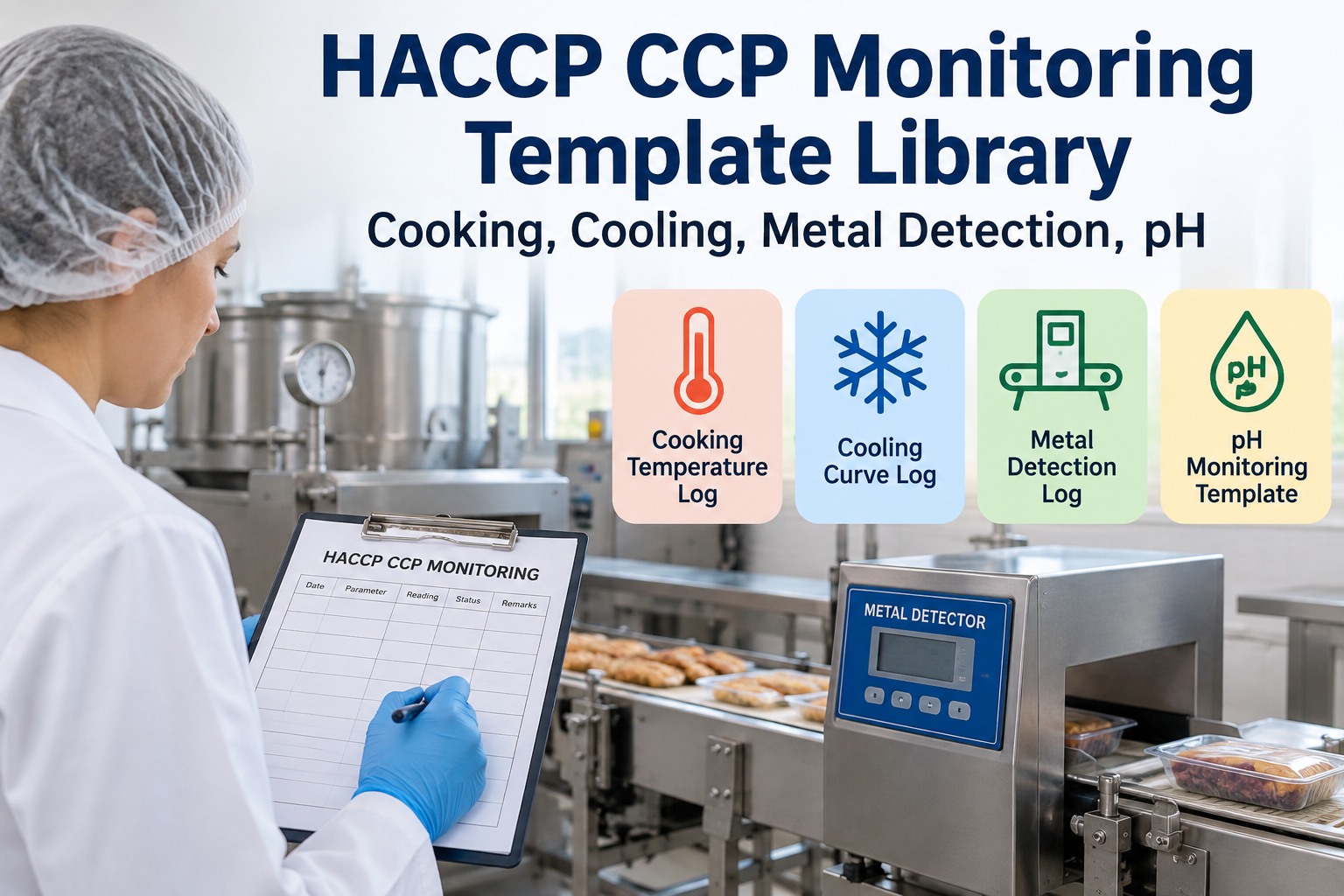
A HACCP plan is only as strong as the record behind each Critical Control Point and in an audit, a missing cooling log or an illegible pH reading is the difference between a pass and a corrective-action notice. Most food plants still run these checks on photocopied paper forms that get coffee-stained, back-filled at shift end, or lost before the auditor arrives. This template library gives you a ready structure for the six CCPs that matter most — cooking temperature, the cooling curve, metal detection, pH, water activity, and allergen change-over — each with its critical limit, monitoring frequency, and corrective action mapped out. Below you'll find what every template must capture, and how OxMaint turns these paper logs into digital records that timestamp themselves, flag a deviation the moment it's entered, and stay audit-ready by default. Book a demo to see your CCP logs go digital.
Six CCP Templates · One Monitoring System
Every critical control point needs a limit, a check, and a corrective action — captured the same way, every shift.
What Every CCP Template Must Capture
A monitoring template isn't just a place to write a number — it's the legal record that a control was in place and working. Auditors look for the same five fields on every CCP, regardless of which hazard it controls. If any one is blank, the record can't prove the control held.
1
The critical limit
The exact measurable boundary — a temperature, a pH value, a sphere size — that separates safe from unsafe.
2
The monitored value
The actual reading taken, with the instrument used and its calibration status noted alongside.
3
Time & who checked
A timestamp that can't be back-filled and the identity of the person who performed the check.
4
The corrective action
What was done when a reading breached the limit — product held, reprocessed, or discarded.
5
Verification sign-off
A supervisor's review confirming the record is complete and the corrective action closed the gap.
The CCP Template Library
Each card below is a working template for one CCP — the hazard it controls, a representative critical limit, how often it's monitored, and the corrective action when a reading falls outside the limit. Use them as the backbone of your plan; your validated limits come from your own process authority.
CCP 1Cooking Temperature
HazardSurvival of pathogens (Salmonella, E. coli, Listeria)
Critical limitInternal temp reaches validated target (e.g. 74°C / 165°F for poultry) held for the required time
FrequencyEvery batch / cook cycle
Corrective actionContinue cooking to target; hold and evaluate product if limit not met
CCP 2Cooling Curve
HazardToxin formation & spore outgrowth in the danger zone
Critical limitTwo-stage: 60→21°C (135→70°F) within 2 hrs, then to 5°C (41°F) within 4 more — 6 hrs total
FrequencyEach cooling lot, logged at each stage checkpoint
Corrective actionDiscard if a stage window is missed; investigate cause
CCP 3Metal Detection
HazardPhysical contamination — metal fragments
Critical limitDetector rejects test spheres (Fe, non-Fe, stainless) at validated sensitivity; reject mechanism confirmed
FrequencyStart-up, then at set intervals + end of run
Corrective actionQuarantine product back to last good check; re-test detector
CCP 4pH Control
HazardC. botulinum growth in acidified / low-acid foods
Critical limitFinished pH ≤ 4.6 (often ≤ 4.2 with a safety margin) for shelf-stable acidified foods
FrequencyEach batch, with calibrated meter
Corrective actionRe-acidify to target or hold batch for disposition
CCP 5Water Activity (aw)
HazardMicrobial growth in dried / intermediate-moisture foods
Critical limitaw ≤ 0.85 to prevent pathogen growth (product-specific targets apply)
FrequencyEach production lot
Corrective actionExtend drying or hold lot for evaluation
CCP 6Allergen Change-over
HazardCross-contact between allergen and non-allergen runs
Critical limitCleaning verified — visual pass + ATP / allergen swab below threshold before next run
FrequencyEvery product / allergen change-over
Corrective actionRe-clean and re-swab; do not start run until pass
Turn These Templates Into Live Digital Logs
Bring your HACCP plan to a 30-minute working session. We'll load your CCPs into OxMaint, set the critical limits, and show deviation alerts firing in real time — so your next audit runs on searchable digital records, not a binder of paper.
Why Paper CCP Logs Fail the Audit
The problem with a paper template isn't the template — it's that paper can't enforce the discipline the record depends on. A digital CCP log closes every gap that turns a good plan into a failed audit. Sign up free and digitize your first CCP log to see the difference.
Paper Templates
Readings back-filled at shift end from memory
Deviations spotted days later — if at all
Illegible entries and missing initials
Calibration status not linked to the reading
Auditor waits while you dig through binders
OxMaint Digital Logs
Timestamped at the moment of entry
Deviation alert fires instantly on a breach
Mandatory fields — no blank or unsigned records
Instrument & calibration captured with each check
Full CCP history pulled up in seconds
How OxMaint Runs Your CCP Monitoring
OxMaint takes the six templates above and makes them living records — every check scheduled, timestamped, and tied to the asset and person behind it. A deviation doesn't wait for a shift-end review; it fires a corrective work order the moment the out-of-limit value is entered. Book a demo to map your HACCP plan into OxMaint.
Schedule
Every Check on a Cadence
Each CCP monitors on its own frequency — every batch, every change-over — with reminders so no check is missed.
Capture
Mobile, Timestamped Entry
Technicians log readings on the floor with mandatory fields — no blank cells, no back-filling, calibration noted inline.
Alert
Instant Deviation Trigger
An out-of-limit reading auto-opens a corrective work order and notifies the supervisor before the next batch moves.
Prove
Corrective Action Closed
Every deviation carries its corrective action and sign-off — the closed-loop record an auditor expects to see.
Verify
Supervisor Review Trail
Verification sign-offs are logged against each record, building the review history HACCP verification requires.
Retrieve
Audit-Ready in Seconds
Filter any CCP by date, line, or operator and export the full monitoring history for the auditor on demand.
Stop Chasing Paper Before Every Audit
Move your cooking, cooling, metal detection, pH, water activity, and allergen CCPs onto one system that timestamps, alerts, and stays audit-ready. Free forever plan available — no card required.
Frequently Asked Questions
What is a CCP monitoring template?
It's the structured record for one Critical Control Point — capturing the critical limit, the monitored value, the time and person who checked, any corrective action, and a verification sign-off. It's the evidence that the control was in place and working at the moment of production.
Start free to build yours digitally.
Which CCPs does this library cover?
Six of the most common: cooking temperature, the two-stage cooling curve, metal detection, pH control, water activity, and allergen change-over. Your validated critical limits should always come from your own HACCP process authority — the templates give you the structure, not a substitute for validation.
Are these critical limits universal?
No — the values shown are representative examples drawn from common food-safety practice. Your actual limits depend on your product, process, and regulatory framework, and must be validated by a qualified process authority before use.
Why move CCP logs from paper to digital?
Paper can't enforce timestamps, mandatory fields, or instant deviation alerts. Digital logs timestamp at entry, block incomplete records, fire a corrective work order on a breach, and let you retrieve full CCP history in seconds during an audit.
Book a demo to see it live.
Does OxMaint handle HACCP monitoring for food plants?
Yes. OxMaint schedules each CCP check, captures timestamped mobile entries with mandatory fields, auto-triggers a corrective work order on any deviation, logs verification sign-offs, and exports audit-ready CCP history on demand. A free forever plan is available to trial the full workflow.