Best CMMS for Food & Beverage Plants 2026: HACCP, FSMA & Sanitary Maintenance
Your sanitation team just signed off on a Clean-in-Place (CIP) cycle for a 5,000-gallon mixing vat. But the temperature sensor was out of calibration by four degrees, and the caustic wash didn't reach the required threshold. You didn't know. The paper log got smudged, and nobody cross-checked the sensor data. Now, your facility is liable for a contamination event that could trigger a massive recall and severe FDA penalties. Under the Food Safety Modernization Act (FSMA) and HACCP guidelines, equipment maintenance and sanitation are not suggestions—they are strictly enforced federal requirements. Every critical control point (CCP), sanitary PM, and allergen changeover must be validated, documented, and instantly available for audit. Yet, many food and beverage plants still manage this with clipboard checklists, fragmented spreadsheets, or binders that haven't been audited in months. When you're managing complex processing lines, manual tracking isn't just inefficient—it's a massive food safety liability hiding in plain sight.
1 in 3
Food and beverage product recalls are directly linked to equipment maintenance or sanitation failures
$10M+
Average direct cost of a significant food recall, not including long-term brand damage and lost sales
Zero
Tolerance in FDA/FSMA enforcement — there is no grace period for missing HACCP preventive control documentation
Not every asset in a food plant requires the same level of scrutiny, but critical equipment requires flawless execution. FSMA and HACCP define strict categories of preventive maintenance, emphasizing sanitary design, allergen control, and traceable validation. Treating a food-contact pasteurizer the same as a warehouse forklift is a compliance violation waiting to happen. Facilities that sign up for food-grade CMMS software automatically map maintenance workflows to regulatory requirements, eliminating documentation gaps.
FSMA Prep
Preventive Controls
Covers:
Mandatory preventive maintenance programs, digital record-keeping, calibration of food safety equipment, and corrective action logs.
Requires unalterable records and digital signatures for FDA compliance.
HACCP PMs
Critical Control Points
Covers:
Maintenance on metal detectors, x-ray scanners, thermal processing units, chillers, and any equipment tied directly to a CCP limit.
Highest priority maintenance; failure directly halts production lines.
CIP Systems
Sanitary Maintenance
Covers:
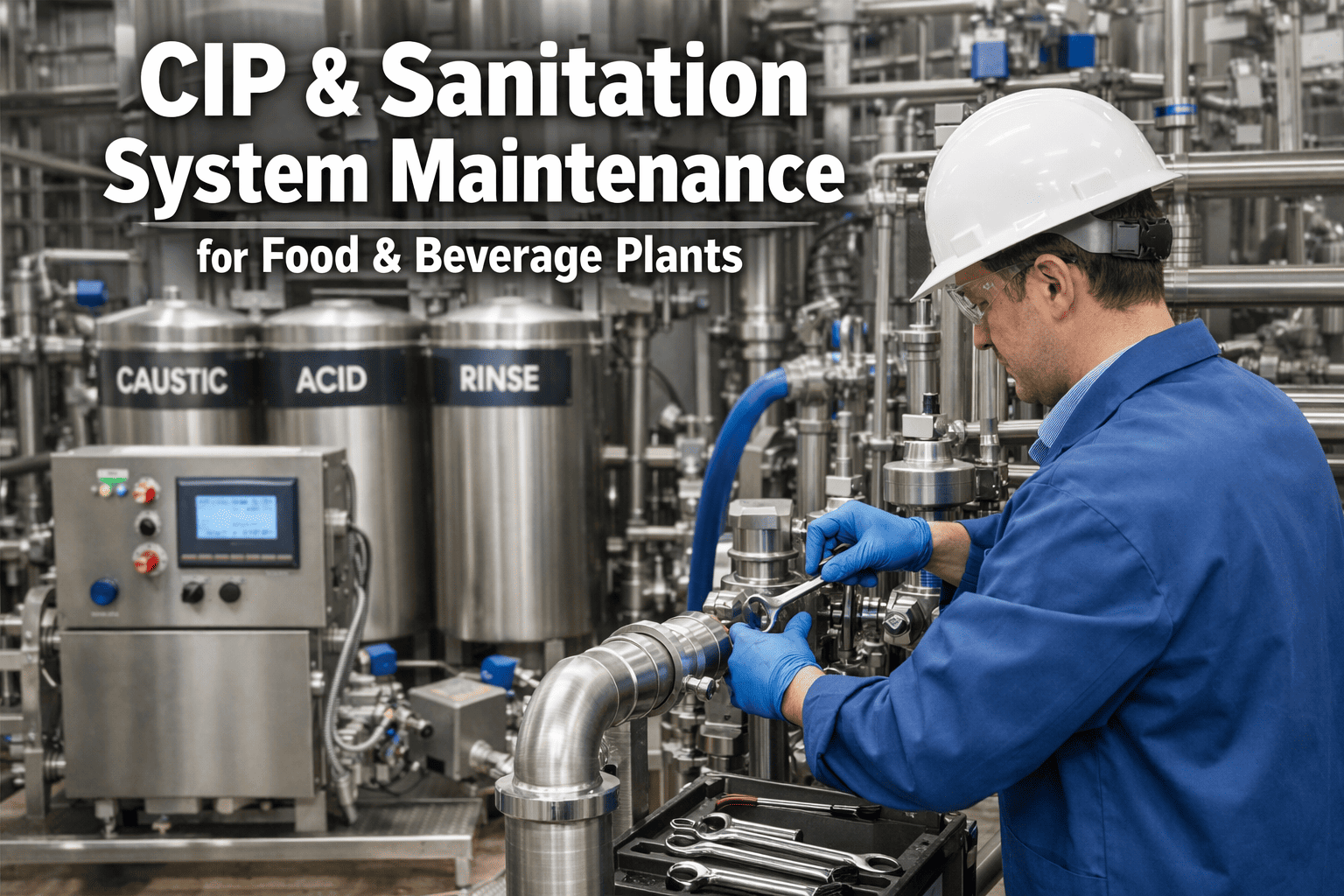
Maintenance of Clean-in-Place pumps, spray balls, sanitary valves, seals, and sensors that validate flow rate, temp, and chemical concentration.
Vital for preventing bacterial growth (Listeria, Salmonella) in closed systems.
Allergens
Changeover Protocol
Covers:
Deep cleaning tear-downs, swapping contact parts, and verifying sanitation effectiveness between distinct product runs to avoid cross-contact.
Requires strict sign-offs to prevent undeclared allergen recalls.
The Compliance Management Problem at Scale
Tracking one daily sanitation log is easy. Tracking thousands of PMs, calibrations, line changeovers, and parts replacements across multiple shifts, lines, and facilities is where paper systems fail. The management burden grows exponentially, and the consequences of a single missed CCP check are the same whether you run one processing line or fifty.
What Goes Wrong
✕Critical sanitary PMs are missed or "pencil-whipped" without execution
✕Food-grade lubricants are accidentally swapped with standard industrial lubes
✕Paper CIP logs are lost, stained, or filed incorrectly before audits
✕Sensors drift out of calibration, invalidating months of thermal processing
✕Auditors arrive and production stops while managers hunt for historical binders
What F&B Software Solves
✓Automated scheduling for all CCPs, sanitary PMs, and calibration routines
✓Strict BOMs enforce the use of only approved food-grade parts and chemicals
✓Digital checklists with photo validation for allergen changeovers and teardowns
✓E-signatures and unalterable timestamp logs for 21 CFR Part 11 compliance
✓One-click SQF, BRC, and FDA audit reports generated in seconds
How F&B CMMS Compliance Workflows Operate
Purpose-built F&B maintenance software doesn't just digitize paper—it actively enforces food safety by connecting maintenance execution directly to QA and compliance standards. Here is the workflow that eliminates manual tracking errors and audit panic entirely.
Schedule & Trigger
System automatically triggers PMs based on runtime hours, cycles, or strict calendar dates. High-priority CCP calibrations and sanitary checks bypass standard queues to ensure immediate dispatch.
Execute & Validate
Technicians follow forced-step digital checklists on mobile devices. They must upload photos of cleaned sanitary valves, record exact calibration values, and verify food-grade lubricant usage before closing the task.
E-Sign & Lock
Completed critical work orders are routed to QA or Maintenance Supervisors for digital signature review. Once signed, records are time-stamped and locked into an immutable database to satisfy FSMA standards.
Audit & Report
When FDA, SQF, or BRC auditors arrive, simply pull up the compliance dashboard. Generate instant reports showing exact PM histories, CIP validation data, and calibration records for any asset in the plant.
Food manufacturing plants that adopt F&B specific CMMS platforms close the gap between performing maintenance and proving it was done correctly—which is the only thing that matters when a federal inspector asks for documentation.
Never Fail an FDA or FSMA Audit Again
OXmaint automates every aspect of F&B plant maintenance — from HACCP workflows and CIP tracking to allergen changeovers. Digital checklists, QA sign-offs, food-grade inventory controls, and instant audit reporting included.
Sanitary Maintenance Status Board: What Your Dashboard Should Show
A compliance dashboard replaces the clipboard, the whiteboard, and the memory of your sanitation manager with a single screen that answers every question about your critical assets—instantly. Here's what a real-time status board looks like for a modern F&B operation.
Sanitary & CCP Status Board
24 Cleared3 Due Today1 Past Due
Asset Name
PM Type
Status
Next Due
Last Verified By
Pasteurizer Unit 1
HACCP / CCP
Compliant
Tomorrow, 06:00
QA - J. Smith
CIP Skid Alpha
Sanitary PM
Compliant
Friday, 14:00
Maint - A. Patel
Metal Detector Line 3
Calibration
Compliant
Nov 15, 2026
QA - M. Lee
Mixing Vat B
Allergen Clean
Due in 2 hrs
Today, 15:00
Sanit - K. Davis
Conveyor Belt 2
Lube Route
Due Today
Today, 18:00
Maint - T. Moore
Cooling Tunnel Fan
Sanitary Tear-down
Past Due
Yesterday
System Alert
Measuring F&B Compliance Health
Tracking PMs isn't just about avoiding breakdowns—it's about ensuring absolute food safety and audit readiness. These four metrics tell you whether your plant is operating strictly within compliance or risking a catastrophic event.
F&B Compliance Metrics
CCP PM Compliance
Percentage of Critical Control Point PMs completed on time. Must be 100% — failure here risks immediate recall.
CIP Validation Rate
Percentage of CIP cycles that meet all temp, flow, and chemical concentration parameters without requiring a re-wash.
Audit Readiness
Percentage of required logs digitally signed, securely stored, and instantly retrievable for inspectors.
Equipment Uptime
Percentage of scheduled production time systems are running, proving that rigorous compliance doesn't destroy efficiency.
Expert Perspective: Why Sanitary Maintenance Is a Business Survival Decision
Most plants think of maintenance as the department that fixes broken things, while Quality Assurance handles food safety. That's a dangerous mindset. In modern food and beverage manufacturing, maintenance IS food safety. If a sanitary weld cracks, if a CIP pump loses pressure, or if a technician uses a non-food-grade grease on a conveyor, you have compromised the product. The companies that thrive treat CMMS as a food safety system. They integrate maintenance checklists directly into their HACCP plans. They never wonder if a line was properly sanitized before a run. They know—because the software proves it.
Integrate with Quality
Maintenance and QA should operate from the same verified data. When a sanitary PM finishes, QA should instantly receive the automated sign-off prompt to unlock the equipment for production.
Build Auditor Confidence
Auditors dig deeper when they see messy paper logs. Handing an SQF or FDA inspector a tablet with beautifully organized, timestamped digital records changes the entire tone of the audit.
Prevent Catastrophic Recalls
Enforcing strict BOMs (Bill of Materials) for food-grade parts and demanding photo-verified allergen changeovers eliminates the human errors that lead directly to multi-million dollar recalls.
The F&B operations that treat maintenance as a strict compliance process—not just turning wrenches—are the ones that scale safely and dominate their markets. If you're ready to see how a CMMS integrates with FSMA, HACCP, and CIP protocols, book a free demo to see the full F&B compliance workflow.
HACCP Enforced. Audits Passed. Recalls Prevented.
OXmaint manages every critical maintenance workflow for food & beverage plants — with automated CCP alerts, digital CIP verification, food-grade inventory controls, and instant compliance reporting. Protect your consumers and your brand.
What makes a CMMS specifically designed for Food & Beverage plants?
A standard CMMS simply tracks work orders and wrenches. An F&B specific CMMS is built around food safety regulations. It features strict access controls and e-signatures to meet 21 CFR Part 11 requirements, dedicated workflows for HACCP/CCP documentation, automated scheduling for sanitary teardowns, and strict inventory segregation to ensure non-food-grade chemicals or lubricants are never accidentally assigned to production-line assets.
How does software help with FSMA compliance?
The Food Safety Modernization Act (FSMA) shifted the FDA's focus from reacting to foodborne illnesses to preventing them. This requires immense documentation proving that preventive controls are actively monitored and maintained. Software automates this by scheduling recurring maintenance on critical equipment, forcing technicians to document parameters (like temps and pressures), requiring supervisor sign-offs, and securely storing these immutable records so they can be instantly produced during an FDA inspection.
Can the software track CIP (Clean-in-Place) system maintenance?
Yes. CIP systems are the lifeblood of liquid and dairy processing safety. The CMMS tracks the preventive maintenance of the CIP equipment itself—such as scheduling regular spray ball inspections, sanitary valve rebuilds, and pump seal replacements. Furthermore, it tracks the calibration of the sensors that validate the CIP cycles, ensuring your wash parameters are legally defensible and scientifically accurate.
How does a CMMS prevent allergen cross-contamination?
Allergen control heavily relies on maintenance and sanitation routines during line changeovers. The software manages this by issuing specific, non-skippable digital checklists for tear-downs. Technicians can be required to take photos of cleaned contact surfaces, check off the swap of allergen-specific parts (like dedicated belts or hoses), and obtain a digital QA signature before the line is allowed to resume production for a different product.
Is the documentation generated by OXmaint accepted by SQF, BRC, and FDA auditors?
Yes. Digital, time-stamped, and easily retrievable records are highly preferred by modern auditors. By utilizing locked historical logs, secure user permissions, and digital signature capabilities, the reports generated by a robust F&B CMMS satisfy the strict record-keeping criteria demanded by the FDA, as well as Global Food Safety Initiative (GFSI) schemes like SQF, BRCGS, and FSSC 22000.

.png)