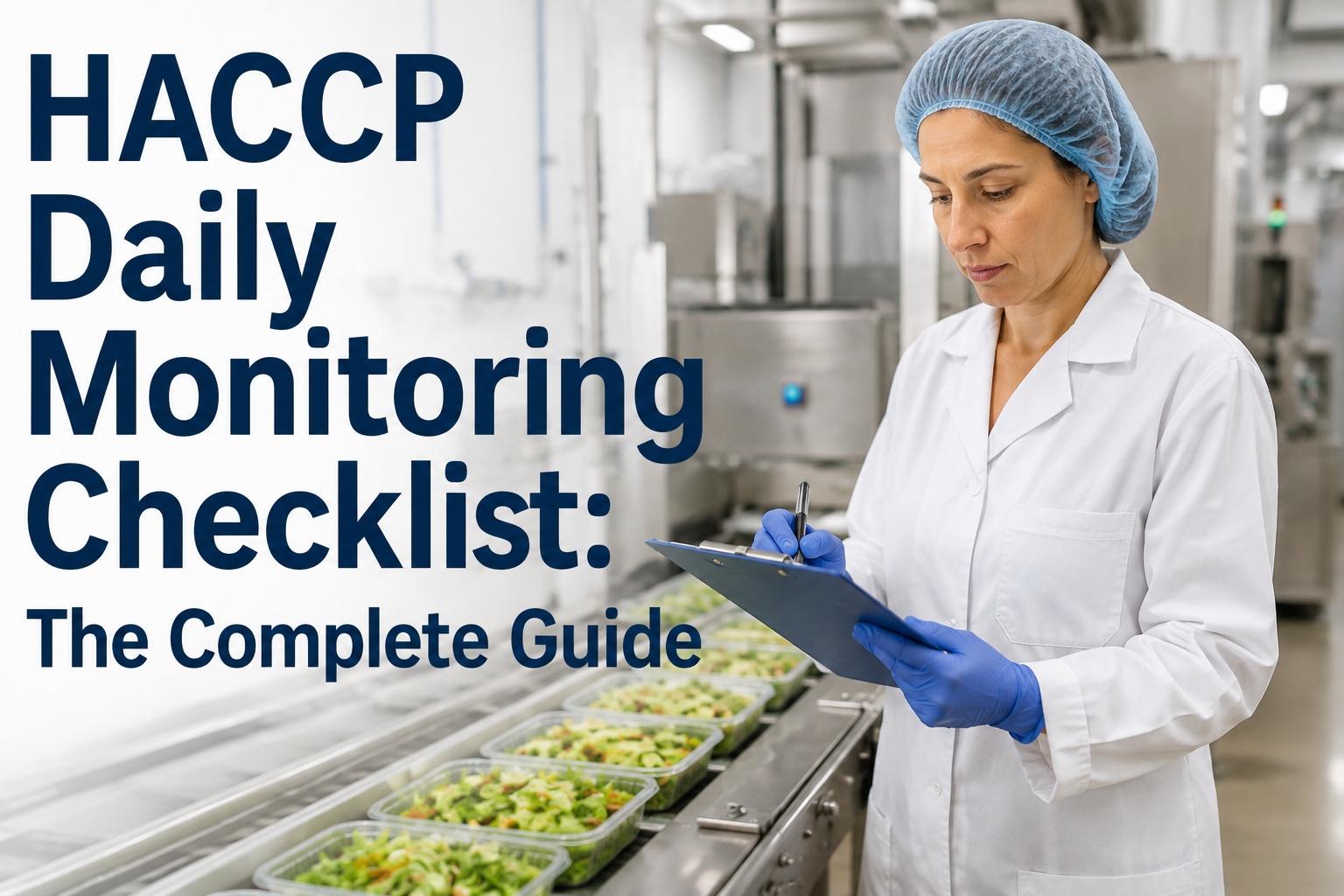
A HACCP daily monitoring checklist is the frontline food safety system that US restaurant kitchens use to verify critical control points — from cold storage temperatures to allergen cross-contact — every single shift. When done right, it prevents foodborne illness outbreaks, keeps you FDA-compliant, and turns surprise health inspections into routine walkthroughs. When done poorly (or skipped), it exposes your business to fines, closures, and reputational damage that can take years to repair. This guide walks through every requirement of a complete HACCP daily monitoring checklist, aligned to FDA Food Code standards, with pass/fail criteria, corrective-action workflows, and the documentation auditors expect to see. We'll also show you how OxMaint's digital maintenance platform transforms paper checklists into audit-ready records with photo proof, e-signatures, and real-time compliance tracking — Start Free Trial to see it in action.
Your HACCP Daily Monitoring Checklist: The Difference Between Passing an Audit and Getting Shut Down
One missed temperature log. One undocumented corrective action. One allergen cross-contact incident. That's all it takes to fail a health inspection — or worse, trigger a foodborne illness outbreak. This checklist covers every critical control point your kitchen must verify daily, with the documentation standards FDA auditors demand.
Why 48 Million Americans Get Sick Every Year — and How a Daily HACCP Checklist Prevents It
The CDC estimates that 48 million Americans — 1 in 6 — suffer foodborne illness annually, resulting in 128,000 hospitalizations and 3,000 deaths. The financial toll? The USDA puts the economic burden at $15.6 billion per year in medical costs, lost productivity, and premature deaths. For restaurants, a single outbreak linked to your kitchen can mean $75,000–$2 million in legal settlements, lost revenue during closure, and permanent brand damage. A HACCP daily monitoring checklist isn't paperwork — it's your insurance policy against becoming a statistic.
The FDA's Hazard Analysis and Critical Control Points (HACCP) system, mandated for juice and seafood processors and adopted voluntarily by most restaurant chains, identifies where contamination can occur and establishes critical limits to prevent it. Daily monitoring verifies those limits are met — every shift, every day. Miss a check, and you're gambling with public health and your business license.
HACCP Daily Monitoring Checklist Requirements: 9 Critical Control Points You Must Verify Every Shift
A compliant HACCP daily monitoring checklist covers nine critical control points (CCPs) identified in the FDA Food Code. Each requires specific measurements, pass/fail criteria, and documented corrective actions when limits are exceeded. Here's what auditors expect to see:
Cold Holding Temperatures
Check all refrigeration units, walk-ins, and prep coolers at the start of each shift and every 2 hours during service. Critical limit: 41°F or below. Log actual temps, not just "OK." If above 41°F, document corrective action (move product, call repair, discard if above 41°F for 4+ hours).
Hot Holding Temperatures
Verify steam tables, warming cabinets, and hot-holding equipment maintain 135°F or above. Check at shift start and every 2 hours. Use a calibrated probe thermometer. If below 135°F, reheat to 165°F within 2 hours or discard. Document time and temp of corrective action.
Cooking Temperatures
Verify final cook temps for high-risk proteins: poultry 165°F, ground meats 155°F, whole cuts 145°F, fish 145°F, eggs 155°F. Check every batch with a calibrated thermometer. Log temp and time. If under temp, continue cooking until limit is met — never serve undercooked product.
Cooling Procedures
Monitor cooling of cooked foods: from 135°F to 70°F within 2 hours, then 70°F to 41°F within 4 more hours (6 hours total). Check temps at 2-hour and 6-hour marks. Use shallow pans, ice baths, or blast chillers. If cooling fails, reheat to 165°F and restart, or discard.
Reheating for Hot Holding
Reheat all potentially hazardous foods to 165°F for 15 seconds within 2 hours before hot holding. Check and log reheat temp. Never use hot-holding equipment to reheat — it warms too slowly and allows pathogen growth.
Allergen Cross-Contact Prevention
Verify allergen separation in storage (top shelf for allergens, sealed containers), dedicated prep tools and cutting boards, and handwashing between allergen and non-allergen prep. Take photos of labeled storage and color-coded tools. Document any cross-contact incidents and product disposal.
Sanitizer Concentration
Test sanitizer buckets and dish machine sanitizer at shift start and every 4 hours. Chlorine: 50–100 ppm. Quaternary ammonium: 200–400 ppm (per manufacturer). Use test strips. If out of range, remix and retest. Log concentration and corrective action.
Employee Health & Hygiene
Verify no employees are working with symptoms (vomiting, diarrhea, jaundice, fever). Check handwashing compliance during prep. Confirm no bare-hand contact with ready-to-eat foods (gloves or utensils required). Document any exclusions or restrictions.
Date Marking & FIFO Rotation
Check that all ready-to-eat, potentially hazardous foods held over 24 hours are date-marked (prep date + 7-day discard date). Verify FIFO (first in, first out) rotation in coolers and dry storage. Discard expired product and log disposal.
Digital HACCP Daily Monitoring Checklist vs Paper Logs: What Auditors Actually Want to See
Paper logs are better than nothing — but barely. They get lost, they're illegible, they're filled out in advance (pencil-whipping), and they offer zero proof the check actually happened. A digital HACCP daily monitoring checklist with photo evidence, timestamps, and e-signatures gives you defensible, audit-ready records that prove compliance in real time.
| Requirement | Paper Log | Digital Checklist (OxMaint) |
|---|---|---|
| Temperature logging | Handwritten, often illegible, filled out in bulk at end of shift | Mobile entry with auto-timestamp, GPS location, and user ID |
| Photo evidence | None — auditor takes your word for it | Attach photos of thermometer readings, labeled storage, sanitizer test strips |
| Corrective actions | Scribbled note in margin, no follow-up tracking | Auto-generated work order, assigned to manager, tracked to completion |
| Audit trail | Stack of clipboards, missing pages, no version control | Immutable digital record, searchable by date/asset/user, exportable to PDF |
| Accountability | Initials that may or may not be legible | E-signature with user authentication, manager approval workflow |
| Real-time alerts | None — you find out about failures during the audit | Instant alerts when temps are out of range or checks are missed |
Health inspectors increasingly expect digital records. A 2023 National Restaurant Association survey found that 68% of multi-unit operators have adopted digital food safety systems, citing faster audits (average 45 minutes vs 3+ hours for paper) and fewer critical violations. OxMaint's digital HACCP checklists integrate with your asset management system, so a failed refrigeration temp doesn't just get logged — it triggers a work order to your refrigeration tech before product is lost.
How to Conduct a HACCP Daily Monitoring Checklist: Step-by-Step Workflow for Restaurant Kitchens
A HACCP daily monitoring checklist only works if it's actually completed — every shift, without exception. Here's the workflow that high-performing kitchens use to make compliance automatic:
Assign Responsibility at Shift Start
Designate a certified food protection manager (CFPM) or shift lead to conduct and document all CCP checks. In OxMaint, assign the daily HACCP checklist to a specific user with a due time (e.g., 30 minutes after shift start). They get a mobile notification with the full checklist.
Conduct Physical Checks with Calibrated Tools
Walk the kitchen with a calibrated probe thermometer, sanitizer test strips, and a mobile device. Check each CCP in order: cold storage, hot holding, cooking temps, cooling, reheating, allergen controls, sanitizer, employee health, date marking. Take photos of thermometer displays and test strips as proof.
Log Results in Real Time
Enter actual values (not just "pass/fail") into the digital checklist. OxMaint auto-timestamps each entry and flags out-of-range values in red. Attach photos directly from your phone. If a CCP fails, the system prompts you to document the corrective action immediately.
Execute & Document Corrective Actions
If a critical limit is exceeded, take immediate action: discard unsafe product, adjust equipment, reheat, or restrict employee duties. Log the action, time, and final outcome. OxMaint auto-creates a work order for equipment repairs and assigns it to your maintenance team or vendor.
Manager Review & E-Signature
At shift end, the manager reviews all entries, verifies corrective actions were completed, and e-signs the checklist. OxMaint locks the record to prevent tampering and archives it in a searchable audit trail. Repeat checks every 2–4 hours during service for continuous monitoring.
"We went from 3-ring binders and missing pages to a fully digital HACCP system in OxMaint. Our last health inspection took 40 minutes — the inspector pulled up our records on his phone, saw the photo evidence and corrective action logs, and we passed with zero critical violations. That's never happened before."
How OxMaint Turns Your HACCP Daily Monitoring Checklist Into Audit-Ready Compliance
OxMaint isn't just a digital checklist — it's a complete food safety and equipment maintenance platform that connects your HACCP monitoring to asset management, work orders, and compliance reporting. Here's how it solves the biggest pain points of HACCP daily monitoring:
Automated Checklist Scheduling
Schedule HACCP checklists to auto-assign at shift start, mid-shift, and close. OxMaint sends mobile reminders and escalates to managers if checks are missed. Result: 100% completion rate, zero gaps in your audit trail.
Photo Evidence & E-Signatures
Attach photos of thermometer readings, sanitizer test strips, and labeled allergen storage directly to each checklist item. Require e-signatures from the person conducting the check and the reviewing manager. Result: defensible proof that satisfies even the toughest health inspector.
Instant Corrective Action Work Orders
When a CCP fails (e.g., walk-in cooler at 48°F), OxMaint auto-generates a work order, assigns it to your refrigeration tech, and tracks it to completion. Link the work order to the failed checklist item for a complete corrective-action record. Result: equipment fixed before product loss, and auditors see a closed-loop system.
Audit-Ready Reports & Analytics
Export compliance reports by date range, location, or CCP. Track trends (e.g., which cooler fails most often) and predict equipment failures before they happen. OxMaint's analytics dashboard shows completion rates, corrective actions, and compliance scores across all locations. Result: walk into any audit with confidence, and catch problems before they become violations.
See How OxMaint Digitizes Your HACCP Daily Monitoring in 30 Minutes
Book a personalized demo and we'll show you how to replace paper logs with mobile checklists, photo proof, and automated corrective-action workflows — tailored to your kitchen's exact HACCP plan.
HACCP Daily Monitoring Checklist: Your Top 5 Questions Answered
What is a HACCP daily monitoring checklist?
A HACCP daily monitoring checklist is a structured form used to verify that critical control points (CCPs) in your food safety plan are within safe limits every shift. It covers temperature checks (cold holding, hot holding, cooking, cooling), sanitizer concentration, allergen controls, employee health, and date marking. Each check must be documented with actual values, pass/fail status, and corrective actions when limits are exceeded.
How often should HACCP monitoring be done?
HACCP monitoring frequency depends on the CCP. Cold and hot holding temperatures should be checked at shift start and every 2 hours during service. Cooking and reheating temps are checked per batch. Sanitizer concentration is tested at shift start and every 4 hours. Cooling is monitored at 2-hour and 6-hour marks. Allergen controls and employee health are verified at shift start. Date marking is checked daily.
What happens if a critical limit is exceeded during monitoring?
If a critical limit is exceeded, you must take immediate corrective action and document it. For example, if cold storage is above 41°F, move product to a working cooler, call for repair, and discard any food held above 41°F for 4+ hours. If cooking temp is below the limit, continue cooking until it's met. Log the deviation, the action taken, the time, and the final outcome. OxMaint auto-generates a work order for equipment issues and tracks corrective actions to closure — Start Free Trial to see the workflow.
Do I need a digital HACCP checklist or is paper OK?
Paper logs are legally acceptable but operationally risky. They get lost, they're illegible, they're often filled out in advance (pencil-whipping), and they offer no proof the check actually happened. A digital HACCP daily monitoring checklist with photo evidence, timestamps, and e-signatures gives you defensible, audit-ready records. Health inspectors increasingly prefer digital systems because they're faster to review and harder to falsify. Digital also enables real-time alerts when temps are out of range, so you can act before product is lost.
How long must HACCP monitoring records be kept?
The FDA Food Code doesn't specify a federal retention period for HACCP monitoring records in retail food establishments, but most state and local health departments require 1–2 years. Best practice is to retain records for at least 2 years to cover the statute of limitations for foodborne illness claims. Digital systems like OxMaint store records indefinitely in the cloud, searchable by date, location, or CCP, so you're always audit-ready. Book a Demo to see how OxMaint's audit trail works.
Stop Gambling With Paper Logs — Digitize Your HACCP Daily Monitoring Today
Join hundreds of restaurant operators who've eliminated clipboard chaos and passed every health inspection with OxMaint's digital HACCP checklists, photo proof, and automated corrective-action workflows.
Free 14-day trial · No credit card required · Set up in under 30 minutes