healthcare-cmms-software-hospital-guide

Healthcare CMMS Software: Complete Hospital Guide 2026


A Joint Commission surveyor walking through your hospital is not looking for perfect equipment — they are looking for documented evidence that your preventive maintenance program is working. The difference between a citation and a commendation is almost never the equipment itself. It is the audit trail: work orders completed on schedule, inspection records with timestamps, corrective actions documented to closure, and calibration certificates accessible in seconds rather than searched for across three different filing systems. Start Oxmaint free — Joint Commission and DNV compliance templates are pre-built and ready.

Healthcare CMMS Software

Pass Every Audit. Protect Every Patient.

Oxmaint gives hospital facility and biomedical engineering teams the PM scheduling, asset tracking, and compliance documentation that Joint Commission, DNV, and CMS require — without the manual compilation overhead that consumes 20+ hours before every survey.

Joint Commission EC and LS standards compliance
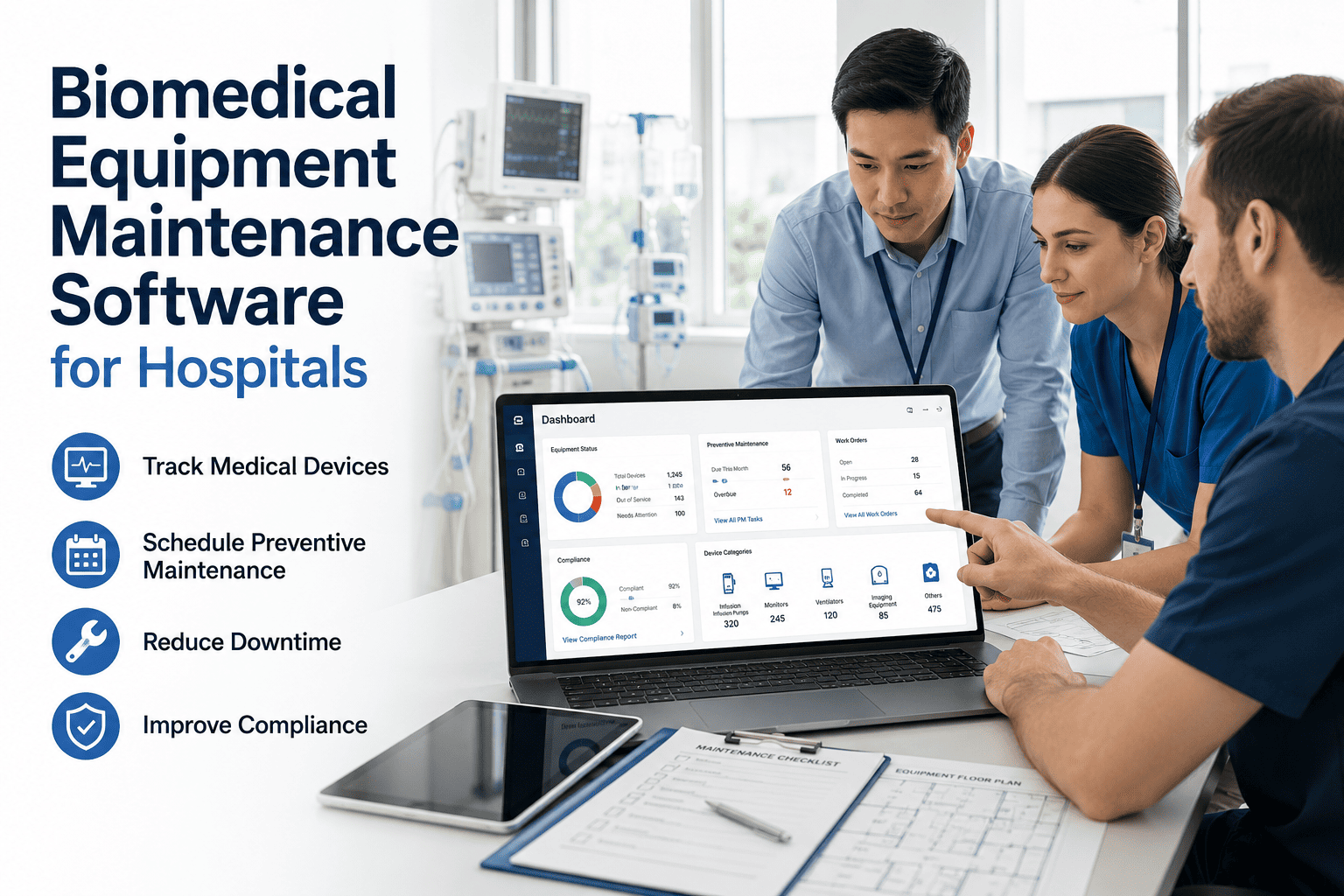
Biomedical equipment inspection and PM tracking
Life safety, fire protection, and utility systems
Instant survey-ready documentation export
Compliance Dashboard Live
EC.02.04.01 Medical Equipment PM
94% On Track
EC.02.05.01 Utility Systems
97% On Track
LS.02.01.35 Fire Door Inspections
3 due Due Soon
EC.02.03.05 Fire Protection
Current On Track
Joint Commission ready

DNV GL compliance

CMS Conditions of Participation

Instant survey export

NFPA 99 / 101 tracking

Four Equipment Categories Healthcare CMMS Must Manage

Hospital maintenance encompasses four distinct asset categories — each governed by different regulatory standards, inspection frequencies, and documentation requirements. Oxmaint structures all four in a single asset hierarchy with compliance templates pre-mapped to the relevant accreditation standards. Book a demo to see your facility type pre-configured.

Biomedical Equipment
EC.02.04.01 · FDA Medical Device Regulations

Life-critical and patient-contact medical devices require inspection and PM schedules documented to manufacturer specifications or AEM program criteria. Every inspection must capture the result, the inspector identity, and the date — per device, per inspection.

Infusion pumps — dose accuracy verification, alarm function test, battery runtime check
Ventilators — leak test, flow accuracy, alarm threshold verification, filter inspection
Defibrillators — energy delivery test, battery status, pad condition, daily charge test log
Patient monitoring systems — alarm audit, lead condition, calibration verification
Sterilisers — biological indicator log, cycle parameter verification, printout archive
Life Safety Systems
LS.02.01 series · NFPA 99 · NFPA 101

Life safety compliance is where healthcare facilities most frequently receive citations. Fire doors, sprinklers, smoke detectors, emergency lighting, and egress paths have mandatory inspection frequencies that cannot be missed without generating an Immediate Threat to Life finding.

Fire door inspections — annual visual and functional test per NFPA 80
Sprinkler system — quarterly, semi-annual, and annual testing per NFPA 25
Fire alarm testing — initiating device testing per NFPA 72 frequency schedule
Emergency generator — monthly 30-minute load test, annual load bank test with log
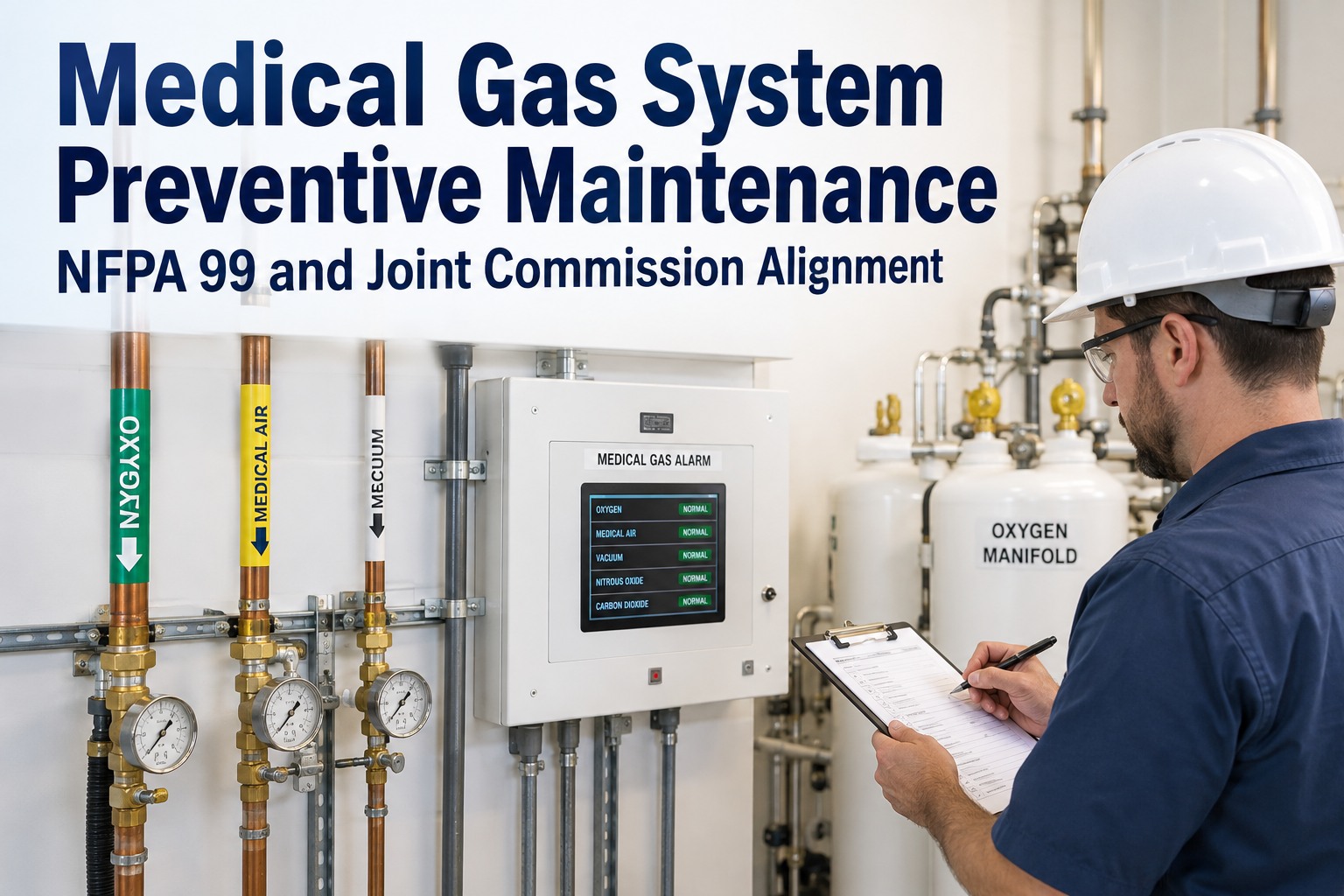
Medical gas systems — annual certification, quarterly alarm panel test, pressure check
Utility and Infrastructure Systems
EC.02.05.01 · CMS Conditions of Participation

HVAC, water systems, electrical distribution, and medical gas infrastructure require continuous operation with documented PM. Legionella water management, isolation room pressure differentials, and emergency power testing are utility PMs with direct patient safety consequences.

HVAC — filter changes, coil cleaning, damper operation, pressure differential log for isolation rooms
Water management — Legionella risk control, cooling tower treatment, hot water temperature
Electrical systems — switchgear inspection, UPS battery test, transfer switch exercising
Medical gas — outlet testing, manifold inspection, alarm verification, gas quality certificate
Elevators — statutory inspection certification, monthly safety function test
Imaging and Diagnostic Equipment
FDA 21 CFR Part 1020 · ACR Accreditation

MRI, CT, X-ray, ultrasound, and nuclear medicine equipment combine high capital value, stringent calibration requirements, and radiation safety regulatory obligations. Shielding integrity, ACR phantom test records, and output calibration certificates require documented chain of custody.

MRI — quench system check, RF shielding integrity, safety zone inspection, cryogen level log
CT scanner — ACR phantom test, dose calibration, HVL measurement, tube current calibration
X-ray systems — kVp and mAs calibration, half-value layer test, collimator alignment
Ultrasound — transducer inspection, output calibration, ACR accreditation QC records
Nuclear medicine — dose calibrator constancy, daily QC, source inventory and disposal log
All four equipment categories are pre-configured in Oxmaint's healthcare template with Joint Commission standard references mapped to each inspection type — so your team always knows which regulatory requirement each PM task satisfies.

What Oxmaint Produces for Your Joint Commission Survey

Joint Commission surveyors request specific documentation at every hospital survey. Oxmaint produces all of it as real-time reports — not post-survey compilations. Sign in to Oxmaint to see your current compliance status across all EC and LS standards.

Equipment Inventory
Complete asset register with device name, manufacturer, model, serial number, location, criticality classification, and inspection interval basis — EC.02.04.01 requires documented inventory for all managed equipment.
EC.02.04.01
PM Completion Rate Report
Percentage of scheduled PMs completed on time by category, department, and period. Oxmaint calculates this in real time — no manual count of completed vs. scheduled work orders needed before the survey team arrives.
EC.02.04.03
Inspection and Testing Records
Every completed inspection — fire door tests, sprinkler tests, generator load tests, medical gas certification — with timestamp, inspector identity, result, and corrective action. Full evidence package by NFPA standard and EC chapter.
LS.02.01 series
Deficiency and Corrective Action Log
Every deficiency from internal inspection, contractor report, or sentinel event — documented with open date, description, responsible party, and resolution date. No deficiency closed without documented evidence of corrective action.
EC.04.01.01
Calibration Certificate Registry
Calibration certificates for all measurement instruments — steriliser indicators, temperature sensors, radiation dosimetry, flow meters — stored digitally against each asset record. Accessible by device name or serial number in under 30 seconds.
EC.02.04.01 / FDA
Staff Competency Records
Training certifications for biomedical and facilities staff — device-specific training, electrical safety, radiation safety, and life safety — with expiry alerts ensuring no technician performs inspections with lapsed credentials.
HR.01.05.03
Zero
Joint Commission citations related to equipment management documentation at a 340-bed regional medical centre — first clean survey in three triennial cycles
18 hrs
Survey preparation time eliminated per survey at a hospital system that previously spent 18–22 hours manually compiling PM compliance reports before each visit
96%
PM on-time compliance at a community hospital within 12 months of Oxmaint deployment — up from 71% baseline measured at implementation start

Frequently Asked Questions

Does Oxmaint support Alternative Equipment Management (AEM) programs for medical devices?
Yes. Oxmaint's healthcare asset template supports AEM program documentation — the risk-based framework that allows hospitals to adjust inspection frequencies based on device risk classification, historical performance data, and manufacturer recommendations. For each AEM device, Oxmaint stores the risk assessment basis, adjusted PM interval and procedure, performance data supporting the adjustment, and the approval authority. This creates the documented AEM program that CMS and Joint Commission require when frequencies deviate from manufacturer recommendations. Start Oxmaint free to configure your AEM program documentation.
How does Oxmaint handle the different compliance tracking requirements for biomedical vs. facilities maintenance?
Oxmaint uses a single asset hierarchy that separates biomedical equipment (managed under EC.02.04.01 with device-level inspection records) from facilities and life safety assets (managed under EC.02.05.01 and LS standards with system-level inspection records). Each asset type is assigned the relevant compliance template. Biomedical engineering and facilities teams see their respective asset queues separately, while management sees the consolidated compliance dashboard across both programmes. Book a demo to see the dual-programme configuration for your hospital type.
Can Oxmaint generate the equipment management report that Joint Commission surveyors request on arrival?
Yes — in under 60 seconds. Oxmaint's Joint Commission survey report package includes the complete equipment inventory by department, PM completion rate by standard reference, open deficiency and corrective action log, upcoming PMs due in 30 days, and calibration certificate status for all registered instruments. The report exports as a single PDF organised by Joint Commission chapter — EC.02.04, EC.02.05, LS.02.01, and EC.04.01. Hospitals using Oxmaint typically hand the surveyor a printed copy within five minutes of survey notification.
Does Oxmaint store patient data, and how does it interact with HIPAA requirements?
Oxmaint stores only equipment and maintenance data — asset records, work orders, inspection results, and compliance documentation. Patient data is never entered into or accessible through Oxmaint, which means the HIPAA business associate agreement complexity of EHR integration does not apply to the maintenance platform. Oxmaint operates independently of clinical systems while complementing them — the biomedical and facilities teams use Oxmaint, the clinical team uses the EHR, and the two systems exchange only equipment availability and maintenance status data via REST API when needed. Start Oxmaint free — no EHR integration required to begin compliance tracking.

Audit-Ready Documentation. Every Day. Not Just Before Survey.

Oxmaint turns daily maintenance activity into the compliance evidence that Joint Commission, DNV, and CMS need — automatically. No pre-survey compilation, no missing records, no citations from documentation gaps.
Share This Story, Choose Your Platform!