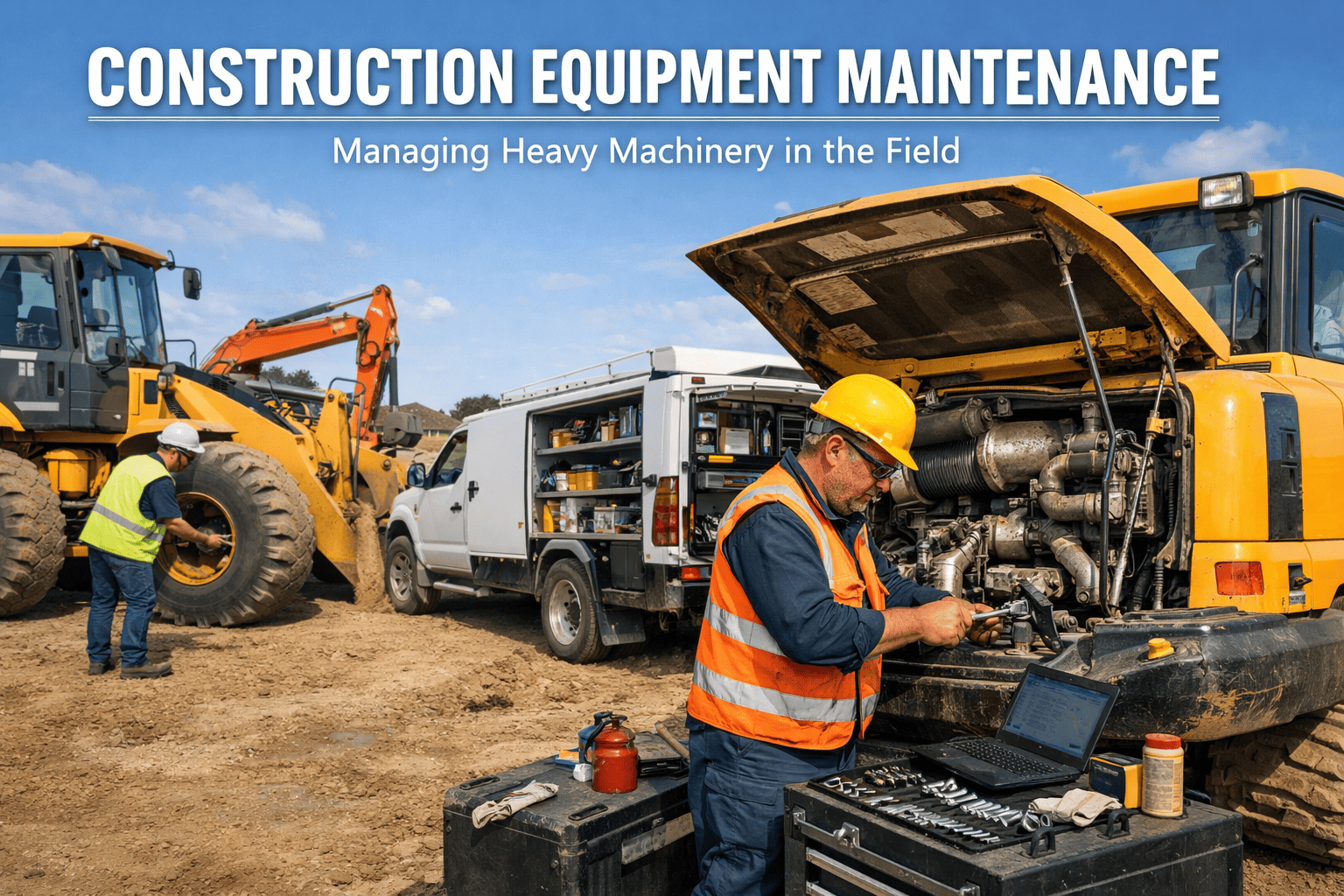
Heavy equipment maintenance in construction and mining operates in conditions that destroy components faster than any on-road fleet — abrasive dust penetrates hydraulic seals, extreme load cycles accelerate undercarriage wear, and remote site locations turn a preventable breakdown into a $40,000 crane deployment and a 3-day production halt. The Associated Equipment Distributors reports that unplanned heavy equipment downtime costs US construction operations an average of $4,200 per machine per day — and 47% of major equipment failures are preceded by warning signals that a systematic PM program would have caught. Managing excavators, loaders, dozers, and haul trucks without a digital CMMS means running blind on the most expensive assets your operation owns. Start managing your heavy equipment fleet in OxMaint — free trial, no credit card.
Heavy Equipment Maintenance: Construction, Mining & Earthmoving Fleet CMMS
Manage excavators, loaders, dozers, haul trucks, and attachments with engine-hour PM triggers, undercarriage wear tracking, hydraulic inspection schedules, and GET lifecycle management — all in OxMaint.
OxMaint manages PM schedules for excavators, loaders, dozers, haul trucks, and attachments — with mobile work order completion, undercarriage wear logging, GET lifecycle tracking, and multi-site fleet visibility. Construction fleets report 55% reduction in unplanned downtime within 90 days of deployment.
Why Heavy Equipment PM Fails Without a CMMS
The most expensive maintenance failures in construction and mining are not sudden — they are slow. A Cat 320 excavator does not seize its engine without warning; it burns through oil faster than its class average for six weeks, a trend that appears in oil sample data if anyone is tracking it. A dozer undercarriage does not fail overnight; the bushing wear percentage crosses 70% over months of operation, visible in the maintenance record if measurements are logged consistently after every 250-hour service. What makes these failures so costly is not their severity — it is that they are completely invisible to paper-based PM systems until the machine stops working on site.
OxMaint connects engine-hour data from PLC and telematics systems (Cat Product Link, Komatsu Komtrax, Volvo CareTrack, Deere JDLink) directly to PM work order triggers — so the oil change fires at exactly 250 hours on the actual machine clock, not when a supervisor notices the service sticker. Fluid sample results from lab partners upload automatically against the asset record. Undercarriage wear percentages are logged on mobile after each 250-hour inspection, and OxMaint trends them against replacement thresholds so the equipment manager sees the projected replacement date weeks in advance — not the day the chain snaps. See how OxMaint connects telematics data to PM triggers.
PM Schedule by Equipment Type & System
Each heavy equipment category has unique PM requirements driven by work cycle, load profile, and operating environment. A haul truck running 24-hour shifts in an iron ore operation needs different PM intervals than an excavator on a 10-hour urban construction site. OxMaint lets you configure engine-hour triggers, condition-based inspection prompts, and fluid analysis intervals by machine class — tracked automatically across every job site. See OxMaint configured for your equipment classes.
| Equipment Type | Oil & Filters | Hydraulic PM | Undercarriage | GET / Attachments |
|---|---|---|---|---|
| Excavator (20–50t) | 250 hrs | 500 hrs | 250 hrs visual / 500 hrs measure | Daily wear check |
| Wheel Loader | 250 hrs | 500 hrs | Tire: weekly pressure | 500 hrs bucket |
| Bulldozer / Dozer | 250 hrs | 500 hrs | 250 hrs / reverse daily | Daily blade check |
| Haul Truck (Mining) | 500 hrs | 1,000 hrs | Tire: daily torque check | 1,000 hrs body |
| Motor Grader | 250 hrs | 500 hrs | Tire: weekly | Daily blade wear |
| Articulated Dump Truck | 500 hrs | 500 hrs | Tire: daily | 1,000 hrs body |
Fleet Health KPI Dashboard
Six equipment fleet metrics tracked automatically in OxMaint — giving equipment managers the data that matters for production continuity, lifecycle cost control, and site safety. These are the KPIs site managers and CFOs review every quarter.
Technology Stack — Five Integrated Layers
The highest-performing construction and mining fleets are not running better equipment — they are running the same equipment with better data. Integrating OxMaint with five connected technology layers moves maintenance decisions from scheduled guesswork to condition-based precision — catching hydraulic seal degradation, undercarriage wear, and engine anomalies 3 to 5 weeks before they stop production.
Undercarriage & GET — The Two Highest-Cost Maintenance Categories
In tracked equipment — excavators, dozers, and compact track loaders — the undercarriage typically represents 50 to 60% of total maintenance cost over the machine's operating life. A Cat 320 excavator running in abrasive rock conditions can consume an undercarriage set worth $28,000 to $35,000 every 3,000 to 4,000 hours without a systematic wear management program. The same machine, with a documented reverse-travel policy and wear measurements taken at every 250-hour service, routinely extends undercarriage life by 25 to 30% — deferring that $30,000 replacement by 12 to 18 months and saving the operation $8,000 to $10,000 per machine per year.
Ground engaging tools — bucket teeth, adapters, cutting edges, and wear plates — represent a separate but equally significant cost center that most fleets manage reactively. A missing tooth on an excavator bucket reduces digging efficiency by up to 30% and can cost $4,000 to $8,000 in lost production time before it is discovered. OxMaint tracks every GET component per machine with wear-based replacement thresholds configured by material type, duty cycle, and site conditions — so replacements are triggered on projected wear, not failure. At scale across a 20-machine fleet, systematic GET management typically saves $120,000 to $200,000 per year versus reactive replacement.
Virtual equipment model runs simulations on engine hours, load cycles, and telematics data — projecting hydraulic seal life, undercarriage wear, and engine health 3–5 weeks ahead of actual failure.
Machine PLC and telematics (Cat Product Link, Komatsu Komtrax, Volvo CareTrack) feed engine hours, fault codes, and fuel consumption directly into OxMaint — PM triggers fire on actual hours, not estimates.
Fluid sample results upload directly to the OxMaint asset record. SAP PM integration syncs work orders and parts costs to the correct cost center — total lifecycle cost per machine, no manual reconciliation.
We had a Cat 390 excavator fail at our quarry with a $280,000 engine rebuild. Since OxMaint, zero major engine failures across 34 machines — the oil analysis alerts alone saved us more than the software costs in a quarter.
Frequently Asked Questions
Stop Losing $4,200 a Day to Unplanned Breakdowns.
Engine-hour PM, undercarriage tracking, GET lifecycle — live in under 2 weeks.