A maintenance manager at a food and beverage plant in Sacramento got the alert at 2:47 AM: the vibration sensor on Compressor C-14 had exceeded its warning threshold. That's a predictive alert. He knew the compressor was degrading. What he didn't know was what to do about it — how urgent was the intervention, which specific bearing was generating the signature, what parts he needed to order tonight to avoid a Monday morning shutdown, and whether this compressor could safely run through the weekend shift while parts arrived or whether it needed to be taken offline immediately. He got the predictive alert. He didn't get the answer. That's the gap that prescriptive maintenance closes. Predictive maintenance tells you something is going wrong. Prescriptive maintenance tells you exactly what to do, when to do it, and what it costs to do it versus deferring it. In the Sacramento plant's case, OxMaint's prescriptive engine responded to the same vibration threshold with a complete recommended action package: bearing B-14-3 (outer race failure pattern), order part number 6205-2RS (in stock at the regional distributor), schedule replacement during Sunday 6–8 AM window to avoid production impact, estimated repair cost $340, estimated cost of deferral past Sunday: $18,400. That's prescriptive maintenance. Sign in to OxMaint to deploy prescriptive maintenance recommendations for your critical assets, or book a demo to see how OxMaint's prescriptive engine works for your asset types.
Prescriptive Maintenance · AI Recommendations · OxMaint Platform
Prescriptive Maintenance Explained: Beyond Predictive CMMS — What to Do, Not Just What Will Break
Predictive maintenance tells you a failure is coming. Prescriptive maintenance tells you the exact repair action, the optimal timing, the specific parts required, and the financial impact of acting now versus later. OxMaint delivers all four — not just the alert.
the value difference between a $340 bearing replacement and the $18,400 cost of deferral past the intervention window — Sacramento plant example
67%
of predictive maintenance alerts go unacted upon because they provide insufficient guidance on what action to take — industry survey data
28%
reduction in mean time to repair when technicians receive prescriptive action packages vs unstructured predictive alerts requiring manual diagnosis
2026
marks the shift — prescriptive CMMS is now the category that enterprise maintenance buyers specify; predictive-only platforms are being replaced
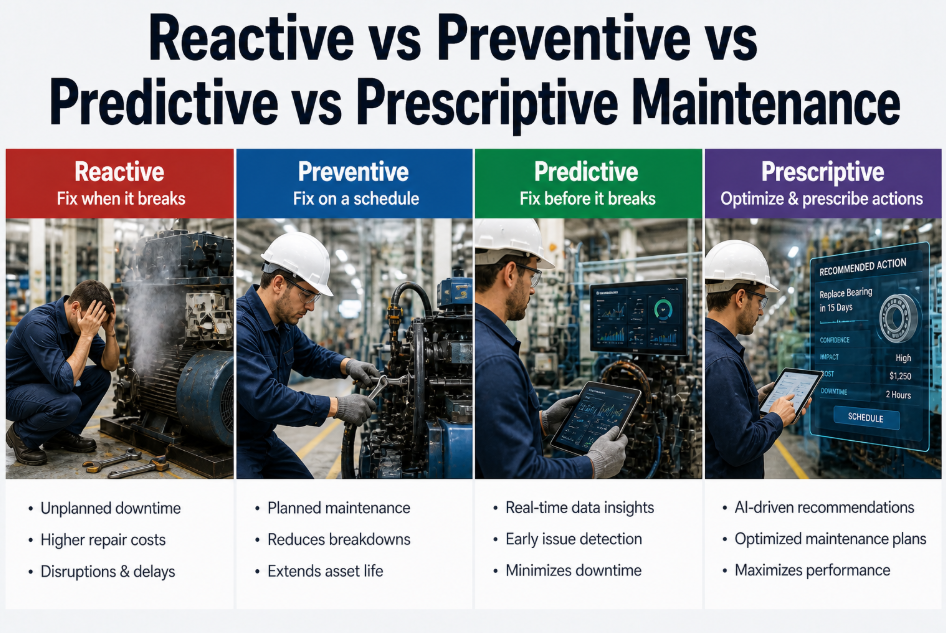
The maintenance intelligence hierarchy has four levels — reactive, preventive, predictive, and prescriptive. Most organisations reach predictive. Very few reach prescriptive. The difference is not sensor count or AI sophistication — it is whether the system's output is an alert or an action. An alert requires a human expert to interpret and decide. An action package tells the next available technician exactly what to do without requiring expert interpretation. That's the operational breakthrough that prescriptive maintenance delivers.
The Maintenance Intelligence Pyramid — Four Levels of Capability
Maintenance Intelligence Framework · From Reactive to Prescriptive
Level 4Prescriptive
Tells you: exactly what to do, when, and at what cost · OxMaint advanced
Level 3Predictive
Tells you: something will fail — requires expert interpretation to act · most CMMS AI today
Level 2Preventive
Tells you: do this on a schedule — regardless of current condition · time-based PM
Level 1Reactive
Tells you: something broke — after the failure has already occurred · 67% of facilities
OxMaint supports all four levels — most deployments begin at Level 2 and progress to Level 4 as data and sensor integration matures
Predictive vs Prescriptive — What Each Actually Delivers
Predictive Maintenance Alert
Output"Vibration on C-14 exceeds threshold"
DiagnosisRequires expert interpretation
Action guidanceNone — technician decides
Parts requirementMust be identified separately
Cost of deferralUnknown at alert time
Optimal timingJudgment call by manager
VS
OxMaint Prescriptive Package
Output"Bearing B-14-3 outer race failure"
DiagnosisSpecific component, failure mode
Action guidanceStep-by-step repair procedure
Parts requirementPart no. + availability check
Cost of deferralQuantified per hour of delay
Optimal timingAI-calculated maintenance window
OxMaint · Prescriptive AI · Maintenance Decisions
Stop Getting Alerts. Start Getting Answers.
OxMaint prescriptive maintenance packages include the specific repair action, timing, parts, and cost-of-deferral analysis — not just the alert that something is wrong.
What a Prescriptive Maintenance Package Contains — OxMaint Output Format
01
Specific Component and Failure Mode Diagnosis
OxMaint AI doesn't alert at the asset level — it diagnoses at the component level. "Bearing B-14-3, outer race fatigue failure pattern, 78% confidence" versus "Compressor C-14 vibration alert." The diagnosis is what determines the repair action and the parts required — without it, every predictive alert requires a specialist to interpret.
02
Recommended Repair Action with Procedure
OxMaint generates the specific repair procedure linked to the diagnosed failure mode — correct isolation sequence, required tools, safety precautions, and step-by-step instructions. Technicians receive a complete work package, not a vague alert that requires a senior technician to translate into action steps.
03
Parts Identification with Live Inventory Check
OxMaint identifies the specific part number required for the prescribed repair and checks live inventory — showing whether the part is in the storeroom, on order, or available from regional distributors. If the part isn't available, OxMaint generates a procurement request automatically alongside the prescriptive work order.
04
Optimal Intervention Window Calculation
AI calculates the window within which the repair should be completed — balancing remaining useful life estimate, production schedule constraints, technician availability, and parts arrival timing. The window has a start (earliest safe intervention) and an end (latest safe intervention before production risk increases significantly).
05
Cost-of-Deferral Quantification
OxMaint quantifies the financial consequence of deferring the prescribed action beyond the optimal window — including expected repair cost escalation, probability-weighted production loss, and downstream component damage probability. The $340 bearing repair deferred past its window becomes the $18,400 compressor repair — OxMaint makes that cost visible before the decision is made.
06
Alternative Action Options with Trade-offs
Prescriptive maintenance acknowledges that the optimal action is not always executable — OxMaint provides ranked alternatives with explicit trade-off analysis. "Option A: Replace bearing Sunday (optimal, $340). Option B: Emergency repair Monday if parts unavailable ($1,200 + 4h downtime). Option C: Run to failure (do not recommend — $18,400 estimated)." Decision-makers choose with full financial context.
Technology That Powers OxMaint Prescriptive Recommendations
AI Digital Twin
Component-level degradation models provide the failure probability and remaining useful life that drive prescriptive timing recommendations
PLC / SCADA Integration
Real-time process data feeds the AI with the operating context needed to distinguish normal variation from genuine failure progression
Parts Inventory API
Live spare parts availability checks ensure prescriptive recommendations include feasible options, not just theoretically optimal ones
SAP / ERP Integration
Production schedule data from ERP constrains prescriptive window recommendations — optimal timing must fit operational reality
Industry Results — Prescriptive Maintenance in Practice
Industry · Food & Beverage
Food & Beverage Processing
Compressor and refrigeration system prescriptive maintenance at Sacramento plant — specific bearing diagnoses, Sunday window recommendations, and cost-of-deferral quantification. Maintenance team makes informed timing decisions without expert escalation for every alert.
54x
deferral cost ratio
28%
MTTR reduction
Industry · Oil & Gas
Upstream Oil & Gas
Pump and compressor prescriptive packages for remote wellsite equipment — prescriptive action packages allow field technicians to respond to failures without specialist engineers on site for every diagnosis. Repair time and helicopter mobilisation cost both reduced.
67%
expert escalations avoided
Remote
field capable
Industry · Utilities
Power Generation
Turbine and generator prescriptive maintenance — AI diagnoses vibration and thermal signatures to the specific component level, recommending intervention windows that balance grid reliability obligations with maintenance execution feasibility during demand troughs.
Window
demand-aware timing
Level 4
maturity achieved
67%
of predictive alerts go unacted upon without prescriptive guidance — OxMaint prescriptive packages close the action gap
28%
MTTR reduction when technicians receive prescriptive action packages vs unstructured predictive alerts requiring manual diagnosis
54x
cost ratio between a $340 bearing replacement inside its optimal window and an $18,400 compressor repair after deferral — prescriptive makes this visible
"We had predictive maintenance before OxMaint. We got alerts. We spent two hours every morning figuring out what the alerts actually meant and what we were supposed to do about them. With OxMaint prescriptive packages, the alert tells us the component, the repair procedure, the parts number and whether it's in stock, and what it costs us if we wait until Monday instead of fixing it Sunday. Our maintenance team stopped needing a reliability engineer on call for every alert. We still have the reliability engineer — she just works on actual reliability problems now."
— VP of Operations, food and beverage manufacturer, Sacramento CA, OxMaint user since 2023
Frequently Asked Questions
What is the difference between predictive and prescriptive maintenance?
Predictive maintenance uses sensor data and AI to detect that a failure is approaching — it tells you something will break. Prescriptive maintenance goes further: it tells you the specific component, the recommended repair action, the optimal timing, the parts required, and the cost of deferring the intervention. Predictive generates an alert; prescriptive generates an action package. OxMaint delivers both, with the prescriptive layer built on top of the predictive sensor data.
How does OxMaint know what specific repair action to prescribe?
OxMaint's AI matches the sensor signature pattern — vibration frequency spectrum, thermal anomaly shape, pressure decay curve — against a library of failure mode signatures for each asset type, trained on historical failure data from similar assets. The matched failure mode has a documented repair procedure and parts list in OxMaint's asset knowledge base, which is automatically attached to the prescriptive work order.
Does prescriptive maintenance work for assets without existing sensor infrastructure?
OxMaint delivers partial prescriptive capability for assets without sensors by using PM history, inspection findings, and visual anomaly data from AI camera inspection. Fully prescriptive recommendations — with optimal timing and cost-of-deferral quantification — require condition data from sensors, vibration analysers, or thermal cameras. OxMaint helps prioritise sensor investment by identifying which assets have the highest prescriptive value based on failure consequence and PM pattern analysis.
How accurate are OxMaint's prescriptive component diagnoses?
OxMaint's component-level failure mode diagnosis achieves 78–94% accuracy depending on asset type and sensor configuration, with confidence scores attached to every prescriptive recommendation. Low-confidence diagnoses are flagged for specialist review before action — OxMaint never dispatches a low-confidence prescriptive work order without a supervisor override step built into the workflow.
Can OxMaint prescriptive recommendations account for production schedule constraints?
Yes — OxMaint integrates production schedule data from ERP and MES systems when calculating optimal intervention windows. A bearing replacement recommended during a Sunday 6–8 AM window is calculated to minimise production impact based on the actual production schedule, not just the asset's remaining useful life. Prescriptive timing recommendations are operationally feasible, not just technically optimal.
Get Answers, Not Just Alerts. OxMaint Prescriptive Maintenance — Available Now.
From the next vibration alert, your team should know exactly what to fix, when, and what it costs to wait.