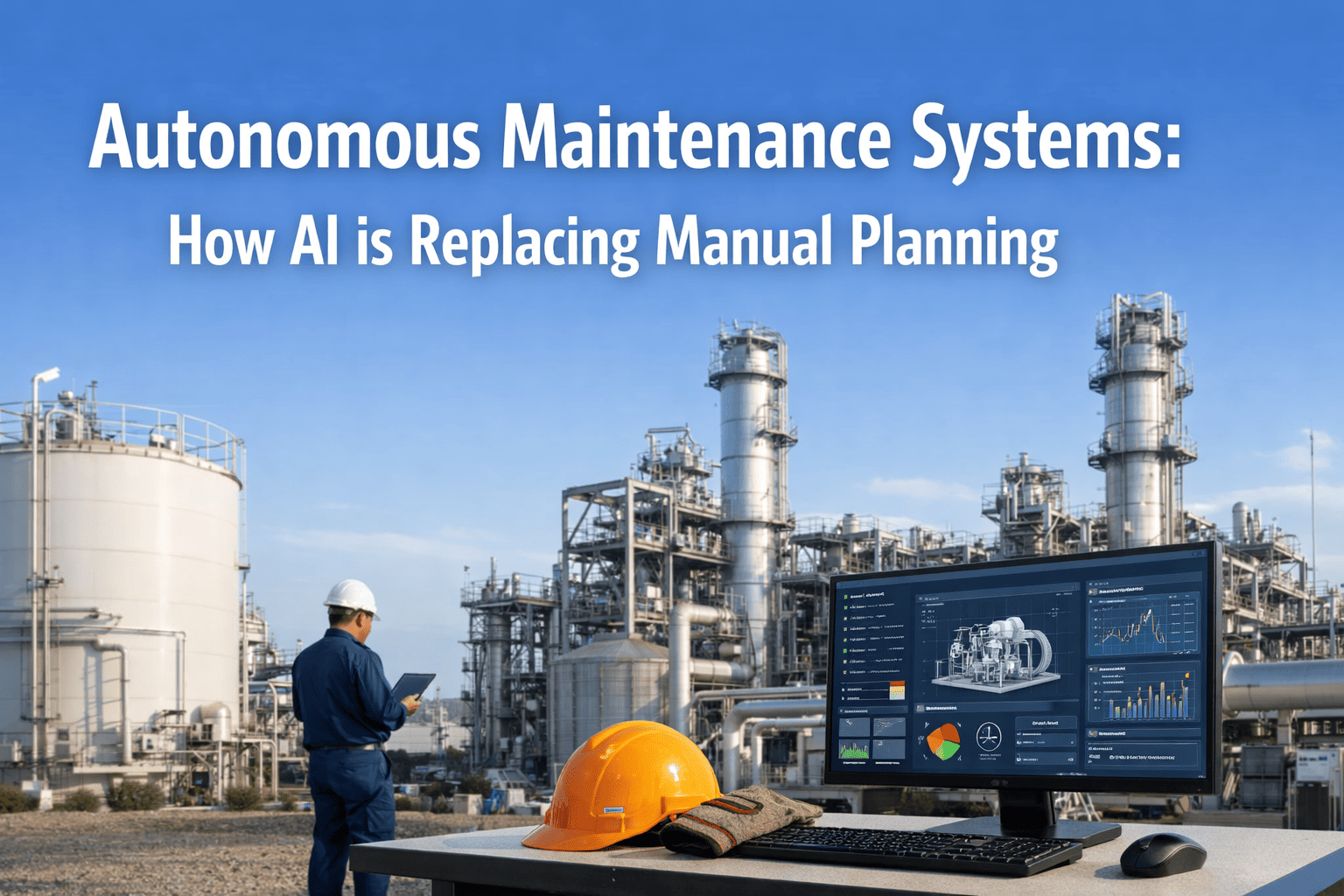
Autonomous Maintenance Systems: How AI is Replacing Manual Planning
In 2019, the reliability engineering team at a petrochemical facility in Baytown, Texas employed three full-time planners whose primary job was to look at maintenance backlogs, check equipment histories, review PM schedules, and decide what work should be prioritised each week. Every Monday morning, those three planners produced a week's worth of work orders from scratch — manually consulting four systems, reconciling technician availability with asset criticality, and making judgment calls on deferral vs acceleration. Today, that facility runs OxMaint. The three planners still exist. But they no longer spend Monday mornings building work queues from scratch. The AI maintenance engine does it overnight — pulling sensor data, PM schedules, asset criticality ratings, parts availability, and technician skill matrices into an optimal weekly work plan before the first shift begins. The planners review, adjust, and approve. What used to take 18 hours of planning labour per week now takes 2 hours of review. The work orders are better — based on current condition data, not last month's PM calendar. The planners are better — freed from schedule-building to focus on reliability strategy and root cause analysis. Sign in to OxMaint to deploy AI maintenance planning at your facility, or book a demo to see how OxMaint's autonomous planning engine works for your asset mix.
Autonomous Maintenance · AI Planning Engine · OxMaint 2026
Autonomous Maintenance Systems: How AI Is Replacing Manual Planning — Not Maintenance Workers
AI-driven CMMS doesn't replace maintenance technicians — it replaces the manual scheduling, prioritisation, and planning work that consumes 30–40% of a planner's week without adding direct maintenance value. The technicians maintain. The AI plans.
average weekly planning labour replaced by OxMaint AI work queue generation — Baytown facility, reduced to 2-hour planner review
34%
improvement in PM compliance rates when AI scheduling replaces manual planning — AI considers real-time availability, parts, and asset condition simultaneously
2026
marks the inflection year — 40% of CMMS platforms now offer AI planning modules; 80% of industrial CMMS RFPs now specify AI scheduling as a requirement
$4.2M
average annual value of downtime avoided at a 500-asset chemical plant running autonomous maintenance scheduling — vs manual PM planning baseline
Autonomous maintenance is not a technology category — it is a maturity state. It describes the point at which a maintenance programme has sufficient data quality, sensor integration, and AI model accuracy that the system can generate, assign, and optimise maintenance work with minimal human input. Most organisations are 2–4 years from full autonomy. OxMaint builds the data infrastructure and AI capability that closes that gap year by year — starting with scheduling assistance and progressing to full autonomous planning.
The Autonomous Maintenance Maturity Ladder — Where Is Your Organisation?
AI generates, assigns, optimises, and adjusts all maintenance work autonomously. Humans set strategy and review exceptions. Self-healing systems initiate maintenance actions without work orders for micro-corrections.
AI-first operations · 2027–2030 horizon
Level 4
AI-Supervised Planning
AI generates complete weekly/monthly work plans from real-time condition, parts, and skill data. Planners review and approve — 2 hours vs 18 hours. OxMaint current capability for mature deployments.
OxMaint Advanced — Available Now
Level 3
AI-Assisted Scheduling
AI recommends work order priority adjustments, surfaces overdue items, and flags condition anomalies. Planners make decisions with AI intelligence. OxMaint standard deployment.
OxMaint Standard — Available Now
Level 2
Digital PM Programme
Scheduled PM work orders generated automatically. Manual prioritisation and assignment. Maintenance history captured digitally. Most CMMS deployments start here.
CMMS foundation — 30–90 day deployment
Level 1
Reactive / Paper-Based
Maintenance triggered by failure. Paper work orders. No asset history. No PM compliance tracking. 67% of industrial facilities globally are still at this level.
Starting point for most deployments
Six Maintenance Planning Tasks AI Is Replacing in 2026
Weekly Work Queue Generation
Manual planners spend 3–5 hours weekly building work queues from PM schedules, inspection findings, and backlog lists. OxMaint's AI engine generates an optimised weekly work queue overnight — ranking work orders by asset criticality, technician availability, parts on hand, and current condition data — ready for planner review at shift start.
PM Interval Optimisation
Fixed-interval PM schedules over-maintain assets with light duty cycles and under-maintain assets running beyond design load. OxMaint AI analyses actual operating conditions per asset and recommends interval adjustments — extending where condition data shows no degradation, accelerating where sensor data shows elevated wear rates.
Technician-to-Task Matching
Optimal technician assignment requires matching skill certification, zone proximity, current workload, and parts availability simultaneously — a multi-variable optimisation problem that manual planners solve approximately. AI solves it exactly, reducing travel time, skill mismatch, and repeated return visits on the same work order.
Shutdown and Outage Planning
Planned maintenance shutdowns involve hundreds of work orders sequenced by dependency, resource constraint, and critical path. OxMaint AI generates shutdown work plans with dependency logic, identifies critical path items that determine minimum shutdown duration, and adjusts the plan in real time as work progresses ahead of or behind schedule.
Parts and Materials Pre-Staging
Work orders that arrive at the asset without the right parts waste technician time and extend downtime. OxMaint AI identifies parts requirements for all upcoming work orders 7–14 days in advance — triggering procurement for items not in stock and pre-staging stocked parts to the appropriate work area before the work order is dispatched.
Failure Risk Prioritisation
Manual planners prioritise by due date and perceived urgency — they lack the data to rank assets by actual failure probability. OxMaint's AI digital twin calculates failure risk probability per asset daily, surfacing assets approaching failure threshold that have no work order scheduled — before the failure occurs.
OxMaint AI Automation Engine · Autonomous Maintenance Planning
Your Planners Should Be Doing Reliability Engineering — Not Building Work Queues From Scratch Every Monday.
OxMaint AI generates optimised maintenance work plans automatically. Your team reviews, approves, and focuses on the reliability work that actually requires human expertise.
AI Planning Data Flow · Overnight Optimisation Cycle · Daily Work Queue Generation
Inputs · Continuous
Data Collection
Sensor readings, PM due dates, asset condition ratings, parts inventory levels, technician availability and certifications, work order backlog — all updated continuously
→
Processing · Overnight
AI Optimisation
Digital twin failure models, criticality weighting, resource constraint solver, and parts availability check run simultaneously to generate an optimised work plan
→
Output · Morning
Planner Review
Planners receive the AI-generated work queue with confidence scores and reasoning for each assignment — review takes 2 hours vs 18 hours of manual build
Technology Stack — What Powers OxMaint Autonomous Maintenance
AI Digital Twin — Asset Condition Modelling
Each asset has a digital twin continuously updated from sensor data, PM history, and operating conditions. The twin computes current failure probability per asset daily — this is the condition signal that autonomous scheduling uses to adjust work order priority beyond fixed PM calendar dates.
AI Camera Vision — Automated Inspection Findings
Inspection cameras at strategic asset locations continuously scan for visual condition anomalies — corrosion, leak indicators, structural changes — and feed findings to the autonomous planning engine without manual inspection triggers. Camera findings generate work orders before the next scheduled inspection cycle.
PLC / SCADA Integration — Real-Time Process Data
OxMaint pulls process variable data from PLC and SCADA systems in real time — temperature trends, vibration signatures, pressure differentials, and flow anomalies — feeding the AI scheduling engine with live operational context that manual planners never had access to at planning time.
For mobile asset fleets, OBD telematics data feeds OxMaint's autonomous scheduling engine — vehicle usage patterns, fault code emergence, and component operating hours all inform AI-generated PM triggers that replace fixed-calendar fleet maintenance scheduling.
SAP / ERP Integration — Capital Decision Automation
When OxMaint's AI digital twin determines that an asset has reached its economic repair limit, it automatically generates a capital replacement recommendation to SAP — with supporting condition data, repair cost history, and remaining useful life estimate — enabling capital planning to respond to actual asset condition rather than age-based depreciation schedules.
Natural Language Work Order Generation
OxMaint's AI assistant generates work order descriptions, checklist steps, safety precautions, and parts lists from asset type and failure mode — technicians receive complete, contextualised work instructions without planner narrative writing. AI drafts; planners review; quality is consistent regardless of the planner who approves it.
Industry Deployment — Autonomous Maintenance in Practice
Industry · Petrochemical
Petrochemical & Refining
PSM-covered rotating equipment, heat exchangers, and pressure vessels with high failure consequence. AI autonomous scheduling on critical assets with SCADA integration — OxMaint generates run-to-failure risk scores that drive the turnaround planning calendar rather than fixed inspection intervals.
$4.2M
avg annual value
AI-first
planning model
Industry · Discrete Manufacturing
Discrete Manufacturing
High machine count with OEM PM schedules that don't reflect actual duty cycles. OxMaint autonomous scheduling adapts PM intervals to actual cycle counts and condition readings per machine — reducing over-maintenance cost while maintaining uptime on bottleneck equipment.
34%
PM compliance gain
18h→2h
planning time
Industry · Utilities / Power
Power Generation & Utilities
Turbines, transformers, and substation equipment where AI autonomous scheduling must balance reliability obligation with maintenance window constraints. OxMaint optimises maintenance windows against grid demand forecasts and asset condition simultaneously — a planning problem manual planners cannot solve optimally.
NERC
compliance aligned
Grid
demand integration
18h→2h
weekly planning labour reduction at Baytown petrochemical facility — AI generates work queue overnight, planners review and approve
34%
PM compliance improvement when AI scheduling replaces manual calendar-based planning — condition-aware vs date-aware prioritisation
$4.2M
annual downtime avoidance value at a 500-asset chemical plant on OxMaint autonomous maintenance scheduling
"Three years ago, I was spending Monday mornings building work queues from four different systems. Now I spend Monday mornings reviewing what the AI built overnight. The plans are better — the AI actually knows which assets are trending toward failure and front-loads those work orders. My team's PM compliance went from 71% to 97% in 14 months. The planners are still essential. We just do reliability engineering now instead of schedule administration."
— Reliability Engineering Manager, petrochemical facility, Baytown TX, 1,200 assets, OxMaint user since 2022
Autonomous maintenance doesn't start with AI. It starts with clean data. OxMaint builds the data foundation from Day 1 that makes autonomous planning possible by Year 2.
Start with digital PM. Add condition monitoring. Let AI take over planning as your data matures. One platform for the entire journey.
Does autonomous maintenance AI replace maintenance planners?
No — it replaces the schedule-building and queue-generation work that consumes 60–70% of a planner's time, freeing them for reliability engineering, root cause analysis, and capital planning that requires human expertise. The Baytown example shows 18 hours of planning labour replaced by 2 hours of AI review — the planners still exist, they just do more valuable work.
How much data does OxMaint need before autonomous scheduling becomes effective?
OxMaint begins delivering scheduling recommendations from Day 1 using industry benchmark data for asset types that don't yet have facility-specific history. Asset-specific AI accuracy improves continuously — organisations typically see meaningful autonomous scheduling capability within 6–12 months of deployment, with full AI-supervised planning available by 18–24 months for mature implementations.
Can OxMaint autonomous scheduling account for production schedule constraints?
Yes — OxMaint integrates production schedule data from ERP and MES systems, constraining maintenance work orders to permitted maintenance windows and flagging conflicts between planned maintenance and production commitments before dispatch. The AI optimises within operational constraints, not against them.
What happens when the AI scheduling recommendation is wrong?
Every AI-generated work plan is subject to planner review and override before dispatch — OxMaint operates at AI-supervised Level 4, not fully autonomous Level 5, for most deployments. When planners override AI recommendations, the system records the override reason and uses it as training data — improving future recommendations based on the accumulated judgment of your reliability team.
How does OxMaint autonomous maintenance handle emergency breakdowns that disrupt the AI plan?
When an unplanned breakdown occurs, OxMaint's AI reoptimises the affected site's work queue in real time — rescheduling displaced PM work orders, adjusting technician assignments, and surfacing the new critical path for supervisors. The AI responds to disruption faster than manual replanning and produces a documented rationale for all schedule changes created by the emergency response.
Start Your Journey to Autonomous Maintenance. The AI Builds the Plan. Your Team Executes It.
Every day of manual planning is a day of sub-optimal maintenance scheduling. OxMaint AI starts improving your plans from the first week of deployment.