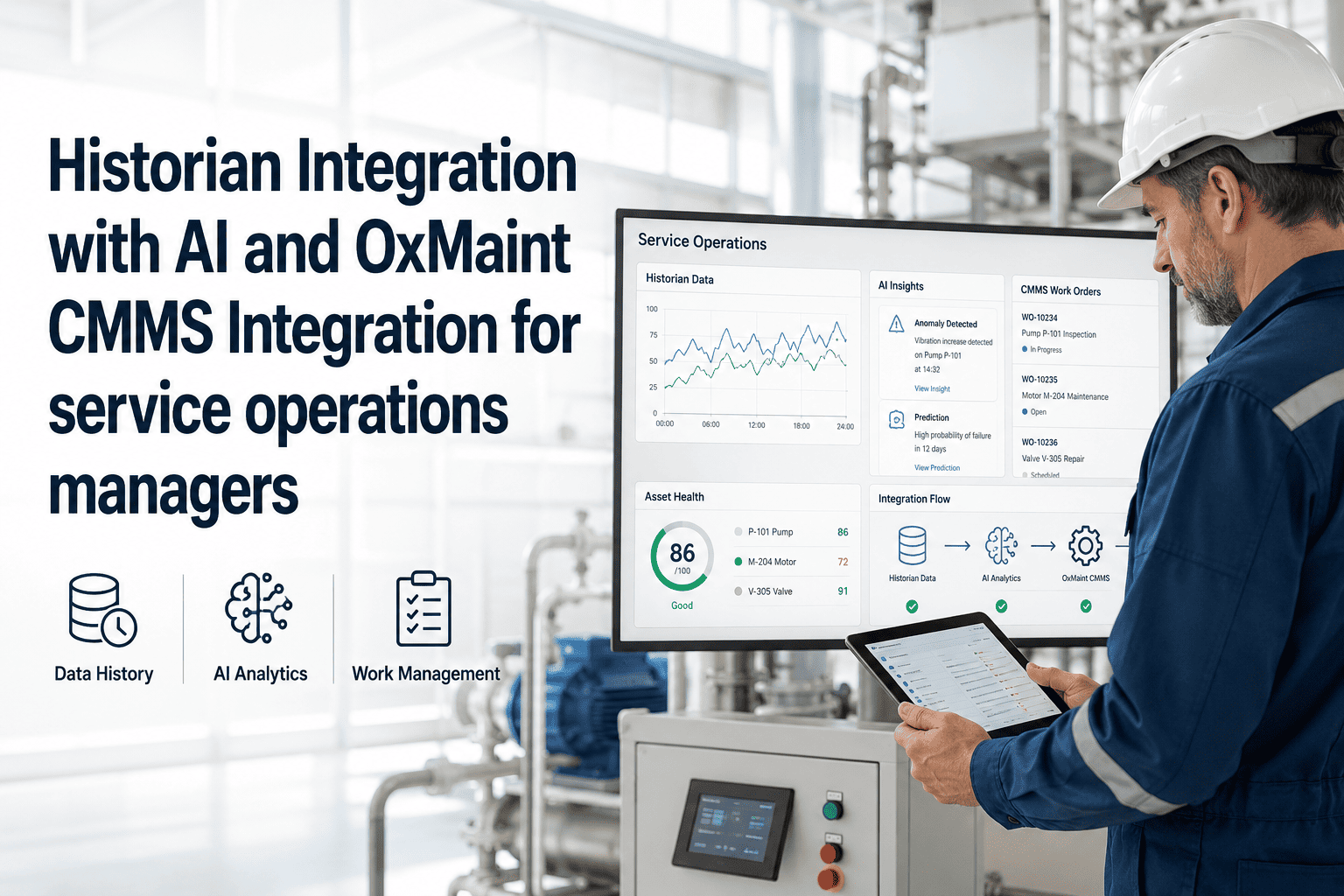
Campus facilities directors managing education campuses — universities, colleges, and multi-building institutional campuses — operate dozens of building systems simultaneously: HVAC, electrical, elevators, water systems, fire suppression, and access control. Each of these systems generates continuous operational data through building management system historians. Without a structured integration connecting historian data to a CMMS, facilities directors manage reactively — responding to failure calls instead of acting on the predictive signals their own systems are already generating. OxMaint's CMMS integration with AI-driven historian analysis gives campus facilities directors a unified platform where BMS historian data becomes scheduled maintenance, compliance documentation, and capital planning intelligence — for every building system across every campus building, from a single dashboard.
HISTORIAN INTEGRATION · CAMPUS FACILITIES · AI-DRIVEN CMMS
Your campus BMS has been predicting failures for years. It is time your CMMS listened.
Education campus facilities directors are managing 50 to 200 building systems on limited maintenance budgets with high occupant expectations. OxMaint turns your BMS historian data into scheduled maintenance, compliance records, and capital planning intelligence — without adding headcount.
THE CAMPUS FACILITIES CHALLENGE
What campus facilities directors face every semester
60+
Building systems per campus building
The average university building runs HVAC, electrical, plumbing, elevators, fire suppression, and access control — each generating its own historian data that rarely reaches the maintenance team in time.
43%
Of campus maintenance is still reactive
Despite BMS investment, 43% of campus facilities maintenance remains demand-driven rather than predictive — because historian data is monitored in BMS dashboards rather than converted to maintenance actions (APPA, 2023).
72 hrs
Average occupant impact before HVAC failure is resolved
Campus HVAC failures that could be predicted from historian trends an average 96 hours in advance instead result in 72-hour resolution windows — disrupting classes, labs, and dormitories.
HOW IT WORKS
How OxMaint historian integration works for campus facilities
1
BMS Historian Connection
OxMaint connects to your campus BMS — Siemens Desigo, Honeywell EBI, Johnson Controls Metasys, or similar — via API or OPC-UA. All building system historian data streams into OxMaint's AI analysis layer without disrupting existing BMS operations.
2
AI Pattern Analysis
Machine learning models identify anomaly patterns in your building system historian data — HVAC efficiency drift, elevator cycle deviation, electrical load imbalance — specific to each building's operational profile across academic calendar seasons.
3
Scheduled Work Order Generation
Validated anomalies trigger scheduled maintenance work orders — not emergency calls. Work orders are assigned to the right technician or contractor, with the historian context attached and parts requirements flagged from the asset's BOM.
4
Compliance & Capital Planning Records
Every completed work order feeds the compliance record and the asset's lifecycle history — giving facilities directors the documented maintenance evidence required for accreditation reviews and the asset performance data needed for capital budget justification.
CAMPUS BUILDING SYSTEMS COVERED
Which campus systems benefit from historian-AI maintenance integration
| Building System |
Historian Signal |
OxMaint Maintenance Action |
Occupant Impact Prevented |
| HVAC / AHU |
Filter DP rise, coil efficiency drop, supply temp deviation |
Filter change WO scheduled, coil cleaning PM triggered |
Classroom / lab temperature complaints |
| Elevators |
Motor current anomaly, door cycle time deviation, vibration signal |
Predictive service WO, safety inspection flag |
Elevator outage in lecture buildings |
| Electrical Systems |
Harmonic distortion rise, load imbalance, breaker trip frequency |
Electrical PM WO, contractor routing |
Power interruption to labs, data centres |
| Water Systems |
Flow rate anomaly, pressure drop, temperature deviation (legionella risk) |
Plumbing PM WO, health compliance flag |
Dormitory water service disruption |
| Fire Suppression |
Pressure tank deviation, valve actuation anomaly |
Compliance inspection WO, regulatory notification |
Life safety compliance failure |
| Access Control / Security |
Door hardware cycle count, reader response anomaly |
Preventive hardware PM WO |
Campus security event at building entry |
EXPERT REVIEW
What campus facilities directors and engineers say
Campus facilities directors are under a specific pressure that industrial maintenance managers are not — their customers are students and faculty who have very direct and very public ways of expressing dissatisfaction with HVAC or elevator failures. Predictive maintenance from historian integration is not just a cost decision for campuses; it is a reputation decision.
Dr. Anita Rao
Director of Campus Operations, South Indian University, 4,000+ student enrollment
University accreditation bodies now routinely ask for documented maintenance records and compliance evidence for building systems. Facilities directors who are still relying on paper-based maintenance logs are walking into those reviews at a significant disadvantage. Historian-integrated CMMS platforms make compliance documentation automatic, not manual.
James Whitfield
Campus Facilities Compliance Consultant, Higher Education Sector
TAKE THE NEXT STEP
Give your campus BMS historian data a place to go — and turn it into scheduled maintenance
OxMaint's campus facilities implementation typically takes 2 to 3 weeks from BMS historian connection to first auto-generated work orders. Most campuses start with HVAC and elevator systems — their highest-impact and most historian-data-rich assets — then expand across building systems over the following semester.
COMMON QUESTIONS
Campus historian-CMMS integration — what facilities directors ask before getting started
Which BMS platforms does OxMaint integrate with for campus building historian data?
OxMaint connects to Siemens Desigo CC, Honeywell Enterprise Buildings Integrator, Johnson Controls Metasys, Schneider EcoStruxure Building, and Tridium Niagara via BACnet, OPC-UA, and REST API. For campuses running multiple BMS platforms across buildings — common in older institutions that have added systems over decades — OxMaint provides a unified data normalization layer.
Book a demo to confirm connectivity for your campus BMS portfolio and see multi-BMS historian normalization in a live demonstration.
How does OxMaint handle seasonal variation in campus building system historian baselines — like HVAC load differences between academic semester and summer break?
OxMaint's AI anomaly models are configured with seasonal operating profiles specific to your campus calendar. HVAC baselines for a fully occupied semester week are stored and applied separately from summer break baselines, ensuring anomaly detection does not flag normal low-occupancy operation as a maintenance signal.
Start a free trial to configure seasonal baseline profiles for your campus systems. Profile setup takes under one day per building system category with your BMS historian data as input.
Can OxMaint generate the documented maintenance evidence required for university accreditation reviews?
Yes. OxMaint's compliance module generates structured maintenance records for every work order — including the historian signal that triggered the work, the scheduled date, the technician or contractor who completed it, and the outcome with photo evidence. These records are exportable as PDF or structured data files accepted by NAAC, NBA, and international accreditation bodies for building systems compliance documentation.
Book a demo to review a sample compliance export in the format used by campus facilities teams preparing for accreditation reviews.
How does historian integration help campus facilities directors make capital budget decisions for aging building systems?
OxMaint builds an asset lifecycle record from historian data and work order history for every building system — tracking repair frequency, cost accumulation, and performance degradation trend over time. When repair cost curves indicate an asset is approaching end-of-life, OxMaint generates a capital replacement flag with documented evidence. This gives facilities directors the quantitative data required to justify replacement budget requests to university administration — replacing subjective asset condition assessments with data-backed lifecycle analysis.
READY TO TRANSFORM CAMPUS MAINTENANCE
Connect your campus BMS historian to OxMaint — and manage every building system predictively, not reactively.
Campus facilities teams using OxMaint's historian integration report 30–50% reductions in reactive maintenance events per semester, accreditation audit preparation cut from weeks to days, and capital budget justification backed by data rather than estimates. Your BMS historian is already generating the intelligence. OxMaint gives it somewhere to go.