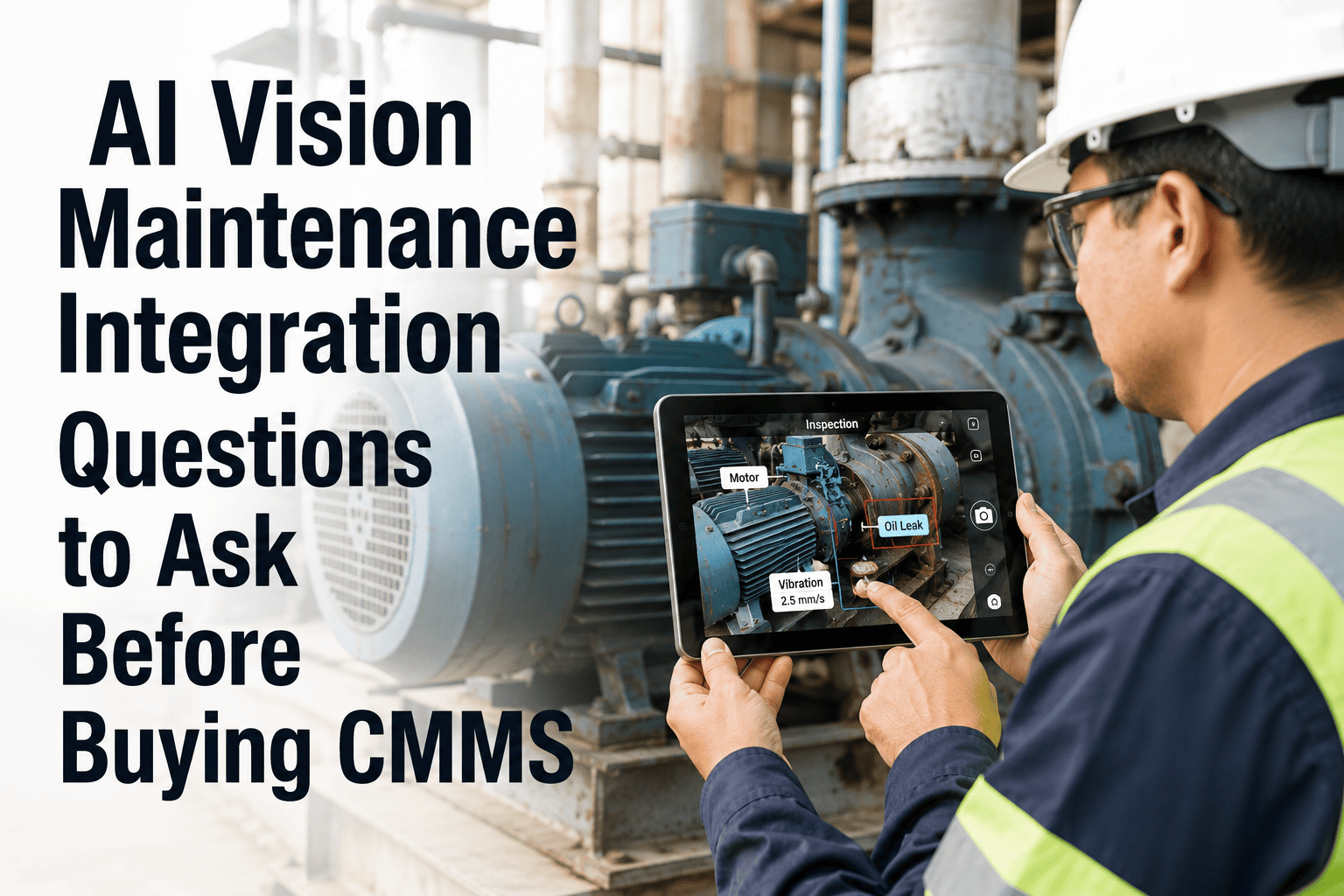
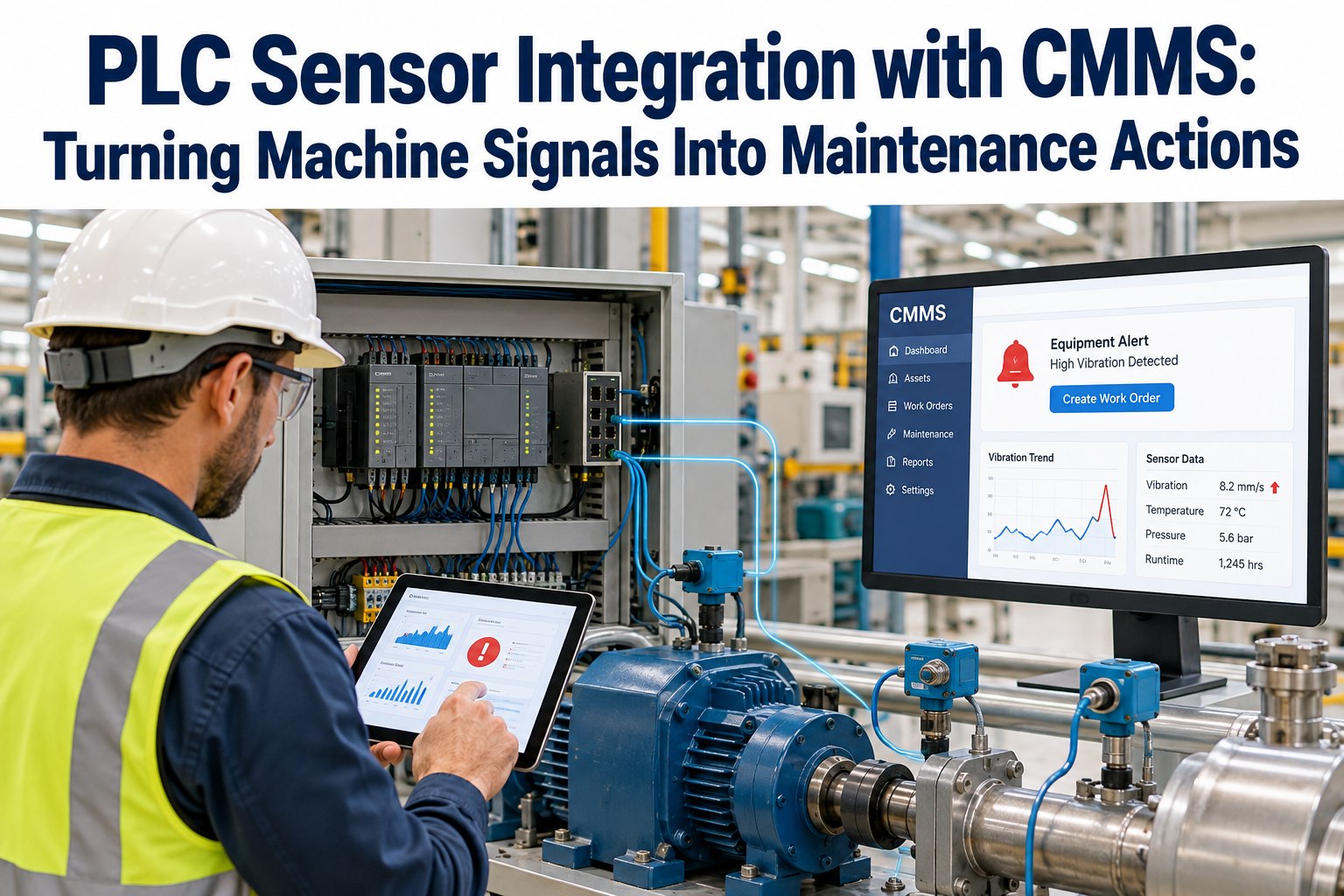
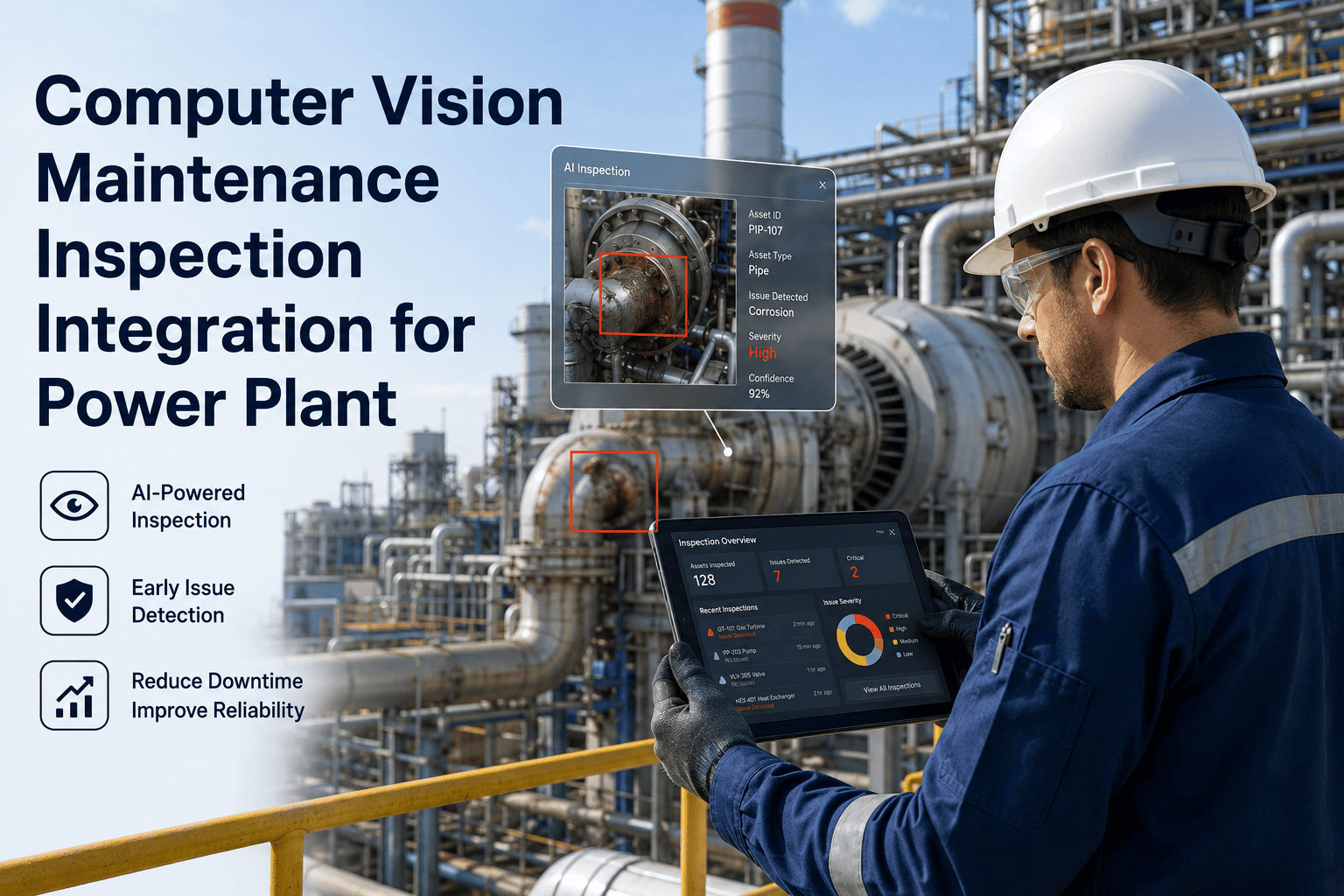
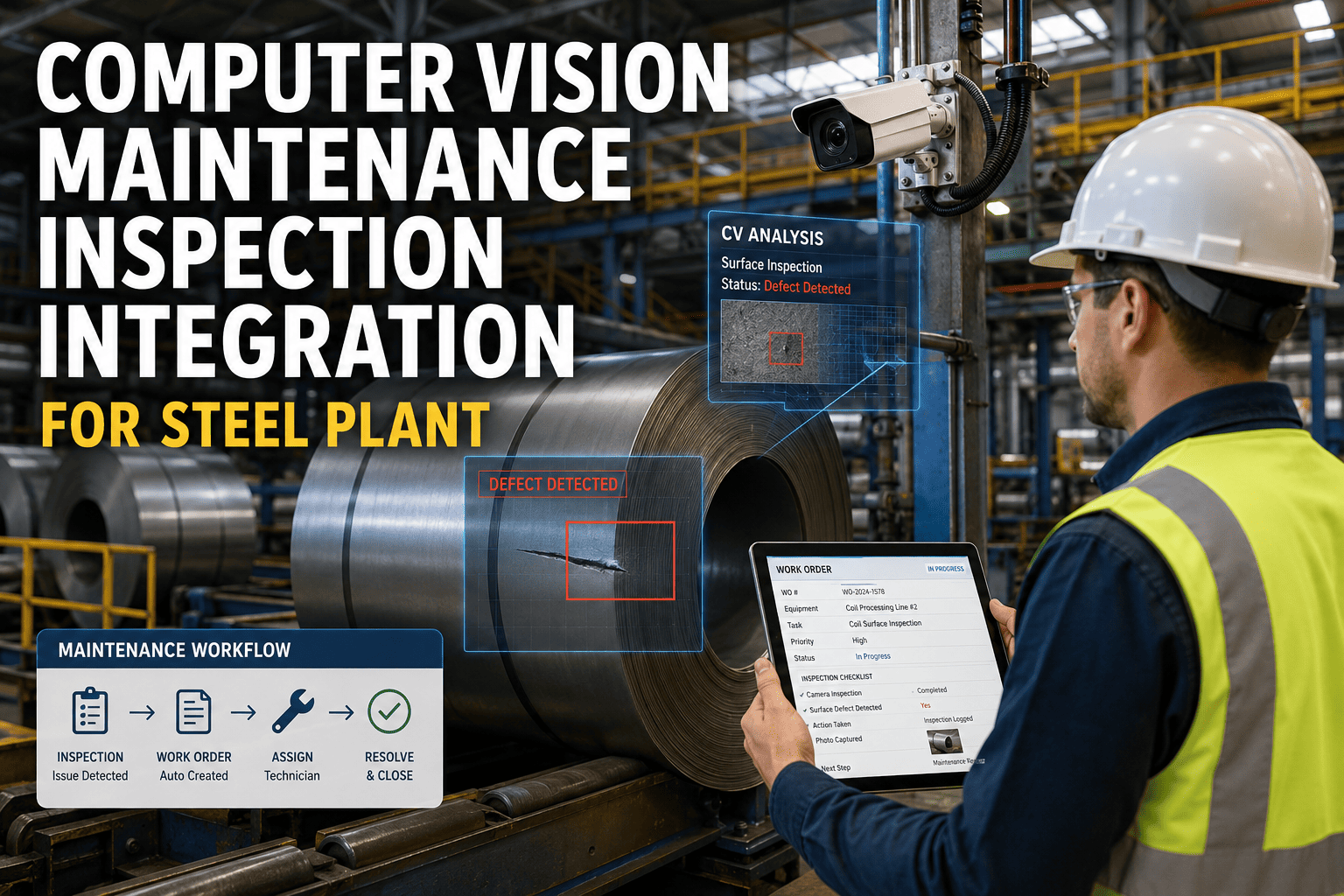
Before signing a CMMS contract, most maintenance teams ask about price, implementation time, and support hours — but the questions that actually determine ROI are about AI vision integration depth. Can the system ingest a photo from a technician's phone and auto-generate a prioritized work order? Does it correlate visual defect evidence with asset history? Does the AI learn from your specific failure modes — or just apply generic models? These are the questions that separate platforms that look good in a demo from ones that drive measurable uptime gains. Book a 30-minute live demo with OxMaint and bring your integration checklist — we will answer every question against your actual asset data.
Buyer's Guide · AI Vision + CMMS
AI Vision Maintenance Integration: Questions to Ask Before Buying CMMS
40%
Defects missed by human-only visual inspection (McKinsey, 2024)
97–99%
Defect detection accuracy with AI computer vision systems
6–9 mo
Typical full ROI payback on AI vision + CMMS deployment
Why These Questions Matter
The Hidden Integration Gap Most Buyers Discover Too Late
Most CMMS vendors demo flawlessly — but fall short after go-live when AI vision data cannot flow cleanly into work orders, technician assignments, or asset history. The gap is always in integration architecture, not features. Ask these 12 questions before you sign.
Category 1 — Visual Evidence Capture
Q1
Does image capture work from any mobile device or only proprietary hardware?
Why it matters: Proprietary camera lock-in inflates deployment cost by 40–60% and slows technician adoption.
Q2
Is visual evidence (photo + defect annotation) stored against the asset record permanently?
Why it matters: Audit trails without visual proof fail regulatory inspections and insurance claims.
Q3
Can the AI classify defect type (corrosion, crack, wear, leak) — not just flag anomalies?
Why it matters: Generic anomaly detection requires human re-classification, eliminating the automation benefit.
Category 2 — Work Order Automation
Q4
How long between visual defect detection and work order creation — seconds or minutes?
Why it matters: Delays above 5 minutes allow defects to move downstream; best-in-class is under 30 seconds.
Q5
Does the system auto-assign work orders based on defect type, severity, and technician skill?
Why it matters: Manual assignment re-introduces the dispatcher bottleneck AI is supposed to eliminate.
Q6
Are parts requirements predicted from the defect classification before the technician dispatches?
Why it matters: Arriving on-site without parts causes 35% of repeat maintenance visits.
Category 3 — Integration Architecture
Q7
What protocols does the vision module use — REST API, OPC-UA, MQTT, or proprietary?
Why it matters: Proprietary protocols block future integrations with ERP, IoT sensors, and historian systems.
Q8
Can vision data be pushed to SAP PM, Maximo, or existing CMMS without middleware?
Why it matters: Middleware adds $20K–$80K implementation cost and a single point of failure.
Q9
Is edge inference available — can the AI run on-site without cloud connectivity?
Why it matters: Manufacturing floors with unreliable connectivity need local inference to avoid data loss.
Category 4 — AI Model Quality
Q10
How is the AI model trained — on generic datasets or on your facility's defect history?
Why it matters: Generic models deliver 70–80% accuracy; facility-trained models reach 97–99%.
Q11
Does the model retrain automatically from technician feedback on false positives?
Why it matters: Static models degrade over time as equipment ages; continuous learning compounds accuracy gains.
Q12
What is the vendor's documented false positive rate — and how is it benchmarked?
Why it matters: High false positive rates erode technician trust, causing teams to bypass AI alerts entirely.
See OxMaint Answer Every One of These Questions — Live
Bring your integration checklist to a 30-minute demo. We run it against your asset types and show AI vision to work order in real time.
Vendor Scorecard
How to Score AI Vision CMMS Vendors on Integration Depth
| Integration Capability |
Basic Tier |
Mid-Market |
OxMaint AI |
| Mobile image capture (any device) |
Proprietary hardware |
iOS/Android app |
Any device + edge camera |
| Defect classification (type + severity) |
Anomaly flag only |
3–5 defect categories |
25+ defect types, custom-trained |
| Work order auto-creation latency |
> 15 min (manual) |
2–5 min |
< 30 seconds |
| Parts prediction at defect detection |
Not available |
Manual lookup |
Auto-suggested from defect type |
| API protocol (open standard) |
Proprietary only |
REST only |
REST, OPC-UA, Modbus, MQTT |
| Continuous model retraining |
Annual retraining |
Quarterly update |
Continuous from technician feedback |
Expert Review
What Analysts and Engineers Say About AI Vision Integration
"The most common failure point in AI vision CMMS deployments is not the computer vision model — it is the integration handoff. Teams spend 60–70% of implementation time mapping defect events to work order fields that were never designed to receive AI-generated inputs. Platforms that ship with a pre-built vision-to-CMMS schema reduce go-live time from months to weeks and dramatically improve first-year adoption rates."
— Plant Engineering Journal, AI Maintenance Integration Report, Vol. 58, 2024
"Buyers who evaluate CMMS platforms on AI vision criteria before purchase — specifically model retraining cadence, false positive benchmarks, and open API protocols — achieve 2.3x higher ROI than those who evaluate on feature lists alone. The questions you ask before signing determine whether AI adds compounding value or becomes shelf-ware within six months of go-live."
— Gartner Peer Insights, Maintenance Technology Buyer Survey, 2024
FAQs
Frequently Asked Questions
What is the most important AI vision integration question to ask a CMMS vendor?
Ask how the AI model is trained and how it improves over time. A vendor using only generic pre-trained models will deliver 70–80% defect detection accuracy at best. You need a system that trains on your specific equipment, failure modes, and environmental conditions — and retrains continuously from technician feedback.
OxMaint's AI models are tuned per facility and improve automatically with every closed work order. This single factor determines whether your AI vision investment delivers compounding ROI or plateaus after month three.
How do I evaluate if a CMMS API can truly support AI vision data at production volume?
Request a load test during your demo: ask the vendor to push 500 defect events per hour through the API and measure work order creation latency. Production facilities with high-throughput inspection generate event volumes most CMMS APIs were never stress-tested for. Demand documented SLA benchmarks for API response time under peak load.
Book a technical demo with OxMaint to see our API architecture handle real production event rates — we will share our published throughput benchmarks in the first 10 minutes.
Can AI vision CMMS systems work in facilities with limited or no internet connectivity?
Yes — but only if the platform supports edge inference. Edge inference runs the AI model locally on an on-site device, queuing work order creation events until connectivity is restored. Without edge support, every network outage is also an inspection gap. Ask specifically whether the edge device supports model updates over low-bandwidth connections and how data reconciliation is handled when the device reconnects. OxMaint supports both cloud and edge inference modes, switchable per facility zone.
Start a free trial to test edge mode in your environment.
How long does AI vision CMMS integration typically take from contract to live alerts?
With a well-architected platform and open API, initial integration — connecting cameras or mobile capture to work order creation — typically takes 2–4 weeks. Full deployment including model training on your defect history and technician onboarding adds 4–6 weeks. Vendors requiring custom middleware or proprietary connectors typically add 8–16 weeks to this timeline and introduce ongoing maintenance overhead.
OxMaint's implementation team targets live alerts within 3 weeks from contract signature for standard deployments.
OxMaint AI Vision
Ready to Run Your Checklist Against a Real Platform?
Every question on this page has a documented answer in OxMaint. Book a demo and we will walk through your specific integration requirements — camera types, existing CMMS, ERP connections, and technician workflow — in 30 minutes.