A rolling mill bearing can show stress signatures for weeks before it fails, and a furnace refractory lining can spall slowly along a wall for months before a breakout, but if nobody happens to be standing in that exact spot when the change appears, the warning sign disappears into the noise of the next shift. Steel plants schedule inspection rounds because walking every zone continuously is not realistic, which means the hottest, loudest, and most hazardous areas of the plant, the ones most likely to fail, get checked the least often. Computer vision closes that gap by watching continuously through cameras already mounted on cranes, conveyors, and furnace walls, flagging what a trained inspector would flag, and sending it straight to maintenance instead of a logbook nobody opens until next week. OxMaint converts every one of those detections into a tracked work order, complete with photo evidence, asset history, and a technician sign-off.
Computer Vision Maintenance Inspection Integration for Steel Plant Teams
Pair the cameras already watching your cranes, conveyors, and furnace walls with OxMaint's predictive maintenance engine, and every defect your AI model flags becomes a work order with photo proof and asset history attached, before the shift supervisor even hears about it on the radio.
Coverage Snapshot
What Missed Defects Actually Cost a Steel Plant
$187,500
$1M+
20-30%
95-99%
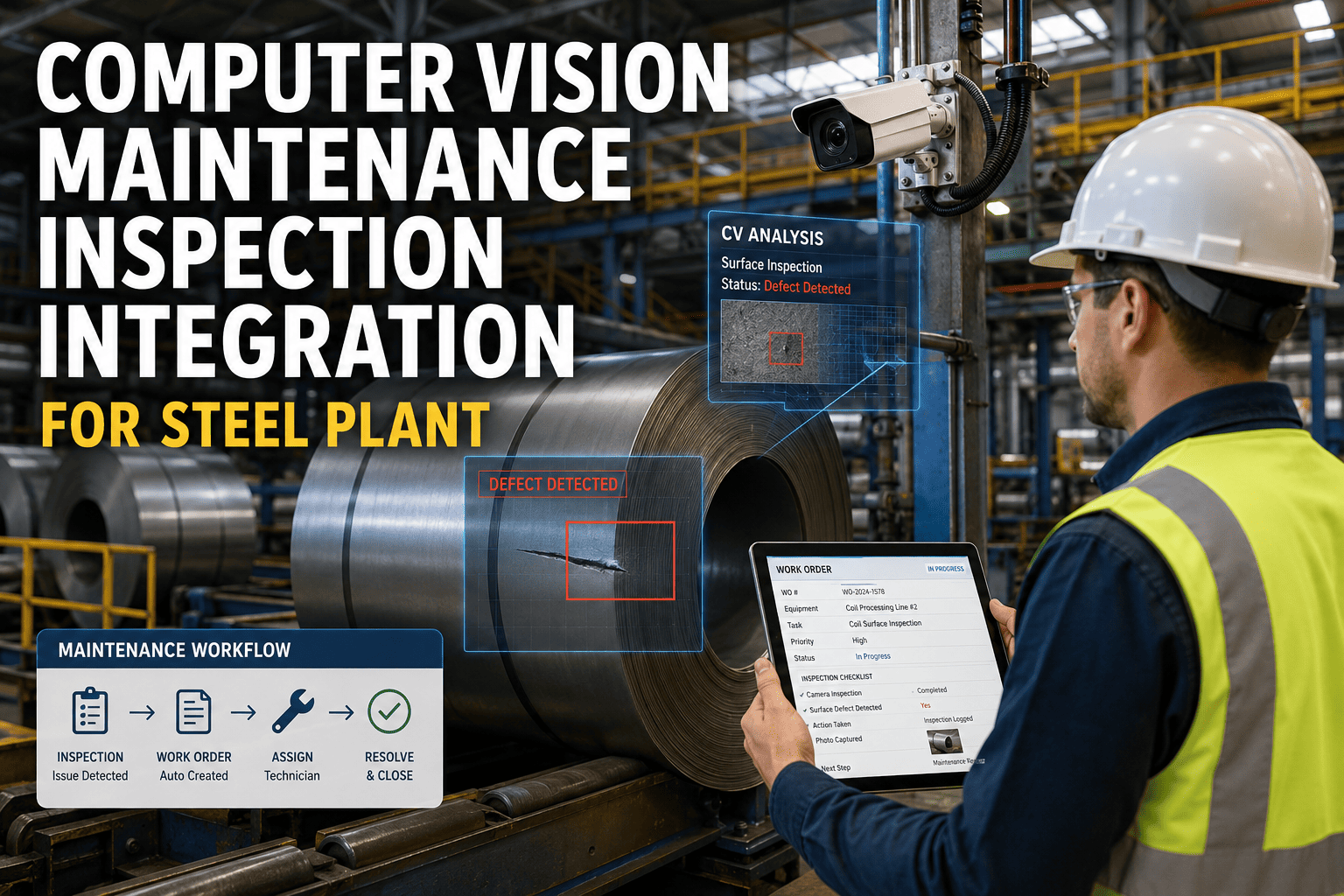
From Camera Frame to Closed Work Order
Capture
Cameras on cranes, conveyors, and furnace walls record continuously across every shift.
Detect
The trained model flags cracks, wear, leaks, and misalignment against a known-good baseline.
Generate
OxMaint's API receives the detection and auto-creates a work order with the asset ID and photo attached.
Dispatch
The assigned technician opens the order on mobile with the full repair history for that exact asset.
Close & Audit
The repair is logged with a before and after photo, building a permanent, audit-ready record.
Your cameras are already watching. They just are not talking to maintenance yet.
Connect your AI vision feed to OxMaint and turn every flagged defect into a tracked, accountable work order, automatically.
Manual Visual Inspection vs. Computer Vision Integration
| Capability | Manual Inspection Round | OxMaint Computer Vision |
|---|---|---|
| Detection accuracy | 70-80% under real shift conditions | 95-99% against trained defect classes |
| Coverage frequency | Once per shift, if the schedule holds | Continuous, every frame, every shift |
| Documentation | Handwritten or verbal handover | Timestamped photo evidence on every work order |
| Response time | Hours, pending the next round or report | Work order created within seconds of detection |
| Inspector exposure | Repeated entry into heat, dust, and height zones | Camera monitors the zone, technician enters only to repair |
| Audit trail readiness | Reconstructed manually from notes | Exportable record by asset, date, or defect type |
What Computer Vision Catches Across a Steel Plant Floor
Conveyor Belt Wear
Tracking, fraying, and misalignment caught before a belt tear stops the line.
Furnace Refractory Spalling
Lining erosion and hot spots flagged long before a breakout risk develops.
Crane Hook & Sling Wear
Deformation and surface cracking identified ahead of scheduled load testing.
Bearing Overheating
Thermal drift on mill drive bearings detected before lubricant failure cascades.
Slab & Billet Defects
Cracks, scale, and dimensional variance flagged at the caster, not after rolling.
Restricted Zone Compliance
PPE gaps and unauthorized zone entry logged alongside the asset record.
What Reliability Leaders Say About Vision-Driven Maintenance
The plants making the fastest progress on predictive maintenance are not the ones buying the most sensors, they are the ones closing the loop between detection and the work order. A camera that flags a defect and stops there has changed nothing. The value only appears once that flag becomes an assigned, tracked, and closed task inside the same system that holds the asset's repair history.
Auditors no longer accept a verbal account of an inspection round. They want a timestamped record showing what was checked, what was found, and what was done about it. Vision-based inspection paired with a CMMS produces exactly that record as a byproduct of doing the work, instead of as a separate compliance exercise nobody has time for.
Questions Steel Plant Teams Ask About Computer Vision Integration
How does computer vision connect to OxMaint's CMMS?
Do we need to replace our existing cameras to use this?
What kind of defects can computer vision realistically catch in a steel plant?
How is this different from a standalone machine vision alarm system?
Can this support regulatory or internal audit requirements?
How long does it take to go live after connecting our vision system?
The defect your camera just caught is either a work order or a future breakdown.
Connect your computer vision system to OxMaint and make sure every detection turns into a tracked repair, not a missed alert.