When the grid fails, a hospital's emergency generator is the only thing between a ventilator, an OR or an ICU and the dark — and it has ten seconds to prove it. The problem is that a generator can idle happily every month and still fail under real load, because monthly no-load runs hide the fault instead of finding it. OXMAINT AI is the AI-powered maintenance management software that schedules every NFPA 110 test — weekly, monthly, load bank and the three-year run — captures the readings, and keeps the record a surveyor checks first.
Hospital Emergency Power · NFPA 110 · Load Bank Testing · 2026
Hospital Generator Maintenance Checklist & Load Bank Testing
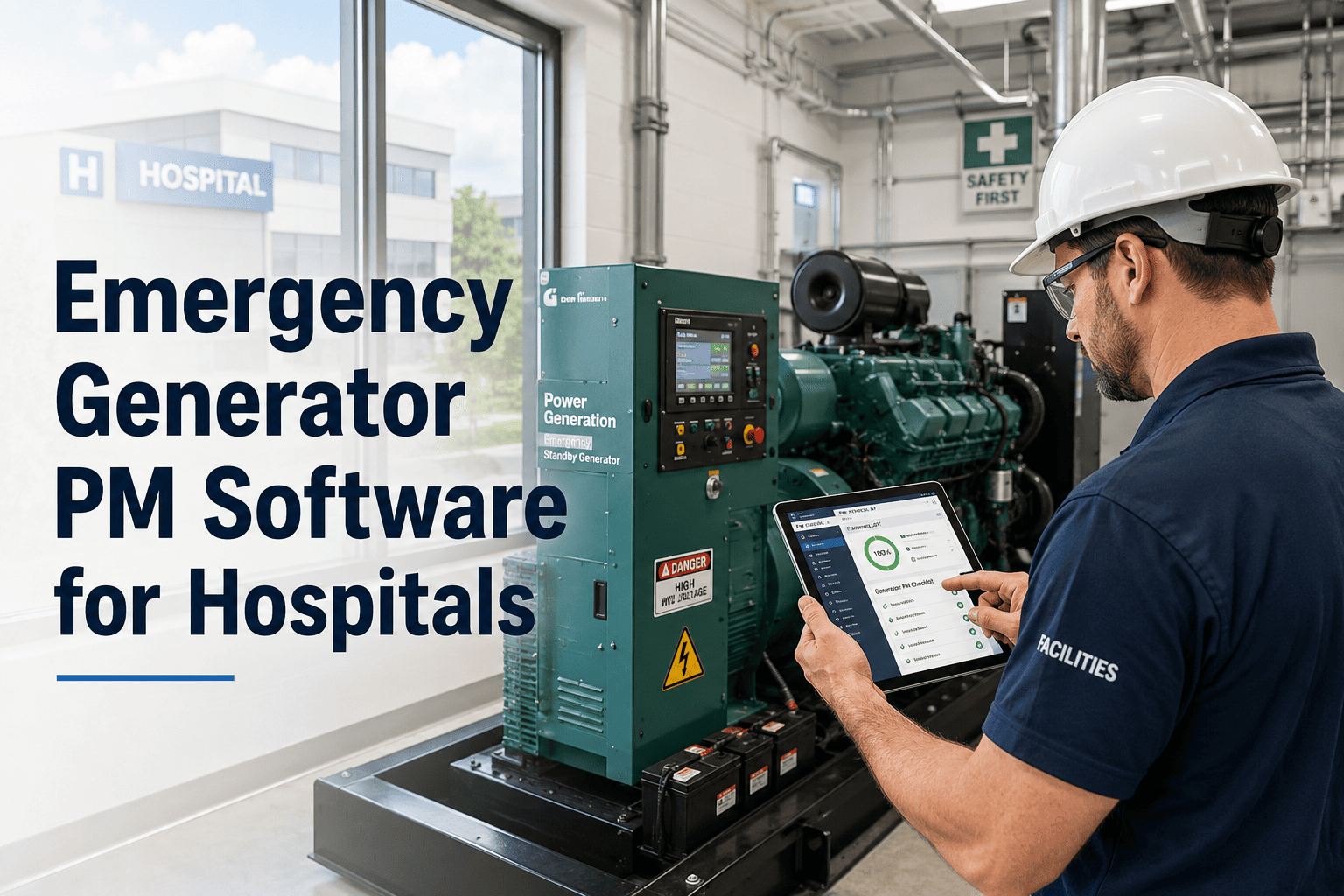
An emergency generator is only as good as its last test under load. OXMAINT AI, a healthcare facilities maintenance platform, runs the full NFPA 110 program: weekly inspections, the monthly load test, the load bank test when runs stay light, and the three-year endurance run — each scheduled, recorded and tracked to a verified repair. You prove readiness on paper before you have to prove it in an outage.
Inspect
→
Load Test
→
Load Bank
→
Record
EMERGENCY POWER · GEN-1
Last monthly load testPass
Next load bank testDue 12 d
Battery & startingOK
Fuel level92%
10-second startVerified
Scope: This checklist explains hospital emergency-power maintenance in general terms. Follow NFPA 110 and NFPA 99, Joint Commission EC.02.05.07 (or your accreditor), CMS, the generator manufacturer's instructions, and your Authority Having Jurisdiction — and use qualified personnel for testing and repairs. Load profiles, intervals and designations vary by system and edition; your written program is the authority.
10 sec
Type 10: power restored within ten seconds of an outage
30%
minimum nameplate load for the monthly test, 30 minutes
12 / yr
monthly tests, run 20 to 40 days apart
4 hr
36-month endurance test for Level 1 systems
The NFPA 110 Test Cadence
Hospital emergency power isn't tested once a year — it runs on a layered schedule, each level proving something the one below it can't. Skip a level and you're trusting the generator on faith.
Weekly
Inspection
A visual and gauge check — fluids, batteries, chargers, leaks, clear exhaust and cooling airflow, no active alarms. Catches the obvious before it becomes the outage.
Monthly
Load test
Start through the transfer switch as a simulated outage and carry at least 30% of nameplate kW for 30 minutes, recording kW, voltage, frequency, oil pressure and coolant temperature.
Annual
Load bank test
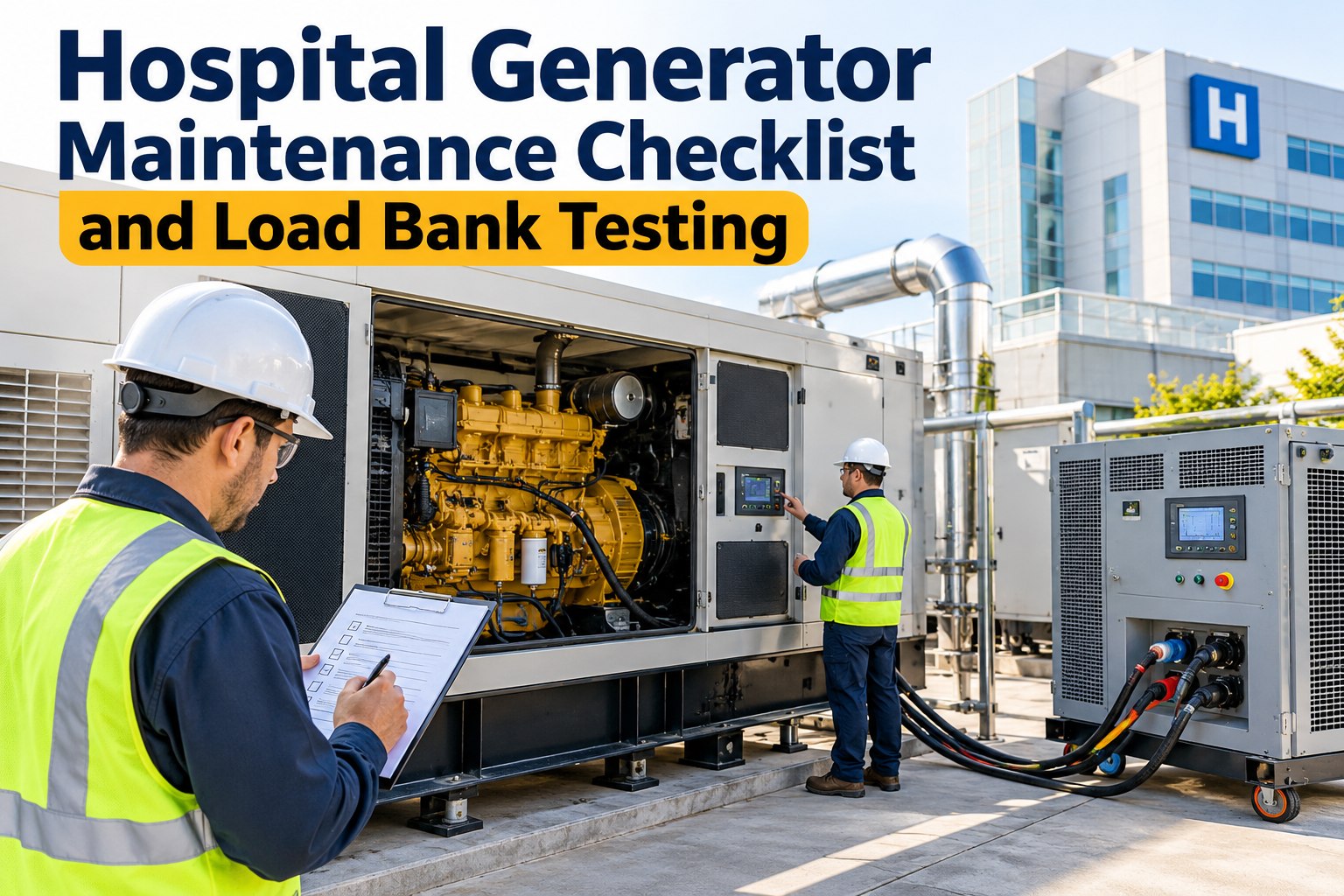
Required when monthly runs don't reach 30% load. A load bank applies a stepped load the building can't — the only way to prove full capacity and clear wet stacking.
3-Year
Endurance run
A 4-hour run under load for Level 1 systems, the final hour at 75% of nameplate — validating fuel supply, cooling, lubrication and control stability over time.
Each level has its own interval and its own record, and a surveyor can ask for any of them. Start free and put all four on one schedule in OxMaint.
Why a Load Bank Test Is Non-Negotiable
Here's the trap: a hospital's essential load is often light, so the monthly test runs the diesel well below the 30% it needs. Run a diesel underloaded for months and it develops wet stacking — unburned fuel and carbon coating the exhaust and cylinders — which quietly strangles the output you'll need when it matters.
1
Underloaded running
Light monthly loads keep combustion temperatures too low for a diesel to burn cleanly.
→
2
Wet stacking builds
Unburned fuel and carbon accumulate, glazing cylinders and fouling the exhaust.
→
3
Load bank clears it
A controlled high load burns off the deposits and proves the generator's real capacity.
A load bank applies that load artificially, in controlled steps, so you verify full output without waiting for a real emergency to do it for you. The corrective annual profile and the three-year run look like this:
3-year endurance
Under load3 hr
75%final hr
Run it, log the load held at each step, and you have proof — not a hope — that the generator carries the hospital. Book a demo to track load bank results in OxMaint.
The Generator Maintenance Checklist
Work these five sections against each generator on their own cadence. Let qualified personnel sign each item, and keep the record dated — the sign-off is what the survey trusts.
Twenty checks, one record per generator — the gap between a program and a pile of run sheets. Start free and run this checklist with a dated record in OxMaint.
A Generator That Idles Fine and Fails Under Load Fails When It Counts.
The only test that proves readiness is one under real load, on the NFPA 110 schedule. OxMaint keeps every weekly, monthly, load bank and three-year test on time, records the numbers, and raises a repair the moment one falls short — so the record proves what the outage would.
How OxMaint Runs Emergency Power
Qualified technicians run the tests and the repairs. OxMaint runs the program around them — the schedule, the readings, the repairs and the readiness record a survey turns on.
NFPA 110 Test Scheduling
Weekly, monthly, annual and three-year tests on their own cadence, each with an alert before it's due.
Load Test Readings
Capture kW, voltage, frequency, oil pressure and coolant temperature against each run, trended over time.
Load Bank Tracking
Record the load held at each step of the annual and 36-month tests, with results kept against the asset.
Battery & Fuel Monitoring
Track battery health, fuel level and quality so a dead battery or stale fuel never ambushes a start.
Corrective Repairs
A failed test or reading becomes a tracked work order with an owner and a verified close — not a note.
Readiness & Survey Records
A live view of test completion and a timestamped history per generator — the proof a surveyor asks for.
The hands-on testing stays with your team; the schedule, the numbers and the proof live in one place. Sign up free and build your emergency-power program in OxMaint.
Reviewed by OxMaint Healthcare Facilities Operations
Content was checked against NFPA 110, NFPA 99 and Joint Commission Environment of Care practice for emergency power. Test intervals, load profiles and system designations vary by edition, equipment and jurisdiction — confirm against the current code and your AHJ.
Frequently Asked Questions
How often must a hospital generator be tested?
Weekly inspection, a monthly load test (12 per year, 20 to 40 days apart) of at least 30% nameplate kW for 30 minutes, an annual load bank test if monthly runs stay light, and a 4-hour endurance run every 36 months for Level 1 systems.
What is a load bank test and why is it needed?
A load bank applies a controlled electrical load the building can't, so the generator is tested at high output. It proves full capacity and burns off wet stacking that light monthly runs leave behind.
Book a demo to track load bank testing.
What is wet stacking?
It's unburned fuel and carbon that build up when a diesel runs too lightly to reach proper combustion temperature. Left unchecked it fouls the engine and cuts output — a load bank test clears it.
Does the monthly test need a real load?
Yes. The monthly test runs through the transfer switch as a simulated outage and must carry at least 30% of nameplate kW for 30 minutes — a no-load idle doesn't satisfy it or prove readiness.
How does this help on a survey?
A complete record of weekly inspections, monthly load tests, load bank results and the three-year run, with the readings and any corrective repairs, is exactly what a surveyor checks for emergency power.
Know the Generator Will Start — Before the Lights Go Out.
Put every hospital generator on one platform with OXMAINT AI — the full NFPA 110 schedule from weekly inspection to load bank and the three-year run, every reading captured, every shortfall turned into a tracked repair, and a readiness record ready for any survey. Prove it on paper so you never have to discover it in the dark.