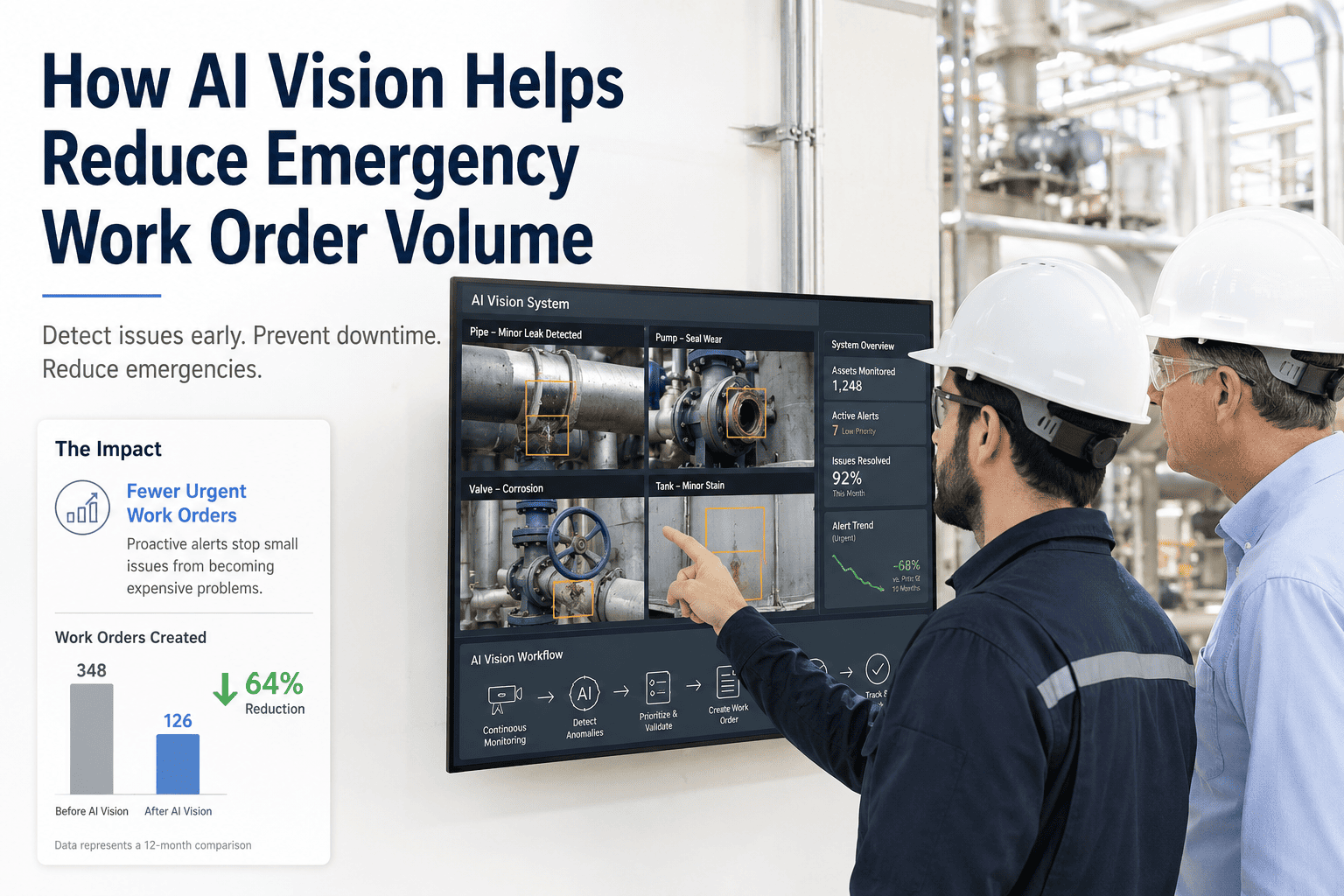
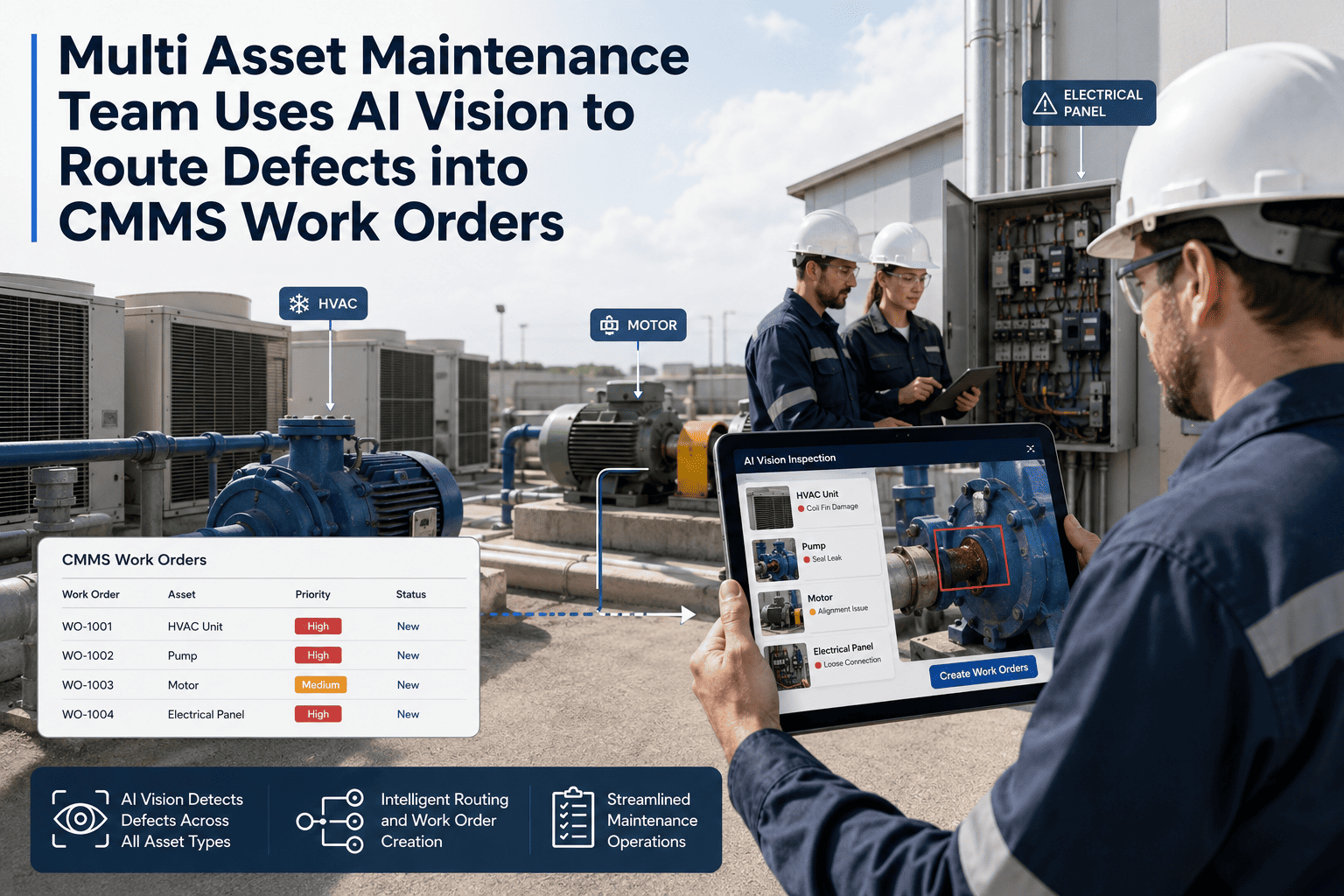
Emergency work orders are the most expensive, disruptive, and avoidable maintenance events in any facility — yet most teams still rely on manual rounds and reactive reporting to catch defects before they escalate. AI vision changes that dynamic entirely. By deploying cameras connected to OxMaint CMMS, maintenance teams detect surface cracks, fluid leaks, overheating components, and debris accumulation the moment they appear — automatically converting visual evidence into structured work orders before any asset reaches a failure state. The result is a measurable, sustained reduction in emergency work order volume across multi-site operations, manufacturing plants, and facilities of every scale. Book a demo to see how OxMaint AI Vision cuts emergency WO volume at your site.
AI Vision · Emergency Work Orders · CMMS Automation
Stop Fighting Fires. Start Preventing Them with AI Vision
OxMaint AI Vision monitors equipment 24/7, routes visual defects into CMMS work orders automatically, and gives maintenance teams the data they need to eliminate emergency callouts before they happen.
68%
Average reduction in emergency work orders after AI vision deployment
4.2×
Faster defect detection vs manual inspection rounds
$8,400
Avg cost per emergency work order avoided
How It Works
From Visual Defect to Closed Work Order — Automatically
01
Camera Detects Anomaly
AI vision cameras scan conveyors, rotating equipment, pipelines, and structural surfaces in real time. The model flags deviations — corrosion patches, misalignment, pooled fluid, heat signatures — that a weekly manual walkthrough would miss entirely.
02
Visual Evidence Captured
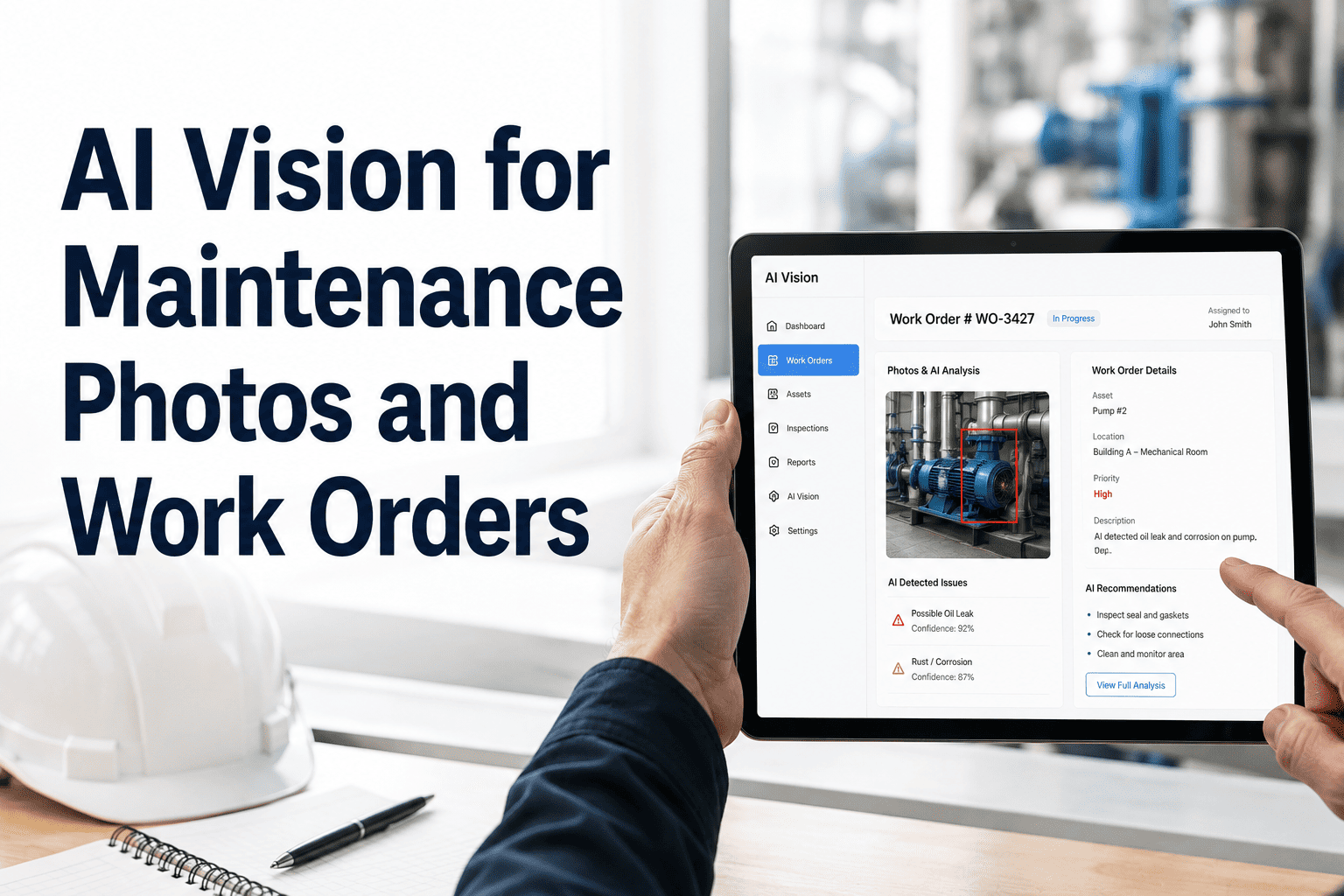
The timestamp, camera ID, defect classification, and photo evidence are captured and attached to the asset record in OxMaint. No technician needs to be present for the detection to be documented.
03
Work Order Auto-Created
OxMaint generates a planned maintenance work order from the vision alert — with priority classification, asset history context, and the photo attached. The maintenance scheduler sees it before it becomes an emergency call.
04
Repair Completed, Record Closed
Technician completes the planned repair, uploads proof-of-work photo, and closes the work order. The asset history reflects a resolved defect — not an emergency breakdown.
OxMaint · AI Vision · Emergency WO Reduction
Every Defect Caught Early Is an Emergency Avoided
OxMaint AI Vision connects visual detection directly to your CMMS work order queue — so planned maintenance replaces emergency callouts across every asset class.
Before vs After AI Vision
What Changes When Visual Detection Feeds Your CMMS
| Work Order Category |
Without AI Vision |
With OxMaint AI Vision |
| Emergency WOs |
35–55% of total WO volume; discovered at failure point |
Drops to under 15% as visual alerts create planned WOs ahead of failure |
| Defect Detection Lead Time |
Days to weeks between manual inspections |
Minutes — continuous camera monitoring, 24 hrs a day |
| Photo Evidence |
Manually captured, sometimes missing from WO record |
Auto-attached to every WO from the moment of detection |
| Asset History Linkage |
Defects logged in isolation; no pattern visible across events |
Every vision alert linked to asset record — repeat defects flagged automatically |
| Repair Accountability |
Verbal confirmation or paper sign-off only |
Before/after photo proof captured in CMMS work order on close |
| Downtime Impact |
Emergency repairs average 4–6 hrs unplanned downtime per event |
Planned repairs scheduled in off-peak windows — near-zero unplanned downtime |
Industry Data
Emergency WO Reduction by Industry After AI Vision Deployment
Source: Aggregated OxMaint deployment data across 200+ sites, 2023–2025
"
The single biggest lever maintenance managers have for reducing emergency work order volume is closing the gap between when a defect starts and when someone sees it. AI vision closes that gap to near zero — which is why plants deploying it consistently report emergency WO rates dropping below 15% of total volume within 12 months.
Frequently Asked Questions
AI Vision and Emergency Work Order Reduction — Common Questions
How quickly does AI vision reduce emergency work orders after deployment?
Most sites see measurable reductions within 60 to 90 days of go-live, as the camera network begins catching defects that would previously escalate undetected. Full impact — typically a 60 to 72% reduction in emergency WO volume — is usually visible within 6 to 12 months as the system learns asset-specific baselines.
Talk to OxMaint about your rollout timeline.
Does OxMaint AI Vision work with existing cameras or does it require new hardware?
OxMaint integrates with most standard IP camera infrastructure already installed at industrial and commercial facilities. Purpose-built thermal and optical cameras can be added for specific asset types where heat signature detection or enhanced resolution is required. Your OxMaint implementation team assesses existing infrastructure at scoping.
Start a free trial to explore integration options.
What types of defects does AI vision detect before they become emergencies?
The system detects surface corrosion, fluid pooling, mechanical misalignment, component wear patterns, heat anomalies, debris accumulation, and structural deformation — across conveyors, rotating equipment, pipelines, structural panels, and facility surfaces. Each defect type routes to the appropriate work order template in OxMaint based on asset class and severity classification.
Can the visual evidence captured by AI vision be used for insurance or compliance reporting?
Yes. Every vision-generated work order in OxMaint retains the timestamped detection image, defect classification, asset ID, and technician completion record. This creates a complete, audit-ready evidence chain that is accepted by insurance underwriters and regulatory compliance reviewers.
Book a demo to see the evidence trail in action.
OxMaint AI Vision · Free to Start · No IT Setup Required
Your Next Emergency Work Order Was Already Preventable
OxMaint AI Vision catches defects before they call you at 2am. Connect your cameras, route alerts to your CMMS, and start reducing emergency WO volume from day one.