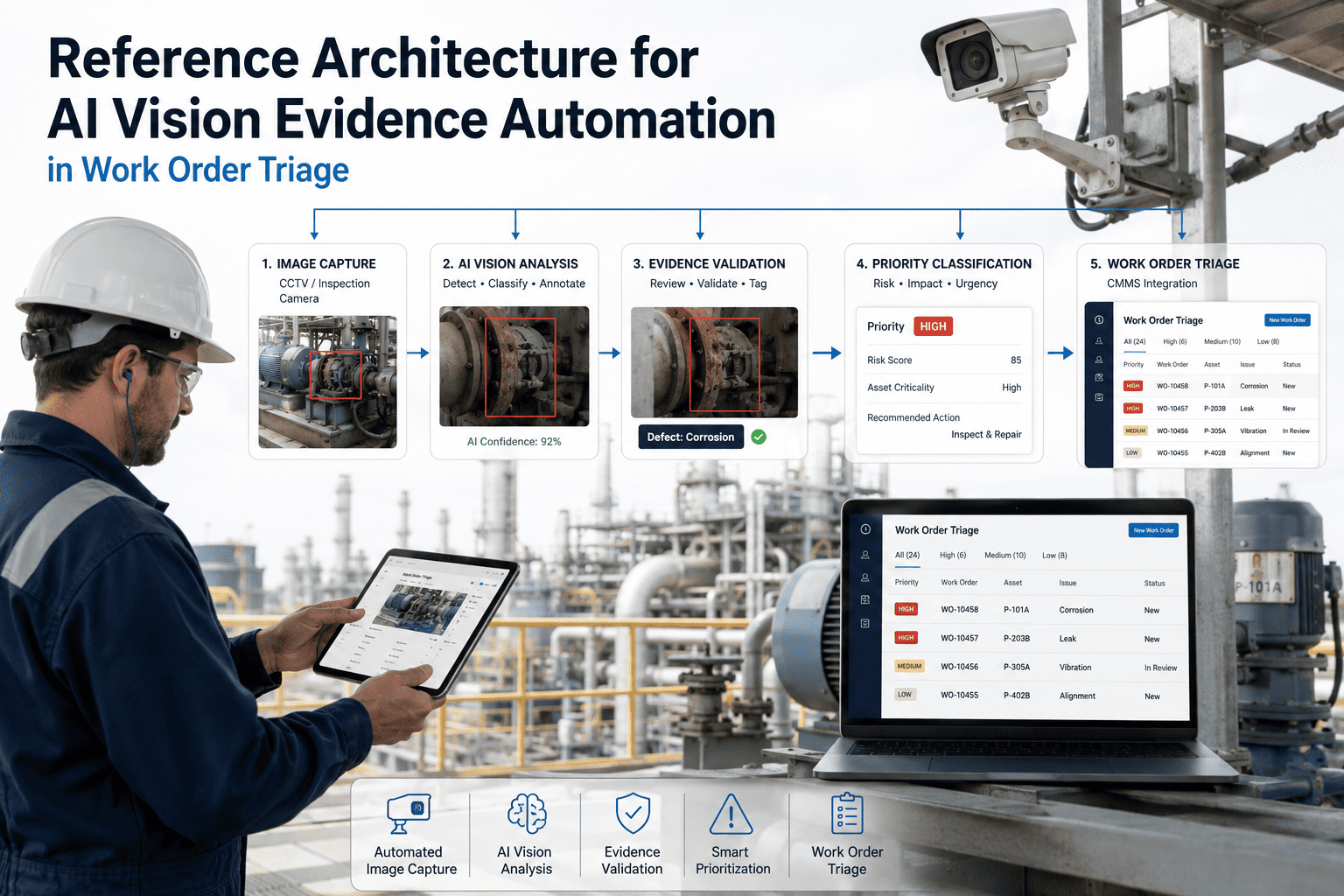
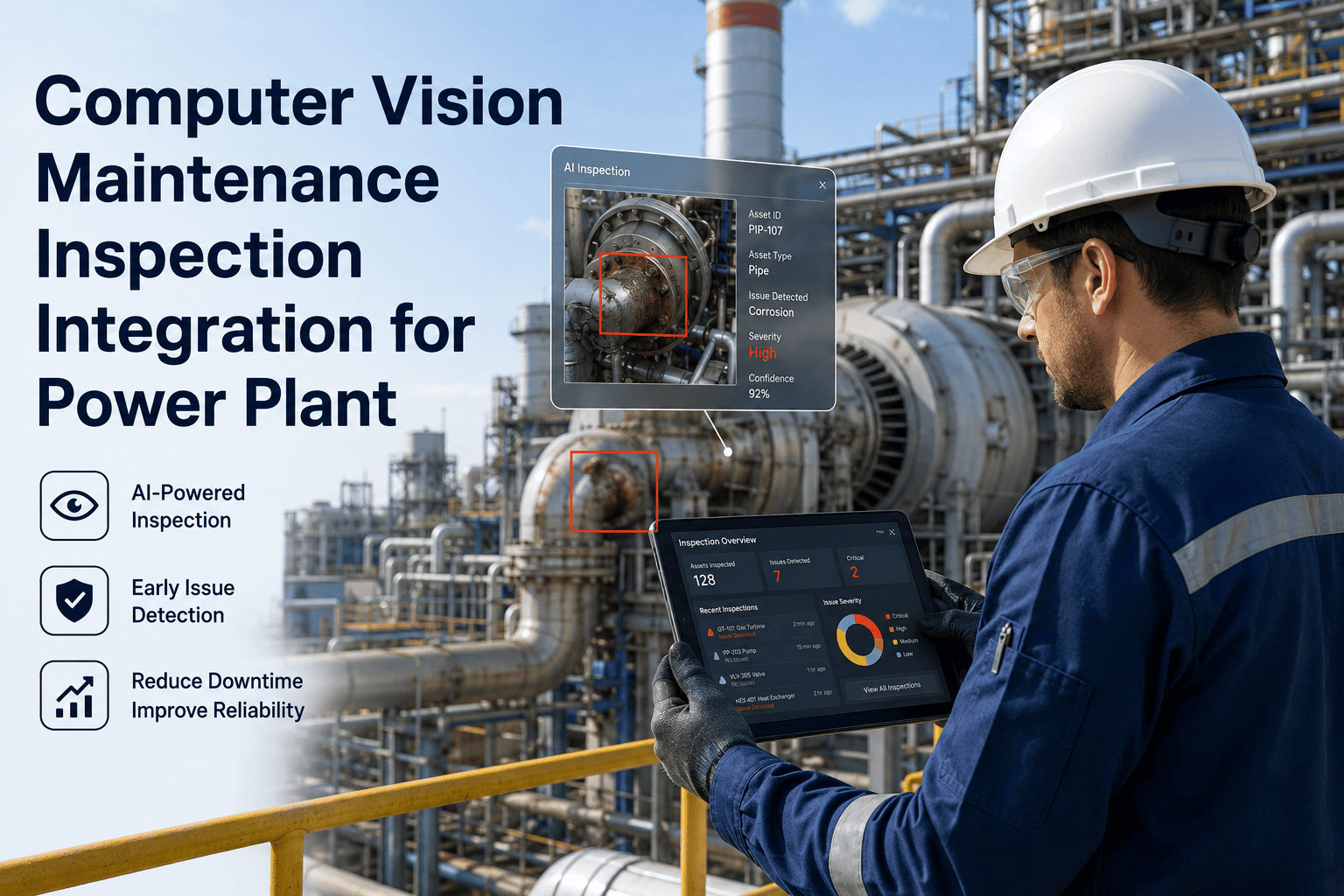
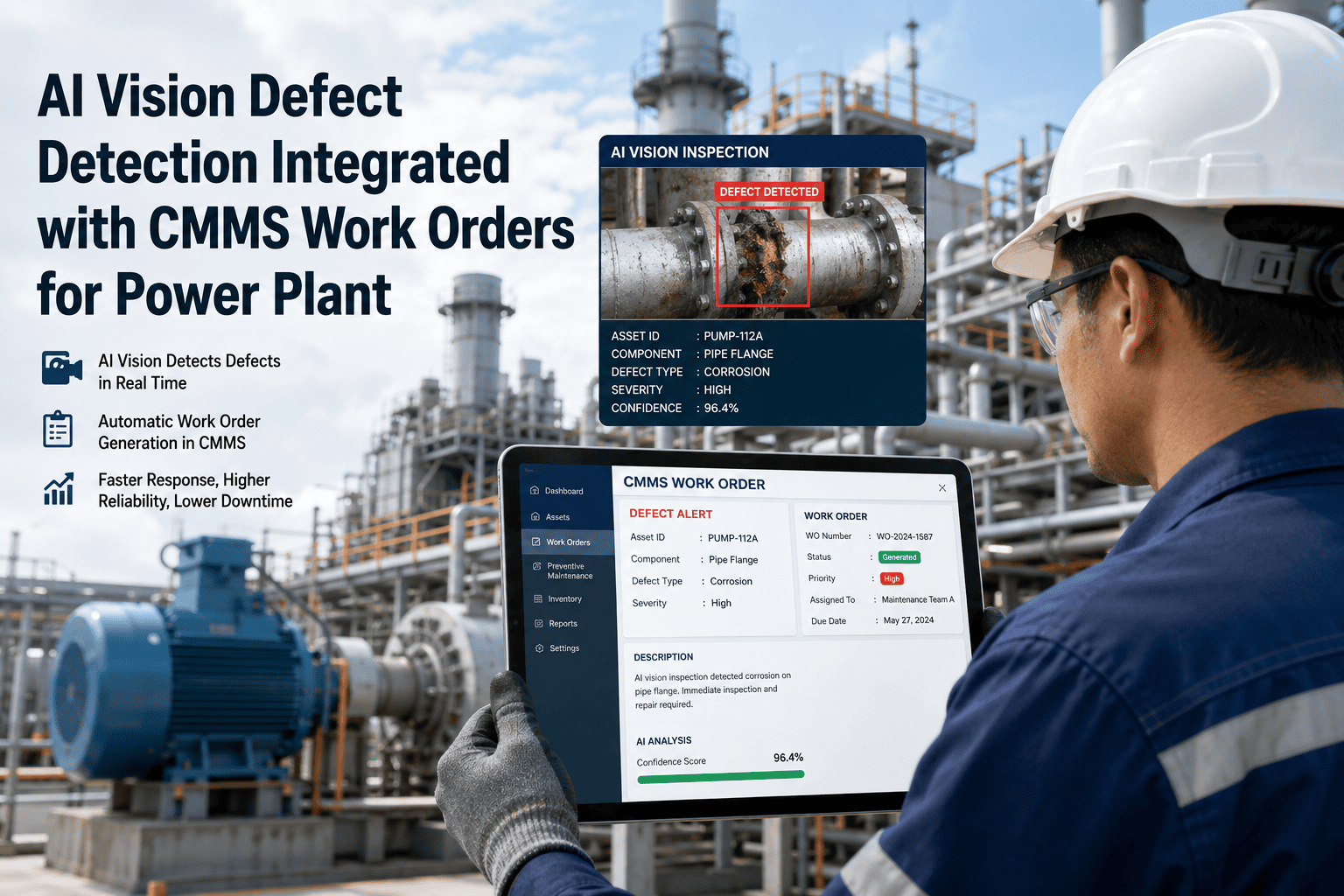
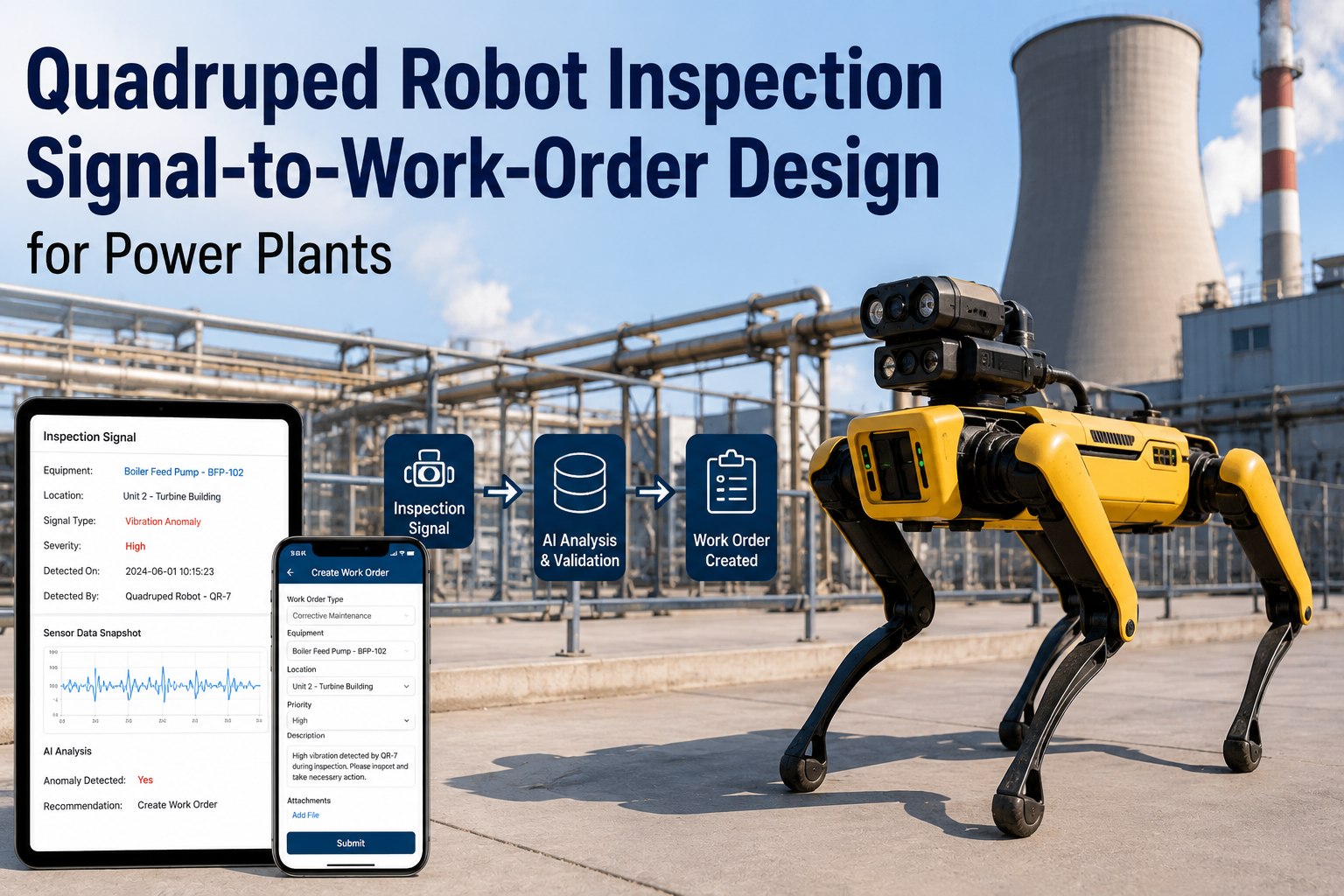
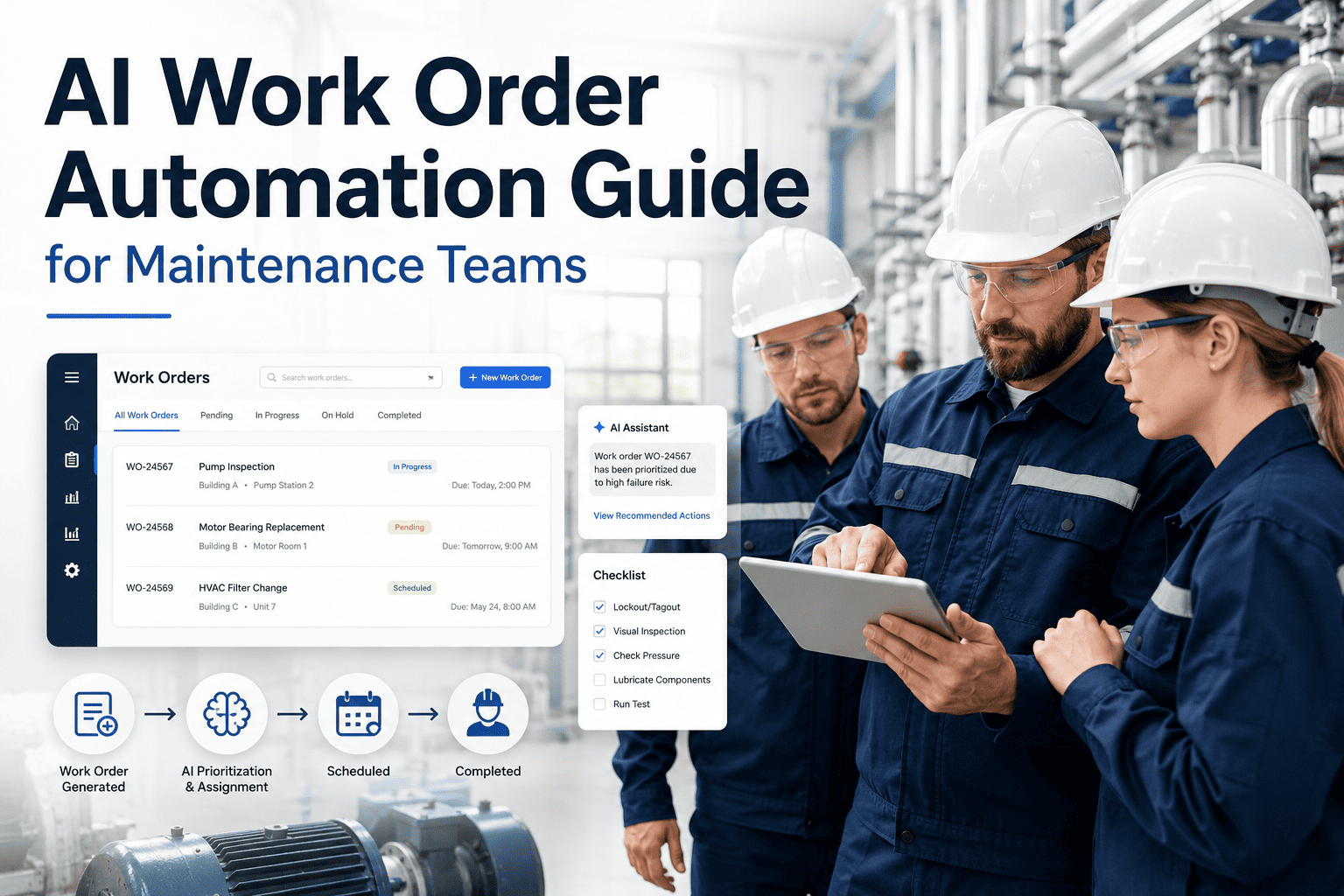
Every minute between a power plant defect being detected and a maintenance technician being dispatched to address it is a minute of compounding risk. Traditional inspection programs accept a 12–72 hour lag between visual identification and work order creation as unavoidable — but teams using AI vision to work order automation in OxMaint's predictive maintenance platform have reduced that window to under 10 minutes. When an AI camera flags a developing thermal anomaly on a transformer bushing at 2 AM, OxMaint doesn't wait for a morning supervisor to read a shift report — it generates a prioritised work order, assigns it to the on-call technician, attaches the thermal image as evidence, and updates the asset's predictive maintenance schedule to shorten the next inspection interval. Book a demo to see how AI vision and predictive maintenance work together in OxMaint to eliminate the gap between what your cameras see and what your maintenance team acts on.
Predictive Maintenance · AI Vision · Power Plant
AI Vision to Work Order Automation for Power Plant Maintenance
How power plant teams connect AI camera detections directly to OxMaint work order automation — eliminating the 12-72 hour fault-to-action lag and building a predictive maintenance loop that gets smarter with every detection.
The Fault-to-Action Timeline: Manual vs. AI Vision Automation
Manual Process — Average 38 Hours
Hour 0
Defect develops — undetected
Hour 6
Inspector schedules next walkthrough
Hour 12
Inspector identifies defect during walkthrough
Hour 14
Paper report submitted to supervisor
Hour 24
Supervisor reviews — manual WO created
Hour 38
Technician dispatched — 38 hours after defect onset
AI Vision + OxMaint — Under 10 Minutes
Min 0
AI camera detects defect above threshold
Min 1
Detection pushed to OxMaint — image + asset tag
Min 2
OxMaint creates prioritised work order
Min 4
Technician receives notification with image + asset context
Min 7
PM schedule adjusted — next inspection pulled forward
Min 10
Technician en route — defect actioned within 10 minutes
Predictive Maintenance Loop: How AI Vision Improves Your PM Schedule
1
AI Detection Event
Camera detects anomaly — severity classified, image captured, asset identified
→
2
Work Order Created
OxMaint auto-generates WO — crew assigned, priority set, evidence attached
→
3
Repair Completed
Technician closes WO — repair type, parts, and duration recorded in asset history
→
4
PM Schedule Updated
OxMaint adjusts PM intervals based on detection frequency — condition-driven scheduling replaces fixed calendar
→
5
Earlier Intervention
Next inspection scheduled before the defect pattern recurs — closing the predictive maintenance loop
| Power Plant Asset |
AI Detection Trigger |
OxMaint WO Priority |
PM Interval Adjustment |
Downtime Prevented |
| HV Transformer |
Bushing thermal spike +18°C |
Critical — 15 min |
Thermal scan: weekly → daily |
Transformer failure |
| Gas Turbine GT-02 |
Casing surface crack detected |
High — same shift |
Visual scan: monthly → weekly |
Forced outage event |
| BFP Pump A |
Seal leakage visual detection |
High — 4 hours |
Pump inspection: 500h → 250h |
Feedwater interruption |
| Cooling Tower CT-3 |
Fill pack deterioration |
Medium — planned |
Visual route: monthly → bi-weekly |
Cooling capacity loss |
| Switchgear Panel C |
Connection overheating — IR |
Critical — immediate |
Thermal scan: monthly → weekly |
Supply interruption |
Expert Review — AI-Driven Predictive Maintenance
The predictive maintenance programs that actually reduce unplanned outages share one characteristic: the loop between detection and action is automated, not manual. When an AI camera fires and a human has to read the alert, open a CMMS, create a work order, and assign it — that's 30 minutes to 48 hours of latency depending on shift timing. When the camera fires and OxMaint creates and routes the work order automatically, the loop closes in minutes. Over a 12-month period, this compounding speed advantage is worth more than any single PM interval improvement a reliability team can model on a spreadsheet.
VP of Reliability Engineering, Multi-Site Power Generation Portfolio
Automate Your Power Plant's Response to Every AI Detection
OxMaint closes the loop between what your AI cameras detect and what your maintenance teams action — automatically, in minutes, with full predictive maintenance feedback built in.
38x
faster fault-to-action time with AI vision WO automation vs. manual inspection and work order creation
61%
reduction in unplanned power plant outages in the first 12 months of AI vision WO automation deployment
2.8x
improvement in PM schedule accuracy when OxMaint adjusts intervals based on AI detection history
Frequently Asked Questions
How does AI vision work order automation connect to OxMaint predictive maintenance?
When an AI camera detection is ingested by
OxMaint, the event is logged to the asset's detection history — which OxMaint's predictive maintenance engine uses to identify detection frequency patterns and adjust PM intervals accordingly. If a transformer shows recurring thermal anomalies, OxMaint automatically shortens the inspection interval for that asset, scheduling the next PM before the pattern recurs at failure-level severity. This closes the loop between real-time detection and long-term maintenance planning without requiring manual engineering input for every interval change.
Can AI vision work order automation handle multiple power plant units simultaneously?
OxMaint supports multi-unit, multi-site AI vision configurations — each generating work orders, updating asset records, and adjusting PM schedules independently. Detection events from GT-01 and GT-02 are processed simultaneously without queue conflicts, with priority routing ensuring the highest-severity detections across all units are surfaced first to the maintenance supervisor dashboard. For power portfolios managing multiple generating units, OxMaint's cross-unit visibility gives plant managers a real-time view of all active AI-triggered work orders across the entire facility.
Book a demo to see multi-unit configuration in action.
What happens to the AI detection history when a work order is completed?
When a work order triggered by AI detection is completed in OxMaint, the repair record is automatically linked to the original detection event — creating a full defect-to-repair chain in the asset's maintenance history. This chain includes: the detection image, the work order, the repair type, parts used, technician sign-off, and completion timestamp. Over time, this history builds a condition-based maintenance profile per asset that informs predictive interval adjustment and feeds into capital planning for asset replacement or major overhaul scheduling.
Is night shift AI detection covered — or only during monitored hours?
OxMaint's AI vision integration operates 24/7 — cameras monitor continuously and work orders are generated regardless of shift timing. Night-shift detections create work orders that appear in the on-call technician's queue immediately, with supervisor notifications sent based on severity and on-call routing configuration. This eliminates the most dangerous coverage gap in traditional power plant inspection programs: the overnight period when human observation is lowest and thermal and mechanical fault progression is highest.
Stop Waiting 38 Hours to Act on Power Plant Defect Detections
OxMaint's AI vision to work order automation converts camera detections into prioritised, crew-assigned, evidence-backed maintenance tasks in under 10 minutes — 24 hours a day, across every generating unit in your facility.