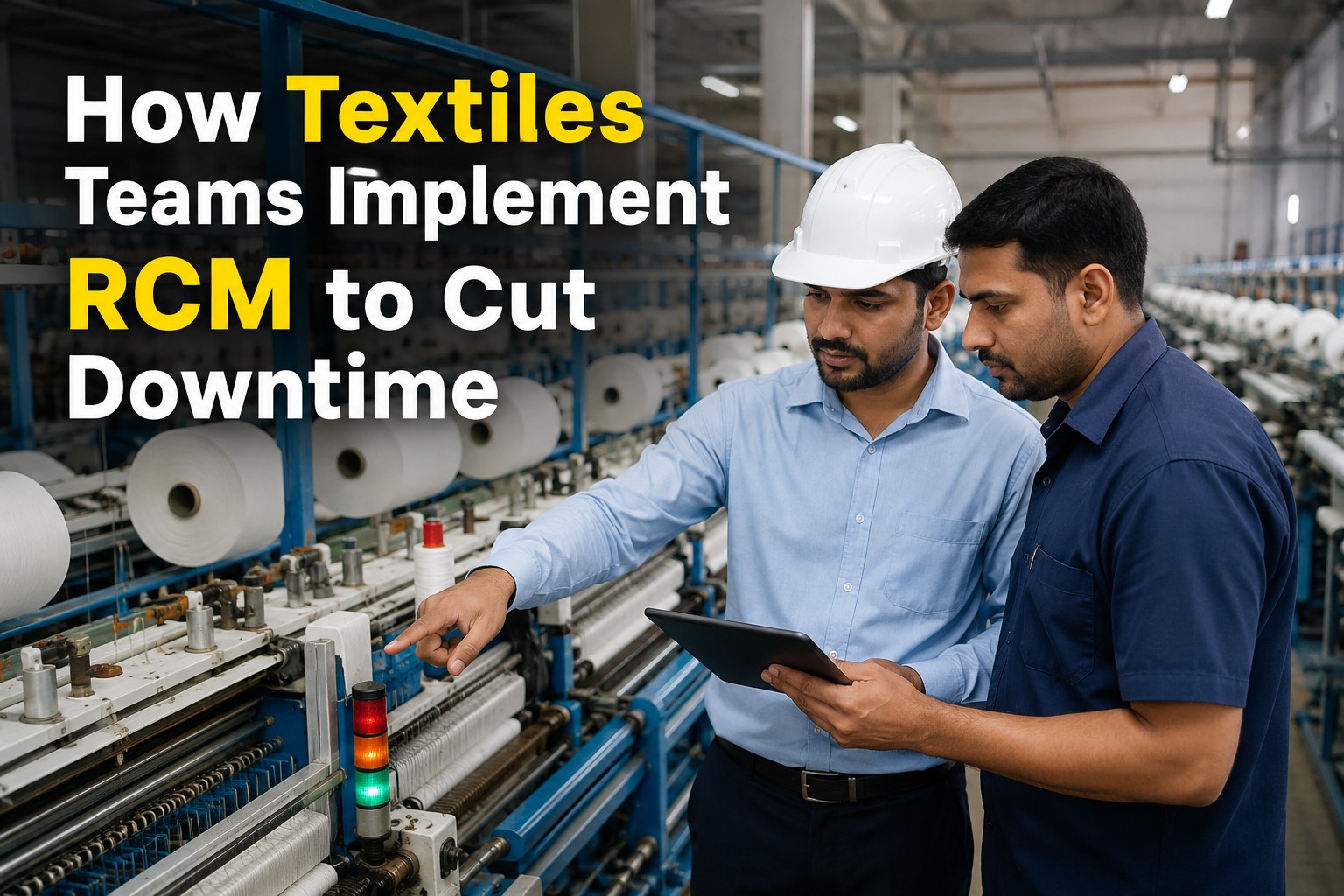
Reliability centered maintenance in textiles is the systematic process of identifying critical asset failure modes—spinning frames, looms, dyeing kettles—and selecting the right maintenance strategy for each to cut unplanned downtime and protect throughput. In textile manufacturing, a single seized bearing on a high-speed rotor or a failed temperature sensor on a dyeing range can halt an entire production line for hours, costing tens of thousands of dollars per incident. By implementing a structured textiles reliability program, plants typically reduce machine breakdowns by 30 to 50 percent and shift from chaotic reactive firefighting to data-driven preventive and predictive workflows. OxMaint's AI-powered CMMS gives textiles maintenance teams the work-order automation, mobile technician apps, and real-time analytics needed to execute RCM seamlessly. You can Start Free Trial today or book a personalized demo to see the platform configured for your plant.
RCM Implementation Playbook
How much is unplanned downtime costing your textile plant every hour?
Most textiles facilities lose 15–20% of annual production capacity to preventable equipment failures. A structured reliability centered maintenance program identifies your highest-risk assets and applies targeted strategies to recover that lost throughput—fast.
Step-by-Step RCM Framework
How to implement RCM in textiles: A 5-month rollout timeline
A successful RCM pilot project in textiles requires disciplined sequencing. Skipping the failure mode analysis phase is the number one reason maintenance optimization initiatives stall. Here is a proven 5-month roadmap reliability engineers use to move from baseline assessment to measurable downtime reduction.
Baseline Assessment & Asset Criticality
Rank all production assets by criticality. A typical 180-asset textile plant will identify 25–30 critical machines (ring frames, sizing machines, stenters) that account for 80% of unplanned downtime. Document current MTBF and MTTR baselines.
Failure Modes and Effects Analysis (FMEA)
For each critical asset, document how it fails. Textiles failure prevention starts here: identify bearing seizures, spindle vibrations, drive belt wear, and heat exchanger fouling. Map each failure mode to its operational consequence.
Strategy Selection
Assign the right maintenance task to each failure mode: predictive (vibration analysis for high-speed rotors), preventive (calendar-based lubrication), run-to-failure (non-critical pumps), or condition-based (thermal imaging on electrical panels).
Pilot Execution
Deploy your textiles RCM pilot project on the top 10 critical assets. Digitize work orders, enforce PM checklists, and track spare-parts consumption. OxMaint automates the scheduling and mobile execution so technicians never miss a task.
Measure & Scale
Compare pilot MTBF and MTTR against baselines. Successful RCM benefits in textiles include a 30–50% drop in unplanned downtime and a 15% reduction in spare-parts inventory. Roll out to remaining assets.
Failure Prevention Strategy
Top failure modes in textiles maintenance and how to prevent them
Textiles reliability programs must target the specific failure modes that drive costly stoppages. The table below maps the most common equipment failures across spinning, weaving, and finishing operations to the recommended RCM strategy and the measurable outcome of acting on them.
| Asset | Failure Mode | Operational Impact | RCM Strategy | Expected Outcome |
|---|---|---|---|---|
| Ring Frame / Spinning | Bearing failure on spindles | 8–12 hrs downtime per event | Predictive (vibration analysis) | Detect 3–4 weeks pre-failure |
| Loom / Weaving Machine | Harness frame mechanical wear | Fabric defects, 4 hr stoppage | Preventive (condition-based) | 85% reduction in defect stops |
| Dyeing Range / Stenter | Heat exchanger fouling | Temperature drift, batch rejects | Predictive (thermal monitoring) | Eliminate off-spec dye lots |
| Compressor Room | Air filter blockage | Pressure drop, line stoppages | Preventive (scheduled replacement) | Zero compressed-air failures |
| Warping Machine | Drive belt degradation | Snapped belt, 2 hr fix | Condition-based (visual inspection) | 90% fewer sudden breakdowns |
Cost of Inaction
Textiles downtime reduction: The ROI math
If a textile plant operates at a contribution margin of $120/hour and experiences 600 hours of unplanned downtime annually, the direct lost margin is $72,000 per year. RCM implementation in textiles attacks this number directly. Use the formula below to calculate your own payback.
Annual Downtime Cost
Unplanned Hours × Contribution Margin / Hour = Annual Loss
Example: 600 hrs × $120/hr = $72,000 lost annually
How OxMaint Helps
How OxMaint powers your textiles reliability program
OxMaint's AI-powered CMMS and EAM platform translates your RCM strategy into daily execution. From automated work-order scheduling to predictive analytics, here is how OxMaint helps maintenance and reliability teams cut downtime and prove ROI.
Automated Work Orders & PM Scheduling
OxMaint auto-generates preventive maintenance work orders based on runtime hours, calendar cycles, or condition triggers. Mobile technician apps eliminate paper delays—techs receive and close tasks on the floor, cutting MTTR by up to 40%.
Predictive Maintenance Analytics
OxMaint ingests vibration, temperature, and pressure sensor data from spinning frames and dyeing ranges. AI models predict bearing failures and heat exchanger fouling 3–4 weeks in advance, enabling planned interventions instead of reactive stoppages.
Spare-Parts Inventory Integration
Stop waiting for parts. OxMaint links every asset to its bill of materials and triggers auto-reorder points. Prevent the missing-spares bottleneck that causes 20% of prolonged downtime events in textiles plants.
MTTR & MTBF Dashboards
Real-time reliability dashboards give plant managers the visibility to prove maintenance is driving throughput, not just fixing things. Track OEE, MTBF, and MTTR trends across every asset class and justify maintenance spend with hard data.
Real-World Impact
Textiles RCM pilot project: A worked example
Consider a mid-size woven fabrics plant running 180 assets and spending $42,000 annually on emergency maintenance callouts. Their maintenance strategy was almost entirely reactive—technicians waited for machines to break, then scrambled for spare parts and paper work orders.
Ready to cut unplanned downtime with a structured RCM program?
See OxMaint configured for your textile plant. Book a 30-minute demo and our reliability experts will map your critical assets to a proven RCM workflow.
FAQ
Frequently asked questions about RCM in textiles
What is reliability centered maintenance in textiles?
Reliability centered maintenance in textiles is a structured methodology that identifies the most likely failure modes for critical production assets—such as spinning frames, looms, and dyeing machines—and assigns the optimal maintenance task (predictive, preventive, or run-to-failure) to each one. The goal is to minimize unplanned downtime and maximize equipment availability while controlling maintenance costs.
How long does it take to implement an RCM pilot project in a textile plant?
A focused RCM pilot project in textiles typically takes 4 to 6 months from baseline assessment to measurable results. The first two months are spent on asset criticality ranking and failure mode analysis, followed by strategy selection, pilot execution, and performance measurement. OxMaint accelerates this timeline by digitizing work orders and providing ready-made FMEA templates. Book a Demo to see a tailored rollout plan.
What are the main benefits of RCM for textiles maintenance?
The primary RCM benefits for textiles include a 30 to 50 percent reduction in unplanned downtime, a 15 to 25 percent decrease in emergency maintenance labor costs, and improved spare-parts inventory control. Plants also see higher OEE, fewer defective fabric batches caused by equipment drift, and better compliance with safety and quality audits.
How is RCM different from preventive maintenance in textiles?
Preventive maintenance applies the same scheduled tasks to all assets regardless of their actual condition or criticality. RCM is smarter: it uses failure mode analysis and condition-monitoring data to apply the right strategy to each specific failure. For example, RCM might prescribe vibration-based predictive maintenance for high-speed spinning bearings, while leaving a non-critical ventilation fan on a run-to-failure strategy.
Can OxMaint CMMS support a textiles RCM implementation?
Yes. OxMaint is built specifically for maintenance and reliability teams executing RCM and other structured strategies. It provides automated work-order scheduling, mobile technician execution, predictive analytics integration for sensor data, spare-parts BOM linkage, and MTBF/MTTR dashboards. You can Start Free Trial to import your asset list and begin configuring PMs immediately.
Start your textiles downtime reduction program today
Join the maintenance teams using OxMaint to predict failures, automate work orders, and prove maintenance ROI. Configure your plant in minutes.
Free 14-day trial · No credit card



-optimizing-your-maintenance-strategy.png)
