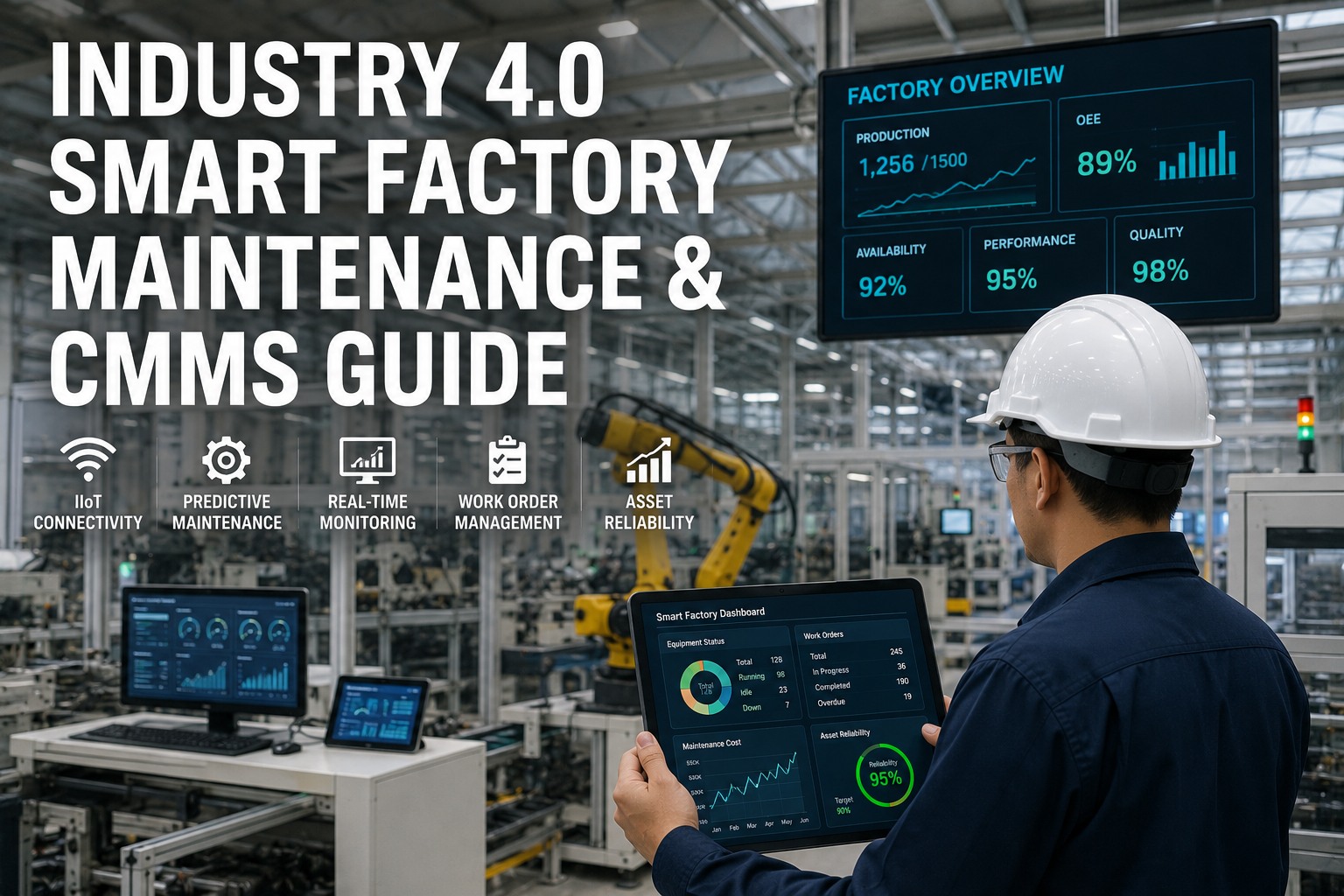
The plant manager who ran a manufacturing site in 2015 and the plant manager who runs one in 2026 are doing structurally different jobs. The 2015 plant manager coordinated preventive maintenance schedules, chased reactive breakdowns, negotiated PM windows with production supervisors, and reviewed lagging KPIs on Monday morning reports assembled from the last week's data. The 2026 plant manager runs an environment where roughly 40-60% of the plant's critical equipment is instrumented with IIoT sensors reporting continuously to an edge gateway, where predictive analytics engines flag anomalies days or weeks before failure, where digital twins simulate maintenance scenarios before technicians touch the physical asset, and where the CMMS itself generates most work orders from AI-driven fault detection rather than from time-based triggers. The gap between the two operating models is not incremental. It is the difference between reacting to what already broke and preventing what would have broken — and the manufacturing companies that have made the transition are producing more, at higher quality, with less downtime, using fewer maintenance hours, than their unmodernized competitors. This 2026 guide walks through the maintenance maturity model that defines the transformation, the smart factory data pipeline that connects sensors to actionable insight, the digital twin architecture that separates a truly connected asset from a lightly-monitored one, the IIoT sensor portfolio that most manufacturers deploy first, and the implementation roadmap that mature programs actually follow. OxMaint gives plant managers the Industry 4.0-ready CMMS platform that operationalizes every stage of this transformation. Book a free demo to see smart factory maintenance inside OxMaint.
Level 1
Reactive · Run-to-Failure
Wait for equipment to fail · fix it · repeat · no PM discipline · lowest cost per intervention but highest total cost of ownership
Level 2
Preventive · Time-Based
Scheduled PM at fixed intervals · calendar-driven · reduces failure rate but over-services healthy assets and misses early-warning conditions
Level 3
Condition-Based · CBM
Manual inspection triggers action · vibration route · thermal survey · oil sampling · reactive to detected condition rather than time
Level 4
Predictive · PdM
Continuous IIoT monitoring · algorithms detect anomalies · maintenance scheduled before failure · Industry 4.0 baseline
Level 5
Prescriptive · AI-Directed
AI recommends specific corrective action · parts, procedures, technician skill matched to the specific fault · CMMS generates the work order
Level 6
Autonomous · Self-Healing
Equipment executes corrective action within defined envelope · human oversight for edge cases · leading-edge frontier
Most manufacturers operate across Levels 2-3 today · the Industry 4.0 transition is the migration to Levels 4-5 · OxMaint's platform supports every level
50%
reduction in unplanned downtime typically delivered by predictive maintenance programs at Level 4 maturity
25-30%
reduction in total maintenance cost when moving from preventive to predictive · industry benchmark
$50B
annual US manufacturing loss to unplanned downtime · every hour prevented reaches directly into P&L
The Smart Factory Data Pipeline — Sensor to Action
Industry 4.0 maintenance is not a single technology. It is a data pipeline that transforms physical machine signals into operational action through five sequential processing stages. Understanding the pipeline architecture matters because most Industry 4.0 initiatives fail not at the sensor layer but at the analytics and integration layers where the data has to become an actionable work order. The framework below reflects how mature smart factory programs actually structure the flow — and how OxMaint sits as the final action layer where predictive insights become tracked, executed maintenance work. Start a free trial to see how the pipeline closes the loop inside OxMaint.
The Five-Stage Smart Factory Data Pipeline
01
Physical Sensor
Vibration, temperature, current, acoustic, pressure sensors attached to asset · continuous signal generation
Output: raw time-series data
02
Edge Gateway
Local processing · noise filtering · initial anomaly flagging · bandwidth optimization
Output: cleaned feature vectors
03
Cloud & Storage
Historical data lake · asset context · production correlation · cross-asset patterns
Output: enriched contextual data
04
AI / ML Analytics
Anomaly detection · failure prediction · remaining useful life · root cause candidates
Output: predicted fault + confidence
05
CMMS Work Order
Work order auto-generated · parts identified · technician assigned · scheduling optimized
Output: executed maintenance action
The pipeline breaks most often at Stage 5 · beautiful analytics that never become tracked maintenance work deliver zero operational value · OxMaint closes the loop
Digital Twin Architecture — Physical Meets Virtual
A digital twin is not a dashboard. It is a live virtual replica of a physical asset that stays synchronized with the actual equipment through continuous sensor data, and that enables simulation, scenario testing, and predictive analysis that cannot be safely performed on the physical asset. The distinction matters for plant managers evaluating Industry 4.0 investments — because many vendors label a static 3D CAD file plus a real-time gauge display as a "digital twin," when it does not carry the bi-directional synchronization or simulation capability that defines the concept. The architecture below reflects what a true digital twin actually delivers. Book a demo to see connected asset architecture inside OxMaint.
Digital Twin · Bidirectional Physical-Virtual Synchronization
Physical Asset
Machine on the Plant Floor
Actual mechanical operation
Continuous IIoT sensor data
Real-time performance metrics
Wear, degradation, faults
Environmental conditions
Digital Twin
Live Virtual Replica
Continuously-updated 3D model
Physics-based simulation engine
What-if scenario testing
Predictive failure modeling
Optimization recommendation
The value is bi-directional · sensors feed the twin · twin analysis feeds control decisions back to the physical asset · a static dashboard is not a digital twin
The IIoT Sensor Portfolio — Where to Instrument First
Every Industry 4.0 transformation begins with sensor deployment, and the sensor selection sequence directly determines the value trajectory of the entire program. Vibration sensors on rotating equipment typically deliver 60-70% of total predictive maintenance value in the first year of deployment — which is why mature programs prioritize them ahead of other sensor categories. The portfolio below reflects the six core IIoT sensor types that manufacturers deploy first, with the typical failure modes each detects and the asset types where each carries the most leverage. OxMaint integrates sensor data streams directly into the asset record so alerts, thresholds, and predictive scoring live where the maintenance work happens. Book a demo to see IIoT sensor integration inside OxMaint.
Core IIoT Sensor Categories · Deploy in This Sequence
Priority 1
Vibration
Bearing wear · misalignment · imbalance · looseness
Pumps · motors · fans · gearboxes · compressors
Priority 2
Thermal / Temperature
Overheating · electrical hot spots · lubrication failure
Motors · electrical panels · bearings · process heat exchangers
Priority 3
Current Signature
Motor faults · winding degradation · rotor issues · load anomalies
Electric motors · pumps · fans · conveyor drives
Priority 4
Ultrasonic / Acoustic
Compressed air leaks · steam trap failure · bearing early wear
Air systems · steam systems · rotating equipment
Priority 5
Pressure & Flow
Process deviations · filter loading · pump degradation
Pumps · filters · valves · fluid handling
Priority 6
Oil Analysis (Inline)
Particulate · water contamination · viscosity · additive depletion
Gearboxes · hydraulics · engines · transmissions
From Sensor Signal to Executed Work Order — One Platform
OxMaint integrates IIoT streams directly into the asset record · auto-generates work orders from predictive alerts · turns Industry 4.0 investment into operational maintenance discipline.
The Implementation Roadmap — Four Phases, 18-24 Months
Industry 4.0 transformation programs succeed or fail on sequencing. Attempting to instrument every asset and deploy every capability simultaneously produces stalled pilots, disillusioned stakeholders, and abandoned platforms — a common outcome in the first-generation Industry 4.0 wave of the late 2010s. The mature 2026 approach follows a defined four-phase roadmap that delivers early value on a pilot line, scales successfully-validated capability to the full plant, and reaches steady-state within 18-24 months. The framework below reflects how mature programs actually execute the transformation. OxMaint's implementation methodology follows this exact sequence. Start a free trial to begin your Phase 1 assessment inside OxMaint.
Industry 4.0 Implementation · Four-Phase Roadmap
Phase 1
Assess & Baseline
Months 1-3
Current maturity assessment · asset criticality ranking · pilot line selection · baseline KPIs captured · quick-win targets identified
Phase 2
Pilot Line Deployment
Months 3-9
Vibration sensors on 8-12 critical assets · edge gateway installed · CMMS integration · initial ML model training · results measured against baseline
Phase 3
Plant-Wide Scale
Months 9-18
Rollout to remaining production lines · additional sensor types deployed · digital twin capability activated · workforce upskilling program · organizational change management
Phase 4
Optimize & Autonomous
Months 18-24+
Prescriptive AI activated · cross-asset pattern learning · autonomous action envelopes defined for select equipment · continuous improvement loop established
Phase 2 delivers first measurable ROI · Phase 3 achieves broad organizational buy-in · Phase 4 unlocks the frontier value · sequencing is not optional
Plant Manager Perspective · What Actually Changed
Twelve months into our Industry 4.0 program, the daily operating rhythm inside the plant was structurally different. Our Monday morning production meetings used to open with the unplanned downtime review from the previous week — the same conversation every Monday about the same recurring failures on the same recurring assets, with the same corrective actions promised for the following week. Twelve months in, those conversations were gone. Not because failures stopped happening — but because the failures that mattered were now flagged as predictive alerts three to seven days before they would have taken a line down, work orders had been auto-generated by OxMaint, technicians had been scheduled during planned windows, and the intervention had already happened by the time Monday morning arrived. Instead of reviewing unplanned downtime, we reviewed predictive alerts closed, planned interventions executed, and forward-looking asset health. That is the transformation. It is not about deploying sensors. It is about changing what the operating rhythm of the plant actually is. Once the CMMS becomes the action layer where predictive insight becomes tracked work, the entire maintenance function moves from reactive to forward-looking. Our unplanned downtime dropped 48%. Our maintenance cost dropped 22%. Our OEE went up 11 points. Those are the numbers I brief the board with now. That is what Industry 4.0 actually delivers when the transformation is executed with discipline.
Predictive Becomes Work
OxMaint auto-generates work orders from IIoT predictive alerts · closing the loop from analytics to executed action.
Every Asset Health-Scored
Sensor data streams live in the asset record · maintenance priority reflects predictive scoring, not just calendar cadence.
Board-Ready ROI
Unplanned downtime, maintenance cost, and OEE dashboards produced from operational data · not reconstructed monthly.
Make Your Plant a Level 4 Operation in 2026
If your maintenance program still operates at Level 2 preventive with manual condition-monitoring on top, you are leaving 40-50% of available downtime reduction on the table every year. See what OxMaint — an Industry 4.0-ready CMMS built for smart factory operations — looks like against your plant.
Frequently Asked Questions
What is the maintenance maturity model and where does Industry 4.0 fit?
The six-level maturity model: Level 1 Reactive (run-to-failure); Level 2 Preventive (time-based PM); Level 3 Condition-Based (manual inspection triggers); Level 4 Predictive (continuous IIoT with algorithmic anomaly detection); Level 5 Prescriptive (AI recommends the specific corrective action); Level 6 Autonomous (equipment self-corrects within defined envelope). Industry 4.0 baseline is Level 4. Most manufacturers today operate across Levels 2-3 and are actively transitioning to Level 4.
What is a digital twin and how is it different from a dashboard?
A digital twin is a live virtual replica of a physical asset that stays synchronized with the equipment through continuous sensor data and supports simulation, what-if scenario testing, and predictive analysis that cannot be safely performed on the physical asset. A dashboard displays data. A digital twin models behavior, simulates scenarios, and enables bi-directional data flow between the physical and virtual instances. Many vendors mislabel dashboards as digital twins; the distinction matters when evaluating investment.
What ROI should manufacturers expect from Industry 4.0 maintenance?
Industry benchmarks: 25-30% reduction in total maintenance cost, 50% reduction in unplanned downtime, 20-25% increase in overall equipment productivity, 15-25% extension of asset useful life, and typical 2-3 year payback on IIoT sensor investment. These figures reflect programs that reach steady-state Level 4 maturity across critical assets. Programs that stall at pilot delivery deliver a fraction of the potential.
Which IIoT sensors should manufacturers deploy first?
Priority sequence: (1) Vibration sensors on rotating equipment — pumps, motors, fans, gearboxes, compressors — which deliver 60-70% of first-year predictive maintenance value; (2) Thermal sensors on motors and electrical panels; (3) Current signature analysis on electric motors; (4) Ultrasonic on compressed air and steam systems; (5) Pressure and flow on process equipment; (6) Inline oil analysis on gearboxes and hydraulics. The sequence maximizes value trajectory and simplifies workforce upskilling.
How long does an Industry 4.0 transformation take?
Well-sequenced programs deliver initial value in 6-9 months and reach steady-state Level 4 maturity across critical assets within 18-24 months. The standard four-phase roadmap: Phase 1 Assess & Baseline (months 1-3); Phase 2 Pilot Line Deployment (months 3-9); Phase 3 Plant-Wide Scale (months 9-18); Phase 4 Optimize & Autonomous (months 18-24+). Programs that attempt simultaneous plant-wide deployment without piloting typically stall.
Why do most Industry 4.0 initiatives fail at the CMMS layer?
Because the analytics-to-action gap is where value creation actually happens. A predictive alert that does not become a scheduled work order, executed by an assigned technician with the right parts, delivers zero operational value regardless of how sophisticated the underlying ML model is. The CMMS is the action layer that closes the loop from insight to executed maintenance. OxMaint is built specifically for this integration — auto-generating work orders from predictive alerts and tracking every intervention against the specific asset.