For a retail facilities leader running dozens or hundreds of stores, the audit you fail is almost never a surprise to the inspector — it is a surprise to you. A health inspector finds the refrigeration log gap, a fire marshal finds the blocked exit, a brand auditor finds the planogram that drifted — and every one traces back to the same root cause: inspections that depend on manual, manager-by-manager execution, where a gap at one store stays invisible until someone official walks in. The cost is steep: fines that can exceed six figures, forced closures, and brand damage that outlasts the violation. Inspection management removes that exposure by putting the same digital checklist in every store, auto-creating a work order for every failed item, and giving corporate one view of which location needs attention now. This guide lays out where that return comes from. See how OxMaint Inspection Management closes the loop. Book a demo to map it across your portfolio.
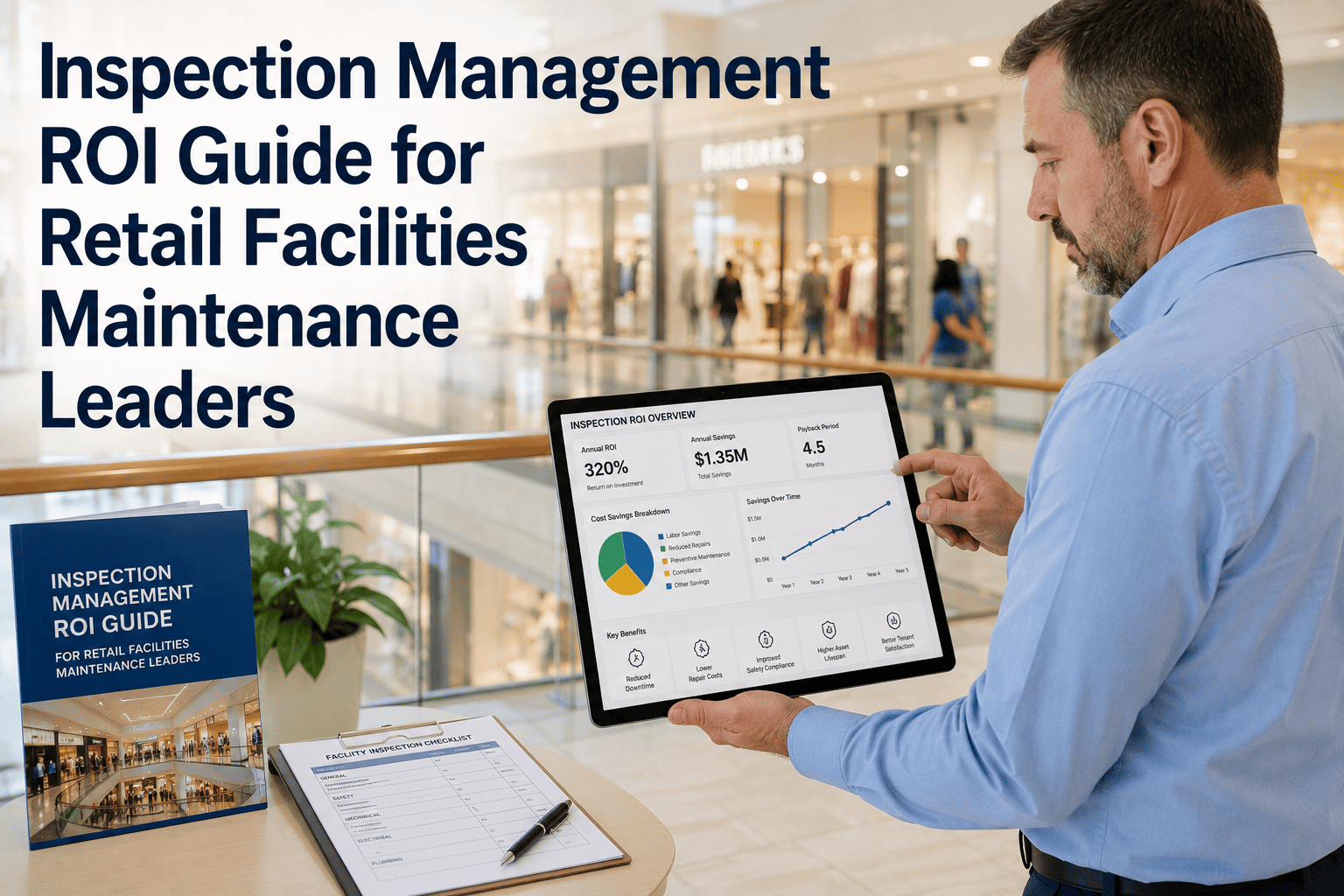
Inspection Management ROI Guide for Retail Facilities Maintenance Leaders
A numbers-first look at where standardized, closed-loop inspections pay back across a store portfolio — audit failures eliminated, every location consistent, issues caught before they close a store, and compliance provable in one click.
The Audit-Failure Tax
Before the savings, there is the recurring cost of failing audits — and in retail those failures follow a predictable, avoidable pattern.
Close the Loop
The whole return rests on one idea: an inspection finding should never just be noted — it should trigger the fix and record the proof, automatically.
Where the Return Comes From
Built for the Store Portfolio
Retail compliance is wide, location-specific, and unforgiving of inconsistency. The program is built around the realities of running many stores at once.
The KPIs That Prove It
What Retail Leaders Say
With two hundred stores, I used to learn a location was non-compliant the same day the inspector did. Now the same checklist runs everywhere, a failed item opens a work order on its own, and I can see on one screen which store is drifting long before anyone official shows up. The fire drill before an audit is just gone.
Director of Retail Facilities · 200-Store ChainThe inspection itself was never the hard part — proving it happened was. When a fire marshal walks in and I can export that store's entire history in one click, the audit is effectively over before it starts. Missing paperwork was our number-one cause of findings, and now there is no paperwork to miss.
Retail Operations & Compliance Manager · 17 Years Multi-SiteFrequently Asked Questions
How does inspection management reduce audit failures?
It removes the two biggest causes at once. Standardized digital checklists end the inconsistent, manager-dependent execution that lets gaps hide between stores, and automatic record-keeping ends the missing-documentation problem that is the most common inspection failure of all. The inspector finds a complete, current record instead of a hole. Book a demo to see standardized inspections.
What does "closing the loop" actually mean?
A failed inspection item — or a score below a set threshold — automatically generates a corrective work order linked to the asset, which is dispatched, completed, and verified, with the whole finding-to-action chain recorded. Nothing relies on someone remembering to follow up, and critical findings can escalate on their own. Start free to see auto-generated work orders.
How does it keep every store consistent?
One checklist library is deployed across the entire portfolio and scored identically everywhere, so what passes at one store passes at all of them, and corporate gets centralized visibility instead of trusting each location to run its own process. Inconsistent execution across sites is the root of most compliance gaps, and standardization closes it. Book a demo to standardize your stores.
How fast can we produce records for an inspector?
In minutes — a store's complete inspection and corrective-action history exports in a single click, because every check was captured digitally with timestamps and photos. That replaces the days-long scramble to assemble paper that, too often, still ends up incomplete and becomes the finding itself. Start free to see one-click exports.
Which inspections does it cover?
The full retail set — fire and life safety under NFPA, OSHA workplace safety, ADA accessibility, FDA food code for stores with food service, refrigerant and GreenChill compliance, and your own brand-standard and merchandising audits. Each becomes a scheduled, tracked, documented inspection rather than a manual walkthrough. Book a demo to map your inspection types.
Does it scale to hundreds of stores?
Yes — inspection management is built for multi-site portfolios ranging from a few dozen locations to many thousands, with a portfolio dashboard that rolls every store's compliance status into one view. You manage by exception, focusing attention on the locations that are drifting rather than checking each one blind. Start free to scale across your portfolio.
Never Be Surprised by an Audit Again
OxMaint runs one inspection standard across every store, turns findings into tracked fixes, and keeps a one-click audit trail per location — so retail facilities pass inspections by default and the next surprise belongs to your competitors, not you.