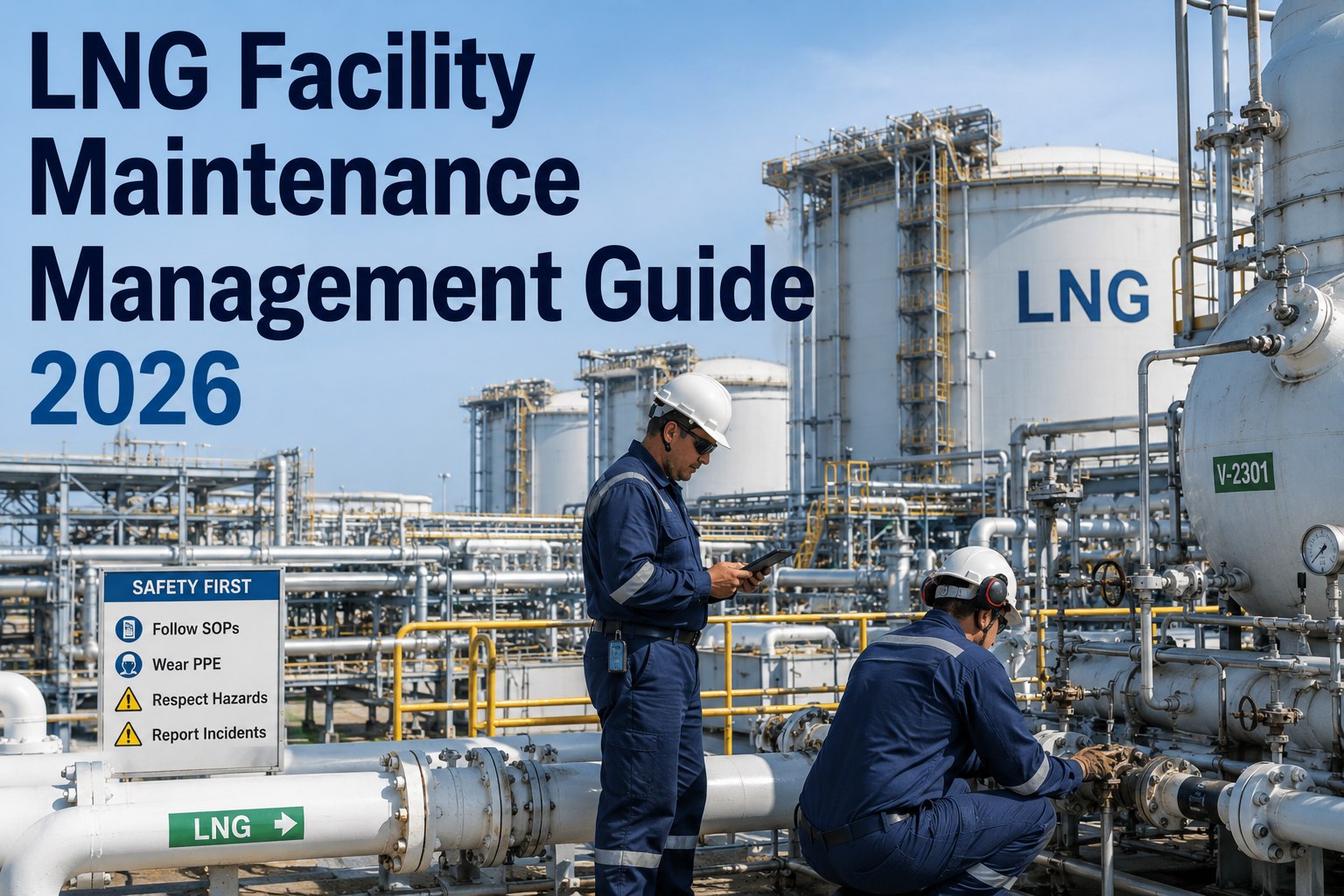
LNG facility maintenance demands a disciplined approach to cryogenic equipment, boil-off gas compressors, loading arms, and vaporizer systems operating at temperatures as low as -162°C under stringent PHMSA and PSM regulatory oversight. A single unplanned outage at a liquefied natural gas terminal can exceed $1M per day in lost revenue and regulatory penalties, making robust LNG maintenance management the critical barrier between profitable operations and catastrophic failure. By implementing a centralized LNG CMMS like OxMaint, operators transition from reactive firefighting to predictive, defensible mechanical integrity programs that safeguard assets, optimize uptime, and ensure audit readiness. You can explore the full platform capabilities when you Start Free Trial or schedule a personalized walkthrough with our reliability engineering team.
LNG FACILITY MAINTENANCE GUIDE 2026
Is Your LNG Terminal Losing Revenue to Cryogenic Equipment Failures?
Unplanned downtime at a mid-scale LNG plant costs over $1M per day. When BOG compressors fail or loading arms seize, your PSM mechanical integrity records are the first thing regulators examine. OxMaint structures your entire cryogenic maintenance workflow — from PM scheduling to audit-ready documentation — so your facility stays online and fully compliant.
CRITICAL ASSET RELIABILITY
LNG Plant Maintenance: High-Risk Asset Categories
LNG facility management hinges on four cryogenic and process-critical asset classes. Each carries unique failure modes that generic maintenance software cannot adequately track. Here is how an LNG plant CMMS structures the risk profile for the assets that matter most.
Cryogenic Heat Exchangers
Main cryogenic heat exchangers (MCHEs) in the liquefaction train are the most expensive single assets in an LNG facility. Thermal stress, maldistribution, and aluminum corrosion drive failure. OxMaint tracks tube-wall thickness data, cryogenic leak test schedules, and differential pressure trends to flag degradation before rupture.
BOG Compressors
Boil-off gas compressors handle continuous vapor recovery. Reciprocating and centrifugal BOG units suffer from seal gas degradation, valve wear, and bearing fatigue. OxMaint schedules vibration analysis, oil sampling, and seal gas differential checks to maintain 99.5% compressor availability.
Marine Loading Arms
LNG loading arms connect the terminal to carrier vessels. Hydraulic swivel failures, emergency release system (ERS) malfunctions, and permafrost on moving parts create high-risk loading events. OxMaint manages rigid inspection cadences and ERS function tests before every cargo transfer.
Ambient Vaporizers
Ambient air and submerged combustion vaporizers regasify LNG for pipeline send-out. Ice buildup, fan motor failure, and water bath chemistry drift reduce vaporization capacity. OxMaint sequences defrosting cycles and tracks burner efficiency to maintain send-out pressure.
CRYOGENIC PM STRATEGY
LNG Loading Arm & BOG Compressor Maintenance Checklist
A defensible LNG terminal maintenance program requires documented preventive maintenance intervals tied to safety-critical inspections. Below is a structured PM checklist framework for the two highest-risk dynamic assets in an LNG facility.
LNG Loading Arm Maintenance
Monthly / Quarterly- Inspect hydraulic swivel joints for seal weepage and verify torque on bolting flanges.
- Test Emergency Release System (ERS) valve actuation and confirm spring-return closure time.
- Check tripod structure and counterweight cables for ice accumulation and stress corrosion cracking.
- Verify cryogenic insulation integrity and purge nitrogen blanket on disconnected quick-connect couplers.
BOG Compressor Maintenance
Weekly / Bi-Annual- Record vibration spectrums on journal bearings and cross-reference against ISO 10816 baseline thresholds.
- Measure seal gas supply differential pressure and inspect dry gas seal filter elements for particulate loading.
- Analyze lube oil for water content (Karl Fischer) and spectrometric wear metals (Fe, Cu, Sn).
- Calibrate suction and discharge pressure transmitters and verify anti-surge controller logic response.
DOWNTIME COST FORMULA
The Real Cost of Reactive LNG Plant Maintenance
When maintenance is driven by breakdowns rather than predictive analytics, the financial impact compounds rapidly. Use this formula to calculate the annual exposure of a reactive maintenance strategy at your LNG facility.
Mid-Scale Liquefaction Terminal (5 MTPA Capacity)
By implementing OxMaint as the facility's LNG CMMS, this terminal reduced unplanned trips by 60% in year one through predictive vibration thresholds and automated PM triggers. The platform's spare-parts inventory module cut MTTR from 18 hours to 6 hours by pre-positioning critical seal kits and bearings, saving an estimated $8M in avoided downtime costs annually.
SOFTWARE CAPABILITIES
How OxMaint Solves LNG Facility Maintenance Management
OxMaint is an AI-powered CMMS and EAM platform engineered for the complexities of cryogenic plant maintenance. Here is how our platform maps directly to the operational and compliance challenges of LNG terminal maintenance.
PSM Mechanical Integrity Workflow
OxMaint digitizes your Process Safety Management (PSM) mechanical integrity program with automated inspection scheduling, RBI (Risk-Based Inspection) scoring, and audit-ready electronic records. Every cryogenic equipment PM is timestamped, signed, and traceable for PHMSA compliance.
AI-Driven Predictive Maintenance
Connect SCADA and vibration sensors to OxMaint. The AI engine analyzes BOG compressor performance trends and cryogenic pump vibration data to predict bearing failures and seal degradation 14-30 days before critical threshold breach, auto-generating work orders.
Cryogenic Spare Parts Inventory
Long-lead-time cryogenic components like dry gas seals and Invar-banded valves require proactive stocking. OxMaint tracks min/max levels, links BOMs to specific assets, and auto-generates purchase requisitions when stock hits reorder points, eliminating parts-related delays.
Maintenance Analytics & KPIs
Real-time dashboards track MTBF, MTTR, OEE, and PM compliance across the entire LNG terminal. Reliability engineers can drill into asset-specific failure codes for vaporizers, loading arms, and compressors to identify bad-actor assets and optimize PM intervals.
See OxMaint Manage Your LNG Facility Assets — Book a 30-Min Demo
Watch how our AI-powered CMMS structures your cryogenic PM, BOG compressor analytics, and PSM compliance workflows in a live, facility-specific walkthrough.
FREQUENTLY ASKED QUESTIONS
LNG Facility Maintenance & CMMS Questions Answered
What is LNG facility maintenance management and why is it different from standard plant maintenance?
LNG facility maintenance management involves maintaining cryogenic equipment operating at -162°C, boil-off gas compression systems, and marine loading arms under stringent PHMSA and PSM regulatory oversight. Unlike standard plant maintenance, cryogenic maintenance requires specialized materials (Invar, aluminum alloys), strict thermal stress management, and documentation that satisfies mechanical integrity requirements for highly hazardous chemicals. You can configure these workflows yourself when you Start Free Trial.
How does an LNG CMMS improve PSM mechanical integrity compliance?
An LNG CMMS enforces inspection intervals, documents thickness monitoring, and maintains a defensible audit trail for every safety-critical asset. OxMaint automatically flags overdue PHMSA-required inspections, stores digital certificates, and generates mechanical integrity reports on demand — eliminating the paper-based gaps that cause compliance violations during regulatory audits.
What are the most critical maintenance intervals for BOG compressors in an LNG plant?
BOG compressor maintenance requires weekly vibration spectrum analysis, monthly lube oil sampling for water content and wear metals, quarterly seal gas differential pressure verification, and bi-annual major inspections of valves and bearings. OxMaint automates these intervals based on run-hours and triggers work orders automatically, ensuring no critical BOG compressor inspection is missed.
Can OxMaint integrate with our existing SCADA and vibration monitoring systems at the LNG terminal?
Yes, OxMaint is designed to ingest data from SCADA systems, vibration sensors, and oil analysis labs via API and IoT connectors. This allows the AI engine to monitor cryogenic pump vibration trends and BOG compressor performance in real time, automatically generating predictive maintenance work orders when thresholds are breached — you can see this integration live when you Book a Demo.
How long does it take to implement a CMMS for an LNG terminal?
A standard LNG terminal CMMS implementation with OxMaint takes 4-8 weeks depending on asset count and integration depth. The platform includes pre-built templates for cryogenic equipment PM, loading arm inspections, and vaporizer maintenance, which accelerates deployment. Most facilities begin seeing improved PM compliance and reduced reactive work orders within the first 30 days of go-live.
READY TO TRANSFORM YOUR LNG MAINTENANCE?
Stop Reacting to Cryogenic Failures. Start Predicting Them.
Join the LNG operators using OxMaint to cut unplanned downtime by 50%, achieve 100% PSM compliance, and manage their entire facility from a single AI-powered CMMS platform.
Free 14-day trial · No credit card required

.png)
