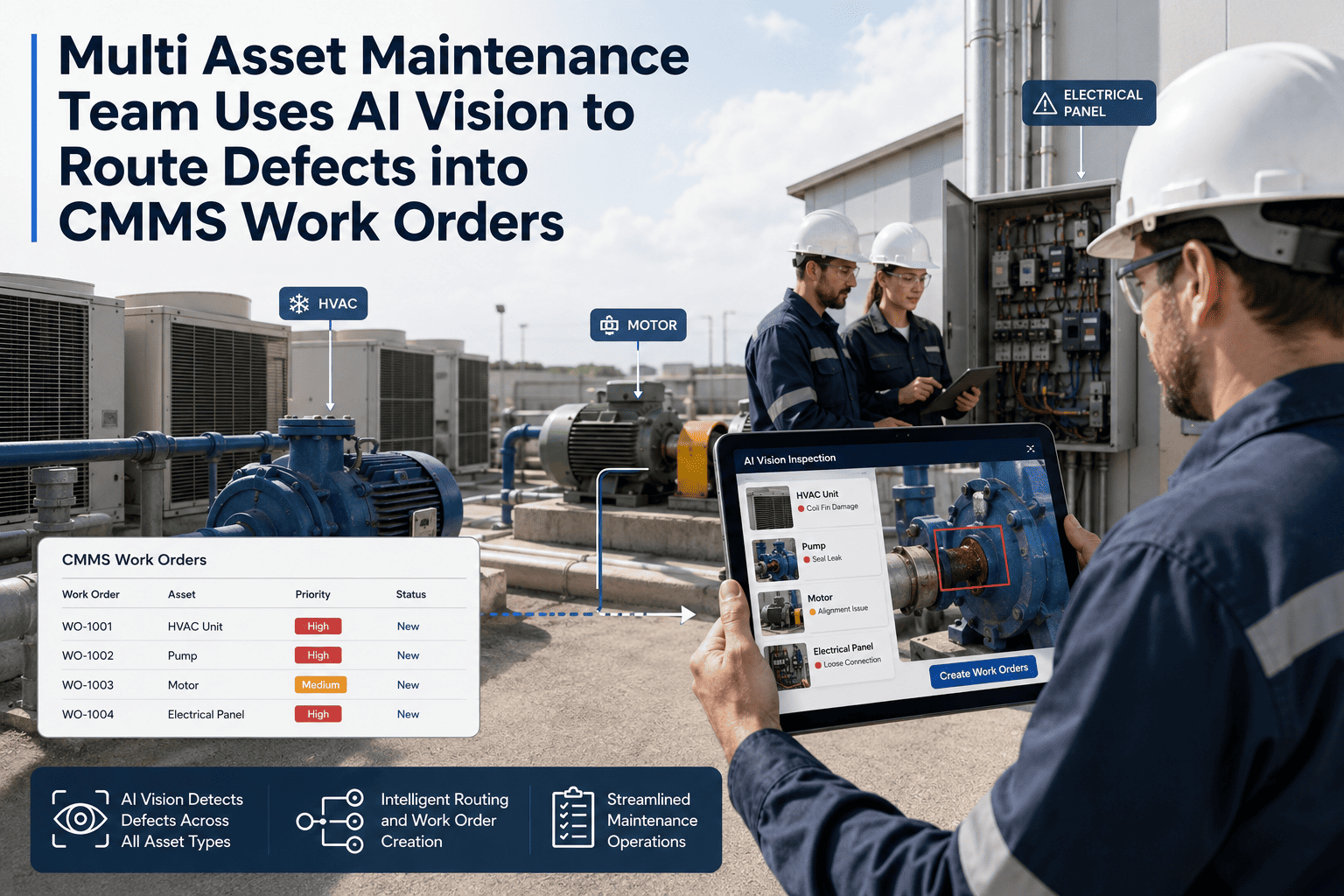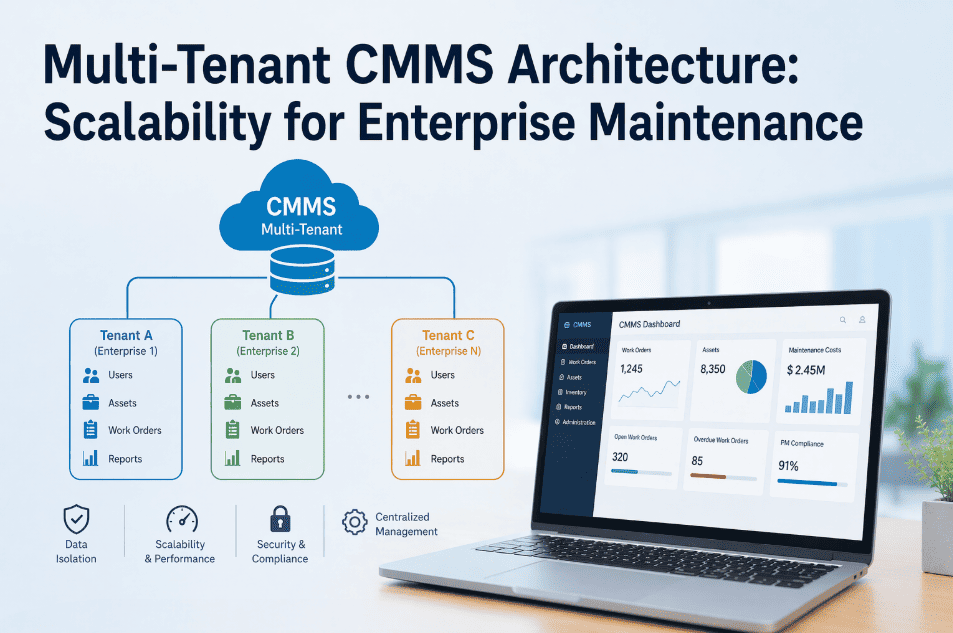
When a regional manufacturer with three plants tries to use a single-site CMMS across all locations, the problems start immediately: asset numbering conflicts between sites, technicians seeing work orders that aren't theirs, managers unable to compare maintenance KPIs across plants without exporting to spreadsheets, and IT managing three separate software instances instead of one. When that same company acquires two more facilities, the situation becomes unmanageable. Enterprise maintenance management at scale requires a fundamentally different architectural approach — multi-tenant CMMS design that separates data by site, region, or business unit while enabling cross-enterprise visibility, standardized reporting, and centralized administration. Multi-tenant architecture isn't just a technical feature — it's what determines whether your CMMS grows with your business or becomes a migration project every time you add a facility. The difference between a platform built for one site and one built for global enterprise operations is architectural, not cosmetic. Oxmaint is built on multi-tenant cloud architecture from the ground up — meaning your first site and your fiftieth site run on the same platform, with the same data model, and the same integration layer, while maintaining complete data isolation where your business requires it.
Multi-Tenant CMMS Architecture: Scalability for Enterprise Maintenance
Understand how modern CMMS platforms scale across multiple plants, regions, and global operations — with data isolation, cross-site reporting, and centralized administration that single-tenant systems can't deliver.
Single-Tenant vs. Multi-Tenant — What Actually Changes
The distinction between single-tenant and multi-tenant architecture determines your total cost of ownership, scalability ceiling, and operational overhead as your maintenance program grows. This isn't a minor technical detail — it's the foundational decision that determines whether your platform scales or bottlenecks.
Single-Tenant
Dedicated instance per organization
Multi-Tenant
Shared platform, isolated data
How Multi-Tenant CMMS Architecture Actually Works
Multi-tenant CMMS architecture is built in layers — each layer handling a specific function of data isolation, shared infrastructure, and organizational hierarchy. Understanding these layers helps maintenance leaders evaluate whether a platform is truly enterprise-ready or just marketing multi-site support.
Data Isolation Layer
Tenant data is separated at the database level using row-level security (RLS) or schema separation. Site A cannot access Site B's data — enforced by the platform, not by user training.
Role Hierarchy Layer
Corporate administrators see all sites. Regional managers see their region. Plant managers see their plant. Technicians see their assigned assets. Role permissions cascade through the organizational hierarchy.
Reporting Aggregation Layer
Cross-site KPI dashboards aggregate data from all plants in real time. PM compliance rates, MTBF, downtime, and cost per asset are comparable across sites without any manual data consolidation.
Configuration Layer
Corporate standards (PM templates, asset categories, failure codes) can be pushed to all sites. Individual sites can customize within allowed parameters. Standardization without rigidity.
Integration Layer
Each site can have its own ERP connection, IoT feeds, and local system integrations — while sharing the same API gateway, authentication, and integration monitoring infrastructure.
Infrastructure Layer
Cloud-native deployment with auto-scaling, geographic redundancy, and independent resource allocation per tenant. High-utilization sites get more compute without affecting other tenants.
From One Plant to a Global Enterprise — On One Platform
Oxmaint's multi-tenant architecture scales from your first site to your fiftieth without migration, re-implementation, or IT projects.
How Enterprise CMMS Scales — From 1 Site to 100+
Scaling a CMMS across an enterprise isn't just adding more users — it's managing organizational complexity, data governance, performance under load, and integration proliferation. Each growth stage introduces specific challenges that architecture either solves or creates.
What Enterprise CMMS Must Deliver Beyond Work Orders
Enterprise maintenance management at 10+ sites requires capabilities that single-site CMMS platforms simply weren't designed for. These six features separate platforms built for enterprise scale from those retrofitting multi-site support onto single-tenant architecture.
Cross-Site Benchmarking
Compare PM compliance, MTBF, cost per asset, and OEE across all plants on a single dashboard. Identify best-performing sites and replicate their practices enterprise-wide.
Template Inheritance
Corporate defines standard PM templates, failure codes, and asset categories. Sites inherit and extend — but can't break — corporate standards. Standardization scales automatically to new sites.
Data Residency Controls
EU operations data stays in EU data centers. US data stays in US. GDPR, CCPA, and local data sovereignty requirements met without compromising cross-regional reporting.
SSO & Identity Management
Enterprise SSO with Okta, Azure AD, or Ping Identity. Users log in once for access to all sites they're authorized for. Role assignments sync from your HR system.
Multi-ERP Integration
Site A connects to SAP. Site B connects to Oracle. Site C uses Dynamics. Each tenant maintains its own ERP integration while sharing the same CMMS platform and API gateway.
Consolidated Audit Trails
Every maintenance event, user action, and configuration change logged and queryable across all sites. Compliance audits and incident investigations cover the entire enterprise from one interface.
"We were running three separate CMMS instances across our plants — different versions, different asset numbering schemes, and no way to compare performance across sites. Moving to Oxmaint's multi-tenant platform gave us enterprise-wide KPI visibility in week one. We onboarded two acquired facilities in days instead of months. The architecture decision saved us more than the software cost."
— VP of Operations, 7-plant food manufacturing group, Midwest
Frequently Asked Questions
Is my data actually isolated in a multi-tenant system?
How quickly can a new plant be added to Oxmaint?
Can different sites have different configurations within the same platform?
What uptime does Oxmaint's cloud architecture guarantee?
How does multi-tenant CMMS handle GDPR data residency requirements?
Scale From 1 Plant to 100 — Without Starting Over
Multi-tenant architecture that grows with your enterprise maintenance program.