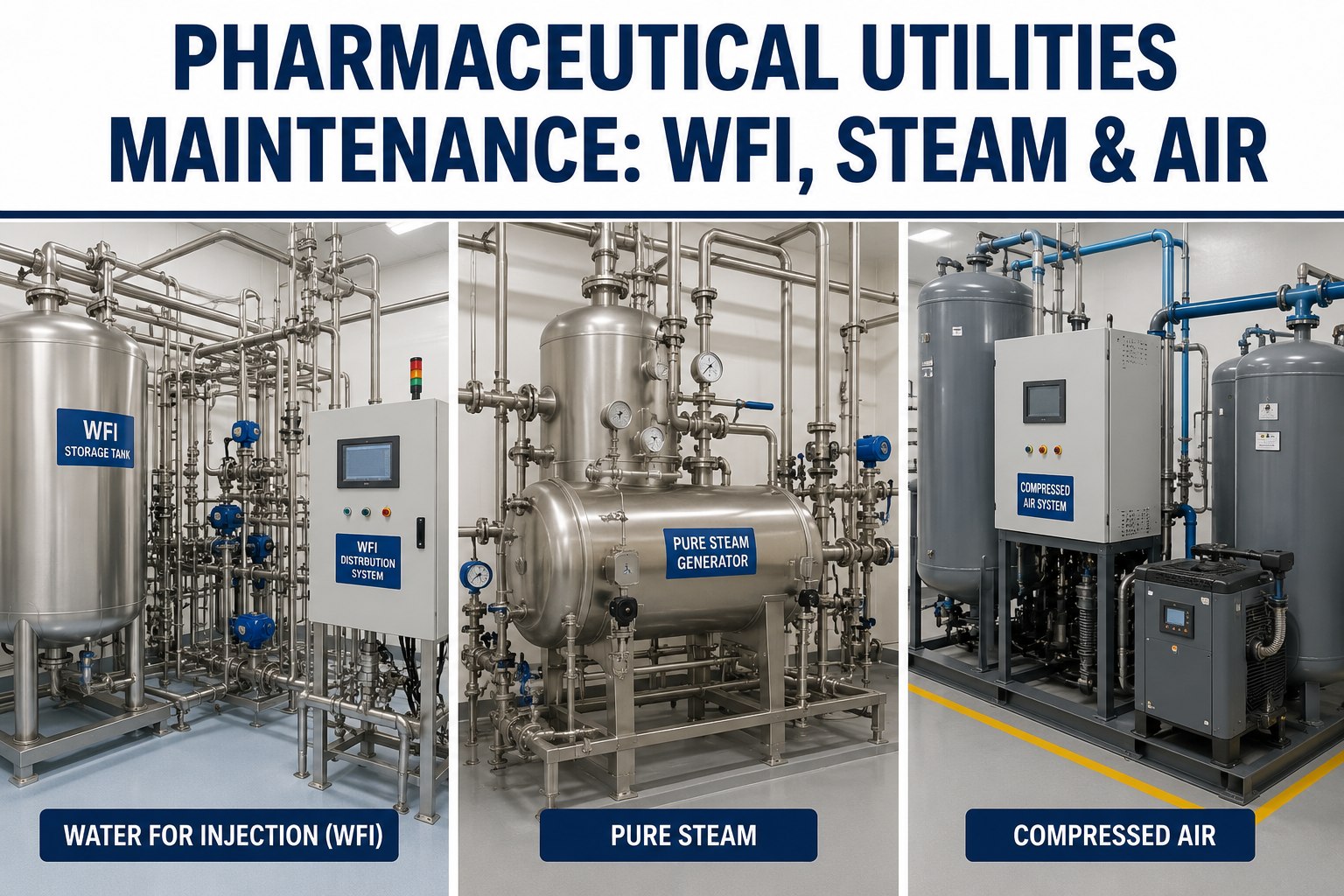
Pure steam is gaseous Water for Injection. Not a utility that happens to touch the product — the same pharmacopoeial-grade water, in vapour phase, condensing onto the surfaces that will hold a sterile drug. Once that idea lands, pharmaceutical utilities stop looking like plant services and start looking like what they are: unpackaged ingredients delivered by pipe. WFI, pure steam, compressed air, and nitrogen all contact the product or its critical surfaces, so each is held to a specification rather than a performance target, and WFI systems are classified as critical equipment under GMP. That reclassification changes maintenance completely. In a normal utility loop, a seal replacement ends when the leak stops. In a WFI loop, it ends when the system has been re-qualified and the water has been demonstrated to still meet conductivity, TOC, microbial, and endotoxin limits. The repair is not the deliverable — the proof is. This guide covers maintaining the four critical utilities: WFI systems, pure steam generators, compressed air dryers, and nitrogen systems in a GMP facility. Start a free Oxmaint trial and gate utility maintenance behind requalification, or book a demo to see TOC, conductivity, and endotoxin trends tied to the asset.
Pharma · Critical Utilities · GMP Compliance
Pharmaceutical Utilities Maintenance: WFI, Steam & Air
WFI systems, pure steam generators, compressed air dryers, and nitrogen systems — how GMP facilities maintain the utilities that are regulated as ingredients, and requalify them before product ever flows again.
-
1.5x
maximum dead leg length, as a multiple of pipe diameter
-
4 tests
conductivity, TOC, microbial load, endotoxins
-
2–4 wks
Phase I daily sampling in WFI performance qualification
-
Every repair
a seal or membrane change triggers brief re-qualification
Utilities Regulated as Ingredients
Four Utilities, Four Specifications
Each of these reaches the product or a product-contact surface, so each answers to a written specification rather than an uptime number. Maintenance exists to keep the specification true — not merely to keep the utility flowing.
- Water for Injection (WFI) The highest grade of pharmaceutical water, used for injectables, equipment cleaning, and sterile product manufacture. Must meet conductivity, TOC, microbial, and endotoxin limits — endotoxins from Gram-negative bacteria trigger pyrogenic reactions in patients.
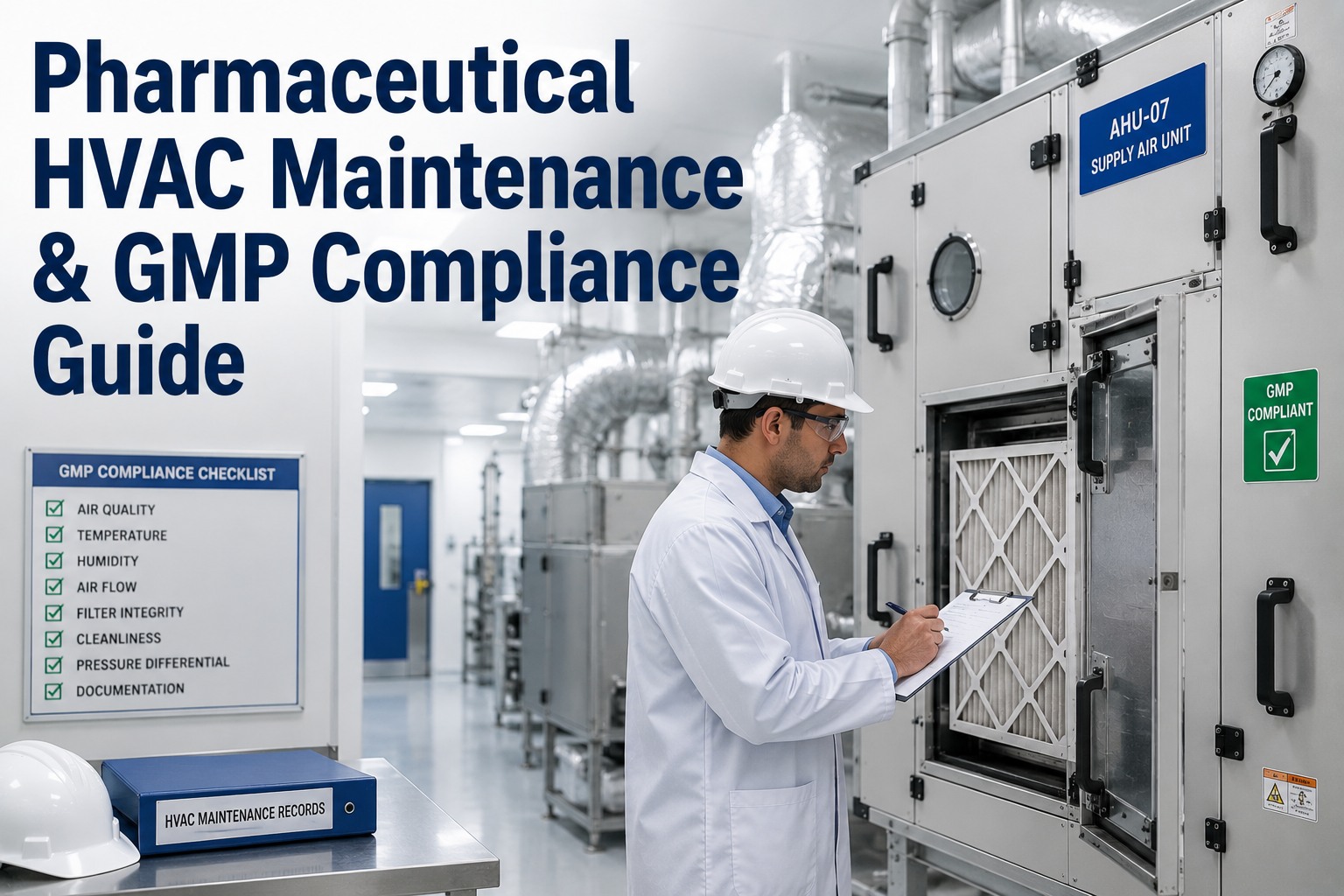
- Pure Steam Gaseous WFI, used for sterilization, drying, and humidification. Saturation, dryness, and non-condensable gas content must be determined per application or per EN 285 — a wet or gas-laden steam does not sterilize what it touches.
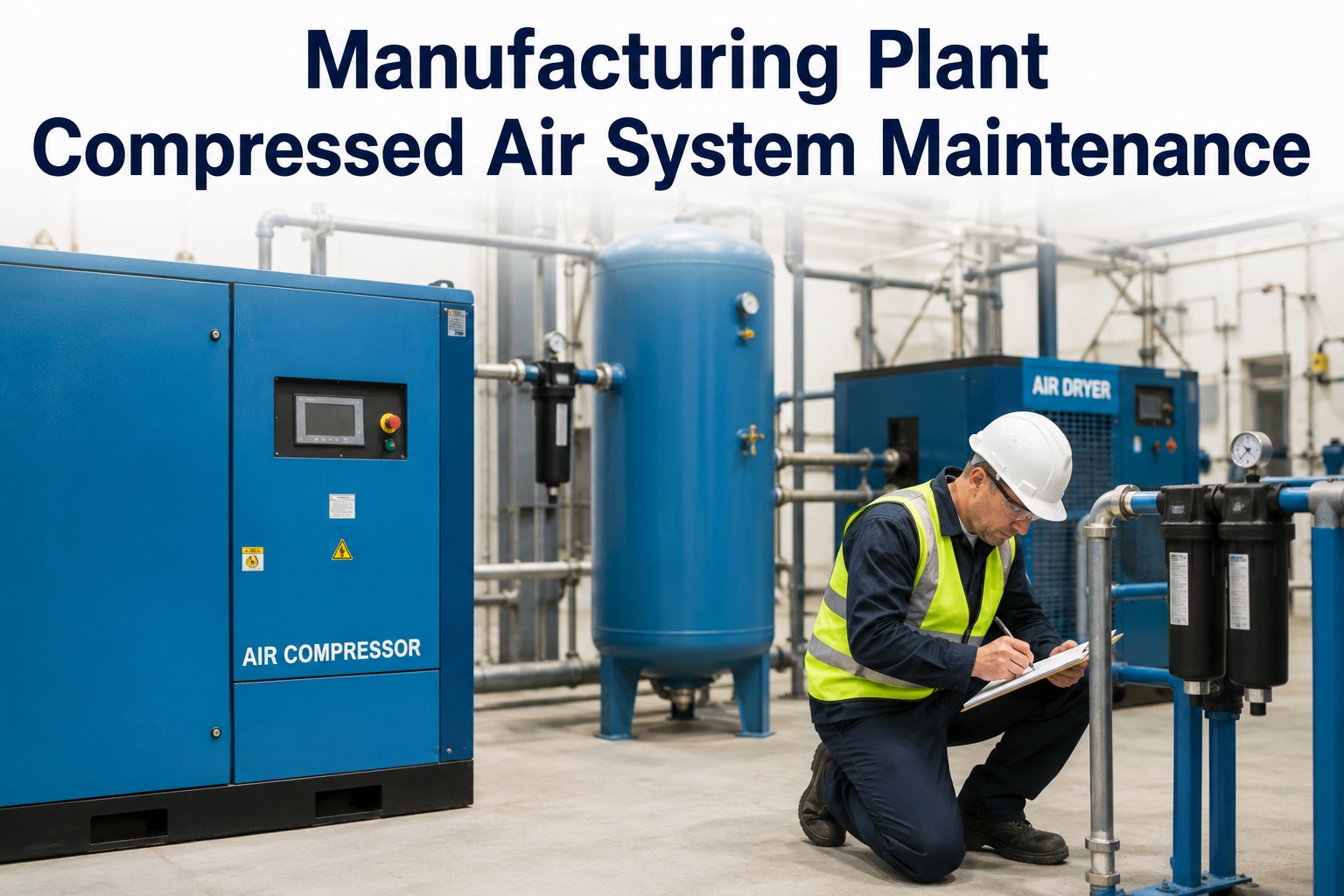
- Compressed Air Contacts product and product-contact surfaces directly. Dryers hold the dew point that prevents condensation and microbial growth downstream; filtration and oil control keep the air itself from becoming a contaminant.
- Nitrogen Blanketing, purging, and headspace displacement on oxygen-sensitive products. Purity and moisture are the controlled attributes, and the delivery train — filters, regulators, point-of-use terminations — carries the contamination risk.
All four sit under FDA 21 CFR 211 and the relevant USP chapters, and WFI systems specifically are treated as critical equipment requiring ongoing qualification. Book a demo to see each utility maintained against its written specification.
The Rule That Governs the Work
The Repair Is Not Done Until the System Is Re-Qualified
This is the loop that separates GMP utility maintenance from every other kind. After a maintenance activity — a membrane change, a seal replacement — a brief re-qualification is performed to demonstrate that water quality has not been affected. The system does not return to service on the technician's word.
-
1
Maintenance is performed
Seal, membrane, gasket, heat exchanger, or instrument. The work itself follows the SOP — but completing it does not release the system. -
2
Re-qualification is triggered
A brief requalification demonstrates the critical parameters are unaffected. Major changes — a loop extension, a major equipment replacement, an unexplained quality excursion, or a prolonged shutdown — trigger full revalidation. -
3
The four parameters are proven
Conductivity, TOC, microbial load, and endotoxins tested against specification — including challenge sampling from the most remote point of use. -
4
The system is released, with the record
Deviations and corrective actions documented, results trended, and the qualification status of the asset updated. Only now can product-contact use resume.
Validation is not a one-time activity — it recurs on annual re-validation and after any change that could plausibly disturb water quality. Sign up for Oxmaint to gate system release behind requalification evidence.
Where Contamination Enters
The Failure Modes an FMEA Names First
A contamination risk assessment on a high-purity water system converges on the same short list every time. These are the mechanisms maintenance is fighting — and every one of them is a maintainable condition, not an act of nature.
| Risk | Mechanism | Maintenance Control |
|---|---|---|
| Dead-leg stagnation | Water that does not circulate | Keep dead legs under 1.5x pipe diameter |
| Biofilm formation | Microbial colonisation of surfaces | Hot circulation or scheduled sanitization |
| Heat exchanger leakage | Utility side crosses into product side | Integrity testing, leak detection |
| Feedwater contamination | Upstream quality excursion | Pretreatment monitoring and trending |
| Non-condensable gases | Steam fails to condense on the load | Steam quality testing per EN 285 |
Design carries half the burden — sanitary piping, orbital welding, slope-to-drain, and no stagnant points — but maintenance carries the other half, forever. Book a demo to see contamination risks tracked as recurring PM controls.
Trend It Before It Fails
Poor Trending Is Itself a Finding
The recurring root causes behind water system observations are not exotic: poor trending, inadequate microbial control, and insufficient monitoring. Regulators expect data to be reviewed over time to identify early warning signals before a problem occurs — not read once and filed. A conductivity value inside specification but drifting steadily, a microbial count creeping at the most remote point of use, a dryer dew point rising slowly across a quarter: each is a system telling you something while it is still cheap to listen. That is why the monitoring programme and the maintenance programme cannot live in separate places. When TOC, conductivity, microbial, and endotoxin results are attached to the asset that produced them, and instrument calibration and sanitization cycles are scheduled against the same record, the trend and its cause sit side by side — and the review that satisfies an inspector is the same review that prevents the excursion.
Oxmaint for GMP Utilities
How Oxmaint Runs Critical Utility Maintenance
-
Requalification Gate
No Release Without Proof
Maintenance on a WFI loop, still, or pure steam generator raises a mandatory requalification task before the asset returns to product-contact service — with results attached to the work order that caused it.
-
Parameter Trending
TOC, Conductivity, Endotoxin
Log conductivity, TOC, microbial load, and endotoxin results per sample point per date, trended against specification so a drift inside limits is visible long before it becomes an excursion.
-
Sanitization Cycles
Scheduled, Logged, Verified
Schedule thermal or chemical sanitization for each loop, record the cycle against the asset, and hold hot-circulation setpoints as a monitored condition rather than an assumption.
-
Steam Quality
Dryness and Non-Condensables
Recurring steam quality testing for saturation, dryness fraction, and non-condensable gas content per EN 285 — the properties that decide whether pure steam actually sterilizes the load.
-
Air & Nitrogen PM
Dryers, Filters, Dew Point
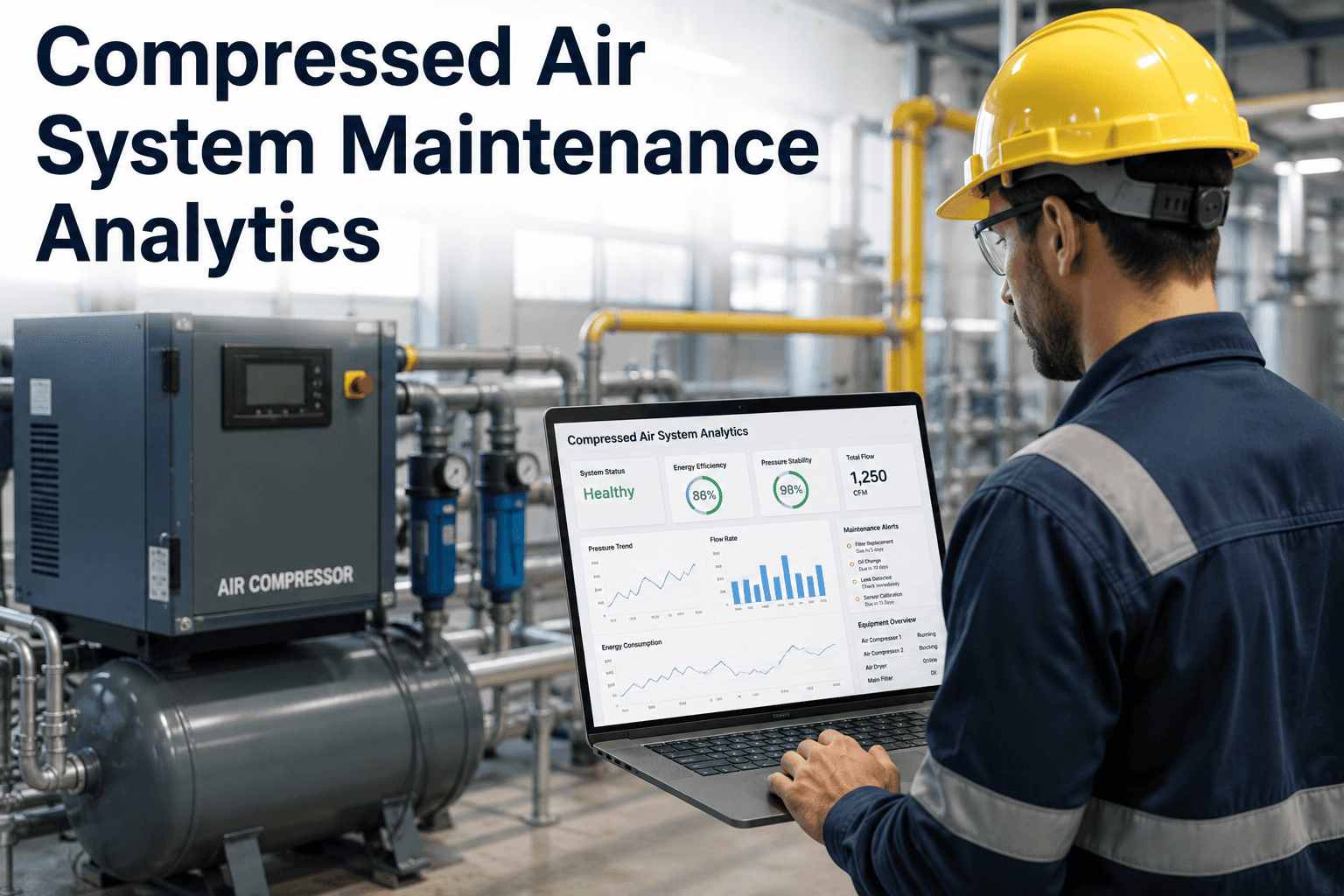
Dryer dew point trending, filter integrity testing, and differential pressure monitoring across the compressed air and nitrogen trains, with point-of-use terminations on their own inspection cadence.
-
Calibration & Records
Instruments and Deviations
Traceable calibration schedules for every monitoring instrument, with deviations and corrective actions documented against the asset — producing the validation record an inspection expects.
Frequently Asked
Pharma Utilities Maintenance Questions
Why does maintenance on a WFI system trigger requalification?
Because WFI systems are critical equipment under GMP, and the deliverable is water that still meets specification — not a completed repair. After any maintenance activity such as a membrane or seal replacement, a brief re-qualification is conducted to demonstrate that water quality has not been affected. Larger events trigger full revalidation: a new loop extension, replacement of major equipment, an unexplained quality excursion, or a prolonged system shutdown. Sign up for Oxmaint to enforce the requalification gate.
What is a dead leg and why does it matter?
A dead leg is a section of pipe where water does not circulate. Stagnant water is where biofilm establishes, and biofilm is the hardest contamination to remove once formed. Regulatory guidance recommends that a dead leg should not exceed 1.5 times the pipe diameter. Good design avoids dead ends and stagnant points using sanitary piping, orbital welding, and slope-to-drain construction — but any modification, tie-in, or added point of use can introduce one, so it becomes a maintenance and change-control concern too.
How is pure steam different from plant steam?
Pure steam is gaseous Water for Injection — produced to the same purity standard and used for sterilization, drying, and humidification, where it condenses directly onto product-contact surfaces. Plant steam is a heat-transfer utility and never touches the product. For pure steam, the degree of saturation, dryness, and quantity of non-condensable gases must be determined for the application or per EN 285, because steam carrying non-condensable gases will not condense properly on the load and therefore will not sterilize it. Book a demo to see steam quality testing scheduled per generator.
What are the recurring root causes of water system findings?
Poor trending, inadequate microbial control, and insufficient monitoring. The expectation is not simply that samples are taken but that results are trended and reviewed over time to identify early warning signals before a problem occurs, with instruments regularly calibrated and the system sanitized on schedule. A contamination FMEA typically names biofilm formation, dead-leg stagnation, heat exchanger leakage, and feedwater contamination as the risks that programme is defending against. Sign up for Oxmaint to trend every parameter against its asset.
Specify · Maintain · Requalify · Trend
A Utility That Touches the Product Is Not a Utility
Every dead leg introduced by a tie-in, every seal replaced without requalification, and every conductivity trend nobody reviewed is an ingredient going out of specification inside a pipe. Oxmaint gives GMP facilities one platform to maintain WFI loops, pure steam generators, compressed air dryers, and nitrogen trains against their written specifications, gate release behind requalification evidence, schedule sanitization and calibration, and trend TOC, conductivity, microbial, and endotoxin results against the asset that produced them.