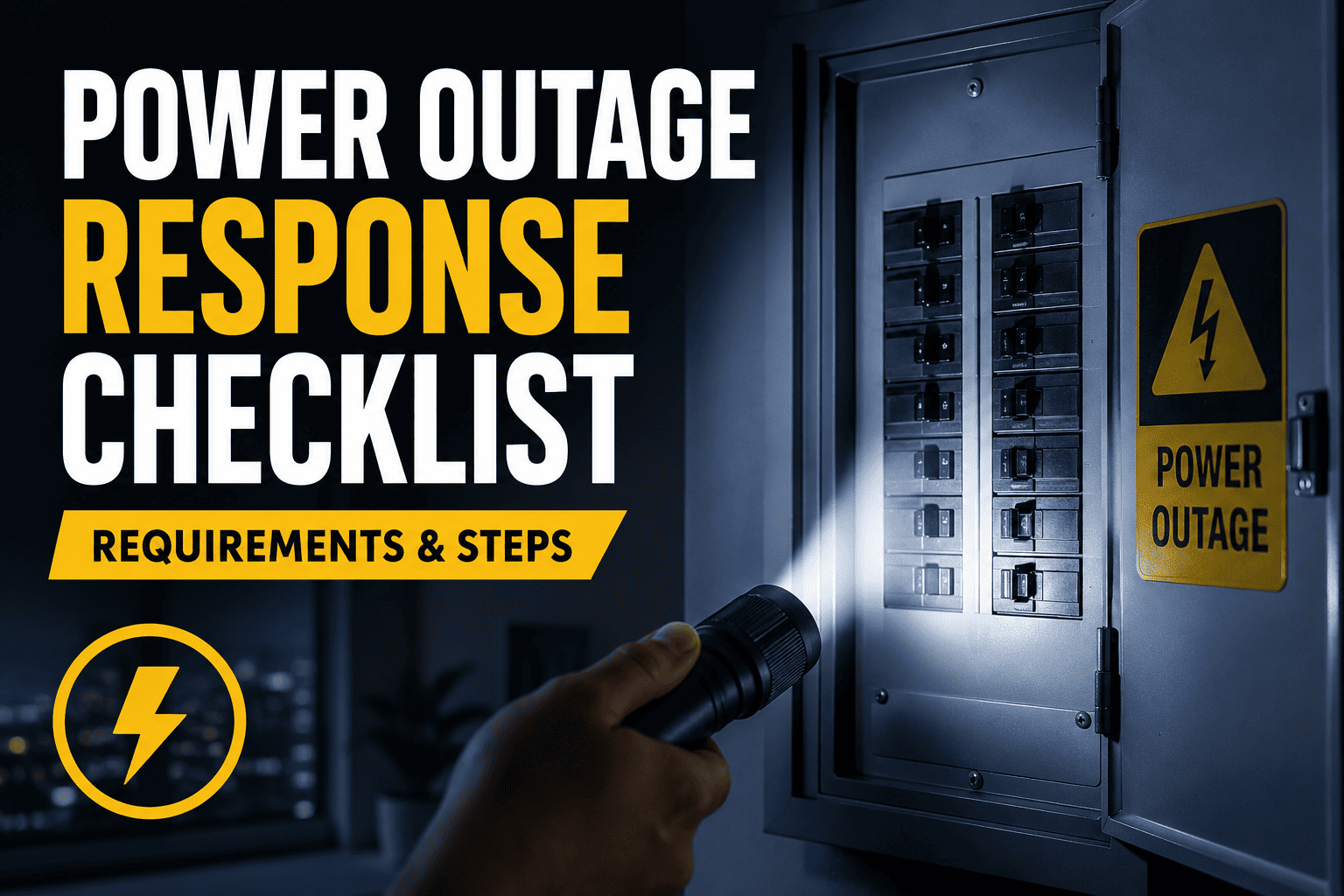
The lights go out and the clock starts running whether anyone's ready or not. What separates a facility that reopens on schedule from one that spends weeks explaining downtime to regulators isn't luck — it's whether the power outage response checklist was actually followed, step by step, with proof. Here's what OSHA-aligned EHS teams need on record before, during, and after every outage.
A Response Is Only As Good As Its Record
Regulators and insurers don't ask what your team meant to do during an outage — they ask for the timestamped log of what actually happened, who signed off, and when power was safely restored. Verbal recollection doesn't hold up. Documented steps do.
Four Checkpoints Every Response Plan Must Pass
Each checkpoint needs a named owner and a pass/fail outcome, not a general sense that "it was handled."
Immediate Isolation
Critical circuits and equipment isolated in the correct order within minutes of the outage being confirmed.
Backup Failover
Generators or UPS systems tested against a fixed runtime, not assumed to have enough fuel or charge.
Communication Cascade
Shift leads, safety officers, and affected teams notified on a defined chain, not word of mouth.
Safe Restart
Equipment re-energized only after inspection confirms no damage occurred during the outage window.
The First 60 Minutes: A Response Timeline
1
0–5 minutes — Confirm and isolate
Outage confirmed, critical circuits isolated per the predefined sequence.
2
5–20 minutes — Engage backup power
Generator or UPS failover confirmed operational, load prioritized to critical systems.
3
20–40 minutes — Notify and log
Communication cascade triggered, incident log opened with timestamps and initial cause notes.
4
40–60 minutes — Inspect before restart
Affected equipment checked for damage before anything is re-energized.
Turning Gaps Into Closed Corrective Actions
Deviation Logged
Any missed step or delayed failover recorded the moment it's noticed, with a timestamp and evidence.
Owner Assigned
A named person and a deadline for the fix, tracked against the incident, not left open-ended.
Restart Verified
A second sign-off confirms systems are safe and stable before the incident is closed.
Oxmaint operationalizes exactly this checklist — mandatory safety checks built into high-risk work orders, digital permit workflows, inspection records linked directly to each asset, photo evidence, e-signatures, and an audit trail that satisfies regulators without a scramble after the next outage. Teams that sign up get every checkpoint, deviation, and sign-off in one defensible record — or book a demo to see the compliance workflow live.
Q
How fast should isolation happen after an outage is confirmed?
Within minutes, following a predefined isolation sequence. Deciding shutdown order on the fly is exactly the kind of pressure-driven mistake a documented plan is meant to prevent.
Q
Who needs to be notified during the communication cascade?
Shift leads, safety officers, and any team whose equipment is affected — through a defined chain, not word of mouth that can miss people during a chaotic moment.
Q
What should happen before equipment is re-energized?
A documented inspection first. Restarting equipment before confirming there's no damage can turn a power outage into a much bigger safety incident.
Turn Every Outage Into A Defensible Record
Mandatory safety checks, digital permit workflows, photo evidence, e-signatures, and an audit trail linked to every asset and every response step. Sign up for a free trial to build your first response checklist, or book a demo to see the compliance workflow live.