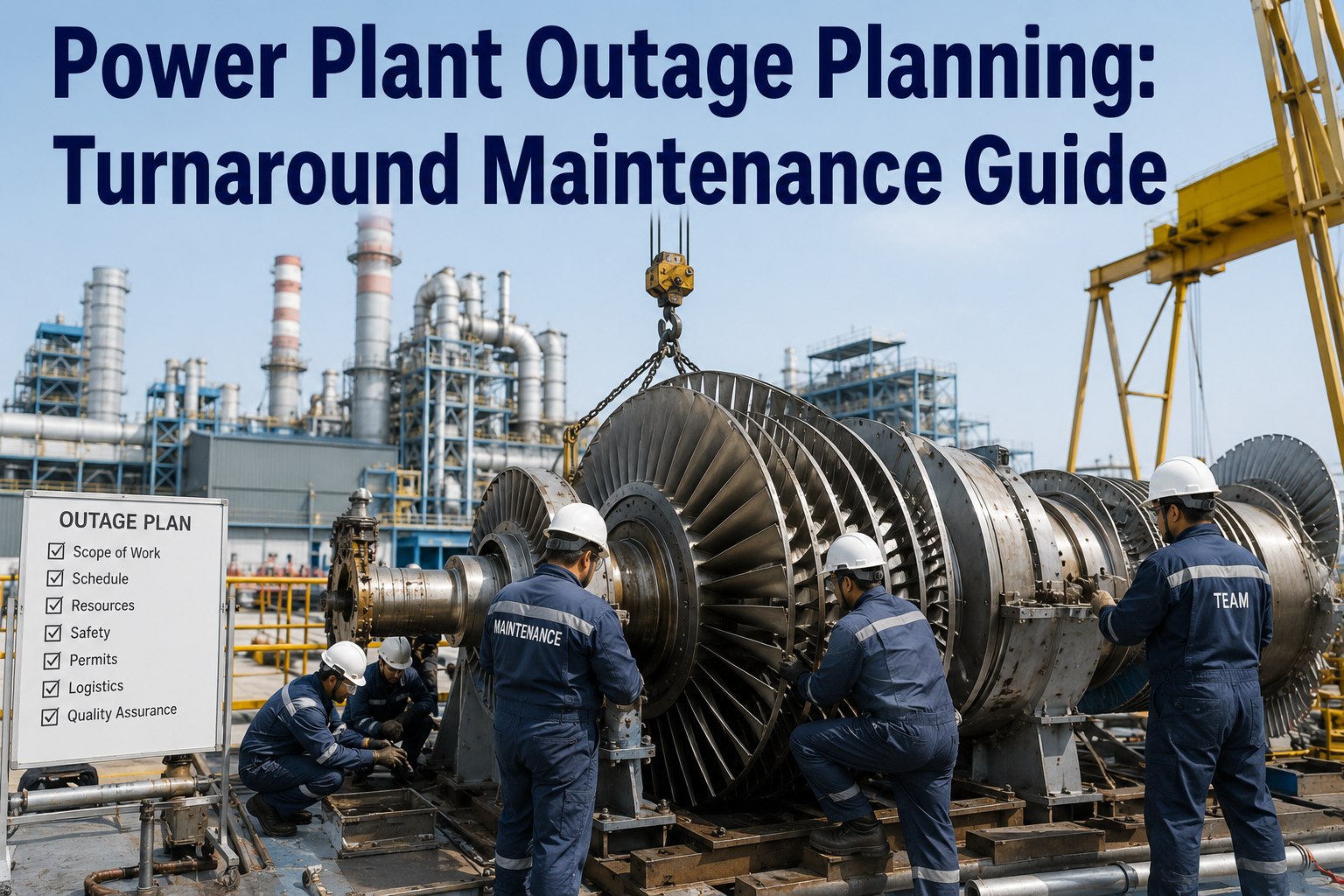
Power Plant Outage Planning & Turnaround Management with CMMS
A poorly scoped major outage either strands money on the table — work deferred that costs 3.8× more as an emergency repair — or burns it needlessly on scope that condition data never justified. For a 600 MW coal unit, every extra day of unplanned outage extension costs $480,000 in lost generation revenue on top of emergency labour and parts premiums. The difference between a 28-day planned major overhaul and a 41-day overrun is not crew size or crane availability — it is whether the scope was defined from condition data, the critical path was built before mobilisation, and contractor work packages were issued through a CMMS that tracked progress in real time. OxMaint manages every phase of outage planning — from scope-setting 6 months out to punch-list close on return-to-service day.
Outage overruns are not surprises. They are the result of scope defined too late, contractors briefed too little, and condition data that never reached the planner.
Scope planning · critical path · contractor packages · real-time progress · punch-list close — all in OxMaint.
revenue lost per extra day of unplanned outage extension on a 600 MW unit at peak demand
3.8×
cost multiplier for emergency turbine repair versus planned overhaul at the scheduled interval
34%
of major outages exceed planned duration — most overruns trace to late scope lock and poor contractor coordination
94%+
on-time return-to-service rate for plants using CMMS-driven outage planning with condition-based scope
34% of major outages overrun their planned duration — costing an average of 6.4 extra days per event. The root cause in 78% of cases is scope defined within 30 days of outage start, rather than 90–120 days out when condition data, parts lead times, and contractor availability can still be managed. OxMaint's outage planning module locks scope 90 days out from condition data — before the overrun window opens.
The Six Phases of a Well-Managed Outage
Every major outage runs through six distinct phases. Most overruns are caused by failures in Phase 1 and 2 — long before the unit is even shut down. OxMaint structures all six phases in a single project timeline, with gates, checklists, and condition data linked at each stage.
1
Scope Definition
T–120 days
Condition data drives scope. Every work order justified by NDT, vibration trend, or EOH threshold — not assumption.
2
Resource & Contractor Mobilisation
T–90 days
Work packages issued per contractor. Parts on order. Scaffold, tooling, and access confirmed before mobilisation.
3
Critical Path Scheduling
T–60 days
Every activity sequenced. Turbine rotor lift on day 4, HP blade inspection day 6. Float identified and protected.
4
Outage Execution
Day 0 → Return
Work orders updated daily. Scope additions assessed against critical path. Every deviation logged in real time.
5
Punch-List & Commissioning
T+2 to T+5 days
Every open item tracked to closure. Recommissioning checks signed off. No return-to-service without full punch-list clear.
6
Post-Outage Review
T+7 to T+14 days
Cost vs budget, schedule variance, and scope findings fed back into next outage plan. Continuous improvement loop closed.
OxMaint · Outage Planning Module
Build your next outage scope from condition data — 90 days before shutdown.
Critical path · contractor packages · real-time progress — active from day one.
Thermal power plant maintenance schedules four outage types — each with different scope, duration, and planning lead time. OxMaint tracks all four with asset-specific EOH counters, inspection histories, and condition-based scope triggers.
Outage Type
Interval
Typical Duration
Key Scope Items
Planning Lead Time
OxMaint Module
Minor Inspection
4,000–8,000 EOH
3–7 days
Blade visual, bearing check, safety valve test, boiler UT sampling
30 days
✓ PM scheduling
Major Inspection
16,000 EOH
14–21 days
Stator PI test, rotor retaining ring UT, full blade inspection, H₂ seal service
60 days
✓ Scope planning
Turbine Major Overhaul
32,000 EOH
28–40 days
Full blade replacement, rotor rebalance, casing inspection, diaphragm service
120 days
✓ Critical path
Boiler Major Inspection
Every 2 years
14–21 days
Full tube UT survey, ASME recertification, refractory renewal, pressure parts
90 days
✓ ASME compliance
Gas Turbine Hot Gas Path
8,000 FF / 24,000 EOH
10–16 days
Combustor, transition pieces, stage 1 blades per OEM parts life
Contractor Coordination — Where Outages Are Won or Lost
A major turbine overhaul typically involves 6–12 specialist contractors working concurrently on the critical path. A single late work package, missing permit, or unsequenced access conflict adds days to the outage. OxMaint issues structured work packages to every contractor, tracks permit-to-work status, and flags access conflicts before they delay the critical path.
Work Package Issuance
Each contractor receives a structured OxMaint work package — scope, drawings, safety requirements, and acceptance criteria — 30 days before mobilisation.
✓ Issued 30 days pre-outage
Permit-to-Work Tracking
Hot work, confined space, and electrical isolation permits linked directly to work orders. No permit — no work order open. Automated compliance trail.
✓ Full PTW audit trail
Daily Progress Tracking
Work order completion status updated daily against the critical path. Any slippage flags immediately with impact assessment on return-to-service date.
✓ Critical path impact alert
Scope Addition Control
Found defects during execution raise a scope addition request. OxMaint assesses impact on critical path, cost, and parts availability before approval.
✓ Controlled scope change process
SAP / ERP Integration
Parts consumed during outage execution automatically trigger SAP replenishment orders. No manual reorder — stock for the next outage is rebuilt while this one runs.
✓ Auto parts replenishment
Punch-List Close
Every open item assigned, tracked, and signed off before return-to-service. OxMaint blocks RTS work order until full punch-list clearance is recorded.
✓ RTS gate check enforced
Technologies That Compress Outage Duration
Six technology integrations directly reduce outage duration — from AI camera inspection that replaces 3-day manual blade surveys to digital twin models that pre-define replacement scope before a single bolt is turned. OxMaint connects all six to the outage work order engine.
AI Camera Vision
3 days → 4 hrs
Blade inspection time cut by 85% — quantified defect maps replace subjective visual reports
Digital Twin
4–8 mo. advance
Predicts blade fatigue and tube wall loss — scope defined before outage start, not during it
Predictive Maintenance AI
6× earlier
Vibration and DGA trends flag developing faults months before outage — parts ordered, scope confirmed
SAP / ERP Integration
Pre-ordered
Long-lead turbine blades and boiler tubes on order before outage start — zero parts-wait delays
DCS / PLC Integration
Auto trigger
Protection trips and process alarms auto-create investigation work orders — scope additions captured instantly
IoT / Online Sensors
24/7
Continuous bearing and vibration data up to shutdown — baseline comparison confirms post-outage improvement
OxMaint · Power Plant Turnaround Management
Scope from condition data. Critical path built before mobilisation. Zero contractor surprises.
Generate full outage compliance packages for ASME, NERC, and insurance review in under 15 minutes.
The cost difference between a well-planned and a reactive outage is not just parts and labour — it includes generation revenue, emergency premium rates, and the downstream reliability impact of deferred scope that returns as a forced outage within 18 months.
Metric
⚠️ Unplanned / Reactive
✅ Planned with OxMaint
Scope definition lead time
<30 days
90–120 days
Turbine overhaul cost
$2.8M (emergency)
$740K (planned)
Outage overrun rate
34% of outages
<6% of outages
Avg overrun duration
6.4 extra days
0–1 day
Parts availability at start
67% ready
99% ready
Post-outage forced failure (18 mo.)
1-in-3 units
1-in-14 units
Total cost saving per major turbine overhaul — planned vs reactive (600 MW unit)
$5.1M saved
"
We used to start scope definition six weeks out and spend the first three days of every outage waiting for parts. After loading our condition data into OxMaint and locking scope at 90 days, our last major overhaul came in two days under schedule — with zero scope surprises and every contractor on-site on day one.
Outage Manager · 750 MW Coal Unit · Queensland, Australia
Frequently Asked Questions
Q1How does OxMaint build outage scope from condition data?▼
OxMaint pulls NDT readings, vibration trends, and EOH counters for each asset — flagging components that meet condition-based replacement criteria and auto-adding them to the outage scope list 90–120 days before shutdown.
Q2Can OxMaint manage multiple contractors working concurrently on the critical path?▼
Yes. Each contractor receives a dedicated work package in OxMaint with their assigned scope, access windows, PTW requirements, and daily progress reporting — flagging access conflicts before they delay the critical path.
Q3How does OxMaint handle scope additions discovered during outage execution?▼
Found defects raise a scope addition request in OxMaint, which immediately models the impact on critical path, cost, and parts availability — giving the outage manager a data-based go/defer decision within minutes.
Q4What compliance documentation does OxMaint generate for post-outage regulatory submission?▼
OxMaint generates complete ASME and NERC inspection packages — tube thickness surveys, safety valve certificates, insulation test records, and work order completion reports — formatted for insurance engineering review in under 15 minutes.
Q5How quickly can a plant get OxMaint outage planning running for a scheduled major overhaul?▼
Plants with an overhaul 90+ days out can be fully configured — assets loaded, condition data imported, scope list generated, and contractor packages structured — within 14 days of starting OxMaint.
OxMaint · Outage · Turnaround · CMMS
Your next outage starts today — 90 days before shutdown.
Scope · critical path · contractor packages · compliance reports — all in OxMaint.