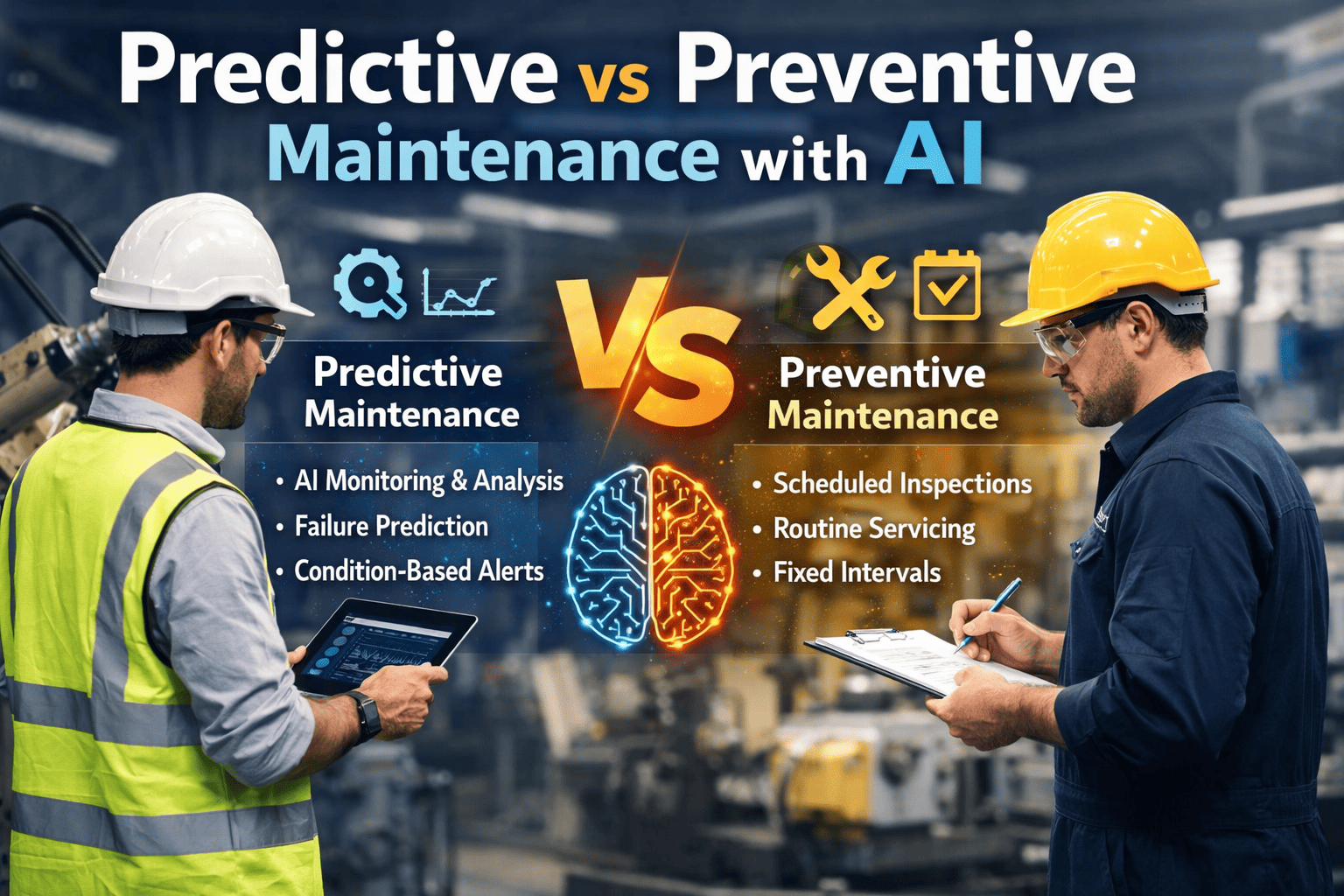
Across industrial floors and production lines, the choice between predictive and preventive maintenance is no longer just a scheduling decision — it is a competitive advantage. Plants still running fixed-interval PM programs are leaving serious uptime and cost gains on the table. AI-powered CMMS platforms like Oxmaint now make it possible for any maintenance team to graduate from calendar-based PM to true condition-based prediction, using real sensor data and machine learning to stop failures before they happen.
── HERO ──Predictive vs Preventive Maintenance with AI
Understand when each strategy wins, how AI transforms both, and how leading facilities use Oxmaint to move from schedule-driven PM to real-time intelligence that cuts unplanned downtime by up to 50%.
What Preventive Maintenance Actually Does
Preventive maintenance (PM) schedules work orders at fixed intervals — every 90 days, every 500 hours, every quarter — regardless of actual equipment condition. It is a significant improvement over reactive "run to failure" strategies, but it comes with a fundamental inefficiency: you are servicing based on time, not need.
For teams ready to move beyond paper-based PM logs, Oxmaint's CMMS automates PM scheduling, tracks compliance rates, and ensures no task slips through the cracks.
- Structured intervals — calendar or meter-based triggers that prevent obvious neglect
- Compliance documentation — audit trails that satisfy regulatory and insurance requirements
- Over-maintenance risk — 40% of PM tasks performed when equipment is still healthy
- Blind to real-time deterioration — cannot detect failures developing between service windows
How AI Transforms Predictive Maintenance
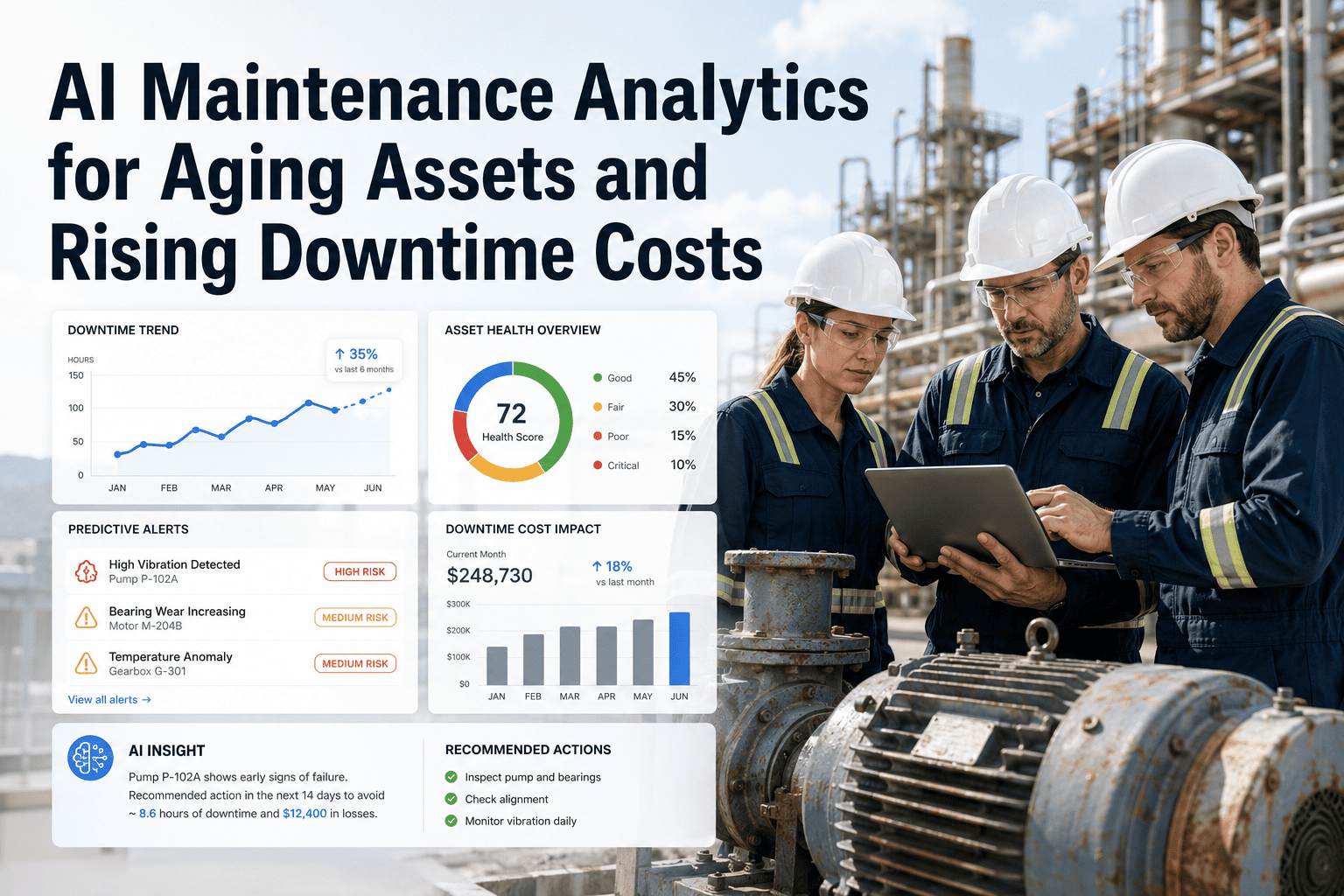
Predictive maintenance uses continuous sensor data — vibration, temperature, current draw, acoustic emissions — fed into AI models that learn the normal signature of each asset. When patterns drift, the system flags the anomaly and triggers a targeted work order before failure occurs.
Plants using Oxmaint's AI analytics module move from fixed-schedule maintenance to asset-specific condition triggers, cutting unnecessary PM labor by up to 30% while catching failures that PM windows would miss entirely.
- Condition-based triggers — work orders only when data indicates deterioration
- Weeks of advance warning — enough time to schedule parts, labor, and planned outages
- Asset lifespan extension — replace components when worn, not when the calendar says so
- Continuous learning — AI models improve with every work order and sensor reading logged
The Winning Strategy: AI-Augmented PM + Predictive Layers
The most cost-effective programs do not choose between PM and predictive maintenance — they use both intelligently. AI determines which assets qualify for condition-based monitoring and which should remain on optimized PM schedules based on failure history, criticality, and sensor availability.
Ready to build your hybrid maintenance strategy? Book a strategy demo with Oxmaint to see how leading manufacturers configure this layered approach for maximum uptime.
- Critical assets — full predictive monitoring with real-time sensor streams and AI anomaly detection
- Semi-critical assets — AI-optimized PM intervals based on actual usage patterns and failure history
- Non-critical assets — simplified PM schedules with CMMS compliance tracking
- AI continuously re-ranks assets by criticality as new failure data is logged
Side-by-Side Comparison: Reactive vs Preventive vs Predictive AI
How the three maintenance strategies stack up across every dimension that matters to operations teams.
| Dimension | Reactive Maintenance | Preventive Maintenance | Predictive AI Maintenance |
|---|---|---|---|
| Trigger Mechanism | Failure Occurs | Fixed Schedule | Condition Signal |
| Warning Time | None — failure is the warning | N/A — calendar-driven | Weeks in advance |
| Maintenance Cost | Highest (3–5× planned) | Moderate (30–40% overservice) | Lowest (service only when needed) |
| Unplanned Downtime | Frequent and severe | Reduced but not eliminated | Up to 85% reduction |
| Asset Lifespan | Shortened by shock failures | Improved with regular care | Maximized — parts replaced at true end of life |
| Data Required | None | Basic scheduling data | Sensor streams + historical work order data |
| Labor Efficiency | Poor — reactive scramble | Moderate — scheduled but potentially unnecessary | High — targeted, condition-justified |
| Best For | Non-critical, low-cost assets | Assets without sensor access | Critical, high-value rotating equipment |
| Data compiled from Deloitte, McKinsey, US Department of Energy, and Oxmaint customer deployments. | |||
See How Oxmaint Combines PM Automation with AI Prediction
Oxmaint gives you calendar-based PM scheduling, sensor-driven predictive alerts, and AI analytics — all in one platform your team can deploy in days.
Your Path from Preventive to AI-Predictive Maintenance
Most teams do not need to overhaul everything at once. This phased approach delivers measurable results at each stage.
Digitize Existing PM Schedules
Import your asset register and current PM task library into Oxmaint. Automated work order generation replaces paper-based scheduling immediately — compliance rates typically improve from 60% to 90%+ within the first month. Start your free account to begin the import.
First quick win: Automated PM remindersConnect Sensors on Critical Assets
Deploy vibration, temperature, and current sensors on the 10–15 most critical rotating assets. Oxmaint's AI baseline module learns normal operating signatures over the first two to four weeks of data collection, establishing the foundation for anomaly detection.
First anomaly alerts begin arrivingActivate AI-Optimized PM Intervals
With work order history and sensor data combined, Oxmaint's AI identifies which PM intervals are too frequent and which are too long. Interval recommendations are generated per asset — typically cutting unnecessary PM tasks by 25–30% while tightening intervals on assets showing early degradation signs.
Maintenance labor costs begin fallingScale Predictive Coverage Across the Plant
Expand sensor coverage to the next tier of assets. AI models now have enough historical context to predict failure modes specific to your equipment models and operating conditions — not generic industry averages. Book a demo to see a live dashboard of this stage in action.
Full predictive coverage operationalHow Oxmaint AI Analytics Powers Both Strategies
One platform that handles PM scheduling, sensor integration, anomaly detection, and work order automation.
Real-Time Anomaly Detection
Oxmaint ingests vibration, thermal, and electrical sensor streams and applies machine learning models trained on your asset's specific operating baseline. Deviations trigger automatic work orders with failure mode classification and severity ranking — giving your team actionable context, not just raw alerts.
AI-Optimized PM Scheduling
Rather than servicing every compressor every 90 days because a manual said so, Oxmaint analyzes actual run hours, load profiles, and historical failure patterns to recommend the optimal interval for each individual asset. Teams using this feature report 25–30% reductions in unnecessary PM labor within the first quarter.
Failure Mode Classification
Not all anomalies are equal. Oxmaint's AI distinguishes between a bearing showing early-stage wear (schedule in next planned window) versus a bearing exhibiting rapid degradation (dispatch immediately). This failure mode classification eliminates the guesswork that turns minor issues into catastrophic breakdowns.
Maintenance Cost Analytics
Every work order in Oxmaint captures labor hours, parts consumed, and technician time — creating a full cost history per asset. AI surfaces which assets are consuming disproportionate maintenance budget, flags repeat failure patterns, and generates replacement-versus-repair recommendations backed by real cost data, not assumptions.
The truth is, most of your maintenance waste is invisible — hidden in reactive scrambles, over-serviced assets, and work orders that never captured what was actually found. A good AI CMMS makes that waste visible, and once you can see it, you can eliminate it.
Frequently Asked Questions
Stop Choosing Between Preventive and Predictive — Use Both
Oxmaint gives your team AI-powered analytics, automated PM scheduling, sensor integration, and real-time anomaly detection in one platform built for maintenance teams who need results from day one.