Quadruped Robot IoT Alert Validation: Autonomous Anomaly Verification with CMMS
Industrial facilities generate thousands of IoT sensor alerts every day — vibration spikes, temperature anomalies, gas concentration warnings, pressure deviations, and acoustic signatures that could indicate anything from a catastrophic bearing failure to a harmless sensor drift. The problem is not detection — modern IoT networks are excellent at flagging anomalies. The problem is validation. Over 60% of IoT alerts in industrial settings are false positives or nuisance alarms, and the remaining 40% require a human to physically travel to the asset, visually confirm the condition, and decide whether maintenance is needed. That manual validation loop — dispatching a technician, waiting for arrival, performing a visual check, filing a report — costs hours per alert and leaves critical findings buried under alert fatigue. Quadruped robots equipped with thermal cameras, acoustic sensors, and visual AI now autonomously validate IoT alerts on-site within minutes, feeding confirmed anomaly data directly into a CMMS like Oxmaint for instant work order generation. The result: only verified, real anomalies become tracked maintenance actions — eliminating false positive waste and cutting response times from hours to minutes. Start Free Trial.
The True Cost of Unvalidated IoT Alerts
Before exploring how quadruped robots solve the validation gap, it is worth understanding why unvalidated alerts are so damaging. IoT sensors are deployed to catch problems early — but without physical confirmation, the alert pipeline becomes a liability rather than an asset. Here is what facilities without autonomous validation face every operating day.
60%+
false positives
Typical false alarm rate in industrial IoT sensor networks without physical validation
3.2 hrs
avg response time
Time from IoT alert to human technician physically confirming the anomaly on-site
$42K
per hour downtime
Average cost of unplanned downtime in process industries while waiting for validation
These numbers compound rapidly. A facility with 500 IoT sensors generating 50 alerts per day wastes hundreds of technician hours per month chasing false positives — while genuine critical alerts sit in the same queue, waiting their turn. Facilities deploying quadruped robots for autonomous alert validation report 80-90% reduction in false positive investigations and under-10-minute physical validation times. Book a demo with Oxmaint to see how autonomous validation eliminates alert fatigue at your facility.
What Separates Autonomous Alert Validation from Basic Robot Patrols
Not every robot inspection program solves the validation problem. Many facilities deploy quadruped robots on scheduled patrols — useful for routine monitoring, but fundamentally different from on-demand, alert-triggered autonomous response. When evaluating validation platforms, these are the capabilities that separate true autonomous anomaly verification from standard robotic inspection.
Reactivity
Alert-Triggered Autonomous Dispatch
When an IoT sensor fires an alert, the robot autonomously navigates to the exact asset location within minutes — no human dispatch required. The robot doesn't wait for a scheduled patrol; it responds to the alert in real time, validating the anomaly while conditions are still active.
Multi-Modal
Thermal + Acoustic + Visual Confirmation
A single IoT sensor provides one data dimension. The robot arrives with thermal imaging, acoustic analysis, and visual AI — cross-validating the alert across multiple independent sensor modalities. A vibration alert confirmed by thermal hot spot and audible bearing noise is a verified fault, not a maybe.
Intelligence
AI Severity Classification at the Asset
Onboard AI doesn't just confirm or deny the alert — it classifies the anomaly severity, compares readings against historical baselines, and determines whether the condition requires immediate action, scheduled maintenance, or continued monitoring.
Integration
CMMS Work Order on Confirmation
Verified anomalies are instantly pushed to Oxmaint CMMS with thermal images, acoustic spectrograms, visual evidence, GPS coordinates, and severity ratings — creating a fully documented, prioritised work order without any manual data entry.
Filtering
False Positive Suppression
When the robot arrives and finds normal conditions — no thermal anomaly, no acoustic deviation, no visual defect — the false positive is documented and suppressed. Over time, this feedback loop improves IoT sensor thresholds, reducing nuisance alerts at their source.
Context
Surrounding Environment Assessment
Unlike a fixed IoT sensor, the robot inspects the entire asset context — neighbouring equipment, floor conditions, pipe connections, secondary indicators. A temperature alert on a pump may be caused by a blocked cooling vent three feet away, something no sensor would detect.
Oxmaint connects IoT alert pipelines with quadruped robot validation and automated CMMS work orders in one platform. See why operations teams choose Oxmaint to eliminate alert fatigue and accelerate maintenance response.
Head-to-Head: Quadruped Platforms for IoT Alert Validation 2026
We evaluated the most capable quadruped robot platforms across the criteria that matter for autonomous alert validation: IoT integration depth, sensor payload range, autonomous dispatch capability, CMMS connectivity, and environmental ruggedness. Here is an honest comparison to help you shortlist the right platform for your facility.
Recommended
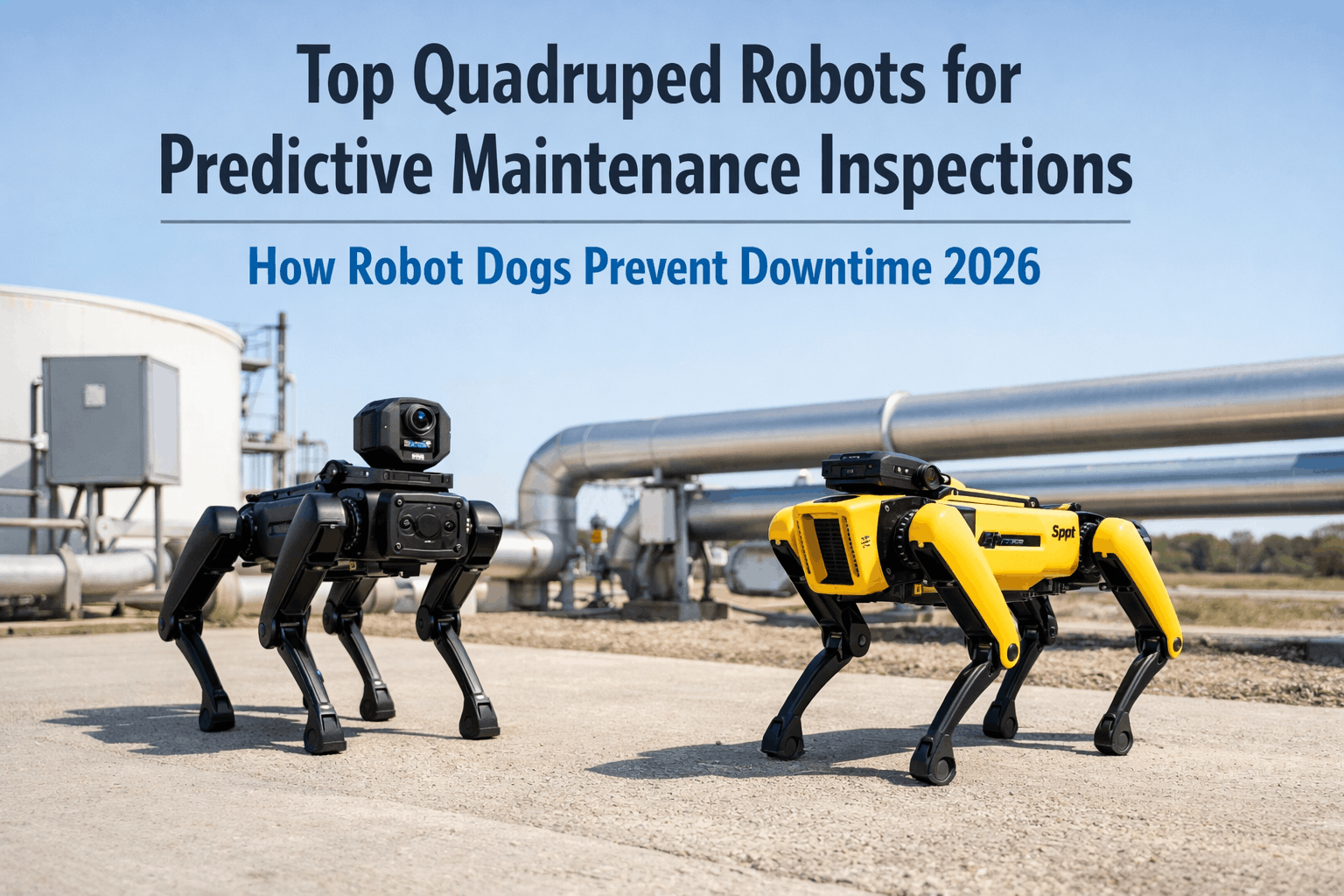
Oxmaint AI + Spot
Full IoT-to-validation-to-CMMS pipeline
Alert-triggered autonomous dispatch via IoT integrationFree tier available — deploy without procurement cycles
Industry-leading quadruped mobility and stair navigationOrbit fleet management for multi-robot schedulingModular payload system for sensor flexibility
Enterprise + hardware licensing
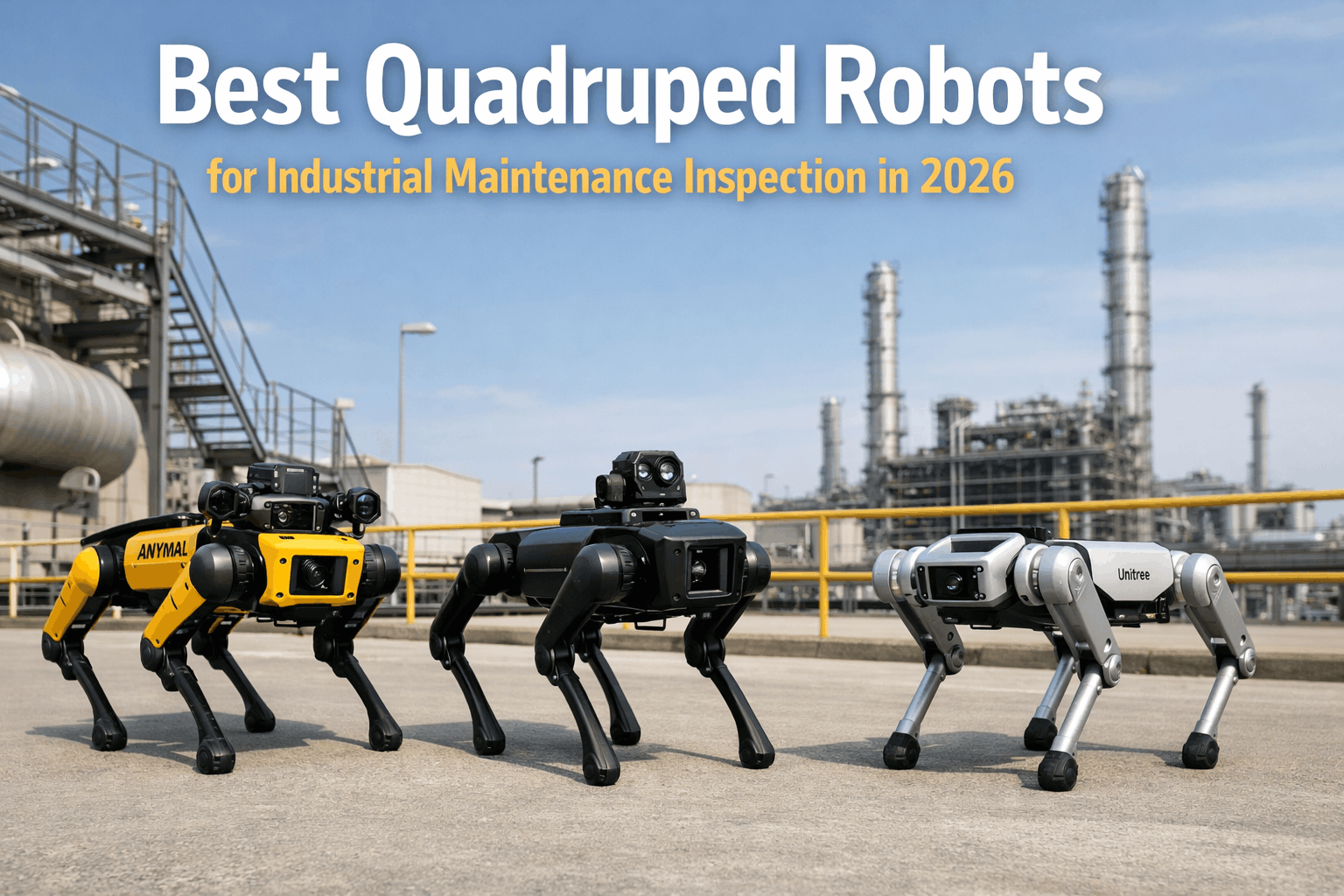
ANYbotics ANYmal
ATEX-rated hazardous environment validation
EX-certified for explosive atmosphere zonesIntegrated thermal, acoustic, and gas sensorsAPI connectivity for external CMMS platforms
Enterprise pricing
Unitree B2 Industrial
Cost-effective high-volume fleet deployment
40kg payload capacity for heavy sensor packagesLower per-unit cost enables larger fleet coverageThird-party sensor payload support
Hardware + integration
Ghost Robotics Vision 60
Extreme environment outdoor validation
Ruggedised for -40°C to 55°C operationsExtended battery for long-duration missionsModular sensor bays for custom payloads
Enterprise pricing
Energy Robotics (Software)
Platform-agnostic robot fleet software
Vendor-neutral fleet management across robot brandsMission automation with conditional logicCloud-based data processing and analytics
Software subscription
Platform capabilities reflect publicly available data as of early 2026. Every facility's IoT infrastructure and alert profile is different — the best way to evaluate is hands-on. Create a free Oxmaint account and run it alongside your current alert handling process to see real results on your assets.
Why Oxmaint Wins for IoT Alert Validation Workflows
Plenty of platforms can deploy a robot to an asset. The real test is whether the validation result reaches the right maintenance team, generates an actionable work order with multi-modal evidence, and closes the loop between IoT detection and physical repair — automatically. Oxmaint is built around one principle: an alert is worthless until it's validated, and a validation is worthless until it drives a repair decision. Here is how that philosophy translates into real capabilities.
IoT Alert Ingestion and Robot Dispatch
Oxmaint receives IoT sensor alerts via MQTT, REST API, or OPC-UA, evaluates priority against configurable rules, and autonomously dispatches the nearest available quadruped robot to the alerting asset. No control room operator intervention required for routine validation missions.
Multi-Modal Evidence Package
Every validated anomaly arrives in Oxmaint with thermal imagery, acoustic spectrogram, visual photographs, gas readings (where applicable), and GPS coordinates — all time-stamped and linked to the specific IoT alert that triggered the mission. No single-sensor guesswork.
Verified-Only Work Order Generation
Only confirmed anomalies generate CMMS work orders — false positives are logged, suppressed, and fed back into sensor threshold tuning. Maintenance teams receive clean, actionable work queues instead of noise-filled alert dumps. Sign up for Oxmaint to see validated work order workflows in action.
Alert-to-Resolution Analytics Dashboard
Track the full lifecycle from IoT alert → robot dispatch → validation outcome → work order → repair completion. Identify which sensors produce the most false positives, which assets generate the most validated alerts, and where your IoT thresholds need recalibration.
Before & After: What Changes With Autonomous Alert Validation
The shift from manual alert investigation to robot-validated, CMMS-integrated anomaly confirmation is not incremental — it fundamentally changes how maintenance teams interact with their IoT infrastructure. Here is what that transition looks like in practice for a typical industrial facility.
Manual Alert Investigation
Technician dispatched to every IoT alert — including 60%+ false positives
3+ hour average response time from alert to physical confirmation
Single-sensor data with no cross-modal verification
Verbal or paper reports with subjective severity assessments
Alert fatigue causes critical findings to be deprioritised or ignored
400+
wasted technician hours per month investigating false positive alerts
Autonomous Robot Validation
Robot autonomously dispatched — technicians only respond to confirmed faults
Under 10-minute physical validation with multi-modal sensor confirmation
Structured evidence packages with AI severity classification in CMMS
Clean work queues with only verified anomalies — zero alert fatigue
85%
reduction in false positive investigations with faster response to real faults
Eliminate alert fatigue without missing a single real anomaly. Oxmaint's free tier lets you run a real pilot connecting your IoT alerts to autonomous robot validation — no procurement cycle, no contracts.
Operations directors and reliability engineers need hard data to justify technology adoption. The evidence from early adopters deploying quadruped robots for IoT alert validation is clear — facilities see measurable returns across multiple dimensions within the first quarter of deployment.
85%
Fewer False Positive Investigations
Technicians respond only to robot-confirmed anomalies
90%
Faster Alert Validation
From 3+ hours to under 10 minutes for physical confirmation
65%
Lower Unplanned Downtime
Faster validated response catches faults before they escalate
55%
Reduced Maintenance Labour Costs
Technician hours redirected from investigation to actual repairs
These improvements compound as AI models learn your facility's alert patterns and sensor baselines improve from validation feedback. Create your free Oxmaint account and start tracking validated vs. false positive metrics within the first 30 days.
Your 4-Step Path to Autonomous Alert Validation
Building an IoT alert validation programme should not take years of pilot studies. Use this streamlined framework to go from alert overload to validated maintenance intelligence in months, not budget cycles.
1
Audit Your Alert Pipeline
Analyse your IoT alert volume, false positive rate, and average validation response time. Identify which asset categories and sensor types generate the most unvalidated or nuisance alerts — these become your priority validation targets.
2
Pilot on 10-20 High-Alert Assets
Deploy a quadruped robot configured for alert-triggered dispatch on your noisiest asset group. Connect IoT alert feeds to Oxmaint and configure autonomous validation missions. Compare validation speed, accuracy, and cost against your current manual process.
3
Validate Results and Tune Thresholds
Review validation outcomes — confirmed vs. false positive rates, time-to-validation, evidence quality. Use false positive data to recalibrate IoT sensor thresholds at their source. Measure technician time savings and work order quality improvement.
4
Scale Across Your IoT Network
Expand validated alert coverage to your full IoT sensor network. Add additional robots for multi-zone coverage. Build predictive models from validated historical data and establish continuous improvement feedback loops between validation outcomes and sensor configuration. Schedule a walkthrough to plan your facility's rollout.
We had 200 IoT sensors generating 80 alerts a day. Our technicians were spending more time investigating alarms than actually fixing equipment. The moment we deployed a quadruped robot to validate alerts before generating work orders, our maintenance team went from drowning in noise to working a clean, prioritised queue of real problems. That single change recovered more productive maintenance hours than any tool we have ever deployed.
Your Maintenance Team Deserves Verified Alerts, Not Noise
Oxmaint connects your IoT sensor alerts to autonomous quadruped robot validation — thermal, acoustic, and visual confirmation happens on-site in minutes, and only verified anomalies become tracked CMMS work orders. Eliminate false positive waste, cut response times from hours to minutes, and give your maintenance crews the actionable intelligence they need — from sensor trigger to completed repair.
How does the robot know where to go when an IoT alert fires?
Every IoT sensor in the system is mapped to a specific asset with precise facility coordinates. When Oxmaint receives an alert, it matches the sensor ID to the asset location and dispatches the nearest available robot with a pre-configured navigation waypoint for that asset. The robot uses SLAM-based autonomous navigation to reach the exact position — including climbing stairs, navigating corridors, and entering confined areas — without human waypoint guidance.
What happens if the robot confirms the alert is a false positive?
When multi-modal validation finds normal conditions — no thermal anomaly, no acoustic deviation, no visual defect — the robot documents the healthy-state evidence and logs the false positive in Oxmaint with a full evidence package. No work order is generated. Over time, Oxmaint's analytics identify which sensors and alert types produce the highest false positive rates, enabling targeted threshold recalibration that reduces nuisance alerts at their source. Sign up for Oxmaint to explore false positive analytics.
Can the system handle multiple simultaneous alerts?
Yes. Oxmaint's dispatch logic implements priority queuing with severity weighting. When multiple alerts fire simultaneously, the system evaluates alert severity, asset criticality, and robot proximity to optimise the validation sequence. Critical alerts on high-value assets are validated first, while lower-priority alerts queue for the next available robot. Facilities with high alert volumes can deploy multiple robots for concurrent multi-zone coverage.
What types of IoT alerts can quadruped robots validate?
Robots can physically validate virtually any IoT alert that has a detectable physical signature — vibration anomalies (confirmed by acoustic and thermal sensors), temperature spikes (confirmed by thermal imaging), gas leaks (confirmed by onboard gas detectors), pressure deviations (confirmed by visual gauge reading), oil leaks (confirmed by visual AI), and equipment state changes (confirmed by visual inspection). The key requirement is that the IoT alert corresponds to a condition the robot's sensors can independently verify. Book a demo to discuss validation capabilities for your specific alert types.
What is the ROI timeline for autonomous alert validation?
Most facilities see measurable returns within the first 90 days. A facility with 50 daily IoT alerts and a 60% false positive rate wastes approximately 400+ technician hours per month on false positive investigations. At $75/hour loaded labour cost, that represents $30,000+ per month in wasted investigation time alone — before accounting for the cost of delayed response to genuine faults. Robot validation typically reduces false positive investigations by 85%, recovering $25,000+ per month in redirected labour while simultaneously cutting real-fault response times from hours to minutes. Schedule a consultation to calculate projected savings for your specific alert volume.