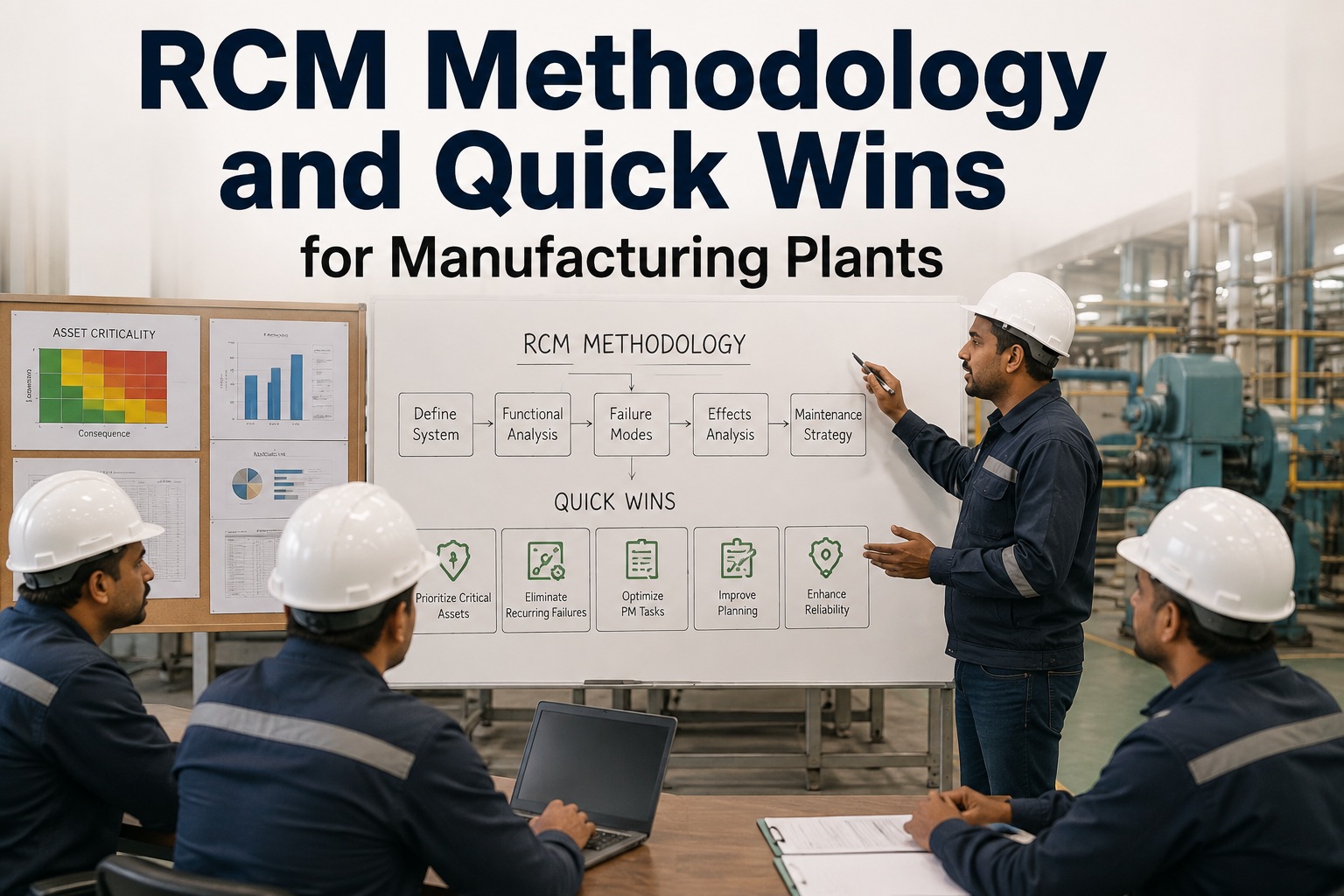
Reliability centered maintenance in manufacturing is the systematic process of identifying how assets fail, selecting the right maintenance strategy for each failure mode, and executing that strategy to eliminate unplanned downtime. For most plants, the gap between RCM theory and daily execution is where productivity bleeds away—technicians wait on parts, schedules built on Friday are obsolete by Monday, and firefighting replaces planning. This guide breaks down how to run an RCM program that actually delivers measurable quick wins, from pilot project selection to maintenance optimization. Ready to stop reacting and start preventing? Start Free Trial with OxMaint and put your RCM strategy into action.
RCM METHODOLOGY GUIDE
Is your plant fighting failures instead of preventing them?
Most manufacturing maintenance teams spend 60% of their week reacting to unplanned breakdowns. A structured manufacturing reliability program flips that ratio—targeting a 30-50% drop in unplanned downtime within the first six months of implementation.
RCM FOUNDATIONS
What is reliability centered maintenance in manufacturing?
Reliability centered maintenance (RCM) in manufacturing is a structured framework that identifies the function, functional failures, failure modes, and failure effects of physical assets—then applies the most cost-effective maintenance strategy to mitigate each risk. Rather than treating all equipment equally, RCM segments assets by criticality and assigns one of four strategies: predictive maintenance (PdM), preventive maintenance (PM), run-to-failure (RTF), or condition-based monitoring.
A common misconception is that RCM requires analyzing every asset on the floor. In reality, an effective manufacturing reliability program starts with the 10-20% of assets that drive 80% of downtime and repair costs. When a 180-asset plant spends $42K annually on emergency parts and labor for just a dozen critical machines, applying RCM principles to that subset alone pays for the program in under a year.
QUICK WINS
RCM implementation in manufacturing: the quick-win timeline
A successful RCM implementation in manufacturing doesn't happen overnight—but it shouldn't take years, either. The most effective plants use a phased approach, securing quick wins in the first 90 days to fund the broader rollout. Here is a proven timeline for a manufacturing RCM pilot project:
Asset Criticality Ranking
Identify the top 10-20% of assets causing the most downtime. Rank by production impact, safety risk, and repair cost. OxMaint's asset hierarchy automatically surfaces your worst offenders using historical work order data.
FMEA & Strategy Selection
Run Failure Mode and Effects Analysis (FMEA) on the critical assets. For each failure mode, assign PdM, PM, or RTF. Map the selected strategy directly to a triggered work order template in your CMMS.
Execute & Measure Quick Wins
Activate preventive triggers, condition-based alerts, and spare-parts kitting for the pilot assets. Measure schedule attainment, unplanned downtime hours, and MTBF weekly to prove ROI before scaling.
STRATEGY SELECTION
How to select the best maintenance strategy for each failure mode
Manufacturing maintenance optimization hinges on matching the right strategy to the right failure mode. Over-maintaining wastes money; under-maintaining invites catastrophic failure. Use the decision matrix below to align failure characteristics with the most cost-effective response.
| Failure Mode Characteristic | Recommended Strategy | Why It Works | Expected Impact |
|---|---|---|---|
| Failure has clear, measurable warning signs (vibration, temperature) | Predictive Maintenance (PdM) | Act on actual condition, not guesswork | 30-50% fewer unplanned events |
| Failure is age-related with predictable wear-out pattern | Preventive Maintenance (PM) | Replace or inspect on fixed intervals | 20-30% downtime drop |
| Failure is random, low-criticality, cheap to fix | Run-to-Failure (RTF) | Saves labor on non-critical assets | 10-15% maintenance cost savings |
| Failure causes safety risk or environmental hazard | Condition-Based + Redundancy | Continuous monitoring with backup | Near-zero catastrophic risk |
| Failure is hidden (no immediate operational impact) | Scheduled Functional Testing | Verify the asset works before it's needed | Prevents dormant failures |
The key to manufacturing failure prevention is data. Without historical work order records, MTBF calculations, and failure code analytics, strategy selection becomes guesswork. OxMaint standardizes failure coding across every work order, giving your reliability engineers the clean data they need to make defensible maintenance decisions.
SOLUTION
How OxMaint powers your manufacturing reliability program
OxMaint's AI-powered CMMS and EAM platform eliminates the gap between RCM strategy and daily execution. Instead of maintaining static spreadsheets that are dead by Monday morning, planners get live, data-driven tools that keep the maintenance schedule and the shop-floor reality in sync all week.
AI-Driven Failure Prediction
OxMaint analyzes vibration, temperature, and historical work order data to predict failures 7-14 days before they happen—enabling true predictive maintenance that cuts unplanned downtime by up to 50%.
Drag-and-Drop Scheduling
Visual work order queues and resource availability let planners build a week-long schedule in minutes. When the floor changes, drag to reassign—technicians get real-time mobile updates instantly.
Failure Code Analytics
Standardized failure coding across every work order builds a clean dataset for FMEA. Reliability engineers get automated MTBF, MTTR, and bad-actor reports to refine RCM strategies continuously.
Spare-Parts Auto-Replenishment
OxMaint links critical spares to PM triggers and tracks min/max inventory levels automatically. Technicians never wait for parts, and planners see real-time stock availability before assigning work.
ROI
Manufacturing maintenance best practices: measuring the payback
The RCM benefits in manufacturing are measurable—but only if you track the right KPIs. Schedule attainment, wrench time, MTBF, and unplanned downtime hours are the hard metrics that separate a reliability program from a buzzword. Here's what a realistic payback model looks like for a mid-sized plant.
RCM Payback Formula
Annual Savings = (Unplanned Downtime Hours Reduced) x (Production Loss per Hour) + (Emergency Repair Cost Avoided) + (Spare Parts Optimization Savings)
| Payback Metric | Before RCM (Annual) | After RCM (Annual) | Savings |
|---|---|---|---|
| Unplanned downtime hours | 1,200 hrs | 600 hrs | $360K |
| Emergency repair labor (overtime) | $85K | $35K | $50K |
| Spare parts (emergency sourcing) | $42K | $22K | $20K |
| Production output loss | $600K | $300K | $300K |
| Total Annual Savings | $730K |
For a plant spending $42K annually on emergency parts for just a dozen critical machines, implementing OxMaint's preventive and predictive triggers on those assets alone can recover the software investment in under 90 days. The cost of inaction—continued firefighting, rising overtime, and unpredictable production output—is always higher than the cost of a structured program.
SEE IT IN ACTION
Book a 30-minute demo on your own assets
See how OxMaint maps your failure modes, automates PM schedules, and predicts breakdowns before they happen. Walk through a live RCM workflow tailored to your plant.
FAQ
Common questions about RCM in manufacturing
What is reliability centered maintenance in manufacturing?
RCM is a structured methodology that identifies how critical assets fail and applies the most cost-effective maintenance strategy—predictive, preventive, condition-based, or run-to-failure—to each failure mode. In manufacturing, it focuses maintenance resources on the 10-20% of assets that drive 80% of downtime and repair costs, maximizing reliability ROI.
How long does an RCM pilot project take to show results?
A well-executed RCM pilot project typically delivers measurable quick wins within 90 days. Month one focuses on asset criticality ranking, month two on FMEA and strategy selection, and month three on execution and KPI tracking. Most plants see a 20-30% reduction in unplanned downtime on pilot assets within the first quarter. You can Book a Demo to see how OxMaint accelerates this timeline.
What are the biggest RCM benefits for manufacturing plants?
The primary benefits include a 30-50% reduction in unplanned downtime, a 20-30% cut in annual maintenance costs, improved schedule attainment, and extended asset life. RCM also standardizes failure data, making future maintenance decisions more defensible and reducing reliance on tribal knowledge from senior technicians.
How do I choose which assets to include in an RCM pilot?
Start with assets that have the highest combination of downtime frequency, production impact, and repair cost. Rank your assets by criticality using historical work order data—OxMaint's analytics dashboard surfaces bad actors automatically. Aim for 10-20 assets that represent your most expensive reliability problems, not your entire plant.
Can OxMaint help implement RCM without replacing our existing processes?
Yes. OxMaint layers AI-driven failure prediction, drag-and-drop scheduling, and standardized failure coding on top of your existing maintenance workflow. Most plants migrate from spreadsheets or legacy CMMS in under two weeks. Start with a Start Free Trial to import your asset list and run your first RCM pilot without disrupting current operations.
GET STARTED TODAY
Turn your RCM strategy into measurable downtime reduction
Stop firefighting. OxMaint gives your maintenance and reliability team the tools to predict failures, optimize schedules, and prove ROI—backed by AI-driven analytics.
Free 14-day trial · No credit card


-optimizing-your-maintenance-strategy.png)
