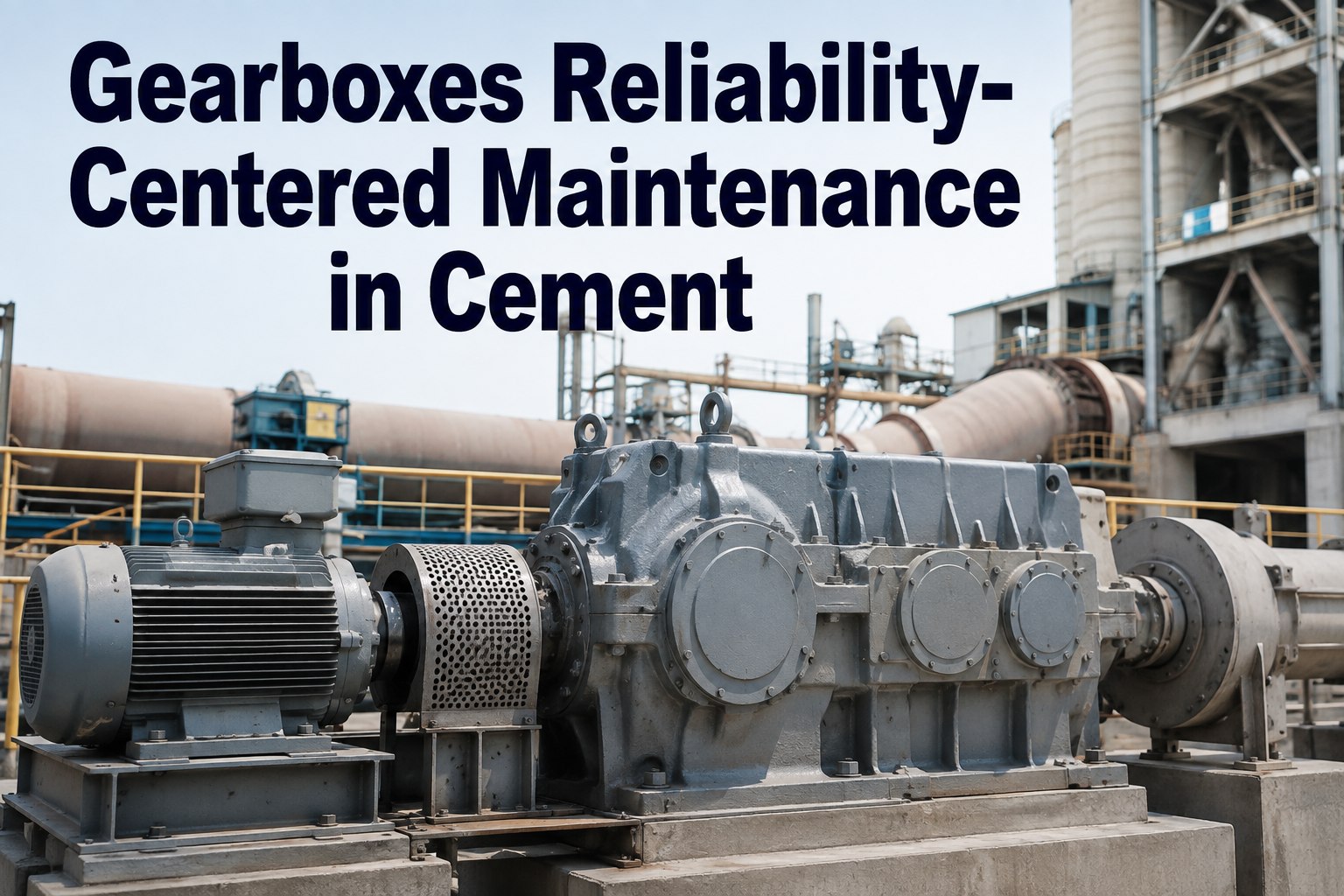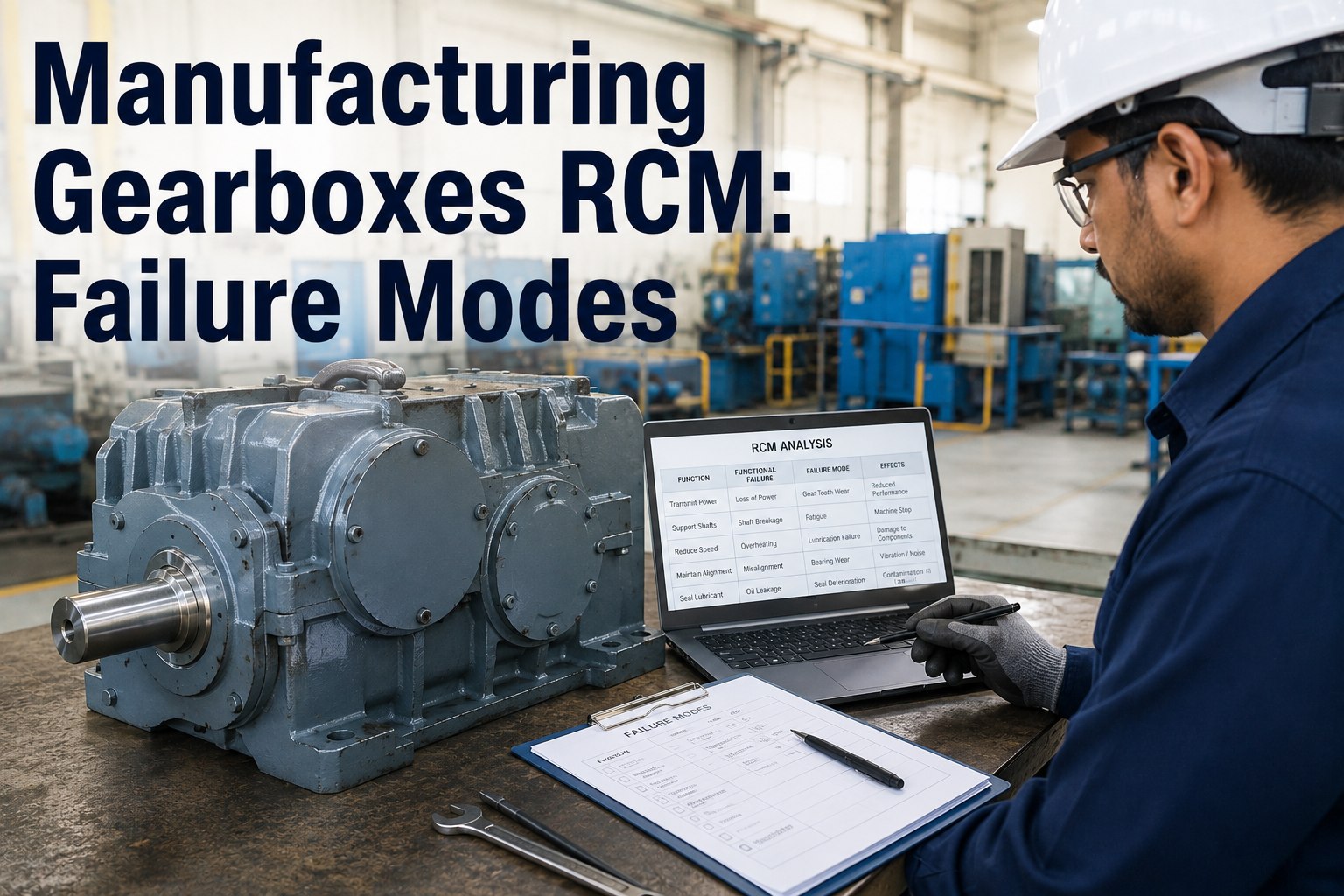
Reliability-Centered Maintenance (RCM) for manufacturing gearboxes is a structured method for identifying dominant failure modes — tooth wear, pitting, scuffing, bearing fatigue, lubrication breakdown — and matching each one with the most effective monitoring and maintenance task before it stops production. Done well, an RCM gearbox strategy typically cuts unplanned drivetrain downtime 30–50% and extends gearbox service life by years, because roughly 70% of gearbox failures are detectable weeks in advance through vibration, oil analysis, and thermography. This guide covers the failure modes that matter most in manufacturing gearboxes, the condition-monitoring techniques that catch them earliest, and a practical RCM task-selection framework you can apply line by line. It also shows how OxMaint's AI-powered CMMS turns that strategy into scheduled, tracked, auditable daily work — you can Start Free Trial and build your first gearbox PM plan today. Whether you run 20 gearboxes or 2,000, the principles below scale.
What if your next gearbox failure announced itself 6 weeks early?
In most plants it already does — through vibration signatures, rising wear metals in oil, and thermal drift. The plants that win are the ones listening systematically. Here is the complete RCM playbook for gearbox reliability in manufacturing.
The 6 dominant gearbox failure modes in manufacturing — and what causes them
Industry failure data consistently shows that over 80% of manufacturing gearbox failures trace back to just six modes. An effective RCM program starts by naming them, because each one demands a different detection method and a different maintenance task.
Surface fatigue from repeated contact stress. Accounts for roughly 25–30% of gear failures. Early sign: fine debris in oil and a rising gear-mesh frequency sideband in vibration spectra.
The single largest killer — 40–50% of gearbox failures originate in bearings. Caused by contamination, misalignment, or lubricant starvation. Detectable 4–8 weeks out via high-frequency vibration envelopes.
Adhesive wear when the oil film collapses under load or heat. Common in high-speed, high-torque manufacturing drives. Oil analysis shows sudden spikes in iron and silicon.
Oxidation, water ingress, or wrong-viscosity oil. Behind an estimated 20%+ of premature failures — and the cheapest mode to prevent with scheduled oil sampling and top-up discipline.
Coupling misalignment multiplies bearing loads 2–4x. Shows as elevated 1x and 2x running-speed vibration. A precision laser alignment task eliminates it at the root.
Degraded seals let oil out and contaminants in — a slow-motion failure that starves bearings. Caught by simple visual inspection routes and oil-level trending in your CMMS.
Best gearbox monitoring techniques for manufacturing: what detects what, and how early
No single technique catches every failure mode. Best-practice gearbox condition monitoring in manufacturing layers three to four methods — the table below shows typical detection lead times and cost per point so you can build the right mix for each asset's criticality.
| Technique | Detects best | Typical lead time | Cost per asset / yr | Best for |
|---|---|---|---|---|
| Vibration analysis (route-based) | Bearing fatigue, imbalance, misalignment, gear mesh defects | 4–8 weeks | $300–$800 | Critical line-drive gearboxes |
| Oil analysis (wear metals, viscosity, water) | Pitting, scuffing, lubrication breakdown, contamination | 3–6 weeks | $150–$400 | All oil-lubricated gearboxes |
| Online vibration sensors (IIoT) | Continuous bearing & gear health, sudden changes | Real-time alarms | $500–$1,500 | Remote or 24/7 critical assets |
| Infrared thermography | Overheating, lubricant starvation, electrical coupling issues | 1–3 weeks | $100–$300 | Monthly survey routes |
| Acoustic emission / ultrasound | Very early bearing defects, leaks, lubrication film issues | 6–10 weeks | $200–$500 | Low-speed, high-value gearboxes |
Rule of thumb: a gearbox costing $25K+ or stopping a line worth $5K+/hour justifies layered monitoring. OxMaint logs every reading against the asset record, so trends — not gut feel — trigger the work order.
How to build a gearbox RCM strategy in manufacturing: the 4-step task logic
RCM (per SAE JA1011) asks one question per failure mode: is there a proactive task that is technically feasible and worth doing? Plants that apply this logic rigorously typically eliminate 30–40% of low-value PM tasks while catching failures earlier. Here is the decision flow applied to gearboxes.
Score each gearbox on production impact, safety/environmental consequence, redundancy, and replacement cost. A typical 200-gearbox plant finds 15–20% are truly critical (A-class), 40% important (B), and the rest run-to-failure candidates (C). This ranking drives everything downstream.
For A-class gearboxes, document the six failure modes above with their likely causes (load, speed, environment, lubricant). Use OEM data plus your own work-order history — OxMaint's asset history makes this a report, not a research project.
Condition-based tasks (vibration, oil analysis) for detectable, high-consequence modes. Scheduled restoration (oil changes, alignment, filter swaps) for age-related modes. Run-to-failure only for C-class assets where consequence is genuinely low. Redesign (breathers, better seals, oil coolers) for repeat offenders.
If vibration gives 6 weeks of warning, a monthly route is safe; quarterly is gambling. Set the inspection interval at less than half the potential-failure-to-failure (P-F) interval, then let your CMMS auto-generate the work orders and escalate overdue readings.
A proven gearbox PM schedule for manufacturing plants (A-class example)
Below is a field-tested preventive maintenance cadence for a critical manufacturing gearbox — the kind driving a main conveyor, extruder, or mixer. Plants running schedules like this report gearbox MTBF improvements of 40–60% within 18 months.
| Interval | Task | Technician time | Failure mode targeted |
|---|---|---|---|
| Weekly | Visual inspection: leaks, oil level, breather condition, abnormal noise/heat | 10 min | Seal leaks, lubrication loss |
| Monthly | Vibration route reading + temperature check; log to asset record | 15 min | Bearing fatigue, misalignment, gear mesh wear |
| Quarterly | Oil sample (wear metals, viscosity, water, particle count) to lab | 20 min | Pitting, scuffing, contamination |
| Semi-annual | Coupling alignment check, bolt torque verification, filter replacement | 2–3 hrs | Misalignment, lubrication breakdown |
| Annual / per OEM hours | Oil change (or condition-based), internal inspection via borescope, backlash check | 4–8 hrs | Tooth wear, bearing wear, sludge |
A 180-asset packaging plant was spending about $42K/year on emergency gearbox repairs and losing 60+ production hours to surprise failures. After classifying its 34 gearboxes with RCM logic and moving the 8 A-class units onto the schedule above inside OxMaint, unplanned gearbox downtime fell 47% in the first year, emergency spend dropped to under $14K, and two failures were caught 5+ weeks early by oil-analysis trends — paying back the entire program roughly 4x over.
How OxMaint operationalizes gearbox RCM across your plant
An RCM strategy only works if it survives contact with the shop floor. OxMaint's AI-powered CMMS/EAM turns your gearbox failure-mode analysis into automated, trackable, auditable work — no spreadsheets, no missed routes, no tribal knowledge.
Model every gearbox under its line, machine, and drivetrain with A/B/C criticality tags — so PM effort concentrates where downtime actually costs you. Outcome: 30–40% less wasted PM labor on non-critical assets.
Build the weekly-to-annual schedule above once; OxMaint auto-generates work orders on calendar, runtime hours, or threshold readings from vibration and oil-analysis results. Outcome: zero missed inspections, failures caught 2–8 weeks earlier.
Technicians get the exact gearbox inspection checklist on their phone — with photos, readings, and pass/fail captured at the asset, even offline. Outcome: paper work orders eliminated, inspection data quality up 90%+.
MTBF, repeat-failure, and cost-per-asset dashboards show which gearboxes are chronic offenders and whether your RCM tasks are working. Outcome: data-backed decisions that cut unplanned downtime 30–50% and keep you audit-ready for ISO 55000.
See your gearbox failure modes trending — before they stop the line
Book a 30-minute demo and we'll map OxMaint to your actual gearbox fleet, criticality classes, and PM schedule.
Gearbox RCM in manufacturing: frequently asked questions
Reliability-Centered Maintenance for gearboxes is a structured process (per SAE JA1011) that identifies each gearbox's likely failure modes — pitting, bearing fatigue, scuffing, lubrication breakdown — and assigns the most effective task to prevent or detect each one: condition monitoring, scheduled restoration, or deliberate run-to-failure. The goal is maximum reliability per maintenance dollar, not maximum maintenance.
Bearing failure is the most common, causing roughly 40–50% of gearbox breakdowns, usually from contamination, misalignment, or lubricant starvation. Gear tooth pitting and wear follow at 25–30%. Both are detectable weeks in advance with vibration analysis and oil sampling — which is why condition-based tasks sit at the heart of any gearbox RCM strategy.
Critical (A-class) gearboxes typically need weekly visual checks, monthly vibration readings, quarterly oil analysis, semi-annual alignment and filter service, and annual oil changes or borescope inspections. Intervals should be set from the P-F curve — the warning time each monitoring technique gives you — then automated in a CMMS. You can Start Free Trial of OxMaint and load this exact schedule in under an hour.
Neither alone — they detect different failure modes. Vibration analysis excels at bearing defects, imbalance, and misalignment (4–8 weeks of warning); oil analysis excels at gear wear, scuffing, and lubricant degradation (3–6 weeks). Best practice for critical manufacturing gearboxes layers both, plus periodic thermography, giving overlapping coverage of all six dominant failure modes.
A CMMS turns your RCM analysis into automatic, trackable work: PM schedules fire work orders on time, condition readings trend against each asset, and failure history reveals chronic offenders. Plants typically see 30–50% less unplanned downtime and full audit trails for ISO 55000. Book a Demo to see how OxMaint handles gearbox criticality scoring, condition triggers, and reliability dashboards out of the box.
Stop reacting to gearbox failures. Start predicting them.
Put your entire gearbox RCM program — criticality classes, PM schedules, condition readings, and analytics — into one platform your whole team actually uses.