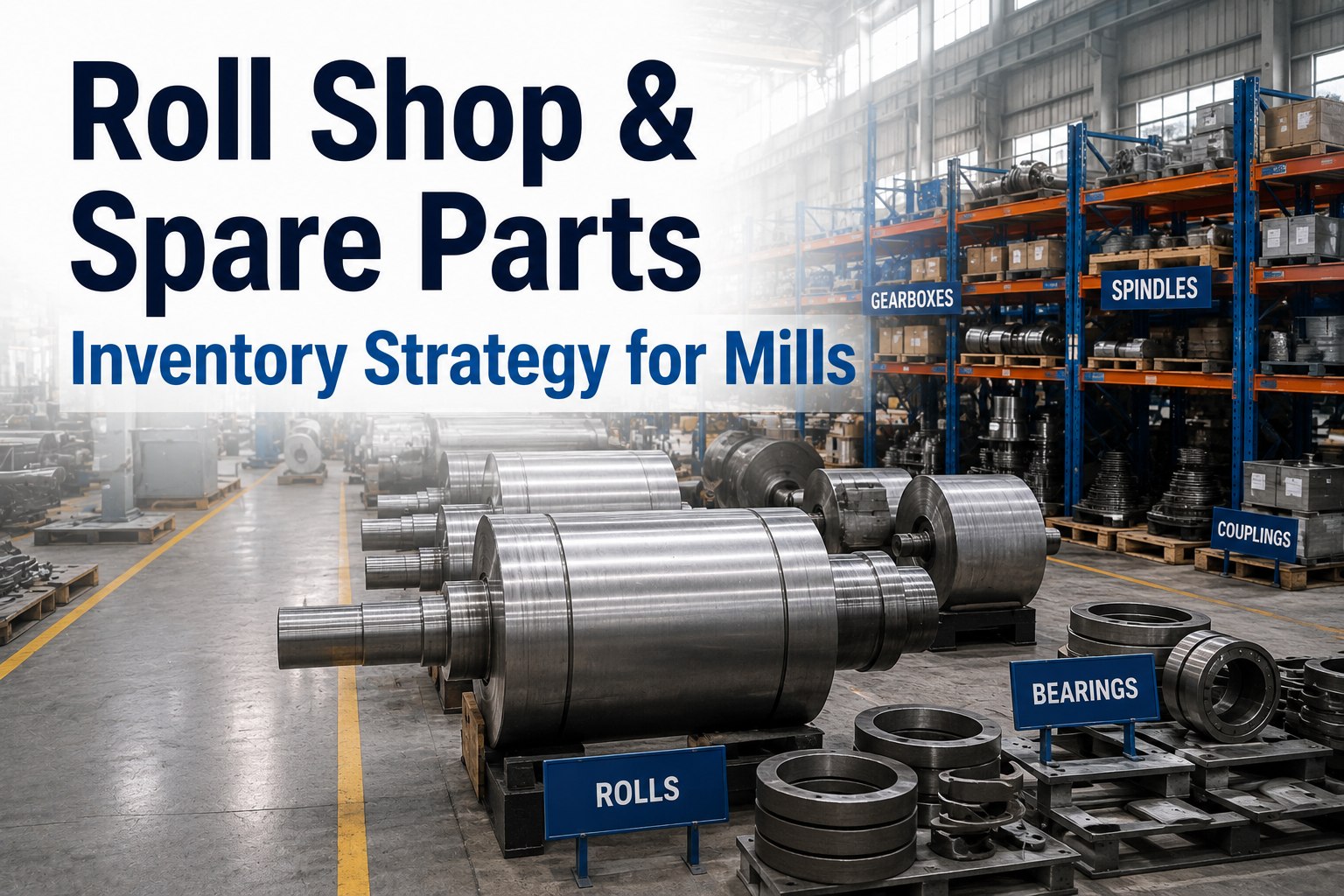
Roll shop and spare-parts inventory strategy is the single most underestimated lever in rolling-mill uptime — a missing work roll or chock at campaign changeover can idle a finishing stand for 6 to 18 hours, with downstream tonnage losses compounding across the schedule. This guide breaks down how maintenance and roll-shop teams structure critical-spares stocking, grinding-cycle discipline and CMMS-integrated inventory so a missing roll never becomes the bottleneck between campaigns. Expect concrete benchmarks, a worked example for a mid-size hot-strip mill, and a decision framework you can apply this quarter. You can put the approach into production on a 14-day pilot — Start Free Trial and configure your roll inventory registers the same day.
Is a missing work roll quietly costing your mill 2–4 campaign hours every week?
The gap between a planned 55-minute campaign changeover and a 6-hour standby almost always traces back to one unground roll, one missing chock bush, or one bearing that wasn't flagged for reorder. OxMaint links roll-shop grinding cycles, critical-spare stock levels and CMMS work orders to the production plan — so parts arrive before the mill waits.
A roll shop is not a warehouse — it's a timing system
Most mills treat roll-shop inventory as a static min/max problem: keep 4 work rolls, 2 backup rolls, a set of chocks. In practice, rolling-mill spares obey campaign rhythm — and a static reorder point that ignores the grinding cycle will either overstock or strand the mill at the worst moment.
A 2.8 MTPA hot-strip mill, 6 stands, 38 active rolls
This plant was carrying $1.9M in roll-shop spares yet still logged 11 standby events in a quarter — a chock bush here, an unground work roll there, a bearing that sat in receiving without a work order. After mapping each spare to its failure mode, lead time and campaign dependency, and moving reorder triggers into the CMMS, carrying value dropped 18% to $1.56M while standby events fell from 11 to 3. The discipline wasn't more stock — it was the right stock, linked to the right trigger.
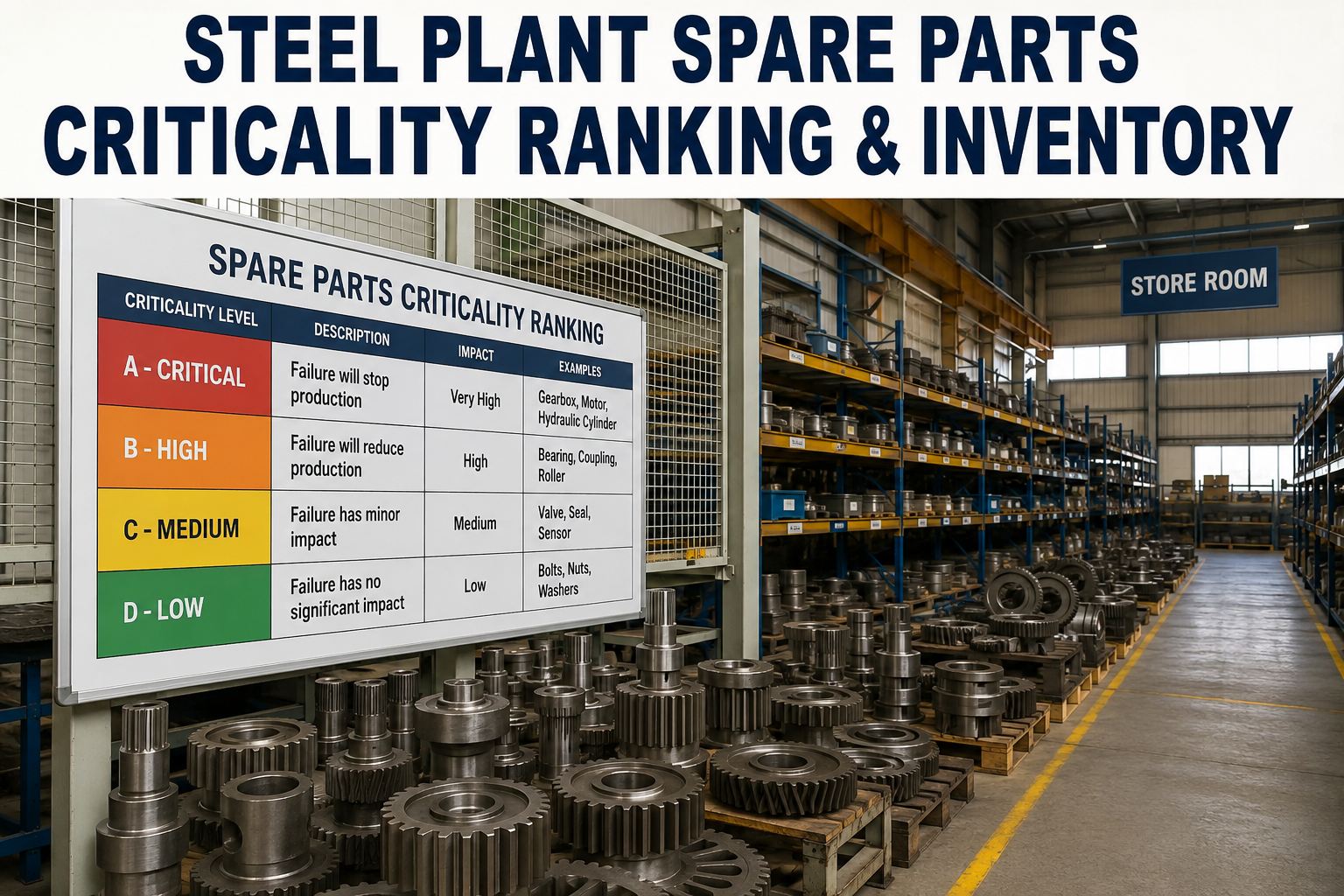
Tier your spares by consequence, not by price tag
ISO 55000-aligned criticality is the backbone of any defensible spare-parts strategy. Price is a red herring — a $300 chock bush that stops a $14K-per-hour stand is far more critical than a $9,000 coupling that runs on three redundant lines.
Campaign-Critical
Work rolls, backup rolls, chock assemblies, primary bearings. Mill cannot run the next campaign without them. Target: 1 ready spare + 1 in grinding cycle, reorder triggered at 1 spare remaining.
Essential
Mill stands can run for one campaign but planned downtime within 7 days is required. Target: min–max with CMMS auto-reorder at min, 7-day safety stock.
Standard MRO
Seals, fasteners, lubricants, wear plates. Failure is absorbed by redundancy or short repair. Target: vendor-managed or kanban replenishment, reviewed quarterly.
Four moves that re-link inventory to the campaign clock
These are the four discipline moves that separate a roll shop that supports the schedule from one that dictates it. Each is measurable, and each maps directly to a module in OxMaint.
Tag every roll to its grinding-cycle position
Each work roll and backup roll carries a grinding-state tag: in-service, due-for-grind, in-grinder, ready-spare, or condemned. The CMMS pushes the next roll due for grinding 48 hours before its campaign ends, so the grinder queue is never the bottleneck. Plants using this discipline cut standby-from-grinding delays by 60–70%.
Stock against the next campaign, not a calendar date
Reorder triggers for Tier 1 spares fire on campaign milestones — not monthly review. When production planning confirms the next campaign's product mix and gauge, OxMaint checks that the matching roll grades, chock configurations and bearings are ready-spare. A gap raises a work order before the previous campaign ends.
Set safety stock from real lead-time data, not vendor SLAs
A forged work roll has a 14–22 week lead time; a precision bearing, 6–10 weeks. Safety stock must reflect actual historical lead time plus a failure-rate buffer, not the 4-week number a vendor promised. OxMaint tracks receipt-to-receipt lead times and auto-adjusts safety stock quarterly.
Condemn rolls on data, not on opinion
Every roll has a hardness-loss and diameter-reduction limit. When a roll crosses either threshold, OxMaint flags it for condemnation and auto-raises a reorder — preventing the silent stockout where a "spare" sits on the rack but fails its first inspection. This alone typically recovers 4–6 ghost-spares per roll shop.
What an undisciplined roll shop actually costs you
The maths is uncomfortable because the losses compound. One standby hour doesn't just cost one hour of throughput — it cascades into reheating fuel, slab-yard congestion, downstream coil-handling disruption, and overtime on the next changeover.
For a 2.8 MTPA hot-strip mill averaging 19 idle hours per month from roll-shop or spare-parts gaps.
Capital tied up in slow-moving spares that don't map to a live criticality tier or a campaign trigger.
| Discipline Gap | Typical Cost | Recovery with CMMS-Linked Inventory |
|---|---|---|
| Unground roll at changeover | 4–8 standby hrs / event | Down to <1 hr with grinding-cycle sync |
| Missing chock bush or seal kit | 6–18 standby hrs / event | Near-zero with campaign-linked reorder |
| Ghost spares (condemned but untagged) | 1 surprise stockout / quarter | Eliminated by condemnation-on-data |
| Overstocked slow-moving spares | 20–30% excess carrying value | 15–20% reduction in 6 months |
| Manual min/max review | 12–16 eng-hrs / month | Auto-review, exceptions only |
From reactive chasing to campaign-ready discipline
The shift isn't about buying more software — it's about moving the roll shop from a passive stockroom to an active node in the production plan. Here's what that transition looks like in practice.
- Min/max reviewed manually in a spreadsheet, monthly at best
- Grinding queue set by shift supervisor's memory
- Reorder triggered after stockout is already felt
- Ghost spares discovered at changeover
- Roll-shop and production planning speak different languages
- Spare spend justified by gut, not by criticality tier
- Reorder triggers fire automatically at tier-based thresholds
- Grinding queue driven by CMMS-linked campaign schedule
- Tier 1 spares confirmed ready before previous campaign ends
- Rolls condemned on hardness and diameter data, not opinion
- Production planning sees roll-shop readiness in a shared dashboard
- Spare spend defended by consequence-of-failure analysis
"We cut standby hours from 19 a month to under 4 in two quarters. The turning point wasn't more inventory — it was finally linking our grinding cycle and reorder triggers to the campaign schedule."
Ready to stop waiting on a roll grind?
See how OxMaint links your roll-shop inventory, grinding cycles and CMMS work orders to the production plan — in a 30-minute walkthrough tailored to your mill.
Roll shop & spare-parts inventory, answered
How do we decide which rolling-mill spares are truly critical?
Run each spare through a consequence-of-failure test: if it fails, does the mill stop within one shift, within one campaign, or can it run on redundancy? Tier 1 (campaign-critical) stops the mill within a shift — work rolls, chocks, primary bearings. Tier 2 allows one campaign of run time. Tier 3 is absorbed by redundancy or short repair. Price is irrelevant to this test; a $300 bush can be Tier 1 while a $9,000 coupling is Tier 3.
What's a realistic timeline to see ROI from CMMS-linked inventory?
Most roll shops see standby-hour reductions within 6–8 weeks of linking grinding cycles and reorder triggers to the campaign schedule. Full criticality re-tiering and carrying-value reduction typically lands in the second quarter. A 2.8 MTPA hot-strip mill recovered $2.5M in annual standby cost and cut carrying value by 18% inside two quarters. You can pilot this on a 14-day free trial with one roll shop and one finishing stand.
How does OxMaint handle rolls that are mid-grinding at changeover?
Each roll carries a grinding-state tag — in-service, due-for-grind, in-grinder, ready-spare, condemned. The CMMS pushes the next roll due for grinding 48 hours before its campaign ends, and blocks a changeover confirmation if a ready-spare of the correct grade isn't available. The grinder queue becomes a planned workflow, not a reactive scramble.
Can we import our existing spare-parts register and min/max data?
Yes. OxMaint accepts CSV imports of spare registers, current stock levels, vendor lead times and historical usage. The system then back-fills lead-time statistics from your receipt data and flags any spare whose min/max diverges from its real lead time plus failure-rate buffer — typically surfacing 15–25% of the register for re-tiering in the first pass.
What if our production planning team uses a different system?
OxMaint exposes campaign-readiness status as a shared dashboard and via API, so production planning sees roll-shop readiness without leaving their own tool. The two-way link means a campaign confirmed in planning automatically triggers a readiness check in the roll shop. Book a 30-minute demo to see the integration pattern for your stack.
Your next campaign changeover doesn't have to wait on a roll.
Start a 14-day pilot on one roll shop. Import your spare register, link your grinding cycle, and watch the standby hours drop.
Free 14-day trial · No credit card

.png)
