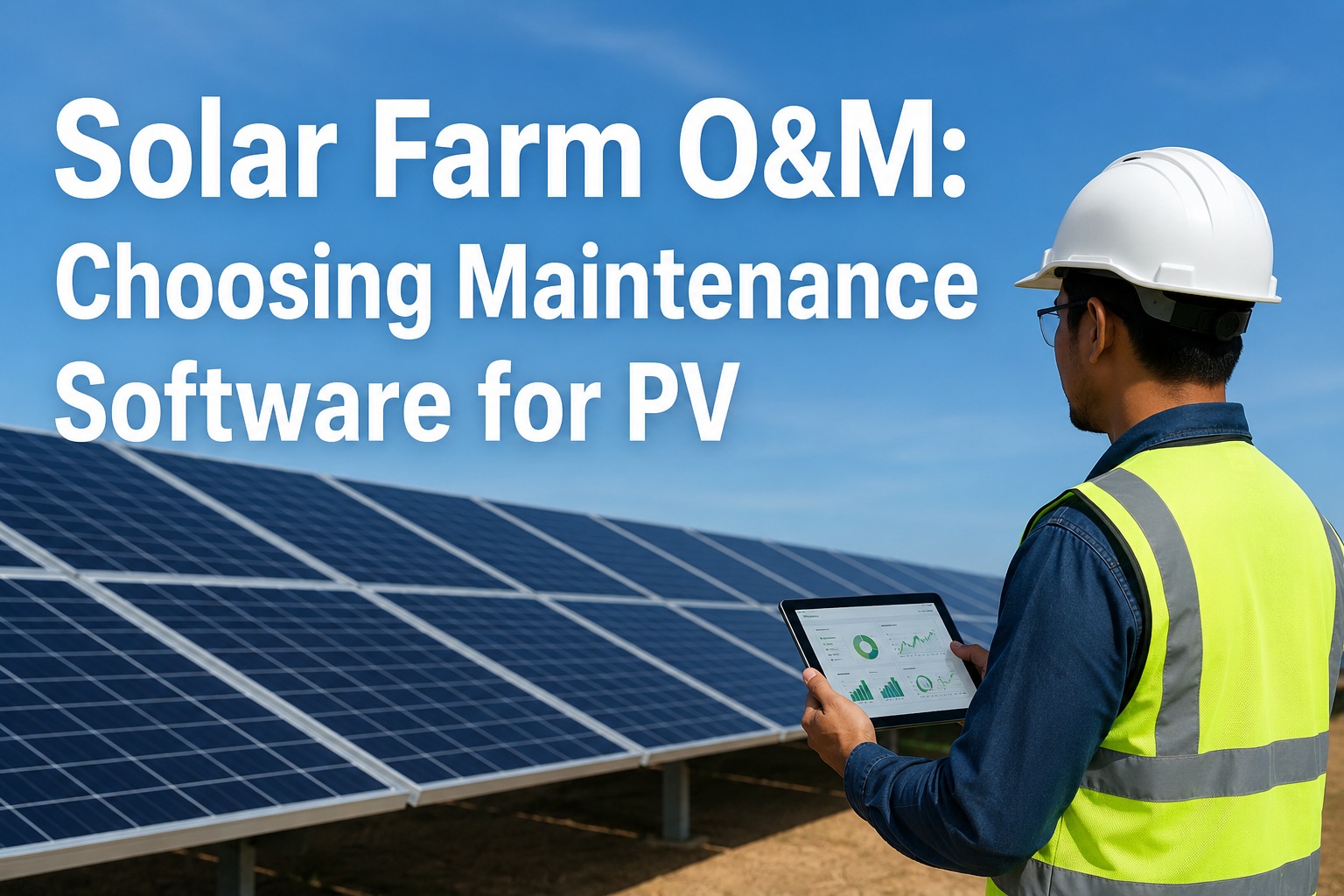
Solar farm O&M is where the physics of photovoltaics meets the discipline of maintenance execution — a single string-level fault can silently bleed 3–6% of a site's annual yield, and a fleet of untracked inverter events across a 500 MW portfolio easily translates into seven-figure losses. Operators that win on LCOE are the ones who treat O&M as engineered asset management, not reactive ticketing, and build a CMMS structure that scales from a single 5 MW site to a portfolio of 50+ plants. OxMaint delivers PV-specific preventive maintenance libraries, inverter and tracker tracking, and string-level fault workflows that make every maintenance decision defensible. Start your Start Free Trial and audit your O&M baseline this quarter.
Is your PV maintenance software built for solar — or is it costing you MWh every week?
Inverter faults, panel soiling, and tracker misalignment can drain 8–14% of a utility-scale plant's nameplate yield. A CMMS engineered for photovoltaic O&M stops that bleed at the string, inverter, and tracker level — before it ever hits your performance ratio.
The four failure modes that quietly drain solar farm output
Industry telemetry from utility-scale PV plants shows that unscheduled downtime, soiling, and component degradation account for 70–85% of all production losses. Here is where the MWh actually escapes — and where structured O&M software intercepts it.
Inverter faults & shutdowns
A single central inverter trip on a 4 MW block can drop 40+ MWh per day. String and central inverter events need PM triggers, firmware logs, and mean-time-to-repair tracking — not email alerts.
Panel soiling accumulation
Dust, pollen, and bird drop build-up erode the performance ratio week over week. Cleaning triggers must be tied to soiling station readings and ROI thresholds, not a fixed calendar.
Tracker misalignment & motor faults
Stuck or misaligned single-axis trackers leave arrays flat during golden-hour irradiance. Without torque-tube and motor PM libraries, tracker drift compounds silently across rows.
String-level faults & fuse opens
A blown string fuse removes ~1.5 kW per string. Across a 50 MW site with hundreds of combiner boxes, undetected string outages are the invisible yield thief in most fleets.
What a solar-specific CMMS must do that generic software cannot
A maintenance platform built for warehouses or fleets breaks down on a PV plant because it cannot model strings, combiner boxes, inverters, and trackers as a hierarchical asset tree. These are the six capabilities that separate solar O&M software from a generic work-order tool.
PV-specific PM libraries
Pre-built preventive maintenance templates for central & string inverters, DC combiners, transformers, and tracker rows — aligned to IEC 62446 and ISO 55000 asset frameworks.
Inverter maintenance tracking
Log firmware revisions, capacitor health, IGBT replacements, and warranty events per inverter. Auto-flag units approaching MTBF thresholds before they trip offline.
String-level fault management
Tie SCADA string alerts to work orders, route technicians to exact combiner & fuse positions, and verify restoration against irradiance-corrected expected output.
Tracker & motor PM cycles
Schedule actuator inspections, torque-tube lubrication, and backtracking calibration checks. Capture stow-angle faults before wind events cause structural damage.
Soiling-loss workflows
Trigger cleaning crews from soiling-station deltas above 2% PR loss. Track cost per cleaned MWh and prove the ROI of each wash cycle against spot energy prices.
Portfolio-scale asset hierarchy
Roll up KPIs — availability, PR, MTTR, mean-time-between-failures — across 50+ sites, by OEM, by region, by tracker vendor. Drill from fleet to a single fuse in four clicks.
A 120 MW portfolio, 11 months in: what changes with solar-built O&M
Consider an operator running a 120 MW portfolio across three utility-scale sites with 84 central inverters and roughly 9,600 tracker rows. Before CMMS rollout, they tracked PM on spreadsheets and chased faults through email threads. After deploying a PV-specific maintenance platform for one fiscal year, the deltas were measurable.
| O&M metric | Before CMMS | After OxMaint (11 mo) | Delta |
|---|---|---|---|
| Inverter MTTR | 9.4 hours | 3.1 hours | −67% |
| String outage detection lag | 11 days | Same-shift | −95% |
| Preventive maintenance compliance | 62% | 97% | +35 pts |
| Annual PR (performance ratio) | 87.3% | 91.8% | +4.5 pts |
| Unscheduled downtime hours/yr | 1,840 | 510 | −72% |
| Recovered MWh (annualized) | — | ~6,400 MWh | +$580K |
That 4.5-point PR gain is the difference between a portfolio that meets its debt-service coverage ratio and one that doesn't. The payback on a PV-specific CMMS, in this band, is typically under four months.
Six questions to ask before buying solar farm maintenance software
Most O&M teams evaluate CMMS platforms on price and UI, then discover 90 days in that the software cannot model a PV plant. Run every vendor through this framework before signing.
Does it ship with a PV-specific PM library, or do you build every template yourself?
If the vendor's answer is "you can create custom PMs," that's 60–80 hours of configuration before your first inspection. OxMaint ships with inverter, combiner, transformer, and tracker PM templates on day one.
Can it model the full PV asset hierarchy — from site down to string & fuse?
A flat asset list cannot support string-level fault routing. You need site → block → inverter → combiner → string → fuse, with roll-up KPIs at every tier.
Does it ingest SCADA & soiling-station alerts and auto-create work orders?
Manual alert transcription is where yield recovery dies. The CMMS should auto-generate prioritized work orders from inverter trips, string under-performance, and soiling thresholds.
Can it manage a portfolio of 50+ sites with multi-tenant access for owners & O&M contractors?
Asset owners, O&M providers, and EPCs need different data slices. The platform must support role-based access across an entire portfolio without exporting spreadsheets.
Does it produce audit-ready maintenance records for PPA & warranty claims?
When an inverter OEM disputes a warranty, your CMMS should export a timestamped PM & fault history in two clicks. Defensible records recover six-figure warranty dollars.
What is the realistic go-live timeline — and is configuration included?
A solar-built CMMS should be live in 2–4 weeks with your asset hierarchy imported. If a vendor quotes 6+ months of professional services, the platform was not built for PV.
The yield-recovery math for a 50 MW solar plant
O&M software payback in solar is not theoretical. Below is a transparent breakdown of how a PV-specific CMMS converts avoided losses into recovered revenue on a single mid-size plant.
Stop losing MWh to reactive maintenance.
Deploy a CMMS built for photovoltaic O&M — with PV PM libraries, inverter tracking, and string-level fault workflows live in weeks, not quarters.
Solar farm O&M software: questions operators actually ask
How is solar O&M software different from a generic CMMS?
A solar-built CMMS models the PV asset hierarchy — site, block, inverter, combiner, string, fuse — and ships with PM templates for inverters, trackers, and transformers. Generic CMMS platforms treat assets as a flat list and force you to build every solar workflow from scratch, which delays go-live by months and misses string-level fault routing entirely.
Can OxMaint integrate with our SCADA and soiling-monitoring systems?
Yes. OxMaint ingests inverter trip events, string under-performance alerts, and soiling-station deltas, then auto-generates prioritized work orders so technicians are dispatched the same shift rather than after the next manual report. You can see a live integration map when you Book a Demo.
What size of solar portfolio is OxMaint built for?
OxMaint scales from a single 5 MW community-solar site to portfolios of 50+ utility-scale plants. The asset hierarchy, role-based access, and portfolio roll-ups are designed for O&M teams managing multiple sites, OEMs, and tracker vendors under one tenant.
How long does it take to go live on a utility-scale solar plant?
A typical 50 MW site goes live in 2–4 weeks, including asset hierarchy import, PM library assignment, and SCADA alert mapping. Configuration is included — you should not need a six-month professional-services engagement to stand up solar O&M software.
Does the platform support warranty and PPA audit reporting?
Yes. Every PM, fault, parts replacement, and technician action is timestamped and tied to the asset record. When an inverter OEM disputes a warranty claim or an asset owner requests PPA performance evidence, OxMaint exports a defensible maintenance history in a few clicks. Try it on your own portfolio with a Start Free Trial.
Run defensible O&M across every MW you own.
PV-specific PM libraries, inverter maintenance tracking, and string-level fault management — built for utility-scale solar, live in weeks.
Free 14-day trial · No credit card
.png)