A distribution center runs on its assets — sortation lines, conveyors, forklifts, dock levelers, refrigeration — and at the pace of fulfillment, a single failed bearing can cascade through an entire zone before anyone spots the fault. Asset management is what keeps that from happening blind: every machine becomes a tracked record with its full cost history, so you can schedule maintenance by runtime, see which assets quietly drain the budget, and time capital decisions from data instead of gut feel. But there's a catch that quietly wrecks the whole system — slow or incomplete work order closure. A record is only as good as the work orders feeding it, and jobs that sit open or close without parts, labor, and notes leave holes that distort every number. This guide lays out the ROI of warehouse asset management done right, and shows how OxMaint's asset management delivers it — or book a demo to model the return on your operation.
Maintenance KPI / Asset Management
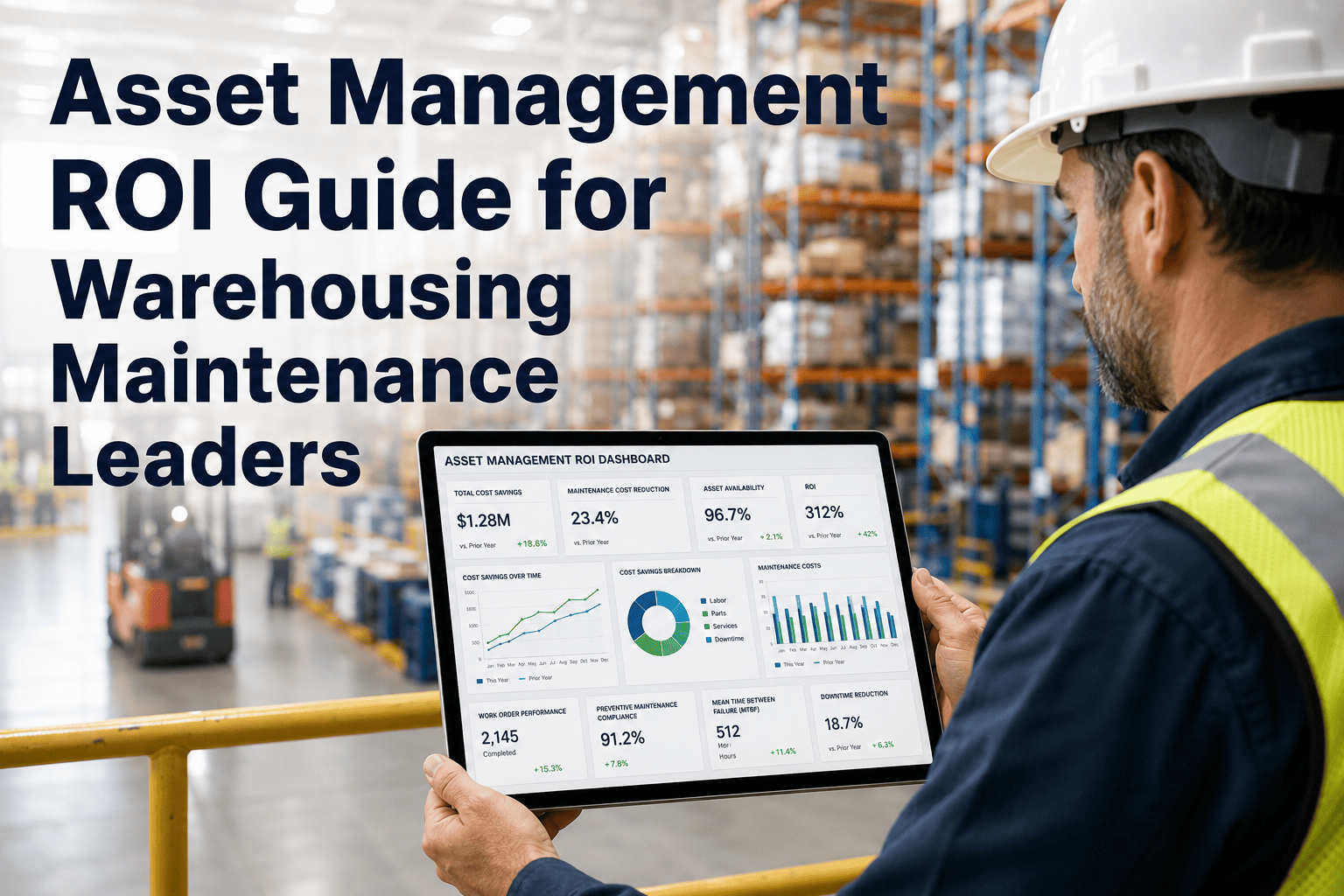
Asset Management ROI Guide for Warehousing Maintenance Leaders
Turn every conveyor, forklift, and dock leveler into a tracked lifecycle record — so you cut downtime, extend asset life, and decide repair-versus-replace from data, not guesswork.
The assets that run a warehouse
Asset management starts with knowing what matters most. Tier every asset by what its failure costs, and your maintenance effort lands where it pays.
Critical
Sortation lines, refrigeration, high-speed doorsFailure cost often exceeds $10,000 per hour — the 2 a.m. crisis calls.
High
Conveyors and AS/RSOne belt splice or motor bearing can cascade through a whole zone.
Standard
Forklifts, dock levelers, wrappersHigh-volume wear, especially at peak when units run 18–22 hours a day.
The asset record: your single source of truth
Asset management's payoff is the record itself — every cost from acquisition to disposal in one place. When it's complete, the worst offenders reveal themselves.
Asset Record · Dock Leveler #5Review: replace
Failures (12 mo)12
Downtime (12 mo)40 hrs
Maintenance cost (12 mo)$15,000
Trend vs new unitApproaching replacement cost
Instead of "the dock levelers are old," the record says exactly which one, how often, and how much — the difference between a hunch and a capital request.
Why slow work order closure breaks it
Every number above depends on work orders closing completely. When they don't, the record fills with holes — and the holes are exactly where the money hides.
Work orders that sit open or close without parts, labor, and notes leave you blind to:
No accurate asset history — repeat offenders stay hidden
Distorted MTTR and MTBF — KPIs you can't trust
Missing cost-per-asset — no real lifecycle cost
Blind repair-versus-replace — capital on gut feel
Close the loop on every work order
OxMaint enforces complete closure — parts, labor, and notes — so your asset history stays clean and your KPIs stay honest.
Repair or replace, decided by data
The hardest call in asset management gets easy when the record is clean. Watch for the crossover — when cumulative repair cost climbs past the price of a new unit.
Cumulative repair cost
Cumulative repairsNew-unit cost
A forklift repaired five times in six months, whose parts-and-downtime cost now tops a new model, has crossed the line. The data, not a hunch, makes the call.
The ROI value drivers
Clean asset management returns value through five reinforcing streams — each one turning maintenance data into a dollar saved or a smarter capital decision.
Downtime ↓ up to 45%
Predictive monitoring on critical conveyors, sorters, and dock equipment.
Asset life ↑ 20–40%
Planned interventions replace run-to-failure on high-value machines.
Conveyor OEE ↑ 23%
CMMS-managed PM programs versus reactive maintenance.
Capital optimized
Lifecycle cost data times every repair-versus-replace decision.
Payback ~8 mo
Average CMMS payback reported in high-volume facilities.
The numbers
Distribution centers that manage assets on a CMMS instead of reacting consistently report results that pay back fast.
45%
Less unplanned downtime with predictive monitoring
41%
Fewer downtime events vs reactive sites
~8 mo
Average CMMS payback in high-volume DCs
With material-handling budgets rising sharply to fight downtime, the asset data that optimizes that spend is among the fastest-returning investments a warehouse can make.
Expert Review
"The facilities running at the highest throughput reliability all share one trait: their asset records are clean, because their work orders actually close. It sounds trivial, but it's the whole game. When a tech closes a job with the parts used, the hours spent, and a real note, that asset's history gets a little sharper — and a year later you can walk into a capital meeting and say 'Dock Leveler #5 cost us forty hours and fifteen grand, here's the replacement case,' instead of 'the levelers feel old.' Slow closure is the silent killer. It doesn't break anything today; it just makes every decision you make next quarter a guess."
Reviewed by a director of facility operations at a top-5 3PL, 3.8M sq ft of distribution space under management.
See the asset ROI on your operation
Walk through lifecycle records, repair-versus-replace flags, and a board-ready savings model built from your own asset data.
Frequently asked questions
What does asset management actually deliver for a warehouse?
It turns every conveyor, forklift, dock leveler, and cooler into a tracked record with its full cost history from acquisition to disposal. That single source of truth is what lets you schedule PM by runtime, spot the assets quietly draining your budget, and make capital decisions from data instead of gut feel. Without it, maintenance is just reaction. See the asset record in
OxMaint.
Why does slow work order closure undermine asset management?
Because the asset record is only as good as the work orders that feed it. A job that sits open, or closes with no parts, labor, or notes, leaves a hole in the history — and those holes distort MTTR and MTBF, hide the true cost per asset, and make repair-versus-replace a guess. Clean closure is the foundation of every other number.
Book a demo to see closure discipline.
Which warehouse assets should be tracked most closely?
Start with anything whose failure cost exceeds about $10,000 an hour — sortation lines, refrigeration, and high-speed doors top that list, with conveyors close behind because a single belt or bearing can cascade through a whole zone. Forklifts and dock levelers matter too, especially during peak when they run 18 to 22 hours a day. Tier them by criticality in
OxMaint.
How does asset data drive a repair-versus-replace decision?
By making the crossover visible. When the cumulative cost of parts and downtime on an aging asset climbs past the price of a new unit, the data says replace — for example, a forklift repaired five times in six months whose costs now exceed a replacement. A dock leveler with 12 failures and $15,000 in a year tells the same story. Decide from the record in
OxMaint.
How much downtime can asset management remove?
Predictive monitoring on critical conveyors, sorters, and dock equipment can cut unplanned downtime by up to 45% while extending asset life 20 to 40%. Distribution centers running CMMS-managed PM have reported 23% higher conveyor OEE and 41% fewer unplanned downtime events than reactive sites. The gains compound as the asset history deepens.
Book a demo to model your reduction.
What KPIs reveal whether asset management is working?
Track mean time between failures, mean time to repair, planned-versus-reactive work percentage, cost per asset or zone, and maintenance cost as a share of replacement asset value. Together they show whether you're getting ahead of failures or chasing them — but they're only trustworthy when work orders close completely. See the dashboards in
OxMaint.
What's the ROI and payback for a distribution center?
Strong, because warehouse downtime is so disruptive at the pace of fulfillment. High-volume facilities have reported CMMS payback averaging around eight months, driven by fewer downtime events, longer asset life, and smarter capital timing. With 2025 material-handling budgets rising to fight downtime, the asset data that optimizes that spend pays for itself quickly.
Book a demo to project yours.
How does OxMaint manage warehouse assets?
OxMaint builds an asset registry organized by zone, tracks full lifecycle cost from acquisition to disposal, triggers PM on calendar, runtime, or condition, and enforces complete work-order closure so the history stays clean. Dashboards surface MTTR, cost per asset, and repair-versus-replace flags across the whole site. Run it on your DC with a
free trial.
Make every asset earn its place
Build the record, close every work order, and let the data tell you what to maintain, what to fix, and what to retire — before the next 2 a.m. call.