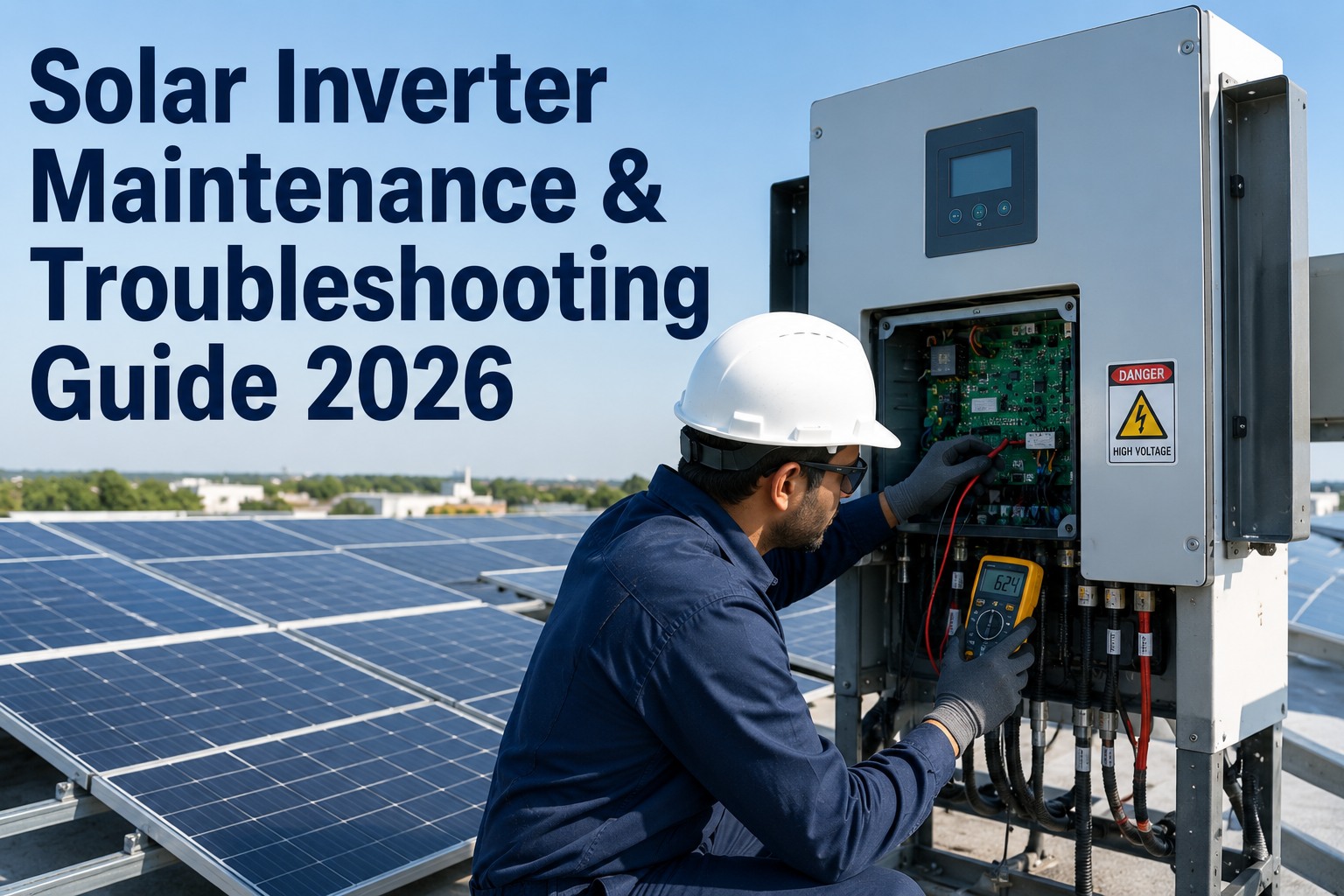
Solar inverter maintenance is the single highest-leverage activity in any PV plant reliability program — inverters account for roughly 50–65% of unplanned solar downtime despite representing less than 10% of capex, making them the most failure-prone asset class in utility-scale operations. A structured solar inverter PM program combining thermal imaging inspections, firmware updates, capacitor replacement schedules, and MPPT performance monitoring can cut unplanned inverter outages by 30–50% and extend service life well beyond the typical 10–12 year mark. This guide walks maintenance and reliability teams through a complete solar inverter inspection checklist, troubleshooting workflow, and reliability strategy — and shows how deploying an AI-powered CMMS like OxMaint replaces spreadsheets and reactive fire-drills with predictive, audit-ready maintenance that protects energy revenue. Ready to modernize your solar O&M program? Start Free Trial or read on to build your inverter reliability roadmap.
Solar Inverter Reliability Guide 2026
Is one failed string inverter quietly costing you $8,000 a week in lost energy revenue?
Inverters are the most failure-prone asset class in solar O&M — but most teams still track PMs on spreadsheets and react to faults only after production drops. OxMaint brings AI-driven preventive maintenance, fault trending, and warranty tracking into one CMMS built for utility-scale PV.
A single 1,500 kW central inverter offline for 4 days during peak irradiance can lose 24,000 kWh of generation daily. At $0.04/kWh PPA, that is nearly $1,000 per day — before clipping, curtailment, and SLA penalties compound the damage.
47%
of solar plant downtime traces back to inverter failures — more than any other asset class
Cost of Inaction
Why solar inverter reliability is where PV availability lives or dies
Inverters convert DC to grid-ready AC and perform Maximum Power Point Tracking (MPPT) across every string — they are the electrical heart of a PV plant. They also contain the most thermally stressed, electromechanically complex components in the entire system: electrolytic capacitors, IGBT power modules, cooling fans, DC contactors, surge protection devices, and communication boards. Small degradation in any of these parts cascades into derating events, ground-fault trips, or full shutdowns.
50–65%
Share of unplanned PV downtime caused by inverter faults
$1,200
Average daily lost revenue per failed 1.5 MW central inverter at peak sun
10–15 yr
Typical inverter service life vs. 25–30 year module warranty
3–5%
Annual energy yield improvement achievable with rigorous PM + MPPT tuning
A 50 MW solar farm running 60 central inverters without a CMMS-driven PM schedule typically loses 2.1% of annual availability to preventable inverter outages. At $0.045/kWh, that is roughly $190,000 in forfeited energy revenue every year — and a reliability program that costs $40K to run pays for itself in under 90 days.
Inspection Checklist
Solar inverter inspection checklist: quarterly, semi-annual & annual PM tasks
A defensible solar inverter PM program follows a tiered cadence: visual and thermal inspections quarterly, electrical and mechanical checks semi-annually, and deep preventive maintenance annually. Below is the checklist O&M teams should codify inside their CMMS as recurring work orders — each tied to an asset record, spare-part minimum, and compliance log.
Thermal & Visual Inspection
- IR thermal imaging of IGBT heatsinks, capacitors, AC/DC terminals — flag any component >85°C
- Inspect enclosure for moisture ingress, corrosion, rodent damage, and door gasket integrity
- Log error/fault codes from event log; trend recurring alarms per inverter serial number
- Verify MPPT efficiency per string — compare actual vs. modeled string yield within 2% tolerance
Electrical & Mechanical PM
- Torque verification on all DC and AC terminal blocks to manufacturer spec (retorque after Y1)
- Replace or clean intake/exhaust filters; confirm fan RPM and airflow within rated CFM
- Test SPD (surge protection device) status indicators; replace if fault flag is tripped
- Update firmware and review manufacturer service bulletins for known defect campaigns
Deep Preventive Maintenance
- Capacitor health screening — ESR measurement, visual bulging/venting, replacement at Year 7–8
- DC and AC isolation resistance test; megger test per IEC 62446-2 standard
- Recommission MPPT tracking; validate efficiency against flash-test baseline (target >98.5%)
- Recalibrate internal sensors (temp, voltage, current); update CMMS asset condition score
Troubleshooting Workflow
Solar inverter troubleshooting: how to diagnose the 5 most common fault codes
When an inverter trips, every minute of unsolved downtime is lost energy. O&M teams need a repeatable diagnostic path that moves from fault-code lookup to root cause in under 30 minutes. Below is a structured troubleshooting workflow covering the most frequent inverter faults — each step should be documented as a checklist inside your CMMS so any technician can follow it consistently.
| Fault / Alarm | Likely Root Cause | Diagnostic Step | Resolution |
|---|---|---|---|
| Grid over/undervoltage | Grid impedance drift; tap setting mismatch; POC breaker degradation | Measure L-L voltage at inverter AC terminals vs. grid meter; compare to trip window | Adjust voltage window / retap transformer; replace degraded breaker |
| Insulation resistance low | Ground fault on DC string; junction box moisture; damaged connector | Isolate strings one by one; megger each string to ground (IEC 62446-2) | Replace faulty connector or cable segment; clear water ingress in J-box |
| Overtemperature derate | Clogged air filter; fan failure; heatsink thermal paste degradation | Check fan RPM, filter condition, and IR image of heatsink temp distribution | Replace filter/fan; reapply thermal paste; verify airflow path cleared |
| MPPT mismatch alarm | String-level shading drift; bypass diode failure; soiling asymmetry | Compare per-string current/voltage curves; IV-curve trace suspect strings | Replace bypass diode; flag for targeted cleaning; rebalance strings |
| Capacitor / IGBT fault | Electrolyte dry-out (Y7+); IGBT solder fatigue; driver board failure | ESR measurement on DC-link caps; oscilloscope gate signal check on IGBT | Replace capacitor bank or power stack; log in CMMS for warranty claim |
Replacement Strategy
When to repair vs. replace: solar inverter replacement cost & payback logic
Most string and central inverters reach end-of-warranty between Years 5 and 10. By Year 8, capacitor aging, IGBT thermal cycling, and fan-bearing wear begin to compound, pushing failure rates sharply higher. O&M managers must decide whether to extend service contracts, invest in component-level refurbishment, or execute a planned inverter replacement — and the right answer depends on condition data, not guesswork.
Inverter Replacement Payback Formula
Payback (months) = Replacement Cost ÷ [(Annual Lost Energy Value from Downtime) + (Annual Repair Cost Avoided) + (Warranty/SLA Penalty Avoided)]
Example: A 1.5 MW central inverter at Year 9 loses 3.2% availability ($19,200/yr in lost energy), incurs $6,500/yr in emergency repairs, and triggers $4,000/yr in SLA penalties. A $95,000 planned replacement pays back in 34 months — before counting the 30% federal ITC and avoided O&M escalation.
| Asset Age | Condition Indicators | Recommended Action | Est. Cost Range |
|---|---|---|---|
| Year 0–5 | Under warranty; <2 unplanned outages/yr; clean thermal profile | OEM warranty PM schedule + CMMS fault trending | $0 (warranty) |
| Year 5–8 | Warranty expired; intermittent derates; filter/fan wear | Refurbishment kit + extended service contract; ESR testing | $3K–$12K per inverter |
| Year 8–12 | Capacitor drift; repeated IGBT faults; >4% availability loss | Planned replacement during low-irradiance season | $55K–$110K (central); $2K–$4K (string) |
| Year 12+ | End-of-life; parts obsolescence; firmware unsupported | Full replacement + recommissioning; consider technology upgrade | $60K–$130K (central); $2.5K–$5K (string) |
How OxMaint Helps
How OxMaint CMMS keeps solar inverter reliability above 99% availability
Managing inverter PM across hundreds of assets with spreadsheets and whiteboards is how teams lose 2% availability and fail warranty audits. OxMaint brings every inverter, work order, spare part, and fault trend into one AI-powered CMMS — turning reactive fire drills into a predictable, data-driven reliability program. Here is what changes when solar O&M teams switch to OxMaint:
Automated PM Scheduling
Auto-generate quarterly, semi-annual, and annual inverter work orders based on asset runtime, calendar date, or condition triggers. Technicians receive mobile checklists with model-specific torque specs, IR image capture, and fault-code lookup — eliminating missed PMs and paper records.
Outcome: 30–50% fewer unplanned inverter outages
AI Fault Trending & Prediction
OxMaint ingests SCADA and inverter event logs, then applies AI to detect degradation patterns — rising capacitor ESR, fan RPM drift, MPPT efficiency loss — weeks before a hard failure. Predictive alerts generate work orders automatically, right-sized to the developing problem.
Outcome: 40% reduction in emergency callouts
Spare Parts & Warranty Tracking
Every inverter serial number links to its BOM, spare-part minimum, and warranty end date. When a capacitor bank or IGBT module is replaced, OxMaint auto-files the claim, tracks lead time, and flags parts below reorder point — so you never wait 6 weeks for a critical component.
Outcome: 60% faster mean-time-to-repair
Maintenance Analytics & Compliance
Dashboards track MTBF, availability, PM compliance %, and cost-per-MWh by inverter model and site. Every work order is audit-ready for ISO 55000, IEC 62446-2, and PPA SLA reporting — exportable in one click for owners, asset managers, and regulators.
Outcome: 100% audit-ready compliance records
See OxMaint on your inverters — book a 30-min demo
We will map your inverter fleet, PM cadence, and fault history inside a live CMMS workspace — and show exactly where you will recover lost availability.
FAQ
Solar inverter maintenance & troubleshooting: frequently asked questions
How often should solar inverters be inspected?
Solar inverters should undergo a visual and thermal imaging inspection quarterly, an electrical and mechanical PM semi-annually, and a deep preventive maintenance overhaul annually. High-ambient or desert sites may require monthly thermal checks during summer. OxMaint CMMS auto-generates these work orders on the correct cadence per asset so no inspection is ever missed — Start Free Trial to automate your schedule today.
What is the most common cause of solar inverter failure?
Electrolytic capacitor aging is the single most common root cause of inverter failure, followed by IGBT thermal fatigue, fan bearing wear, and DC contactor degradation. These components degrade predictably after Year 6–8, which is why capacitor replacement schedules and ESR testing are critical to any inverter PM program.
When should a solar inverter be replaced instead of repaired?
A solar inverter should be replaced when annual repair costs plus lost-energy value from downtime exceed 30% of replacement cost, or when the unit passes Year 10 with compounding faults. OxMaint tracks condition scores, MTBF, and cost-per-MWh per asset so the repair-vs-replace decision is data-driven, not reactive. Book a Demo to see the replacement-priority dashboard.
What does MPPT maintenance involve?
MPPT maintenance involves verifying that each maximum power point tracker is operating within 2% of modeled string yield, checking per-string current and voltage curves, identifying bypass diode failures, and recommissioning tracking parameters annually. A 1–2% MPPT efficiency drift across a 50 MW plant can cost over $60,000 per year in lost generation.
Can a CMMS improve solar inverter warranty management?
Yes — a CMMS like OxMaint links every inverter serial number to its warranty start date, coverage scope, and claim history. When a covered component fails, the system auto-generates a warranty claim with attached fault logs, work order records, and thermal images, reducing claim processing time from weeks to days and ensuring no eligible reimbursement is missed.
Stop losing availability to preventable inverter failures
Join the solar O&M teams using OxMaint to cut unplanned downtime 30–50%, automate PM compliance, and make every inverter replacement a planned event — not a surprise.
Free 14-day trial · No credit card