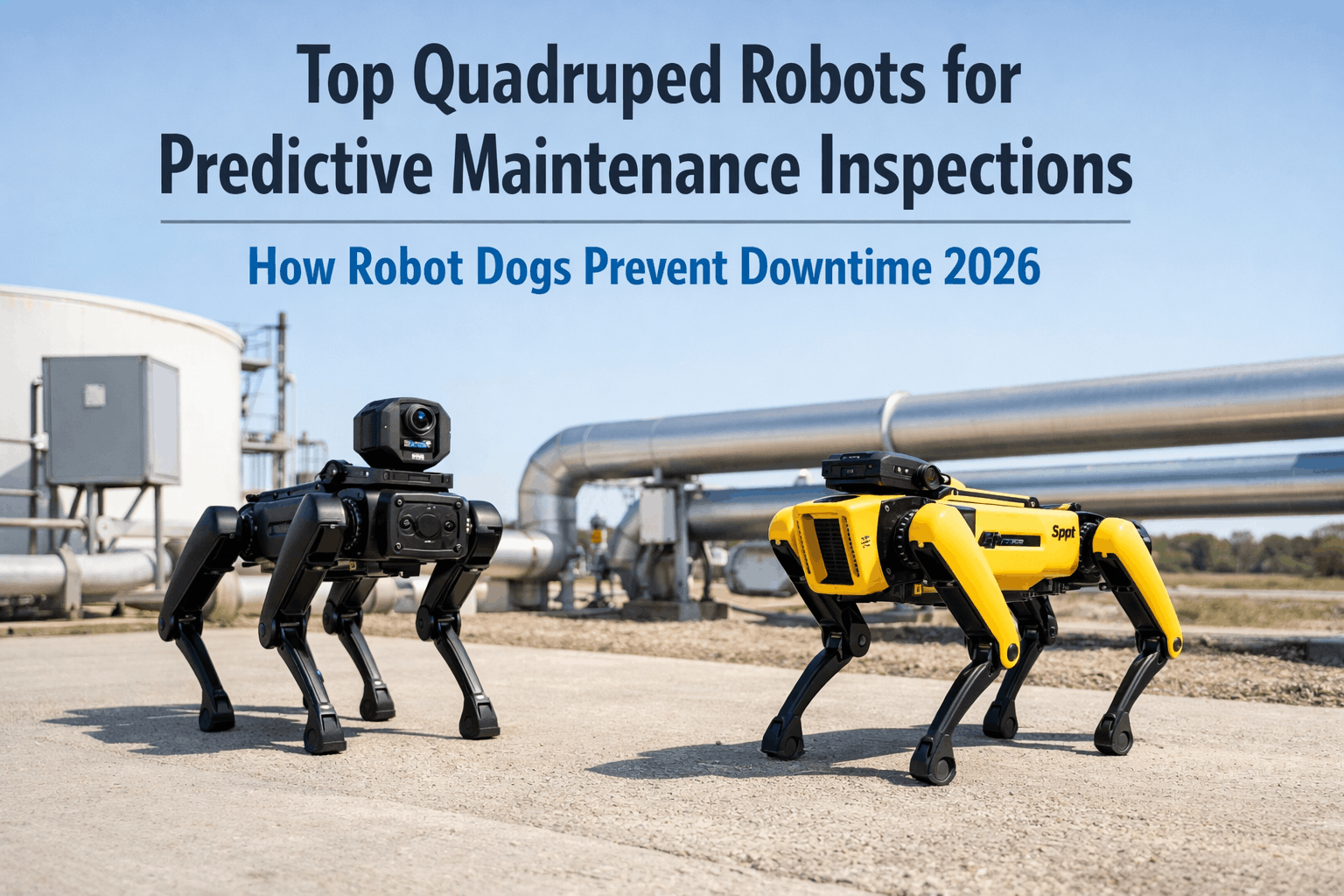
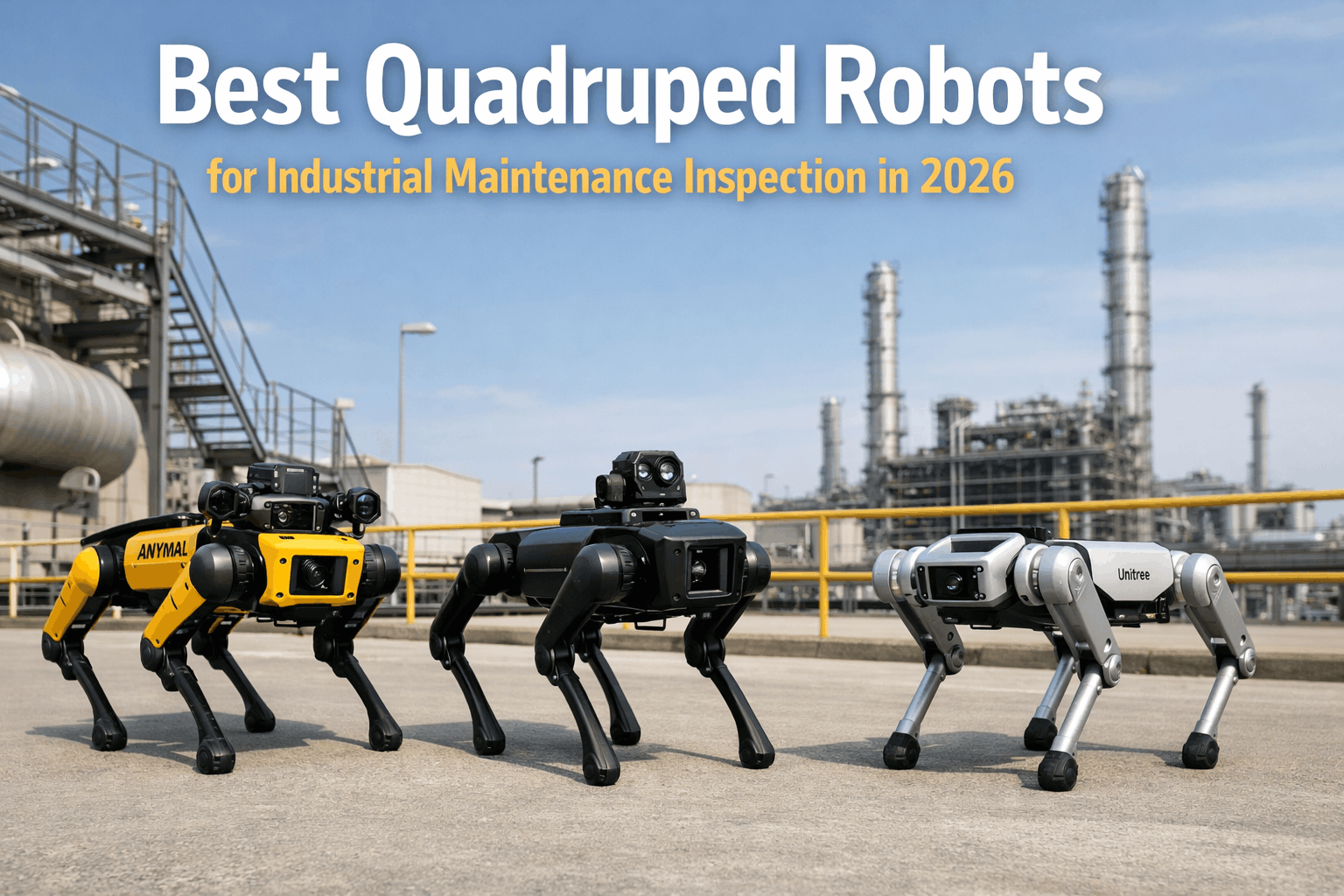
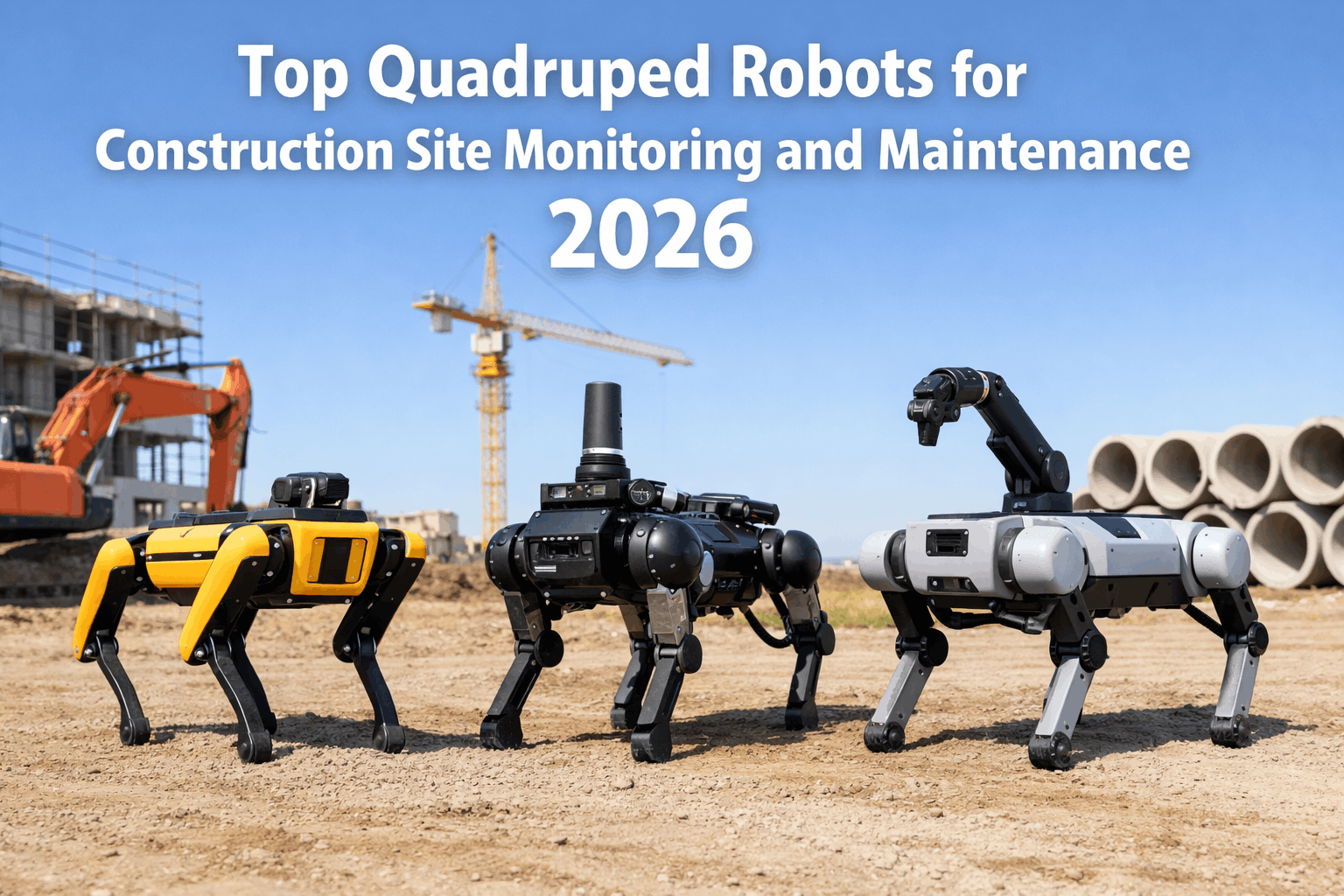
Every modern industrial facility faces one critical challenge: detecting equipment failures before they halt production. As plants grow larger and more complex, traditional inspection methods can't keep pace. Quadruped Robots (Robot Dogs) are emerging as the ultimate solution for predictive maintenance inspections in 2026—combining autonomous mobility with advanced thermal imaging, acoustic sensing, and vibration analysis to prevent costly downtime. This complete guide explores the top robot dogs, their sensor capabilities, CMMS integration, and the ROI of deploying four-legged inspection fleets. Schedule a consultation to explore your facility's quadruped strategy.
The Hidden Cost of Manual Inspections in 2026
Relying on human technicians to manually patrol vast facilities is slow, inconsistent, and increasingly dangerous. Quadruped robots eliminate human limitations by autonomously navigating complex terrain—stairs, catwalks, uneven floors—while collecting high-fidelity sensor data around the clock. The shift from manual rounds to autonomous robot dog patrols is the next evolution in Condition-Based Maintenance (CBM).
$260K
/hr
Average cost of unplanned downtime in discrete manufacturing sectors
5x
More ground covered per shift by a robot dog vs. a human inspector
24/7
Continuous autonomous patrol capability in hazardous and remote zones
70%
Reduction in inspection-related safety incidents with robotic deployment
Quadruped Robots vs. Wheeled AMRs: Why Legs Win
While wheeled autonomous mobile robots (AMRs) excel on flat factory floors, quadruped robots conquer the terrain that wheels cannot. Understanding the advantage of four-legged mobility is essential for facilities with multi-level structures, outdoor yards, and confined access points. Book a Demo.
The 5 Core Capabilities of Inspection Robot Dogs
A quadruped robot is far more than a walking platform. Each robot dog is a multi-sensor inspection system on legs, combining autonomous navigation with an advanced suite of predictive maintenance technologies designed to catch failures weeks before they occur. Book a Demo.
01
Thermal Imaging & Radiometry
Onboard FLIR-grade thermal cameras detect heat anomalies in electrical panels, motors, bearings, and steam traps. By mapping temperature gradients during every patrol, robot dogs identify overheating connections, phase imbalances, and insulation failures—often weeks before a human would notice. Thermal data is geo-tagged and time-stamped for trend analysis.
02
Acoustic & Ultrasonic Sensing
High-frequency microphone arrays detect compressed air leaks, steam trap failures, and early-stage bearing degradation through sound signatures invisible to the human ear. Robot dogs can isolate specific acoustic anomalies even in noisy industrial environments, saving facilities thousands in wasted energy from undetected leaks alone.
03
Vibration Analysis & Monitoring
Contact and non-contact vibration sensors mounted on articulated arms allow robot dogs to measure shaft imbalance, misalignment, and bearing wear on rotating equipment. Spectral analysis algorithms identify characteristic fault frequencies, providing Remaining Useful Life (RUL) estimates that feed directly into maintenance scheduling systems.
04
AI-Powered Visual Inspection
HD and 4K cameras paired with computer vision models detect corrosion, fluid leaks, belt fraying, gauge reading anomalies, and structural cracks. Machine learning continuously improves detection accuracy by comparing patrol images against historical baselines, flagging subtle changes a human eye would miss across thousands of checkpoints.
05
CMMS Integration & Auto Work Orders
All sensor data streams directly into Oxmaint CMMS, where AI correlates findings across inspection cycles. When anomalies breach configurable thresholds, the system auto-generates work orders with asset location, fault type, severity, and recommended parts—ensuring technicians arrive prepared, not guessing.
Sign up for Oxmaint to close the loop.
Turn robot patrols into repair actions. Oxmaint bridges the gap between quadruped sensor data and technician productivity, automating work order creation and reducing response time by up to 65%.
Start Today
Top Quadruped Robots for Industrial Inspection in 2026
The market for inspection-grade robot dogs has matured rapidly. Each platform offers unique strengths depending on facility type, payload requirements, and environmental conditions. Selecting the right quadruped depends on matching its capabilities to your plant's specific challenges.
The industry benchmark for quadruped inspection. Spot carries modular payloads including thermal cameras, acoustic sensors, and LiDAR. Its Autowalk feature enables repeatable autonomous routes, and the Spot ARM provides contact-based vibration measurement and valve manipulation in the field.
Purpose-built for fully autonomous industrial inspection. ANYmal features IP67 protection, integrated thermal and acoustic sensors, and self-charging docking stations. Its ATEX/IECEx certification makes it one of the few robot dogs rated for explosive atmosphere zones in petrochemical facilities.
A high-performance, cost-effective quadruped offering impressive speed and payload capacity. The B2 supports third-party sensor integration for thermal, acoustic, and visual inspection tasks. Its competitive price point makes fleet deployment financially viable for mid-size manufacturers.
Designed for ruggedized outdoor and perimeter inspection. Vision 60 excels in extreme weather conditions and rough terrain. Its open architecture allows deep customization of sensor payloads, making it ideal for energy infrastructure and remote asset monitoring across large outdoor facilities.
An emerging platform combining affordability with AI-driven navigation. CyberDog 2 integrates ROS2 for custom inspection workflows and supports modular sensor attachments. Best suited for indoor facility patrols, R&D environments, and organizations piloting their first quadruped inspection program.
A compact, agile quadruped optimized for confined space entry and dense facility navigation. Lite3 features advanced dynamic balancing for narrow walkways and cluttered environments. Its lightweight design and rapid deployment make it ideal for supplementary patrol coverage across complex plant layouts.
Sector-Specific ROI of Robot Dog Inspections
Quadruped robots deliver measurable returns across every major industrial vertical. Facilities using Oxmaint to integrate robot dog data into their maintenance workflows consistently outperform industry reliability benchmarks.
Strategic Advantages of Quadruped Inspection Fleets
Robot dogs aren't just mobile sensor platforms—they fundamentally transform how maintenance teams operate. Their ability to traverse any terrain, work around the clock, and integrate seamlessly with CMMS platforms creates a maintenance ecosystem that is proactive, data-rich, and dramatically safer.
All-Terrain Facility Coverage
Unlike wheeled robots, quadrupeds climb stairs, navigate catwalks, cross uneven ground, and enter confined spaces—reaching 100% of inspectable assets including those in areas previously requiring scaffolding or rope access teams.
Hazardous Zone Elimination
Robot dogs perform routine inspections in explosive atmospheres, high-radiation areas, extreme temperatures, and toxic gas environments—completely removing human technicians from the most dangerous inspection scenarios on the plant floor.
Multi-Sensor Fusion Intelligence
By combining thermal, acoustic, vibration, and visual data in a single patrol, robot dogs provide a holistic health profile for each asset—dramatically improving prediction confidence and virtually eliminating false positives that plague single-sensor approaches.
Automated Digital Twin Updates
Every patrol generates geo-tagged, time-stamped inspection data that automatically updates the facility's Digital Twin. Maintenance managers can "replay" asset deterioration over weeks or months to refine predictive models and justify capital expenditure decisions.
Closing the Loop: Robot Dogs + Oxmaint CMMS
Inspection data is only valuable when it triggers the right action at the right time. Oxmaint CMMS transforms raw quadruped sensor data into prioritized work orders, ensuring that every anomaly detected by a robot dog results in a technician arriving with the correct tools, parts, and safety documentation.
75%
Fewer unplanned downtime events
65%
Faster fault-to-repair response time
50%
Reduction in manual inspection labor costs
95%
AI prediction accuracy for critical asset failures
The Deployment Roadmap: 4 Stages to Robot Dog Success
Deploying quadruped robots effectively requires a phased approach. Rushing a fleet deployment without proper planning leads to underutilized robots and missed ROI. Follow this proven four-stage roadmap to ensure success.
Stage 1: Assessment
Facility Mapping & Asset Criticality
Map all inspection routes including stairs, confined spaces, and hazardous zones
Rank assets by downtime cost and assign sensor requirements per checkpoint
Initialize Oxmaint CMMS with asset registry, failure history, and baseline health data
Stage 2: Pilot Patrol
Single Robot Deployment & Baselining
Deploy one quadruped robot on the highest-value inspection route
Calibrate thermal, acoustic, and vibration sensors against known asset conditions
Establish "Normal" health baselines using supervised AI learning over 4-6 weeks
Stage 3: Integration
CMMS Automation & Workflow Connection
Configure Oxmaint to auto-generate work orders from robot anomaly detections
Integrate spare parts inventory with predicted failure timelines for just-in-time ordering
Deploy mobile reliability apps so technicians receive alerts in real-time
Stage 4: Fleet Scale
Multi-Robot Autonomous Operations
Scale to a coordinated fleet covering all facility zones including outdoor and multi-level areas
Enable 24/7 continuous patrol schedules with automated docking and recharging
Continuously refine AI models using fleet-wide data for zero-surprise maintenance operations
Deploy Your Robot Dog Inspection Fleet with Oxmaint
Don't let manual inspections hold your facility back. Oxmaint connects your quadruped robot data, IoT sensors, and maintenance engineering team into a single intelligent command center. Automate condition-based workflows, extend asset life, and join the elite manufacturers leading Industry 4.0 with robot dog inspections.
Frequently Asked Questions
How do robot dogs integrate with existing CMMS platforms like Oxmaint?
Robot dogs export inspection data (thermal maps, vibration spectra, acoustic alerts, visual reports) via APIs directly into Oxmaint CMMS. The platform's AI engine correlates this data with asset history to auto-generate prioritized work orders, check parts availability, and schedule technicians during optimal maintenance windows—closing the loop from detection to repair automatically.
Can quadruped robots operate in hazardous or explosive environments?
Yes. Models like the ANYbotics ANYmal carry ATEX/IECEx Zone 1 certifications for explosive atmospheres. Boston Dynamics Spot also offers configurations for hazardous area use. These robots routinely patrol petrochemical plants, offshore platforms, and chemical storage zones where human entry is restricted or requires extensive safety protocols.
What is the typical ROI timeline for a robot dog inspection program?
Most facilities see measurable savings within 3-6 months, with the earliest wins coming from detecting impending failures in high-criticality assets. The reduction in manual labor costs, elimination of safety incidents, and prevention of even a single major unplanned shutdown typically delivers full program ROI within the first year of deployment.
Do robot dogs require specialized operators?
Modern inspection-grade quadrupeds are designed for autonomous operation. After initial route programming and sensor calibration, they patrol independently on preset schedules. Oxmaint's dashboard presents findings in plain-language alerts like "Motor Bearing Wear Detected - Estimated 3 Weeks to Failure," so your team needs maintenance expertise, not robotics PhDs.
How many robot dogs does a typical facility need?
It depends on facility size and complexity. A single robot dog can cover 50-100+ inspection points per patrol shift. Most mid-size plants start with one unit during the pilot phase and scale to 2-4 units for full 24/7 coverage. Large petrochemical or power generation complexes may deploy fleets of 6 or more coordinated units.