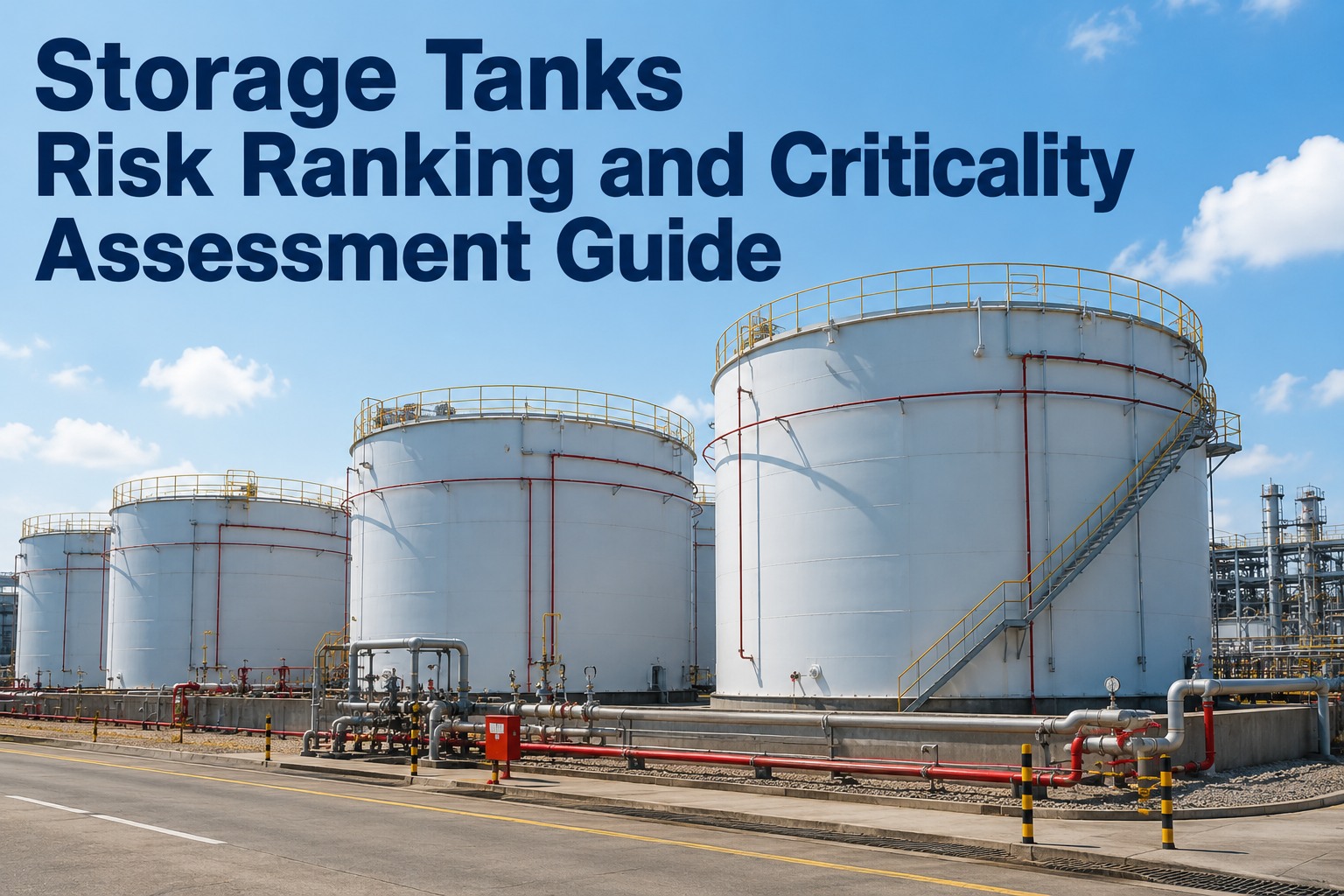
Criticality analysis for storage tanks is the process of ranking each tank by its risk and consequence of failure so maintenance teams can direct limited budgets, inspection intervals, and technician hours toward the assets that matter most. A well-structured storage tanks risk assessment combines the probability of failure — driven by floor and shell corrosion, age, service severity, and inspection history — with the consequence of failure, including environmental impact, safety hazard, production loss, and regulatory exposure. By applying a consistent storage tanks criticality ranking methodology, facilities shift from reactive firefighting to controlled reliability, reducing unplanned outages and avoiding catastrophic leaks. This guide walks through a proven storage tanks risk matrix, priority scoring criteria, and maintenance strategy selection framework, and shows how OxMaint turns that framework into daily practice — or you can Start Free Trial to apply it immediately.
STORAGE TANKS CRITICALITY ASSESSMENT
Which of your tanks would cause the most damage if it failed tomorrow?
Without a systematic storage tanks criticality ranking, every tank gets the same attention — which means your highest-risk assets are under-inspected while your lowest-risk assets consume spare parts and labor. Rank them by consequence and probability, and your maintenance strategy becomes defensible, auditable, and cost-efficient.
THE FRAMEWORK
How to build a storage tanks risk matrix that actually drives decisions
A storage tanks risk matrix is a two-dimensional grid: probability of failure on one axis, consequence of failure on the other. Each tank lands in a cell that maps to a risk tier — and each tier carries a defined inspection frequency, maintenance strategy, and escalation path. The goal is not complexity; it is consistency. A 200-tank terminal using a 5×5 matrix can rank every asset in a few days, then govern maintenance spend by tier rather than by guesswork.
RISK SCORE FORMULA
Risk Score = Probability of Failure (1–5) × Consequence of Failure (1–5)
Score range: 1 (lowest risk) to 25 (highest risk). Tiers are defined by score bands — see the tier table below.
Probability of Failure factors
- Internal floor corrosion rate (mm/yr, from UT inspections)
- Shell course thickness loss and weld integrity
- Years since last internal inspection (API 653 interval)
- Stored product corrosivity (crude, water, chemicals)
- Cathodic protection system status and coating condition
- Historical leak, repair, or retrofit frequency
Consequence of Failure factors
- Stored volume and product hazard class (flammable, toxic)
- Proximity to waterways, population, or ignition sources
- Production dependency and replacement lead time
- Environmental and SPCC regulatory exposure
- Secondary containment capacity and integrity
- Business interruption cost per day of downtime
TIER RANKING SYSTEM
Storage tanks tier ranking: from critical to low-priority
Once each tank has a risk score from 1 to 25, group scores into four tiers. Each tier defines the minimum acceptable maintenance strategy, inspection cadence, and spare-parts readiness. This storage tanks importance ranking makes it immediately clear where to spend the next maintenance dollar — and just as importantly, where to stop over-maintaining.
| Tier | Risk Score | Asset Label | Inspection Cadence | Maintenance Strategy | Spare-Parts Posture |
|---|---|---|---|---|---|
| Tier 1 | 20–25 | Critical | Quarterly external, annual internal UT | Predictive + condition-based | Full critical spares kit on shelf |
| Tier 2 | 12–19 | High | Semi-annual external, 3-yr internal | Preventive + RBI-driven | Key seals and valves stocked |
| Tier 3 | 6–11 | Moderate | Annual external, 5-yr internal | Preventive maintenance | Standard parts, vendor-managed |
| Tier 4 | 1–5 | Low | Biennial external, 10-yr internal | Run-to-failure / corrective | No dedicated spares held |
WORKED EXAMPLE
Storage tanks consequence analysis in practice: a 180-tank terminal
Consider a mid-sized bulk-liquid terminal with 180 storage tanks across crude, refined products, and water service. Before implementing criticality ranking, the facility inspected every tank on the same 5-year internal cycle and carried $180K in annual maintenance labor — yet still suffered two unplanned leaks in 18 months, both from Tier 1 tanks that had been deferred for lower-priority work.
$42K
Annual maintenance labor reallocated from Tier 3–4 tanks to Tier 1–2 inspections and predictive sensors
3
Tier 1 tanks identified with floor corrosion rates above 0.5 mm/yr — flagged for immediate UT verification
0
Unplanned leaks in the 12 months following tier-based inspection cadence adoption
“The terminal moved 28 tanks from a blanket 5-year internal inspection to risk-based intervals. Tier 1 tanks were inspected every 12 months; Tier 4 tanks every 10 years. The net effect was more inspection coverage on the assets that could actually hurt someone — at a lower total cost.”
The shift required no new headcount. It required a structured storage tanks failure impact scoring method, an asset hierarchy that tied each tank to its service, product, and containment data, and a CMMS that could enforce the new inspection cadence automatically. That is exactly what OxMaint provides.
STRATEGY SELECTION
Choosing the right maintenance strategy by risk tier
Storage tanks maintenance priority is not one-size-fits-all. A Tier 1 tank storing high-volume flammable product next to a navigable waterway demands predictive maintenance — continuous level monitoring, periodic UT thickness surveys, and automated alerts when corrosion trends cross threshold. A Tier 4 water tank can run to failure with a corrective work order triggered by a level alarm. Matching strategy to tier is where storage tanks reliability becomes economically defensible.
Predictive maintenance for Tier 1
Continuous sensor data — tank level, temperature, CP readings, and UT thickness trends — feeds into OxMaint’s predictive analytics engine. When floor corrosion rate exceeds 0.3 mm/yr, a work order auto-generates for UT verification before the next planned inspection. Target: detect 80% of floor failures 3–6 months before breach.
Risk-based inspection for Tier 2
Inspection intervals driven by API 580/581 risk-based inspection methodology, adjusted by service severity and previous inspection results. OxMaint tracks each tank’s RBI score and automatically reschedules the next external and internal inspection based on findings, not a fixed calendar.
Preventive maintenance for Tier 3
Time-based PMs for roof drains, vent valves, gauge devices, and seal inspections on a 6- or 12-month cycle. OxMaint generates and assigns PM work orders automatically, tracks completion, and escalates overdue tasks to the reliability lead — ensuring no Tier 3 tank drifts into silent failure.
Corrective-only for Tier 4
No scheduled inspections beyond biennial external visual checks. When a Tier 4 tank faults, OxMaint’s mobile app lets operators snap a photo, generate a work order on the spot, and route it to the nearest technician — capturing the repair without bloating the preventive maintenance schedule.
See OxMaint rank your tanks by real risk — not guesswork
Book a 30-minute demo and we will load your tank inventory, apply a 5×5 criticality matrix, and show you the tier ranking, inspection schedule, and PM automation live on your data.
HOW OXMAINT HELPS
How OxMaint operationalizes storage tanks criticality ranking
A risk matrix on a spreadsheet changes nothing. OxMaint turns your storage tanks asset priority into enforced action — automated PM schedules by tier, work order workflows that route to the right technician, mobile inspection capture, and analytics that update risk scores as new inspection data arrives. The result: maintenance decisions are driven by data, not by who shouts loudest in the morning meeting.
Asset hierarchy with risk tier tagging
Build a full tank hierarchy — terminal, battery, tank, component — and tag each asset with its Tier 1–4 label. Risk scores are visible on every asset record, so technicians see criticality context the moment they open a work order. Outcome: 100% of work orders carry tier-aware priority routing.
PM automation by inspection cadence
Define inspection intervals per tier — quarterly for Tier 1, biennial for Tier 4 — and OxMaint auto-generates PM work orders on schedule, assigns them to the right technician, and escalates overdue tasks. Outcome: eliminate missed inspections and reduce manual scheduling effort by 70%.
Mobile inspection capture with UT data
Technicians capture UT thickness readings, photos, and anomalies on the OxMaint mobile app — online or offline. Readings flow back to the asset record and update the corrosion-trend chart automatically. Outcome: cut inspection documentation time by 50% and eliminate paper forms.
Predictive analytics for corrosion trends
OxMaint’s AI engine analyzes UT reading sequences and flags tanks where floor or shell corrosion rates are accelerating beyond threshold — auto-generating a high-priority work order before the next scheduled inspection. Outcome: detect 70–80% of corrosion-driven failures 3+ months early.
COMMON QUESTIONS
Storage tanks criticality analysis: frequently asked questions
What is criticality analysis for storage tanks?
Criticality analysis for storage tanks is a structured method of ranking each tank by its risk of failure and the consequence of that failure. It combines probability factors — corrosion rate, age, inspection history, service severity — with consequence factors like environmental impact, safety, production loss, and regulatory exposure. The output is a tier ranking (typically 4 tiers) that drives inspection frequency, maintenance strategy, and spare-parts decisions. You can build and enforce this ranking in OxMaint — Book a Demo to see it on your tank inventory.
How often should storage tanks be inspected?
Inspection frequency depends on the tank’s risk tier. API 653 requires external inspections every 5 years and internal inspections every 10–20 years as a baseline, but a risk-based approach shortens that for high-criticality tanks. Tier 1 tanks should receive external inspections quarterly and internal UT surveys annually; Tier 4 tanks can follow the maximum API 653 interval. OxMaint automates these cadences per tier so no inspection is missed or over-scheduled.
What is the difference between probability of failure and consequence of failure?
Probability of failure estimates how likely a tank is to leak or structurally fail, based on corrosion rates, coating condition, CP system health, and years since last inspection. Consequence of failure estimates the impact if it does fail — environmental damage, safety hazard, production downtime, and regulatory fines. Multiplying the two (each scored 1–5) produces a risk score from 1 to 25 that feeds the storage tanks risk matrix and determines the tank’s tier.
How do you prevent floor and shell corrosion in storage tanks?
Preventing floor and shell corrosion requires a combination of protective coatings, cathodic protection systems, regular UT thickness monitoring, and product-side corrosion inhibitors where appropriate. The maintenance team’s job is to track corrosion rates over time and intervene before rates exceed safe thresholds — typically 0.25–0.5 mm/yr depending on design margin. OxMaint’s predictive analytics engine flags accelerating corrosion trends automatically and generates verification work orders before breach.
Can a CMMS improve storage tanks reliability?
Yes — a CMMS like OxMaint improves storage tanks reliability by enforcing tier-based inspection schedules, capturing UT and visual inspection data on mobile devices, tracking corrosion trends over time, and auto-generating work orders when readings cross threshold. Facilities that replace spreadsheet-based tracking with OxMaint typically cut unplanned tank downtime 30–50% and reduce inspection documentation time by half. Start Free Trial to apply it to your tank fleet today.
Stop guessing which tanks matter most
Rank every storage tank by real consequence and failure probability, automate inspections by tier, and catch corrosion before it becomes a leak. OxMaint makes it operational in days — not months.
Free 14-day trial · No credit card