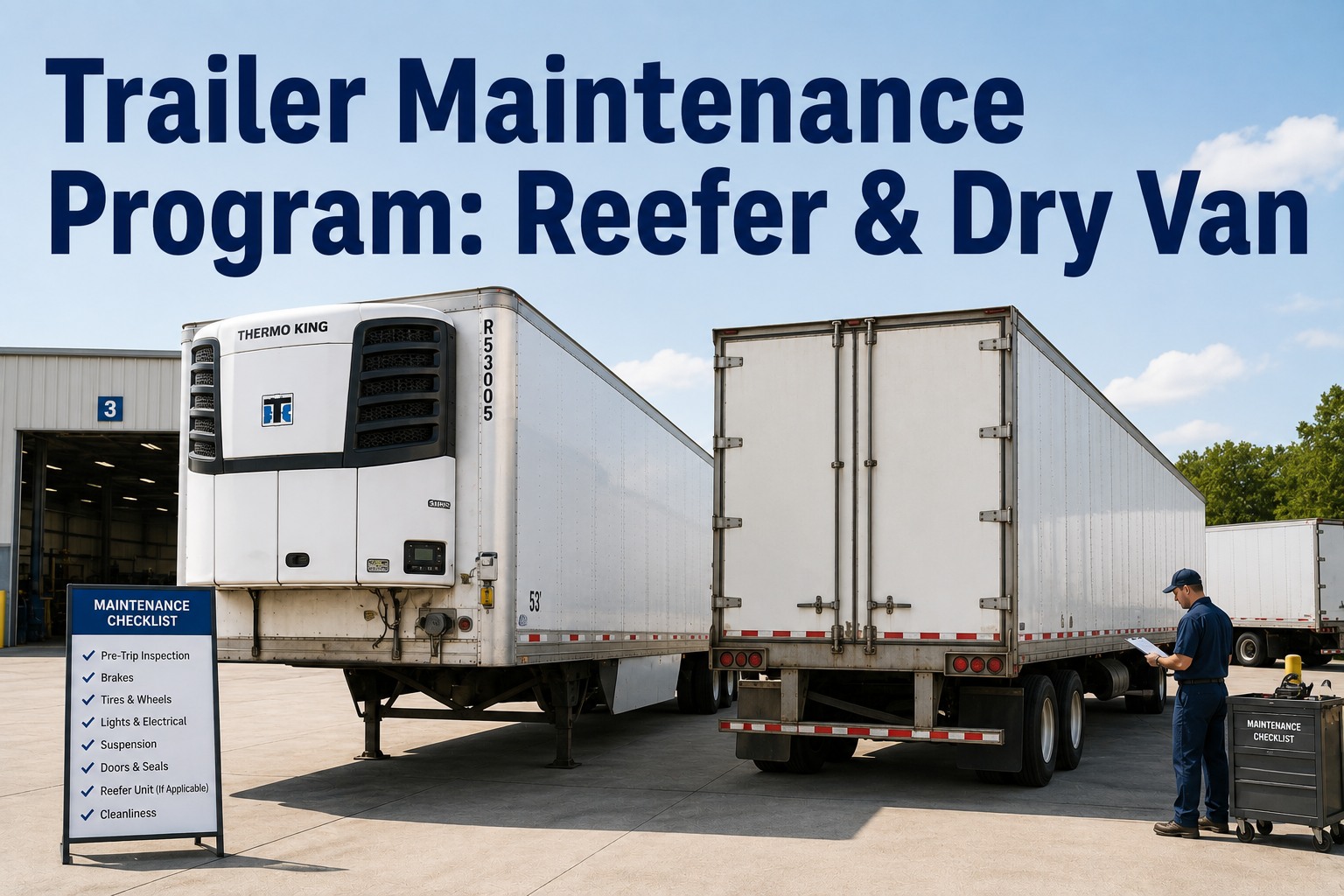
A trailer maintenance program for reefer and dry van fleets is the operational backbone that prevents in-transit failures, protects perishable and high-value cargo, and keeps delivery schedules intact. Trailers are often the most overlooked assets in a fleet until a refrigeration unit fails on a loaded reefer or a dry van axle suffers a roadside violation—by then, the cost of a single rejected load can wipe out months of margin. This guide breaks down how to build a disciplined trailer PM and inspection program, covering reefer unit maintenance, structural and tire checks, DOT compliance, and how a CMMS like OxMaint enforces it all. Ready to modernize your fleet maintenance? Start Free Trial and see how quickly you can digitize your trailer PM library.
Trailer PM & Compliance
One spoiled reefer load can cost $20K–$60K. Is your trailer maintenance program protecting every shipment?
Reefer and dry van trailers demand a single, disciplined maintenance strategy — combining DOT inspection compliance, refrigeration reliability, and structural integrity. OxMaint gives fleet maintenance teams the CMMS structure to keep mixed trailer fleets road-ready and audit-defensible at every terminal.
The Cost of Inaction
Why trailer reliability is a margin problem, not just a shop problem
FMCSA data consistently shows that brake, tire, and lighting violations account for the majority of out-of-service orders during roadside inspections. For a 200-trailer fleet, even a 10% out-of-service rate means 20 trailers sidelined — each one pulling a driver and a load out of rotation. When the sidelined asset is a refrigerated trailer, the clock starts ticking on a perishable commodity: most reefer loads have a 2–4 hour window before temperature excursions render the cargo a total loss.
A reactive trailer fleet maintenance approach — fixing trailers only when they break or fail a roadside check — creates a chaotic shop environment, unpredictable downtime, and skyrocketing road-service call costs. The fleet that shifts to a structured trailer maintenance program recovers those losses through fewer emergency repairs, higher CSA scores, and predictable shop labor scheduling.
Reefer vs. Dry Van PM
Reefer maintenance vs. dry van maintenance: what changes?
Dry van maintenance focuses on structural integrity, running gear, and door systems. Refrigerated trailer maintenance adds a complex mechanical layer — the reefer unit itself — which requires its own hourly PM schedule, fuel system checks, and microprocessor diagnostics. Mixing both trailer types in one fleet without a CMMS to separate and track PM triggers leads to missed reefer hour-meter services and premature compressor failures.
| Maintenance Domain | Dry Van | Reefer |
|---|---|---|
| PM Trigger | Mileage / calendar | Reefer hours + mileage |
| Refrigeration Unit | N/A | Compressor, evaporator, fuel, diagnostics |
| Running Gear | Hubs, brakes, suspension | Hubs, brakes, suspension |
| Cargo Care | Load locks, floor, doors | Air chute, bulkhead, drain lines |
| Critical Risk | Roadside OOS violation | Load spoilage + OOS violation |
| Inspection Cadence | Annual DOT + DVIR | Annual DOT + pre-trip reefer check |
OxMaint handles both asset profiles natively — you can trigger a PM on mileage for the trailer axle and on a separate hour-meter for the reefer unit, so neither service interval is missed.
Inspection & PM Checklist
Trailer maintenance checklist: reefer and dry van PM essentials
A safety-defensible trailer maintenance program breaks inspections into three tiers: driver pre-trip DVIRs, scheduled preventive maintenance at defined intervals, and the annual FMCSA-mandated DOT inspection. Below is a structured trailer PM checklist covering both reefer unit maintenance and dry van structural care.
- Tire pressure, tread depth, and visible damage
- Brake adjustment and air system leaks
- Lights, reflectors, and DOT tape
- Door seals, hinges, and latch operation
- Reefer: fuel level, set-point temp, and alarm panel
- Reefer: pre-cool / pre-heat to load temperature
- Wheel bearings repack and hub oil check
- Brake chamber, slack adjuster, drum wear
- Suspension bushings, air-ride height
- Landing gear operation and grease
- Reefer: condenser & evaporator coil cleaning
- Reefer: belt tension, fuel filter, and oil level
- Complete brake system teardown & measurement
- Frame, cross-members, and floor structural integrity
- All lighting, wiring, and ABS system diagnostic
- Kingpin, fifth wheel plate, and upper coupler
- Reefer: full annual inspection per manufacturer spec
- Decal issuance and compliance documentation
Worked Example
A 180-trailer mixed fleet: the real cost of PM gaps
Consider a regional fleet operating 120 dry vans and 60 refrigerated trailers. Before implementing a CMMS-driven trailer maintenance program, they tracked PM on whiteboards and spreadsheets. Over 12 months they recorded: 14 roadside OOS violations (mostly brake and tire), 6 spoiled reefer loads averaging $38K each, and $52K in emergency road-service calls. Total annual loss: roughly $312K — not counting the late-delivery chargebacks and driver detention costs.
After deploying OxMaint CMMS
Reefer hour-meter PMs triggered automatically, DOT inspection deadlines tracked per asset, and DVIR defects converted to work orders in real time. Within 9 months the fleet cut roadside OOS violations by 62%, reduced spoiled loads to 1 incident, and redirected $41K from emergency road service into scheduled shop labor. The CMMS paid for itself in under 4 months.
OxMaint Platform Fit
How OxMaint enforces your trailer maintenance program
OxMaint is an AI-powered CMMS and EAM platform built to give maintenance and reliability teams total control over work orders, preventive and predictive maintenance, asset tracking, parts inventory, and analytics. For trailer fleets, that means turning a scattered PM spreadsheet into a safety-defensible, audit-ready system of record.
Dual-Trigger PM Scheduling
Trigger reefer unit maintenance on hour-meter and trailer axle service on mileage — independently, per asset. OxMaint auto-generates work orders before intervals lapse, eliminating missed PMs and compressor failures.
DOT Inspection & Compliance Tracking
Track annual DOT inspections, DVIR defect resolution, and CSA-related repairs in one dashboard. Every work order is timestamped and parts-traced — your audit defense is built into the workflow, not reconstructed after the fact.
Predictive Failure Alerts
OxMaint AI analyzes reefer temperature logs, fault codes, and historical repair data to flag units trending toward failure — so you can pull a trailer before a $40K load is at risk, not after.
Spare-Parts & Tire Inventory
Auto-deplete belts, filters, hub oil, and trailer tires against work orders. Set reorder points so the shop never delays a PM because a $12 fuel filter is out of stock — cut parts-related downtime to near zero.
Implementation Timeline
Building your reefer maintenance program in 90 days
Moving from reactive repairs to a disciplined trailer maintenance program doesn't require a multi-year project. With OxMaint, most mixed-trailer fleets are live within 30–60 days and seeing measurable downtime reduction by day 90.
Asset & PM Library Setup
Import all reefer and dry van assets into OxMaint. Configure PM templates by trailer type — reefer hourly services, dry van mileage services, and annual DOT inspection schedules.
DVIR Integration & Work Order Routing
Connect driver DVIR submissions to the CMMS so defects auto-generate work orders routed to the nearest terminal. Set priority rules for reefer temp faults versus cosmetic dry van damage.
Parts Inventory & Vendor Linking
Map critical PM parts — filters, belts, brakes, hub oil — to each trailer type. Configure reorder points and link approved vendors so procurement is automated, not a bottleneck.
Analytics & Predictive Tuning
Review MTBF, PM compliance rate, and reefer fault-code trends. Activate OxMaint's predictive alerts on high-risk assets and present the first quarterly reliability report to leadership.
See OxMaint on your trailers — book a 30-min demo
We'll show you how to digitize your reefer and dry van PM library, automate DOT compliance tracking, and cut roadside failures before the next inspection cycle.
Frequently Asked Questions
Trailer maintenance program FAQs
How often should a reefer trailer be serviced?
Reefer unit maintenance is typically scheduled by running hours: a standard PM interval is every 1,000–1,500 hours for oil and filter changes, with a major inspection at 4,000–5,000 hours. For a trailer running 40 hours per week, that means a PM roughly every 6–9 months. OxMaint tracks the hour-meter automatically and generates the work order before the interval lapses, so no reefer unit maintenance is ever missed. You can Book a Demo to see the hourly PM trigger in action.
What is included in a trailer PM checklist?
A complete trailer PM checklist covers tires and inflation, brake adjustment and component wear, wheel bearings and hub oil, suspension and air-ride, lighting and electrical, landing gear, door seals and floors, and for reefers the condenser, evaporator, belts, fuel filter, and diagnostic codes. OxMaint ships with pre-built reefer and dry van PM templates so your technicians follow the same checklist every time — no missed steps.
How do you track DOT inspection compliance for a trailer fleet?
Every trailer must carry a valid annual DOT inspection sticker. OxMaint stores the inspection date, inspector, decal number, and any defect corrections per asset, then alerts you 30, 60, and 90 days before expiration. This creates a defensible compliance record for FMCSA audits and ensures no trailer rolls past its annual deadline.
Can a CMMS prevent refrigerated trailer load spoilage?
Yes — by combining scheduled reefer PMs with predictive fault-code monitoring. OxMaint logs reefer temperature data and diagnostic alerts, then flags units trending toward compressor or sensor failure before the next load is dispatched. Fleets using predictive maintenance typically reduce temperature-related load claims by 40–70% within the first year.
How long does it take to implement trailer maintenance software?
Most mixed trailer fleets are fully live on OxMaint within 30–60 days. The process involves importing your asset list, configuring PM templates for reefer and dry van types, connecting DVIR workflows, and setting parts reorder points. You can Start Free Trial today and have your first PM library configured in a single afternoon.
Stop losing loads to missed PMs. Start your OxMaint trial today.
Join the fleet maintenance teams using OxMaint to cut unplanned downtime, automate DOT compliance, and protect every reefer load from pickup to delivery.
Free 14-day trial · No credit card