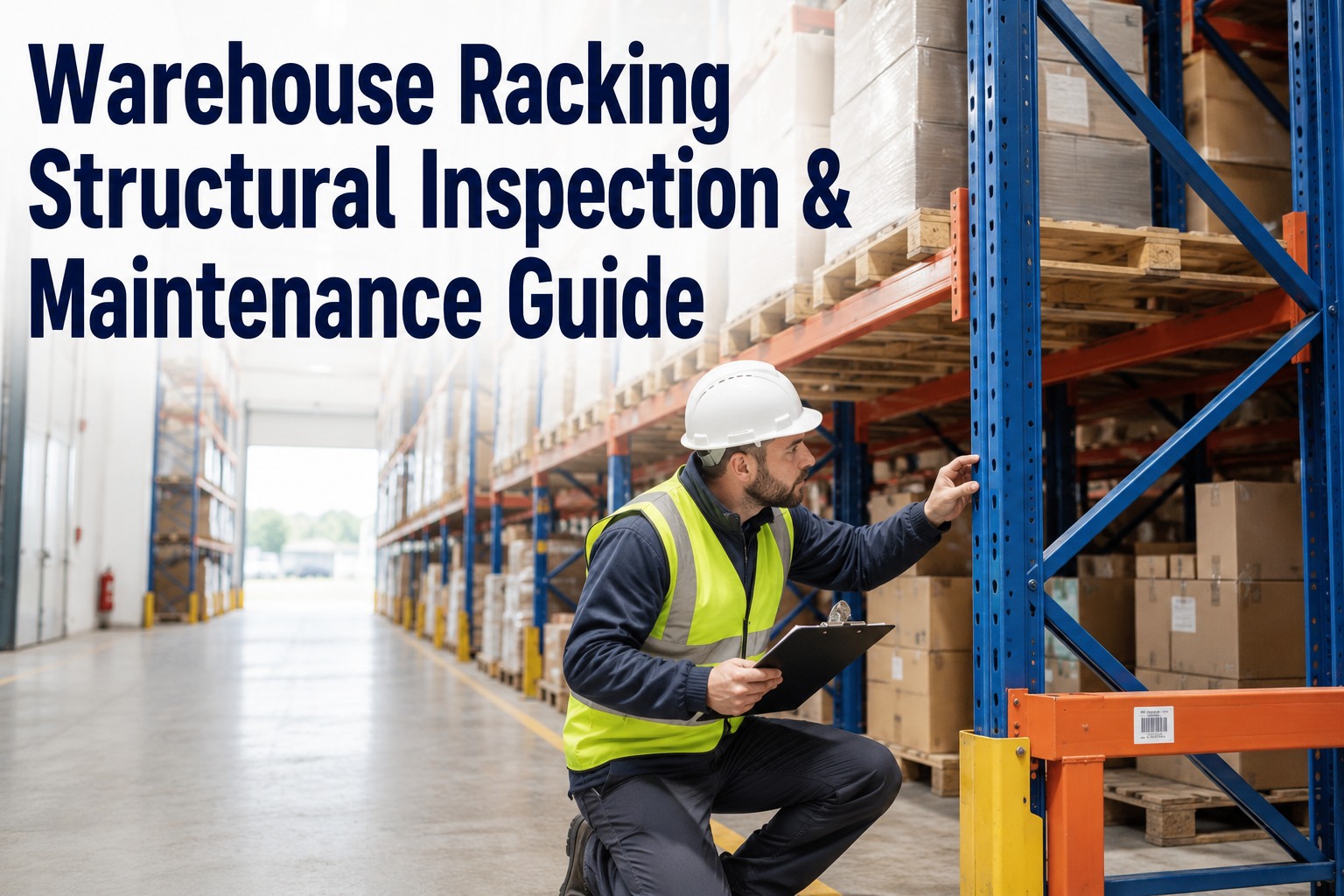
Warehouse racking maintenance and pallet rack inspection are not optional housekeeping tasks — they are safety-critical obligations governed by RMI/ANSI MH16.1 standards and enforced by OSHA. A single damaged upright, deflected beam, or overloaded pallet position can trigger a progressive collapse that endangers workers, destroys inventory, and halts operations for weeks. This guide walks maintenance and reliability teams through a complete racking inspection and maintenance program — covering damage classification, load capacity verification, repair criteria, and how a CMMS like OxMaint makes compliance defensible. Ready to digitize your rack inspection program? Start Free Trial and build your first racking inspection workflow today.
RACKING INSPECTION & MAINTENANCE GUIDE
Is one damaged upright all it takes to bring down your entire racking bay?
RMI/ANSI MH16.1 requires regular, documented racking safety inspections — yet most warehouses still rely on paper checklists and memory. OxMaint digitizes the full inspection-to-repair lifecycle so every damaged beam, brace, and baseplate is classified, tracked, and resolved before it becomes an OSHA citation or a collapse.
The cost of one rack collapse:
A single pallet rack collapse averages $250K–$500K in inventory loss, structural damage, and operational downtime — before factoring in OSHA fines of up to $165K per willful violation and potential worker injury claims.
RMI / ANSI MH16.1 COMPLIANCE
Why warehouse racking inspection is safety-critical — not cosmetic
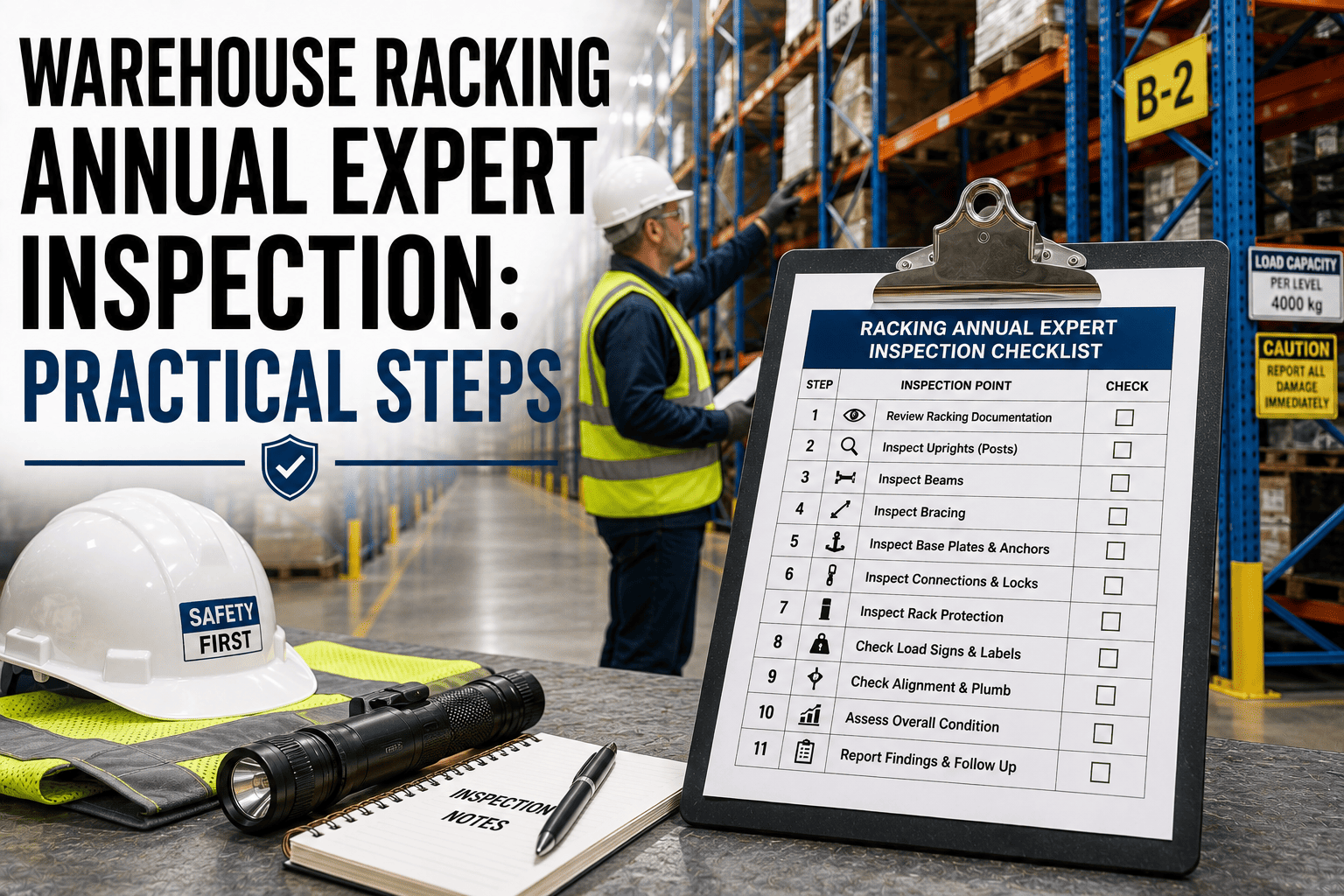
Rack Management Institute (RMI) and ANSI MH16.1 standards require that all pallet rack systems be inspected at least annually by a qualified inspector, with interim visual inspections conducted monthly by in-house staff. OSHA references these standards under the General Duty Clause — meaning undocumented or skipped inspections are directly citable.
DAMAGE CLASSIFICATION WORKFLOW
Pallet rack damage assessment: how to classify and act on rack damage
The RMI damage classification system uses a three-tier color code based on deflection thresholds measured with a straightedge or go/no-go gauge. Every inspection finding must be classified, documented, and routed for repair within the timeframe dictated by its severity level.
Deflection within manufacturer tolerance. Upright or beam deviation less than 0.5% of dimension.
- Minor paint scrapes or surface rust
- Beam deflection under 0.5% of span length
- Upright deviation measurable but within tolerance
- Missing safety pins — replace immediately
- Re-inspect at next scheduled cycle (90 days)
Deflection exceeds tolerance. Load capacity compromised. Upright or beam deviation 0.5%–1.0%.
- Beam deflection 0.5%–1.0% of span length
- Visible upright column deviation or bowing
- Diagonal brace bends or dents
- Baseplate deflection or anchor loosening
- Unload affected bay and schedule repair
Deflection exceeds 1.0%. Structural integrity critically compromised. Risk of imminent failure.
- Beam or upright deflection over 1.0%
- Torn, cracked, or buckled steel members
- Weld failures at connections
- Anchor bolts sheared or pulled from slab
- Immediately unload and rope off bay
INSPECTION CADENCE & TRACKING
Warehouse rack PM schedule: monthly, quarterly, and annual inspection cadence
A defensible racking inspection program operates on three frequencies. Spreadsheets and clipboard checklists fail at this because they cannot enforce cadence, escalate overdue repairs, or produce an audit trail. Below is the minimum cadence RMI-compliant warehouses follow.
In-house visual rack walk
Trained warehouse staff conduct a visual sweep of all aisles checking for obvious damage, displaced loads, missing safety pins, and clearance issues. Each finding is logged with location, photo, and initial damage classification in OxMaint.
Supervisor-level detailed inspection
Maintenance supervisor or trained team lead performs a bay-by-bay inspection with straightedge and go/no-go gauge. All amber and red findings generate automated repair work orders in OxMaint with assigned technicians and deadlines.
Qualified RMI inspector certification
Certified RMI inspector conducts the formal annual inspection per ANSI MH16.1. Findings are uploaded to OxMaint, cross-referenced against open repair work orders, and compiled into a compliance-ready audit report with timestamps and digital signatures.
SPREADSHEET VS. CMMS
Manual rack inspection vs. OxMaint racking CMMS — what changes
Most warehouse facility teams track racking inspections on shared spreadsheets or paper forms. The gap between that approach and a CMMS-driven racking inspection program is measurable in compliance, speed, and cost avoidance.
| Capability | Spreadsheet / Paper | OxMaint CMMS |
|---|---|---|
| Inspection scheduling | Manual reminders, frequently missed | Automated PM triggers by date or usage |
| Damage classification | Free-text notes, inconsistent criteria | Standardized green/amber/red workflow with photos |
| Repair work order generation | Manual entry, up to 5-day lag | Auto-generated on red/amber finding — instant |
| Audit trail | Paper files, no version control | Full digital history with timestamps and e-signatures |
| Overdue repair escalation | No automated alerts | Escalation to supervisor after deadline breach |
| OSHA audit readiness | Hours to days to compile | One-click compliance report export |
A 320,000-sq-ft distribution center with 1,400 pallet rack bays switched from quarterly spreadsheet inspections to OxMaint's racking CMMS. Within 60 days, the team identified 23 amber-level damage findings that had been sitting unlogged for over 90 days, auto-generated repair work orders for all of them, and cut their OSHA audit prep time from 3 days to under 20 minutes. Estimated cost avoidance: $180K in potential collapse-related losses.
HOW OXMAINT HELPS
How OxMaint digitizes your warehouse racking inspection program
OxMaint is an AI-powered CMMS and EAM platform built for maintenance and reliability teams. For warehouse racking, it replaces paper checklists and scattered spreadsheets with a single, auditable inspection-to-repair pipeline.
Digital racking inspection forms
Build custom mobile inspection checklists for each rack type — selective, drive-in, pushback, cantilever. Technicians classify damage green/amber/red on a tablet, attach photos, and submit from the aisle floor. No paper, no rekeying, no lost forms.
Auto-generated repair work orders
When an inspector tags a finding as amber or red, OxMaint instantly generates a repair work order with the correct priority, assigned technician, required parts, and deadline — then escalates if the SLA is breached.
One-click OSHA compliance reports
Every inspection, damage classification, repair work order, and sign-off is time-stamped and stored in a tamper-evident audit trail. Export a full RMI/ANSI MH16.1 compliance report in seconds when OSHA or your insurance auditor arrives.
Predictive damage trend analytics
OxMaint's AI engine analyzes rack damage patterns by location, aisle, forklift operator zone, and rack type — identifying high-impact zones before damage accumulates to collapse risk. Route protective guarding and operator retraining where the data points.
See OxMaint manage your rack inspection program — book a 30-min demo
Watch how fast your team can move from paper checklists to a fully auditable, OSHA-defensible racking inspection workflow. We will build a live rack inspection form with your damage criteria during the call.
FREQUENTLY ASKED QUESTIONS
Warehouse racking inspection and maintenance FAQs
How often should warehouse racking be inspected?
RMI and ANSI MH16.1 require a formal inspection by a qualified inspector at least once every 12 months. Between formal inspections, in-house staff should perform monthly visual walk-throughs to catch obvious damage early. High-traffic facilities or those with frequent forklift impacts may need quarterly detailed inspections. OxMaint automates all three cadences with PM triggers so no inspection is ever missed — book a demo to see the scheduling workflow.
What is the RMI green, amber, red damage classification system?
The RMI color-coded system classifies rack damage by severity. Green means damage is within tolerance and should be monitored at the next cycle. Amber means deflection exceeds tolerance (0.5%–1.0%) and the bay must be unloaded and repaired within 30 days. Red means deflection exceeds 1.0% or structural members are torn, cracked, or buckled — the bay must be unloaded and roped off immediately and repaired before returning to service.
Can I use a CMMS for pallet rack inspection tracking?
Yes. A CMMS like OxMaint is the most effective tool for managing racking inspections because it enforces cadence, standardizes damage classification, auto-generates repair work orders, and maintains a tamper-evident audit trail. Unlike spreadsheets, a racking CMMS escalates overdue repairs automatically and compiles OSHA-ready compliance reports in one click. You can Start Free Trial and build your first rack inspection form in under 15 minutes.
What are the most common causes of pallet rack damage?
Forklift impacts account for roughly 70% of all pallet rack damage, followed by overloading (exceeding the rack's rated load capacity), improper loading techniques, missing or displaced safety pins, and environmental corrosion in unheated or humid storage areas. OxMaint's analytics module tracks damage by aisle and operator zone so you can target high-impact areas with protective guarding, speed limits, and operator retraining.
Who is qualified to perform a formal racking safety inspection?
A formal annual inspection per ANSI MH16.1 should be conducted by a qualified inspector — typically an RMI-certified rack inspector or a registered professional engineer with experience in pallet rack systems. Monthly visual inspections can be performed by trained in-house warehouse staff using a standardized checklist. OxMaint stores inspector certifications, inspection findings, and digital signatures in one audit-ready record so you can prove compliance on demand.
Stop inspecting racks on paper. Start building a defensible racking inspection program today.
Join warehouse facility teams using OxMaint to digitize racking inspections, automate repair work orders, and stay OSHA-audit-ready year-round. Set up your first rack inspection workflow in minutes.
Free 14-day trial · No credit card
.png)

