You can't ship what you can't find, and you can't trust a count you took by eye. The gap between what the system says is on the shelf and what's actually there is where orders go wrong — and the fix starts with how every item is identified and read. RFID and barcode both close that gap; they just do it differently. OXMAINT AI is the AI-powered maintenance management software that tracks your tagged assets and spares and keeps the reader and scanner hardware working — or book a demo of the scan-to-work-order loop in OXMAINT AI.
RFID vs BARCODE · INVENTORY TRACKING · WAREHOUSE-TO-DELIVERY TRACEABILITY · 2026
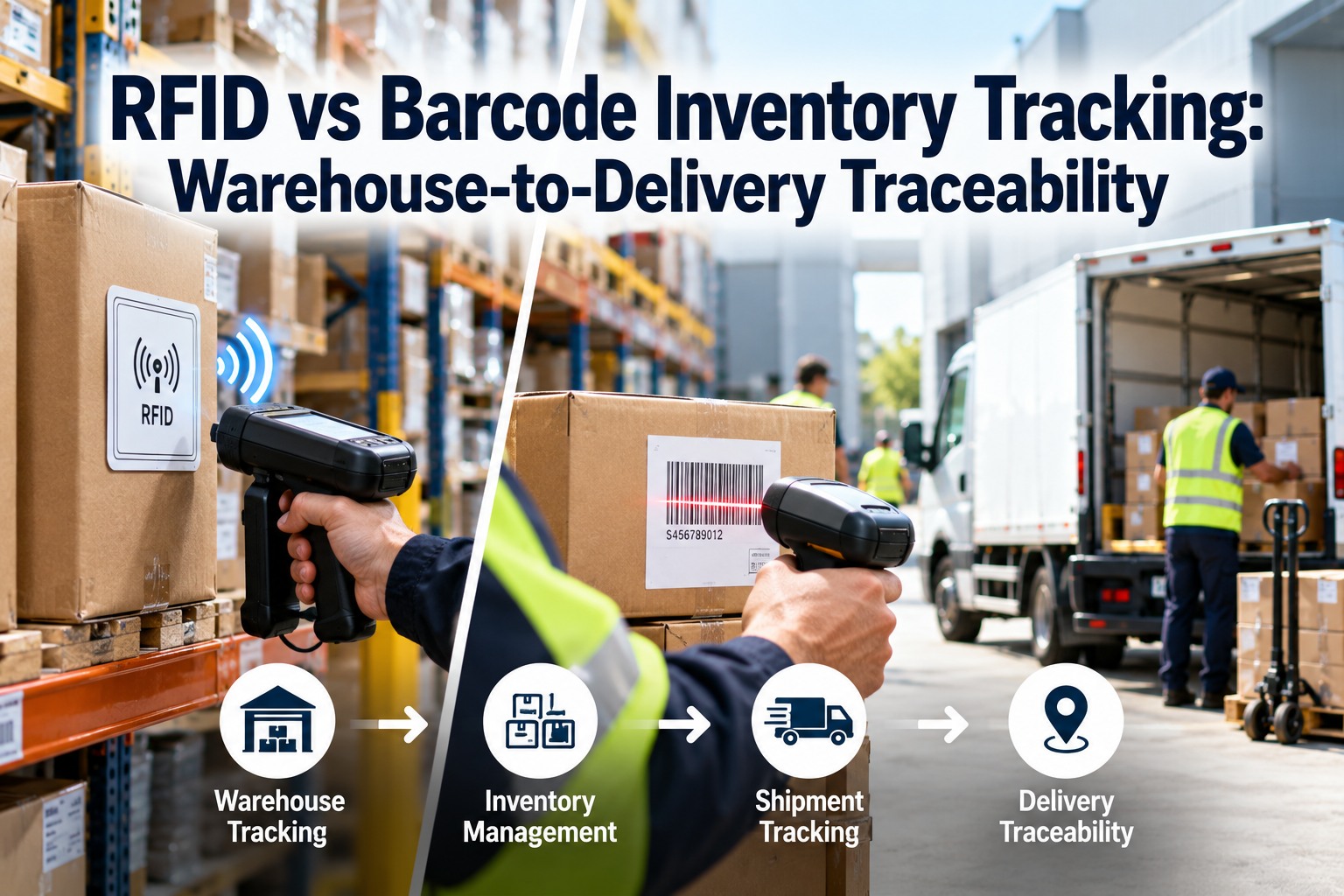
RFID vs Barcode Inventory Tracking: Warehouse-to-Delivery Traceability
Barcode is cheap and proven; RFID is fast and hands-free — and most operations end up running both. Whichever you choose, the tag is only useful if something tracks it and the reader keeps working. OXMAINT AI is the AI-powered CMMS that registers every tagged asset and spare, turns a read failure or inventory exception into a ranked work order, and keeps the scanners, readers and printers calibrated. Accurate counts, traceable shipments, and the records behind both.
1 · Tag
2 · Read
3 · Track
4 · Exception → WO
99.5%+
inventory accuracy RFID reaches, versus 95–98% for barcode
1,000+
tags RFID can read per second, with no line of sight — barcode reads one at a time
$0.01–$0.50
the per-tag cost gap — barcode pennies, RFID dimes — that keeps barcode in play
60–80%
cut in stockouts and counting labor reported with RFID
RFID vs Barcode: The Head-to-Head
Neither wins on everything — barcode owns cost and simplicity, RFID owns speed and accuracy. The right call depends on which rows matter most to your operation.
Attribute
Barcode
RFID (UHF passive)
Line of sight
Required — aim at each code
Not needed — reads in bulk
Read range
2–15 inches
Up to 40 ft fixed, 20–30 ft handheld
Read speed
~1–2 seconds per item
200–1,000+ tags per second
Cost per tag
$0.01–$0.10 per label
$0.10–$0.50 per tag
Inventory accuracy
95–98%
99.5–99.9%
Durability
Vulnerable to dirt, wear, damage
Rugged; can be embedded
Data capacity
20–100 chars (1D), to 7,000 (2D)
96–512 bits, up to 8KB
When to Use Which
The honest answer is rarely “rip out barcode.” It's about matching the technology to the item and the read point — start free and track assets and spares in OXMAINT AI.
USE BARCODE WHEN
Low-cost items, high tag volumes, a single read point, or a tight budget. Proven, cheap and everywhere — still the default for most parcels and case labels.
USE RFID WHEN
Bulk counts, hands-free reads, high-value or hard-to-reach stock, and where accuracy pays back the tag cost — reusable totes, returnable assets, fast cycle counts.
RUN BOTH WHEN
Most real operations: barcode on cheap, high-volume units and RFID on pallets, assets and totes. One register should hold both without caring which read the item.
The Warehouse-to-Delivery Traceability Chain
Traceability isn't one scan — it's an unbroken chain of read events from the dock to the doorstep. Each read writes a timestamp and a location, so any unit can be traced forward to the customer or back to the receipt.
1
Receive
Inbound read against the ASN
2
Putaway
Location bound to the item
3
Pick
Read against the order line
4
Pack
Unit confirmed into the carton
5
Ship
Manifest read at the dock
6
Deliver
Final read, chain closed
OXMAINT AI · IDENTIFICATION HARDWARE · DC-03 · 14:20
RFID PORTAL · Dock 4Antenna fault — tags missed at ship readWO 8120 raised
SCANNER · Pick Zone BNo-read rate climbing — window wearPM queued
LABEL PRINTER · Pack 2Grade slipping — print head service duePdM alert
HANDHELD FLEET · FloorCharged, reading cleanOn target
How OXMAINT AI Supports Inventory Traceability
OXMAINT AI isn't a WMS or an RFID platform — it is the AI-powered maintenance management software that tracks your assets and spares by tag, keeps the reading hardware accurate, and turns every read or inventory exception into action. Put your tagged assets on it when you start free and build your tagged-asset register in OXMAINT AI.
Tagged Asset & Spares Register
Assets and MRO spares tracked by barcode or RFID on one register, so a part is found, not hunted.
Reader & Scanner PM
RFID portals, antennas and handheld scanners serviced on cadence so read rates don't quietly slide.
Printer & Encoder Care
Label and RFID encoders calibrated so every tag is written and printed to a readable grade.
Read Exception → Work Order
A missed read, a failing antenna or a no-read cluster becomes a ranked work order on the device.
Asset Traceability Record
Each tracked asset's read and service history on one record — where it is and what was done to it.
Multi-Site Read Board
Read-point health and open work across every DC on one screen, with the history behind each.
The Best Tag in the World Is Useless if Nothing Reads It.
RFID or barcode, the count is only as good as the reader behind it — and a drifting scanner or a dead antenna breaks the chain silently. OXMAINT AI keeps the hardware honest and turns every miss into a work order, on one screen.
EXPERT REVIEW
Written for inventory, warehouse and maintenance teams. OXMAINT AI is a maintenance management platform, not a WMS or RFID middleware — it works alongside those systems, tracking tagged assets and spares and keeping the readers, scanners and printers calibrated so counts stay accurate. Read ranges, costs and accuracy figures are published industry benchmarks that vary by tag, environment and hardware.
Frequently Asked Questions
Is RFID always better than barcode?
No. RFID wins on speed, range and accuracy; barcode wins on cost and simplicity. Barcode stays the default for cheap, high-volume items, while RFID pays off on pallets, assets and totes. Most operations run both.
Start free and track both tag types in OXMAINT AI.
Does OXMAINT AI replace our WMS or RFID software?
How does hardware affect inventory accuracy?
A dirty scanner window, a misaligned RFID antenna or a worn print head quietly lowers read rates until counts drift and the trace chain breaks. Scheduled PM on the readers is what keeps the accuracy real.
Start free and schedule reader PM in OXMAINT AI.
What is warehouse-to-delivery traceability?
Can it track read-point health across sites?
Trust the Count, Trace the Shipment.
Run barcode, RFID or both — and put the tagged assets, spares and the reading hardware on OXMAINT AI: exception-to-work-order routing, PM that keeps read rates high, and a read-point health board across every site, so the number on the screen is the number on the shelf.



.png)


