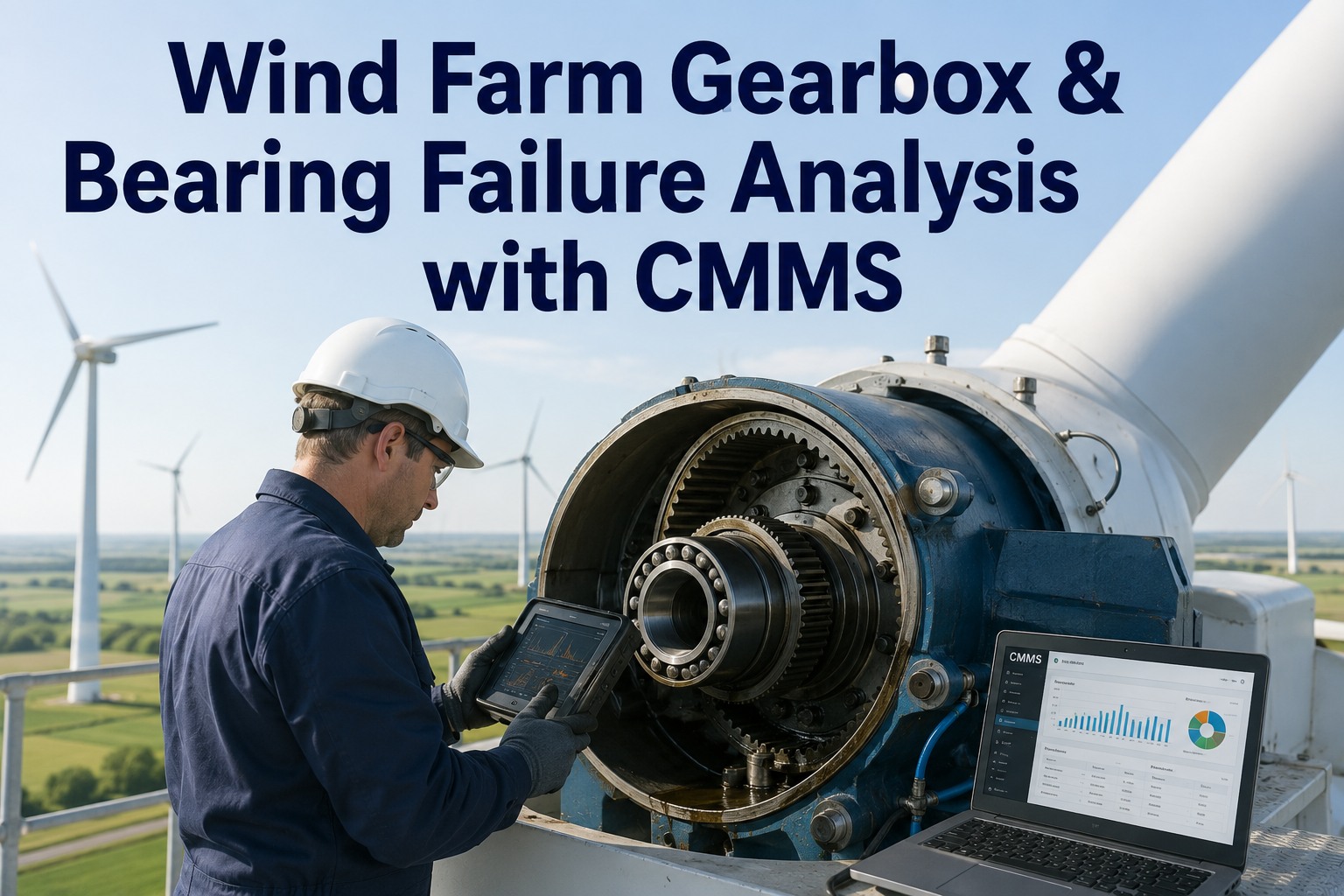
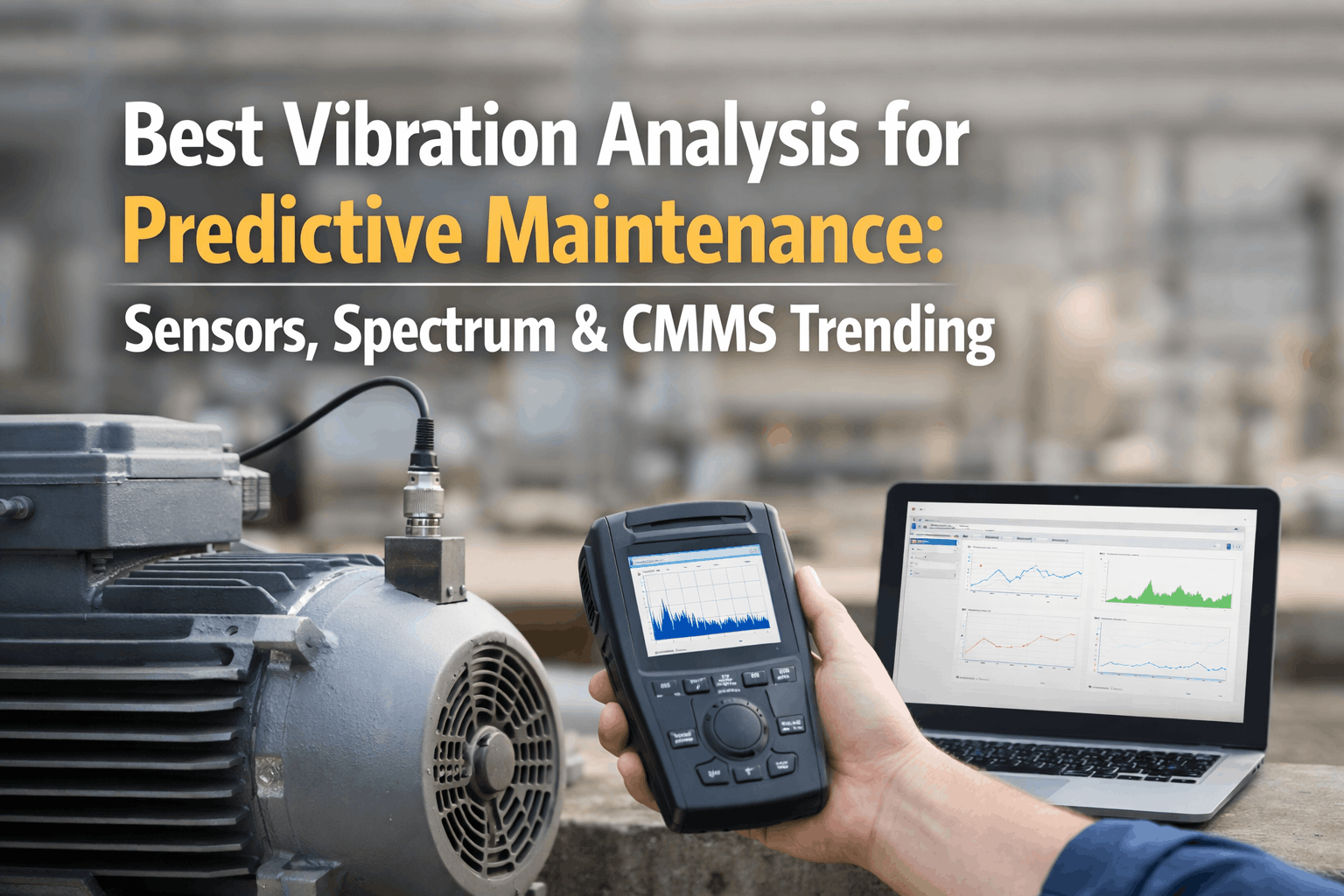
Wind Turbine Gearbox Reliability: Failure Modes, Monitoring, and Maintenance
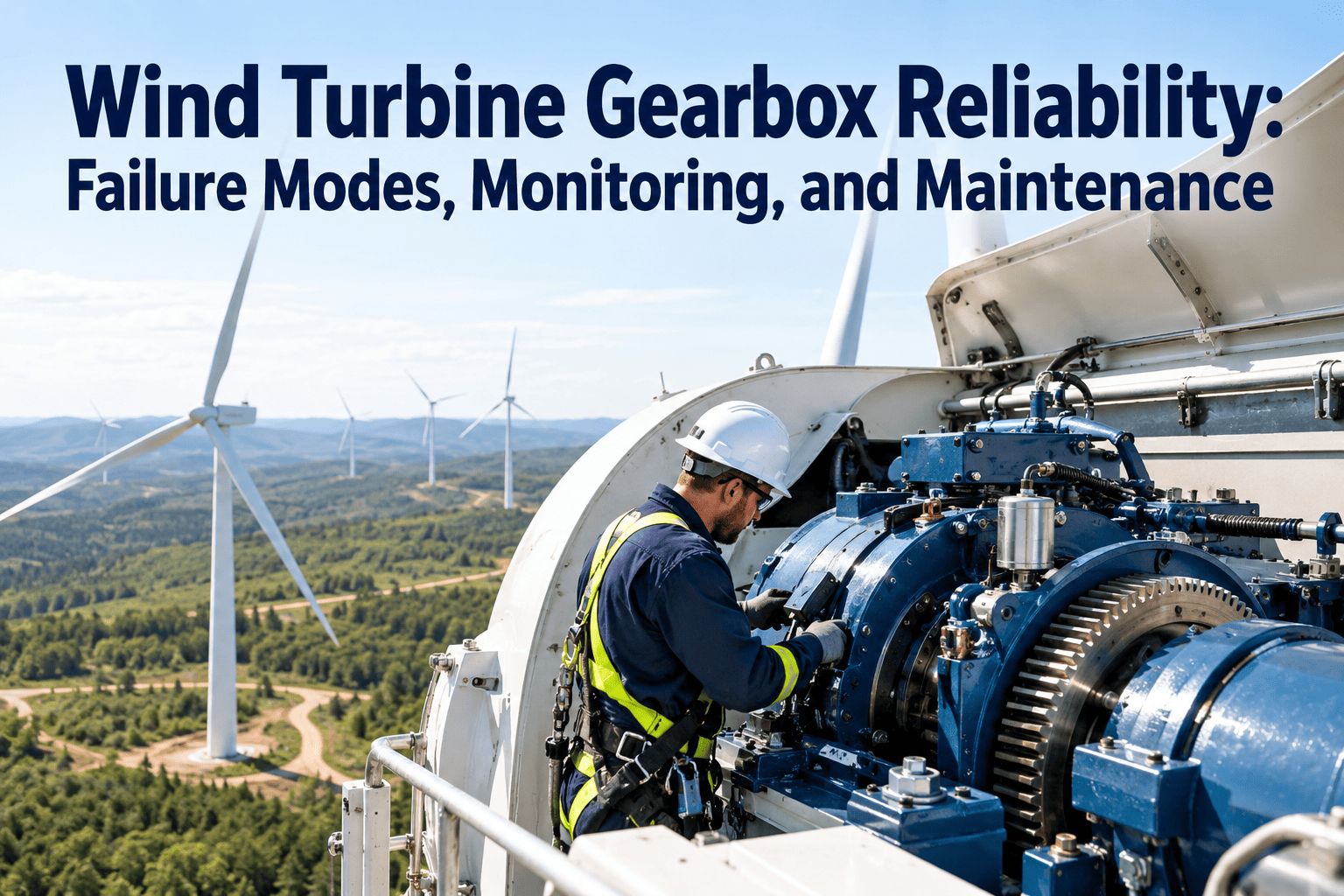
A wind turbine gearbox has one of the hardest jobs in rotating machinery — stepping a slow, gusty rotor up to generator speed under constantly shifting loads. It's also the costliest failure point in the drivetrain, causing two to three times more downtime than any other component. This guide covers the failure modes, the monitoring signals that catch them early, and how OXMAINT AI turns those signals into scheduled work orders. See it on your fleet with a live demo.
Gearbox trouble rarely arrives without warning — but warnings get lost between an inspection note, a SCADA alarm, and a work order that never gets raised. OXMAINT AI closes that gap: an AI-powered CMMS that connects inspections, condition signals and preventive schedules in one platform, so an early sign turns into a planned repair instead of a surprise failure.
of gearbox failures start in the bearings (NREL GRD)
$250K+
typical cost of a land-based gearbox replacement event
1 in 145
turbines has a gearbox failure each year
20–30%
of lifecycle cost is O&M — most of it unplanned
Why the Gearbox Is the Drivetrain's Weakest Link
A gearbox rarely "wears out" — it fails because a variable-torque rotor overloads components with thin safety margins, so bearings can fail within 5–10% of their rated life. OXMAINT AI maps that drivetrain risk stage by stage and keeps every gearbox's condition history in one place. Start free and map your fleet's drivetrain risk in OXMAINT AI.
Low-Speed Stage
Planetary Gears
Takes raw rotor torque. Failures here are the worst — a planetary failure usually can't be fixed up-tower and means a full gearbox swap.
High consequence · lower frequency
→
Intermediate Stage
Intermediate Shaft
Bearings and gears here account for a large share of up-tower repairs. Micropitting and contact fatigue build quietly over years.
High frequency · repairable up-tower
→
High-Speed Stage
HSS Bearings
The single most common failure location. Fast rotation, high temperature, and electrical discharge drive scuffing and white etching cracks.
Most common failure point
The 6 Failure Modes That Kill Gearboxes
These modes rarely occur alone — they cascade: a lube breakdown starts surface fatigue, and debris from one damaged surface damages the next. OXMAINT AI tags each fault against its work orders and inspections, so recurring patterns surface across your fleet instead of hiding in a paper log. Book a demo to see failure-mode tracking in OXMAINT AI.
White Etching Cracks (WEC)
Subsurface microstructural damage that develops before any visible surface sign. Linked to hydrogen, transient loads and electrical discharge. Can end a bearing at 5–10% of rated life.
Most dangerous · invisible early
Micropitting
Microscopic surface fatigue from too-thin a lubricant film. Dulls tooth flanks, changes load distribution, and seeds larger pitting and cracking downstream.
Lube-film driven
Scuffing / Smearing
Adhesive damage when metal surfaces contact under load with a failed oil film — often during transients. Once it starts, the affected surface degrades fast.
Transient-load driven
Axial Cracking
Cracks running axially across bearing raceways, tied to improper fits, ring rotation and WEC networks below the surface. A leading premature-failure mode.
Raceway integrity
Macropitting & Spalling
Advanced rolling-contact fatigue — chunks of material break away from gear teeth or raceways. This is what vibration analysis reliably catches, but it's already late-stage.
Late-stage · vibration-visible
Tooth-Root Cracking & Fracture
Bending fatigue at the tooth root leading to tooth breakage or flank fracture — the top failure mode for gears (as bearings are for the assembly overall).
Top gear-side mode
Failures Cascade — Catch the Chain Early
1Lube breakdown / contamination
→
2Surface fatigue (micropitting)
→
3Cracks & scuffing spread
→
4Debris damages next surface
→
5Gearbox failure
The Warning Was There. It Just Wasn't Acted On.
A gearbox bearing running hot for 72 hours, an oil debris count climbing sample over sample, a vibration harmonic trending up 18% in three days — these signals exist in your data right now. OXMAINT AI is the maintenance management software that connects your SCADA feeds, CMS sensors and oil analysis results per turbine, watches the trends, and auto-generates the work order before the failure window closes — so the signal never dies in an inbox.
How Early Can You See It Coming? The Warning-Time Ladder
Different methods catch different modes at different lead times — and an early signal only helps if someone acts on it. OXMAINT AI ingests these feeds per turbine, trends them automatically, and raises a work order the moment a threshold is crossed. Here's the realistic warning window by method. Sign up free and start trending these signals in OXMAINT AI.
Oil debris & particle trendMonths out
A climbing ferrous count between quarterly samples flags accelerating wear long before it's audible or catastrophic — the closest thing to an X-ray of the drivetrain.
Vibration harmonics (BPFO/BPFI/BSF)~60–90 days
HSS bearing degradation shows characteristic vibration harmonics 2–3 months before spalling reaches critical severity — the industry-standard method for bearing and gear-tooth faults.
Acoustic emission~30–60 days
Sensitive to early raceway-surface degradation and gear-tooth crack signatures that lower-frequency methods miss, at the cost of extra sensors and complexity.
SCADA temperature residualsWeeks out
Already on every utility-scale turbine — no new hardware. Sustained temperature elevations and fluctuations flag developing bearing-stage trouble, though they can't pinpoint the exact mode alone.
The Four Pillars of Gearbox Condition Monitoring
No single method sees everything, so reliable programs layer all four — and correlation is the hard part when each stream lives in a different system. OXMAINT AI pulls all four into one turbine record, so a rising temperature, a climbing debris count and a vibration trend read as one story. Book a demo to see the four streams correlated in OXMAINT AI.
Pillar 1
Vibration Analysis
Gear-mesh frequency and bearing-defect frequency decomposition (BPFO, BPFI, BSF). Industry standard for late-stage bearing and tooth faults — 60–90 day warning on HSS bearings.
Strong on: spalling, tooth damage
Pillar 2
Oil & Debris Analysis
Particle count, ferrous debris, viscosity, moisture and acidity. Magnetic drain-plug debris means active surface failure. Catches lubrication problems before they become wear problems.
Strong on: earliest warning
Pillar 3
Temperature & SCADA
Bearing and oil temperatures, speeds and electrical parameters at 1–10 min intervals. Already installed on every utility turbine — a free trend baseline across the asset's whole life.
Strong on: zero-cost coverage
Pillar 4
Acoustic Emission
High-frequency sensing of raceway degradation and crack propagation. Detects some faults earlier than vibration, but adds sensor cost and is harder to retrofit on older turbines.
Strong on: early crack signatures
Lubrication: The Single Biggest Lever on Gearbox Life
Lubrication is the factor you control most directly — the oil cools, cleans, and carries the diagnostic evidence of what's happening inside. Get these five right and you starve most failure modes at the source. OXMAINT AI enforces each as a scheduled, trackable task, so a sampling interval never slips and a drain-plug finding never goes unlogged. Sign up free and schedule oil sampling in OXMAINT AI.
01
Use WEC-tested gear oil. Not all oils resist white etching cracks equally — specify oils with independent WEC design evaluation (e.g. DNV-GL) for turbine gearboxes.
02
Maintain film thickness. Too-thin a film is the direct cause of micropitting and scuffing. Match viscosity grade to load and operating temperature, not just the OEM default.
03
Control contamination. Particles and moisture seed surface fatigue. Filter to target cleanliness and replace elements on a fixed interval — not "when it looks dirty."
04
Sample on a trigger, not a whim. Quarterly oil sampling plus filter changes every ~6 months or 4,000 operating hours — whichever comes first — keeps the diagnostic trend unbroken.
05
Read the drain plug every change. Significant ferrous debris on the magnetic plug is active tooth or bearing-surface failure — it triggers an endoscopic inspection, not a top-up.
Reactive vs. Predictive: The Economics Are Not Close
A gearbox caught early is a planned repair; the same gearbox caught at failure is a crane, a long-lead replacement, and weeks of lost generation. The difference is simply whether the warning became an action in time — the gap OXMAINT AI closes by turning every condition signal into a scheduled work order. Book a demo to model this on your own fleet.
Run-to-Failure
$250K+
per catastrophic gearbox event
✕ Full replacement, not a targeted fix
✕ Emergency crane mobilization
✕ Long-lead spare — weeks of downtime
✕ Lost generation at peak season
✕ Secondary damage to generator & shafts
Predictive + CMMS
~$20K
for a planned repair caught early
✓ Targeted up-tower component swap
✓ Repair planned into a campaign
✓ Long-lead parts ordered on first alert
✓ Downtime scheduled in low-wind window
✓ Damage contained before it spreads
Where OXMAINT AI Fits: From Signal to Work Order
Monitoring only pays off if the signal becomes an action. OXMAINT AI turns every gearbox data stream into a scheduled, parts-ready work order — the CMMS layer that makes condition-based decisions happen at machine speed. Here's what it puts in your team's hands. Sign up free and connect your first turbine's data feeds.
Unified Turbine Record
SCADA feeds, CMS vibration, oil analysis results and manual inspection notes flow into one record per turbine — a trend baseline across the asset's full operating life.
Auto Work-Order Generation
A hot bearing, a rising debris count or a SCADA alarm auto-creates a work order with the fault context — no hunting through logs after the stoppage.
Multi-Trigger PM Scheduling
Schedule oil sampling, filter changes and major services on time and operating-hour triggers — quarterly, 4,000-hour, 6/12/24/48-month intervals, whichever hits first.
Mobile Field Checklists
Techs capture torque values, sight-glass levels, desiccant color and drain-plug findings on site — structured, attributed, and searchable, not on a clipboard.
Spare-Parts Lead Time
Long-lead gearbox components get flagged for procurement when the first anomaly appears — not after the turbine has already stopped.
Warranty & History Trail
Complete maintenance history and post-service reviews per turbine — the record that supports warranty claims and clean end-of-warranty handover.
"
We were running our fleet on fixed calendar intervals and gut feel. The gearbox that finally got our attention had been throwing a slow-climbing bearing temperature for weeks — nobody was trending it. Once we routed SCADA and oil-sample data into OXMAINT AI per turbine, the alerts stopped being a surprise. The first time the system flagged an HSS bearing months out and we swapped it up-tower during a planned low-wind window, the math on the whole program paid for itself.
O&M Manager · Onshore Wind Fleet
Frequently Asked Questions
What causes most wind turbine gearbox failures?
Bearings — NREL's Gearbox Reliability Database attributes about 76% of gearbox failures to bearings and roughly 17% to gears. The high-speed and intermediate stages are the most common failure locations, driven by scuffing, micropitting and white etching cracks.
How much does a gearbox failure cost?
Land-based gearbox replacement events are generally estimated at $250,000–$300,000 once the gearbox, transport, crane and labor are included — and a gearbox failure causes two to three times more downtime than any other component. Caught early, the same issue can be a far smaller planned repair.
How early can condition monitoring detect a gearbox problem?
It depends on the method: oil-debris trends can flag accelerating wear months out, vibration harmonics typically give 60–90 days on high-speed bearings, and SCADA temperature residuals surface trouble weeks ahead. Layering methods gives the widest warning window.
Can vibration analysis catch white etching cracks?
Not early. WEC develops below the surface with no obvious signature until damage nears the raceway, so vibration usually catches it late. Oil analysis, WEC-tested lubricants, correct loading and electrical protection are the more effective defenses against it.
Does OXMAINT AI replace my SCADA or condition-monitoring system?
No — it connects to them. OXMAINT AI ingests SCADA feeds, CMS sensor data and oil-analysis results per turbine and turns those signals into scheduled, parts-ready work orders. You keep your monitoring; OXMAINT AI makes it actionable.
Turn Gearbox Signals Into Scheduled Repairs — Not Surprises.
Every gearbox failure leaves a trail in your data before it stops the turbine. Connect SCADA, oil and vibration feeds to OXMAINT AI, and catch the failure while it's still a planned repair.